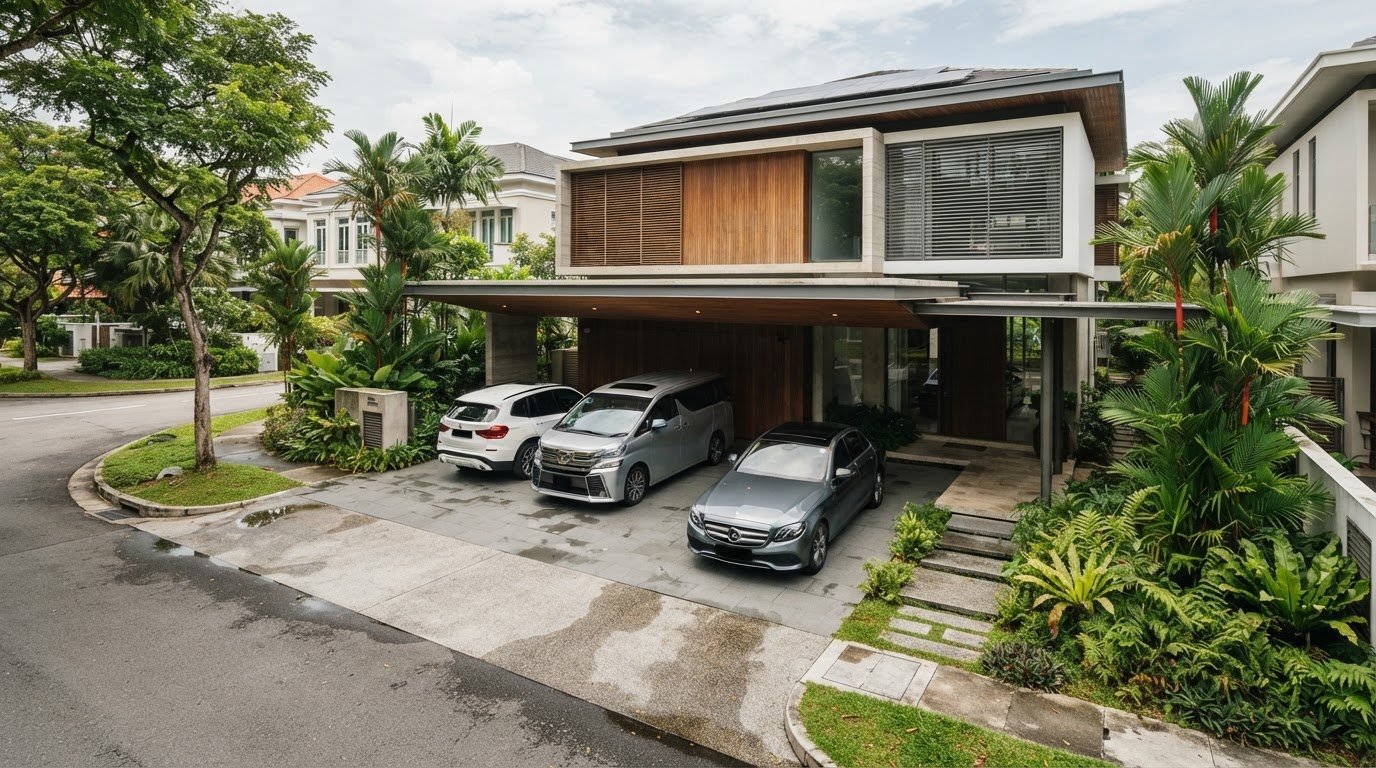
What if the landed home with the most impressive car porch is the least practical one for your household? When searching for “buying a landed property with large car porch singapore,” appearance alone won’t tell you whether several cars can fit without blocking one another, or whether you can enter, turn and leave with ease.
A generous porch can be a valuable everyday advantage, but only if access, parking and the rest of the property work for your needs. A tight approach, awkward vehicle movements or a layout that sacrifices useful indoor or outdoor space can change how the home feels to live in.
This guide explains how to assess usable parking capacity, test access and turning in person, and compare porch dimensions with your household’s vehicles and routines. It also covers the planning and approval considerations to verify before making an offer or considering alterations. Vincent Lim (OrangeTee & Tie) specialises in Singapore landed-property sales, including terrace, semi-detached and detached houses. Assessing a porch as part of the whole home, rather than as an isolated feature, can help you compare properties and decide whether a large car porch genuinely suits your priorities.
Key Takeaways
- When buying a landed property with a large car porch in Singapore, judge parking by usable space and vehicle movement, not the porch’s appearance or listing photos.
- Map your household’s vehicles and routines, then test how cars enter, park and leave during a property viewing.
- Compare single-row, tandem and independent-access layouts against your parking habits and the home’s indoor and outdoor space.
- Separate visible condition checks from planning, building and access matters that require documentary or professional verification.
- Define your needs, compare suitable homes and verify details before deciding. Experience with landed-property sales can help keep the search focused on the home as a whole.
Why a Large Car Porch Matters When Buying Landed Property in Singapore
A broad roofline and generous frontage can make a car porch look substantial, but neither confirms that it can comfortably accommodate your household’s vehicles. Columns, walls, gates and the shape of the driveway all affect usable space. A porch may appear wide enough for several cars yet leave too little room to open doors or manoeuvre without moving another vehicle.
That distinction matters because the porch is part of the home’s daily circulation. A suitable arrangement can make arrivals, school runs, shopping trips and access to the front door more convenient. A poor fit can turn an ordinary departure into a sequence of vehicle shuffling. When buying a landed property with large car porch singapore, assess the feature against your household’s routines, not as a standalone selling point.
Usable car-porch capacity is the number of vehicles your household can park and access safely in its usual routine, not simply the number that fit within the porch’s outline.
Access matters as much as the area beneath the roof. Observe the approach from the road, the gate opening and the space available to turn into the porch. Then consider the route from parked cars to the entrance. A sheltered path can be useful in Singapore’s frequent rain, but its value depends on whether people can reach the home without squeezing between vehicles or crossing an awkward driveway.
What does a large car porch need to accommodate?
Start with the vehicles your household uses now, and consider any likely changes. Record each vehicle’s width, length and height, then compare those dimensions with the clear parking area, not the full frontage. Check whether doors can open and whether someone can load children, groceries or luggage without blocking another car.
- Allow room to walk safely around parked vehicles.
- Include bicycles or motorcycles only if they won’t obstruct parking or vehicle movement.
- Consider whether larger vehicles can enter and leave without awkward manoeuvres.
How does porch size affect daily use of the home?
Test the routine, not just the fit. Picture leaving in the morning, returning with bags or welcoming visitors. If one car parks behind another, a driver may need to move it before anyone else can leave. That may be acceptable for some households, but inconvenient when schedules often differ.
Consider how the porch uses the property’s frontage, too. A deeper parking area may affect access to the entrance or leave less room for other outdoor uses. Decide which trade-offs suit your household. The best fit may differ between a terrace, semi-detached or detached house because each property’s access and overall layout shape how the porch functions. Judge it alongside the home’s internal circulation and usable outdoor space, then decide whether the practical benefits justify the area it occupies. When residential frontage cannot realistically accommodate an expanding car collection, looking at dedicated vehicle real estate concepts—such as the resources shared by The Garage Condo Guy—provides a helpful perspective on how specialized garage condo ownership operates for multi-car enthusiasts.
How to Assess a Multi-Car Car Porch Before You Buy
A listing photograph can make a porch look spacious, but it won’t show whether your vehicles can enter, park and leave without conflict. A measured viewing gives you a more reliable basis for comparison. If you’re buying a landed property with a large car porch in Singapore, use the same checks at each viewing and compare the layout with your household’s actual needs.
Vehicle manoeuvring space matters as much as parking positions: a car that fits on paper may still be difficult to turn, access or drive out.
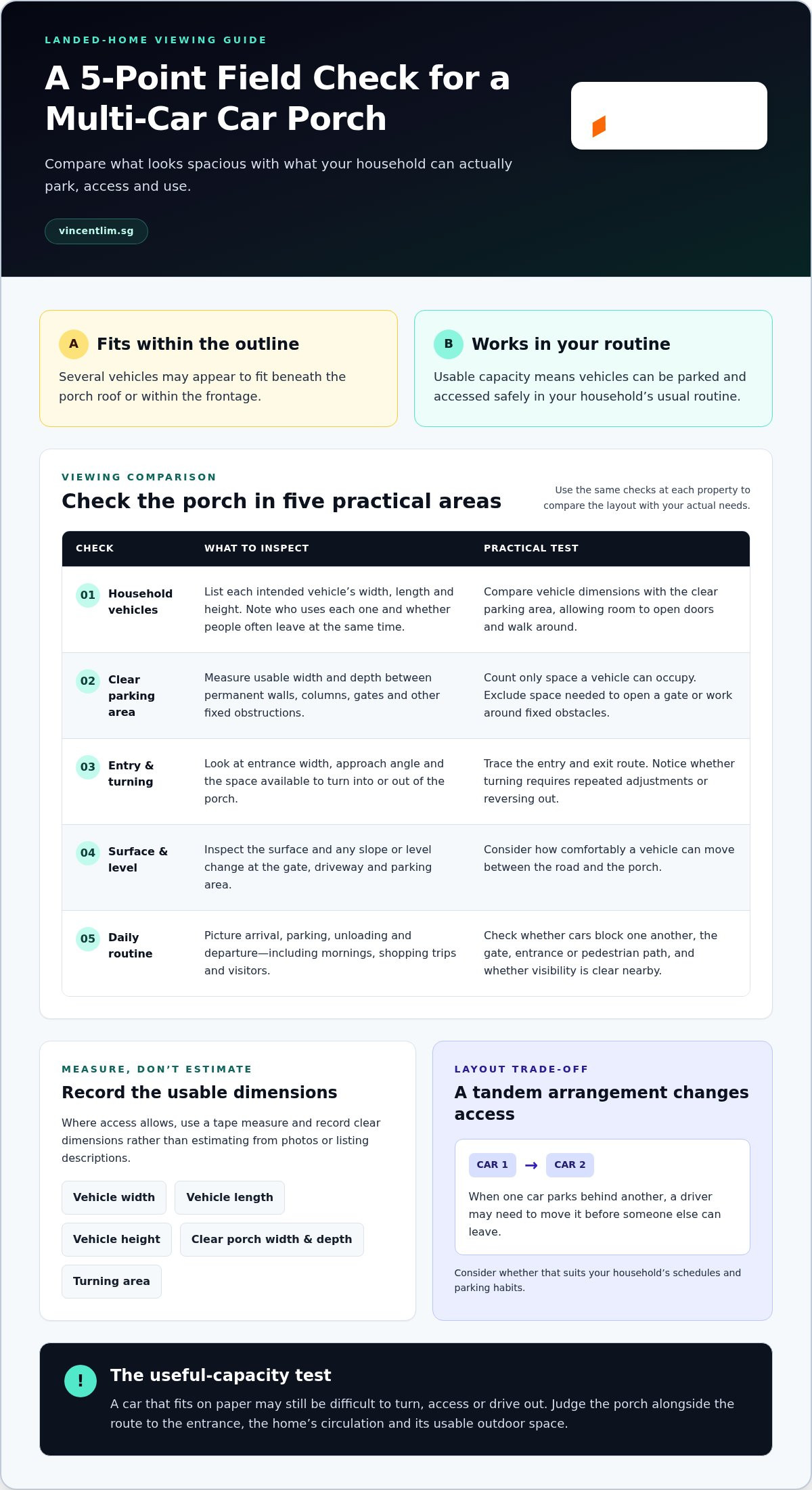
- Record your household’s requirements. List each vehicle you expect to park, along with its width, length and height. Note who uses each vehicle and whether household members often need to leave at the same time.
- Measure the clear parking area. Check usable width and depth between permanent walls, columns, gates and other fixed obstructions. Don’t count space a vehicle cannot occupy or space needed to open a gate.
- Check entry and turning space. Look at the entrance width, approach angle and room to turn into or out of the porch. A generous parking bay can still be impractical if the approach requires repeated adjustments.
- Inspect the surface and level changes. Note changes in slope or surface at the gate, driveway and parking area. These may affect how comfortably a vehicle moves between the road and porch.
- Walk through the routine. Consider arrival, parking, unloading and departure. Check whether vehicles block the gate, entrance, pedestrian path or one another, and whether visibility is clear when people are walking nearby.
Which measurements should buyers record?
Use a tape measure where access allows, and record clear dimensions rather than estimating from photos or listing descriptions. Compare these measurements with each intended vehicle, allowing practical room to open doors and walk around it. Note the turning area at the entrance and the path a vehicle takes when entering or reversing out. These details help distinguish theoretical capacity from a workable arrangement.
How can you test the layout during a viewing?
Walk the route from the road into the porch, then picture each vehicle in its intended position. From the driver’s perspective, consider sightlines, turning movements and whether another car would need to move first. Check where passengers would get out and how they’d reach the entrance. If possible, view the porch with vehicles parked in it to understand how the clearances feel in practice.
Keep your measurements and observations together for each property. A simple sketch showing vehicle positions, the gate, fixed obstructions and pedestrian routes can make comparisons more objective. As you assess Singapore landed-property options, comparing each porch against your household’s needs can keep it in perspective alongside the property’s wider layout and access.
Compare Car-Porch Layouts and Landed Home Types for Your Needs
A porch’s capacity depends on how vehicles are arranged, how they reach the road and how the parking area connects to the home. Compare the layout with your household’s departure patterns as well as the number of cars you hope to accommodate. When buying a landed property with a large car porch in Singapore, assess each home’s actual access and circulation instead of assuming a particular house type guarantees a certain arrangement.
Which parking arrangement suits multiple vehicles?
Consider who needs to use each vehicle and whether departure times overlap. Side-by-side positions may let drivers leave independently if the entrance and available width allow it. Tandem parking can make better use of a narrow or deep area, but the vehicle behind another may depend on it being moved first.
| Layout | Potential advantage | Trade-off to assess |
|---|---|---|
| Single-row parking | Vehicles park alongside one another, which may make access more independent. | Check whether the clear width allows doors to open and people to pass safely. |
| Tandem parking | Vehicles park one behind another, making use of depth where frontage is limited. | One car may need to move before another can leave, so consider household schedules. |
| Independent-access layout | Separate routes or positions may help drivers arrive and depart without coordinating. | Confirm that gates, turning space and the approach allow each route to work in practice. |
No configuration is automatically best. A household with staggered schedules may value independent access, while one that usually travels together may find tandem parking acceptable. Compare convenience with the space the arrangement takes from the entrance, frontage and other parts of the home.
How should property type influence the comparison?
Assess the individual property, not the label. A terrace, semi-detached or detached home may have different frontage, driveway access and connections between the porch and entrance, but the type alone doesn’t establish how many vehicles fit or how easily they move. Evaluate the measured layout and approach on their own merits.
For a terrace home, consider how its particular frontage and access shape parking and pedestrian movement. Weigh these practical points alongside the wider terrace-house acquisition guide. With a detached home, examine how its access and usable outdoor areas relate to the porch, as you would when considering the broader detached-house acquisition guide. In either case, don’t let a large-looking porch outweigh a layout that works less well for your household.
Compare each option against the same priorities: vehicle access, parking independence, safe movement to the entrance and the space left for other uses. This keeps the porch in proportion to the home as a whole and helps you identify which trade-offs you’re willing to make.
What to Verify Before Buying a Landed Property with a Large Car Porch
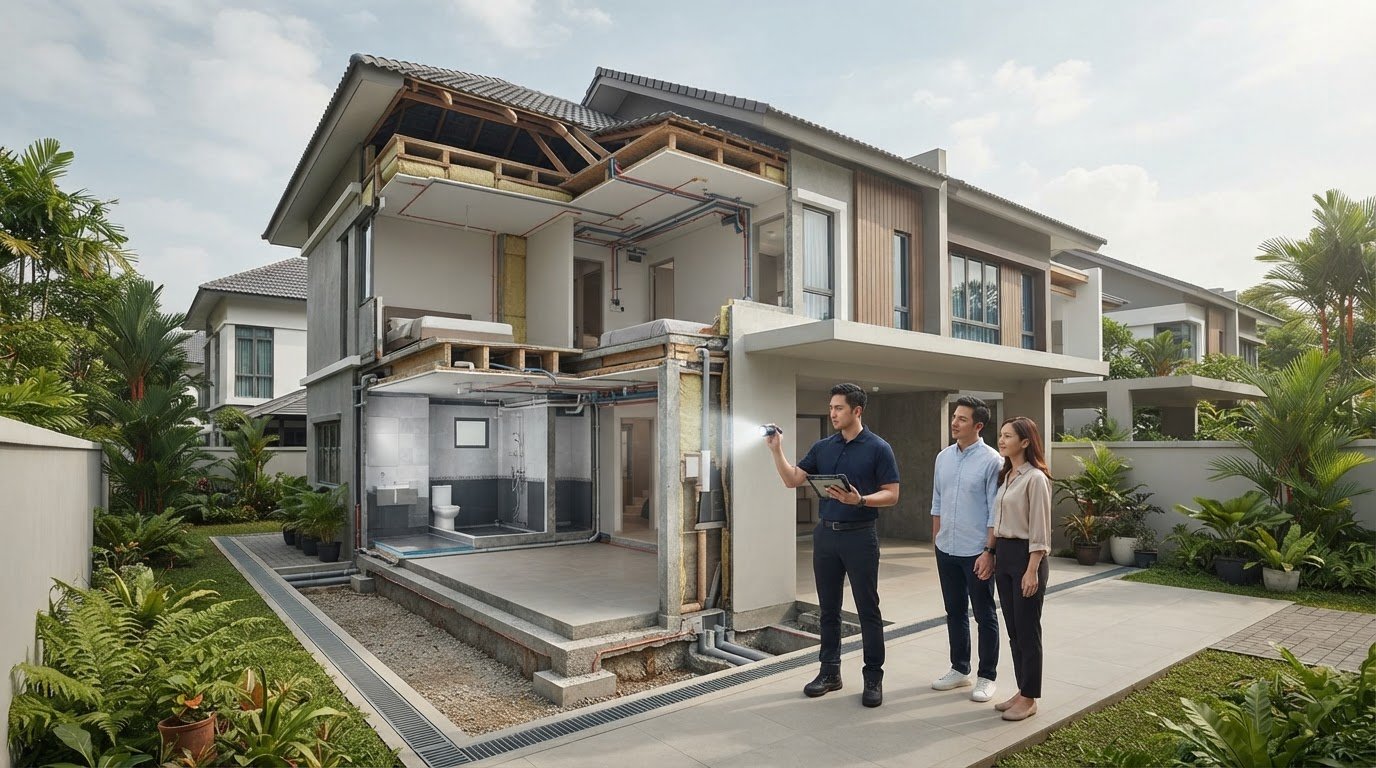
A viewing shows how the porch looks and functions today. It doesn’t, by itself, establish whether past alterations were properly documented or whether a proposed change can be carried out. Separate the two tasks: note visible conditions during the visit, then verify records and applicable requirements before relying on future plans.
A feature you can see at a viewing is not proof that an alteration is permissible or that it can be changed as you intend.
For buyers considering a landed property with a large car porch in Singapore, this distinction matters if the porch has been extended, enclosed or otherwise modified, or if you’re considering changing its structure. Planning, building and access requirements depend on the property and the proposed work. Check current guidance from the relevant authorities rather than assuming an existing feature establishes what is allowed.
Which property and planning details deserve verification?
Review the available property records, plans and documents for the existing layout and any recorded alterations. Compare them with what you observed, and note apparent differences for follow-up. Before relying on an extension or planning a change, establish which requirements apply to that specific property and proposal.
- Planning and building: Check current Urban Redevelopment Authority (URA) guidance for planning matters and Building and Construction Authority (BCA) guidance for building matters relevant to the porch or proposed works.
- Road access: If a driveway or access arrangement interacts with the road, identify whether Land Transport Authority (LTA) guidance is relevant to that situation.
- Physical constraints: Check whether gates, ramps, drains, columns or other structures reduce usable space or affect vehicle entry and pedestrian movement.
Requirements can vary with the property and scope of the proposed change. Don’t treat a feature’s presence, age or apparent practicality as confirmation that it complies with current requirements. Where records, plans or the physical layout raise questions, obtain appropriate professional advice and verify the applicable authority guidance before making assumptions.
What should your pre-offer car-porch checklist include?
Bring together what you observed, measured and still need to confirm. A concise record makes it easier to distinguish an everyday inconvenience from a condition or approval question that may affect your decision. Resolve material uncertainties before relying on a proposed use or alteration.
- Confirm that vehicles can fit, turn and leave in the intended arrangement, with safe pedestrian routes and independent access where needed.
- Record visible defects, signs of poor drainage, uneven or damaged surfaces, and overhead constraints that may affect vehicle clearance.
- List unresolved questions about plans, alterations, access or proposed works, and identify the documents, authority guidance or professional advice needed to address them.
Use this due-diligence record alongside your assessment of the whole home, not as a substitute for it. Explore Vincent Lim’s landed-property services as you assess your priorities and the property as a whole.
Make the Car Porch Part of a Smarter Landed-Home Purchase
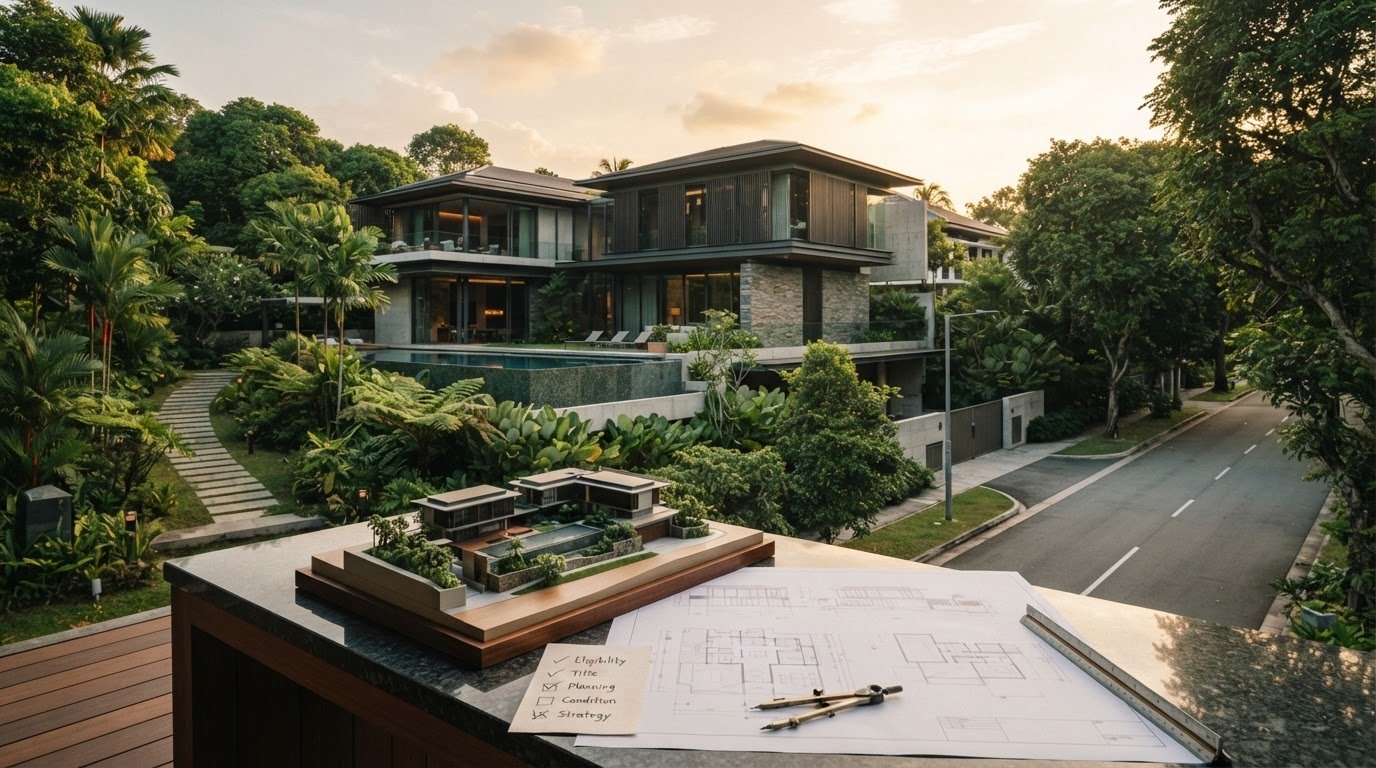
A car porch should improve your daily experience of a home, not distract from shortcomings elsewhere. Bring your viewing notes together and assess each property in the same sequence: define what your household needs, compare how each home meets those needs, verify important details, then decide whether the overall fit is right.
- Define your needs. Separate essential requirements, such as parking the household’s vehicles and reaching the entrance safely, from preferences such as extra storage or a particular porch design.
- Compare homes consistently. Use the same criteria at each viewing, including access, vehicle movement, parking arrangement, the home’s layout and condition, and the space available for other uses.
- Verify key details. Resolve questions about property records, existing alterations and proposed changes before relying on assumptions about how the porch can be used.
- Decide in context. Weigh parking convenience against the home’s broader suitability, including how it supports your household now and over time.
How should you rank car-porch requirements against other priorities?
Start by identifying what would make a property impractical. If household members need to leave independently, a layout that routinely requires one car to move may be a serious drawback. If the household usually travels together, that trade-off may matter less. Treat features such as additional storage as preferences unless they serve a clear daily need.
Then consider the porch alongside the home’s condition, internal arrangement, outdoor space and access. A larger parking area may be less valuable if it compromises a layout that otherwise suits your household. A consistent comparison sheet helps keep a striking feature from outweighing more important considerations during a viewing.
How can a landed-property specialist support your decision?
Choosing between terrace, semi-detached and detached homes involves assessing more than property type or frontage. Vincent Lim’s landed-property sales work includes these home types. He has been active in Singapore real estate since approximately 2004. His experience can support a structured search centred on your household’s requirements and priorities, while keeping the car porch in perspective alongside the property as a whole.
For buyers looking for a landed property with a large car porch in Singapore, a disciplined process can turn viewing observations into a clearer comparison and a more considered acquisition decision. The aim isn’t to select the home with the most impressive porch, but to identify a property whose parking, access and overall layout work together for your household.
Discuss your landed-property search with Vincent Lim to consider your requirements and the property options that may suit them.
Choose a Home That Works Beyond the Driveway
The right landed home should make daily life easier, not simply offer an impressive place to park. As you move from viewing to decision, consider how the property will serve your household over time, including how its layout supports routines that may change. If you’re buying a landed property with a large car porch in Singapore, turn your priorities into a clear brief and use it to guide your search.
Vincent Lim specialises in landed homes, including terrace, semi-detached and detached houses, and has been active in Singapore real estate since approximately 2004. His experience can help you consider property options in light of your household’s requirements and approach the acquisition process with care.
Discuss your landed-property search with Vincent Lim and take a considered next step towards finding a home that fits the way you want to live.
Frequently Asked Questions
How many cars can a large landed-property car porch fit?
There’s no fixed number; capacity depends on the porch’s usable dimensions, access and parking arrangement. A space that can hold several cars briefly may not work for daily use if a vehicle is blocked or passengers can’t get out comfortably. If you’re researching “buying a landed property with large car porch singapore,” assess the vehicles your household actually uses. Treat visitor parking as an extra, not part of essential everyday capacity.
Can two cars park side by side in a landed-property car porch?
Yes, if the clear width and access allow both cars to park and be used safely. Two vehicles appearing to fit in a photograph doesn’t show whether doors can open or whether a gate, column or wall restricts one position. Consider a practical scenario: can a passenger exit one car while the other remains parked? If not, the arrangement may be less convenient than the apparent space suggests.
Is tandem parking suitable for a household with multiple cars?
It can suit a household if drivers’ schedules are predictable and the cars can be moved when needed. It may be less suitable when family members regularly leave at different times or need separate vehicles at short notice. Think through a weekday morning, an unexpected errand and a late return. If any situation regularly depends on coordinating keys or moving another car, consider whether that friction is acceptable.
What should I measure when viewing a landed property car porch?
Measure the clear width and depth available to each vehicle, including restrictions created by walls, columns, gates and fixed structures. Also note the gate’s usable opening, overhead clearance and the turning area between the road and parking position. Compare these with your vehicles’ actual dimensions. A low beam or a tight gate opening can limit practical use even if the parking area itself seems generous.
Do I need approval to alter a landed-property car porch in Singapore?
Structural changes to a car porch, including extensions, require approval from the Urban Redevelopment Authority and the Building and Construction Authority under the guidance provided in this article’s research. Requirements depend on the property and proposed works, so verify current authority guidance before proceeding. If a change affects access from the road, establish whether Land Transport Authority guidance is relevant as well. Don’t assume an existing feature can automatically be altered.
Does a large car porch increase a landed property’s value?
Not automatically. A useful porch may appeal to buyers who need convenient parking, but its contribution depends on how well it functions and how it fits the rest of the property. Compare homes with similar overall characteristics and consider whether the porch improves everyday use or takes space from features your household values more. Treat it as one part of the purchase assessment, not as a guaranteed source of added value.
Should I prioritise car-porch size over indoor living space?
Prioritise the needs that matter most to your household, rather than choosing by size alone. If several vehicles are essential for daily routines, usable parking and access deserve close attention. If the porch would mainly provide occasional extra space, indoor layout or other parts of the home may matter more. Decide which requirements are non-negotiable, then compare each property against the same list to keep the trade-offs clear.