
A power of attorney can keep a property purchase moving, but it shouldn’t transfer your judgment to someone else. If you’re buying a detached house in singapore and can’t attend key steps, a representative may be able to act within the authority you grant. The practical aim is to delegate specific tasks while keeping control of major decisions.
This guide explains what a property power of attorney may allow your representative to sign or do, where its authority ends, and how it differs from a Lasting Power of Attorney. A POA doesn’t remove property-ownership restrictions: detached houses are restricted residential properties, and buyers who require Singapore Land Authority approval should address that before entering a binding agreement.
You’ll also learn what to discuss with your conveyancing solicitor, including the scope of authority and the applicable execution and registration formalities. Vincent Lim can help you assess a detached house and coordinate your purchase priorities, while legal advice and POA preparation remain with your solicitor. The aim is to let a representative handle defined tasks without surrendering your oversight.
Key Takeaways
- Identify which purchase steps you may not be able to attend before deciding whether a representative would help.
- Define the specific tasks you may want to delegate, and decide which decisions you want to retain.
- For buying a detached house in singapore, keep property due diligence separate from the legal process of authorising a representative.
- Discuss the POA’s scope, execution requirements, and transaction documents with your conveyancing solicitor.
- A landed-property specialist can help you assess the home and coordinate purchase priorities as the legal process proceeds.
Buying a Detached House in Singapore: When Might a Power of Attorney Help?
You may have found a detached house worth considering, but work, travel or family commitments could prevent you from attending every transaction step. The practical question is whether someone can act for you without taking over the purchase. For buyers buying a detached house in singapore, a power of attorney may help address a specific attendance problem, provided you discuss its scope with a conveyancing solicitor.
What does a power of attorney do in a property purchase?
A power of attorney (POA) is a document through which one person authorises another to carry out specified actions on their behalf. Its wording matters: the representative, often called an attorney, can act only within the authority granted and applicable requirements. This overview of Power of Attorney explains the general concept, but property procedures depend on the relevant jurisdiction and circumstances.
A POA delegates defined authority; it doesn’t transfer ownership of the property or the buyer’s judgment. Depending on the proposed scope and the solicitor’s advice, examples to discuss might include signing specified transaction documents or handling an agreed administrative step. These are not automatic powers. The document and transaction requirements determine what the representative may do.
You remain responsible for deciding whether the house is suitable, what terms to accept and whether to proceed. A representative’s role does not replace independent legal advice from your conveyancing solicitor or careful property assessment. Keep responsibilities distinct: the solicitor advises on legal matters and the POA, while you make the property-selection and purchase decisions.
Why might a detached-house buyer consider one?
If you are overseas during a key stage, travelling for work or unable to attend because of health or scheduling constraints, signing in person may be difficult. A POA may be worth discussing if a trusted representative needs authority to perform particular actions in your absence. Start by identifying which tasks genuinely need to be delegated and which decisions you want to make yourself.
Planning early gives you, your representative and your solicitor time to coordinate responsibilities and clarify document requirements. It may ease scheduling pressure, but it doesn’t guarantee faster completion; timing depends on the circumstances and steps involved. Vincent Lim can help you assess a detached house and coordinate purchase priorities. For a wider view of evaluating a property and planning the acquisition, see the detached-house acquisition guide.
How a Power of Attorney Fits into Singapore’s Property Transaction
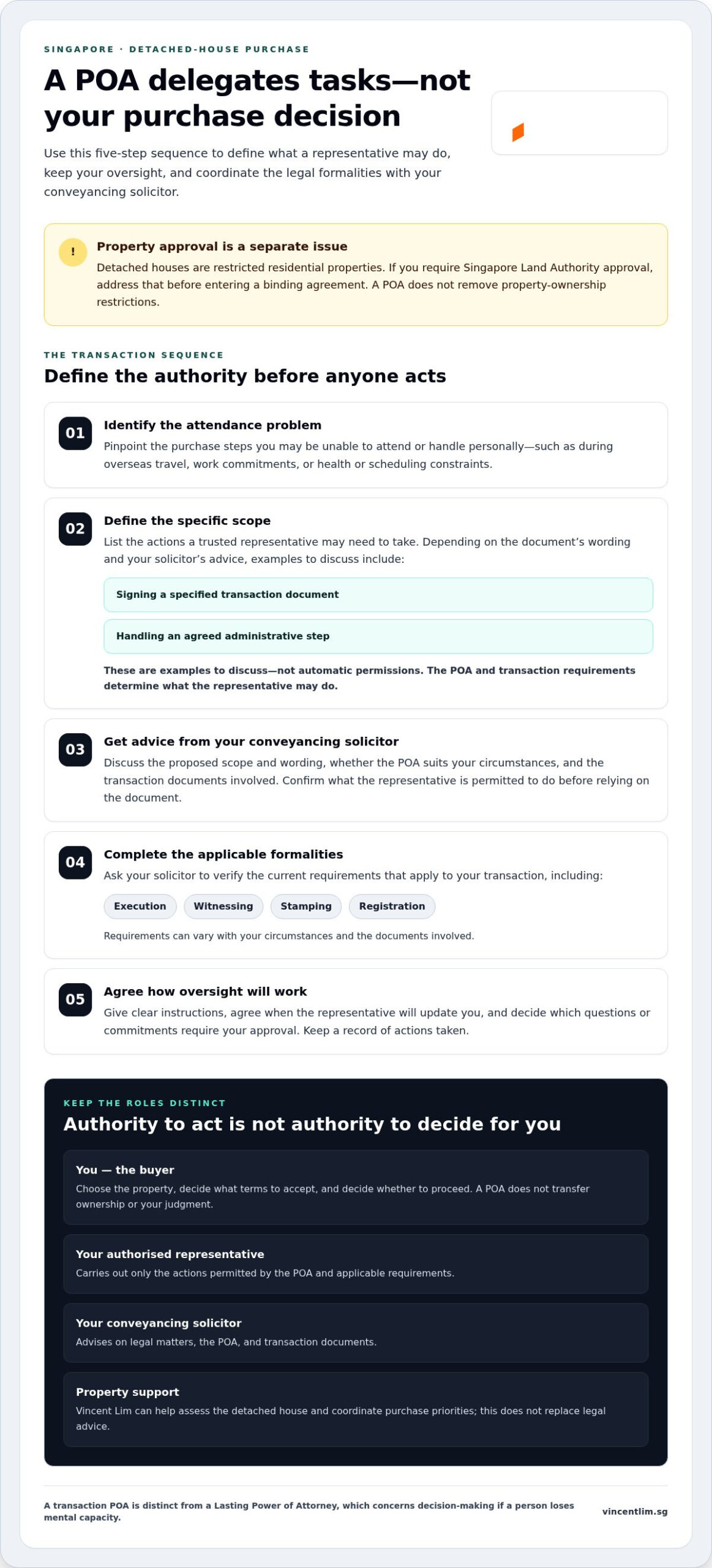
For a buyer buying a detached house in singapore, a power of attorney should fit into the wider purchase plan. A clear sequence helps you define delegated tasks and retain oversight:
- Identify the attendance problem. Pinpoint the transaction steps you may be unable to handle personally.
- Define the proposed scope. List the specific actions a representative may need to take instead of assuming broad authority is necessary.
- Seek legal advice. Ask your conveyancing solicitor to advise on the document, its proposed wording and its suitability for your circumstances.
- Complete the required formalities. Have the solicitor verify the current execution, witnessing, stamping or registration requirements that apply to your transaction.
- Monitor its use. Agree how the representative will report actions taken and when you must be consulted before a decision or commitment.
Requirements and transaction steps can vary with your circumstances and the documents involved. Confirm the applicable process with your solicitor before relying on a POA or authorising anyone to act.
Which purchase tasks could be delegated?
Depending on the POA’s wording and your solicitor’s advice, you might consider authorising a representative to sign a specified document or manage a defined administrative step. These are examples, not automatic permissions. A representative cannot assume that every milestone, signature or requirement can be handled on your behalf. Ask your solicitor to review both the authority granted and the documents involved before proceeding.
Keep the roles clear. You set priorities and give instructions. The authorised representative carries out only tasks permitted by the document. Your conveyancing solicitor advises on legal matters and reviews the POA and transaction documents. Vincent Lim supports your property assessment and purchase coordination, but does not replace your solicitor or make your legal decisions.
What remains the buyer’s decision?
Delegating a transaction task does not, by itself, delegate your judgment about whether to proceed. Your property selection, financial commitments and tolerance for risk should reflect your own priorities and advice from the appropriate professionals.
Preserve informed oversight with clear written instructions, agreed update points and a record of questions that require your approval. A transaction POA should not be confused with a Lasting Power of Attorney, which concerns decision-making if a person loses mental capacity. Singapore’s Ministry of Social and Family Development explains the Lasting Power of Attorney (LPA) process.
Vincent Lim, an OrangeTee & Tie Executive Associate Director specialising in landed homes, can help you assess a detached house and coordinate purchase priorities alongside your legal process. Explore Vincent Lim’s landed-property guidance as you plan the property side of your purchase.
Power of Attorney or Personal Attendance: Compare Control, Convenience, and Risk
For buyers buying a detached house in singapore, the choice between attending personally and authorising a representative depends on your schedule, the tasks involved and your conveyancing solicitor’s advice. A POA can be practical, but it isn’t automatically more convenient or suitable. Representation does not replace professional advice or mean every transaction step can be handled remotely.
When could a representative be useful?
If overseas travel or a demanding schedule makes attendance difficult, a representative may help with clearly specified tasks. First consider whether you can describe those tasks precisely and monitor them through updates. Don’t assume remote participation or representation will be accepted for every step. Ask your conveyancing solicitor to confirm the requirements for your circumstances. If you sign a POA overseas, ask whether additional formalities apply; the Singapore Academy of Law authentication portal explains its legalisation and apostille services.
What safeguards help preserve control?
Agree on a narrow scope, written instructions and regular progress updates. Before granting authority, review its wording and practical implications with your solicitor, including how the representative should handle questions that need your decision. Consider whether you trust the person to act responsibly, protect confidential information and account clearly for actions taken. Convenience matters, but so do accountability and your comfort with the arrangement.
How to Prepare Before Authorising Someone for a Detached-House Purchase
Before discussing a power of attorney with your solicitor, separate two workstreams: assessing the detached house and deciding whether another person needs authority to handle specific transaction tasks. A POA doesn’t replace property due diligence, and completing due diligence doesn’t determine what authority you should grant. Keeping these questions distinct helps you prepare focused instructions and retain control of the purchase.
Use this checklist to organise your first discussion:
- Identify the attendance gap. Note which steps you may not be able to attend and why, such as travel or scheduling constraints.
- List potential tasks. Describe what you hope the representative can handle, without assuming each task can be delegated.
- Choose and brief the representative. Consider trust, availability, understanding of your instructions and ability to communicate reliably.
- Prepare practical details. Keep relevant identity and contact information accessible, agree on a communication channel and decide how transaction records will be stored and shared.
- Continue property assessment separately. Record your priorities and outstanding questions about the home, so decisions about its suitability remain distinct from the POA process.
Questions to settle with your conveyancing solicitor
Ask which specific powers are necessary for your purchase and which should be excluded. Have your solicitor explain the applicable execution, witnessing, stamping and registration requirements, as well as the timing and documents relevant to your circumstances. Requirements can depend on the transaction and your situation, so a generic checklist cannot confirm which formalities apply.
Also ask how the authority may be changed or revoked, what steps that would involve, and how a change could affect the transaction. These questions require current legal advice. Your solicitor should review the document’s scope before you sign or rely on it.
Instructions and oversight for your representative
Set expectations before authorising anyone. Agree how often you’ll receive updates, which matters the representative may handle independently and which require your express direction. Define escalation points, such as a request to accept a material change or make a commitment beyond the agreed scope. Keep written records of instructions, updates and important decisions so there’s a clear account of what was agreed.
Vincent Lim, an OrangeTee & Tie Executive Associate Director specialising in landed homes, can help you assess the property and coordinate purchase priorities. He supports the property side of the process, while legal advice and POA preparation remain with your conveyancing solicitor. For guidance on your detached-house purchase priorities, discuss the property assessment and purchase plan.
Next Steps: Coordinate Your Detached-House Purchase with Confidence
A power of attorney addresses a practical attendance issue; it isn’t a shortcut around careful purchase planning. Before deciding, identify which moments you may need to manage from a distance, define the tasks you might delegate, and get your conveyancing solicitor’s advice on the proposed authority. The right arrangement depends on your circumstances and the transaction requirements.
A simple decision sequence for buyers
Map the purchase stages where your presence or signature may be requested. For each stage, note whether you expect to attend personally, participate remotely if permitted, or ask a representative to handle a specified task. Treat these as planning questions, not assumptions about what the transaction will allow.
- List the attendance gaps. Record the appointments, document steps or periods when travel or scheduling could prevent your participation.
- Define possible delegated tasks. Describe what you want the representative to do and identify decisions you want reserved for yourself.
- Review the proposed authority. Ask your conveyancing solicitor to advise on its wording, scope, applicable formalities and practical implications.
- Set communication expectations. Agree how updates will be shared and which material issues must come back to you before action is taken.
This structure supports informed oversight without blurring responsibilities. Your solicitor advises on and prepares the legal document; you make the property and financial decisions. A representative acts only within the authority established for the transaction.
Bring property strategy and transaction coordination together
Delegating a task doesn’t answer the larger question of whether the house suits your needs and priorities. Vincent Lim is an OrangeTee & Tie Executive Associate Director specialising in landed homes, including detached houses. Active in Singapore real estate since approximately 2004, he can provide property-side guidance, help assess a home and coordinate purchase priorities. Legal advice and interpretation of the POA remain with your conveyancing solicitor.
If your purchase forms part of a wider property plan, the landed-property asset progression guide offers a broader planning perspective. For buying a detached house in singapore, bring together your property criteria, attendance constraints and solicitor’s guidance before committing to an arrangement.
Discuss your detached-house purchase strategy with Vincent to organise the property assessment and priorities alongside your legal process.
Plan Your Purchase with Clear Authority and Oversight
A power of attorney can help address an attendance challenge, but its value depends on a clearly defined scope, appropriate legal guidance and a representative you trust. The central distinction is simple: you may delegate specified transaction tasks without handing over your judgment about the property or your purchase priorities.
Before buying a detached house in singapore, identify which steps you may not be able to attend, decide what you might delegate and ask your conveyancing solicitor to advise on the document and current requirements. Keep property assessment and legal advice distinct, while coordinating both as part of a considered purchase plan.
Vincent Lim has been active in Singapore real estate since approximately 2004 and specialises in landed-property sales, including detached houses. He can help you assess the home and coordinate your property priorities, while your solicitor handles legal advice and document preparation. Discuss your detached-house purchase strategy with Vincent and take your next step with a clear plan.
Frequently Asked Questions
Can I use a power of attorney to buy a detached house in Singapore?
Yes, a power of attorney may allow a representative to handle specified purchase tasks if the document and transaction requirements permit. When buying a detached house in singapore, remember that a POA doesn’t resolve ownership eligibility or any approval requirements that may apply to you. Ask your conveyancing solicitor about the applicable process, execution requirements and timing before relying on a representative or entering a binding agreement.
What can a representative do under a property power of attorney?
A representative can carry out only actions authorised by the POA and accepted for the relevant transaction step. Depending on the wording and your solicitor’s advice, this might include signing a specified document or handling an agreed administrative matter. These are examples, not automatic permissions. Don’t assume a representative can complete every milestone, make every decision or act simply because they have been appointed.
Do I still need a conveyancing solicitor if I use a power of attorney?
Yes. A POA doesn’t replace a conveyancing solicitor. Your solicitor advises on the purchase, reviews the proposed scope of authority and explains the legal requirements that apply to your circumstances. The representative performs only authorised tasks, while the solicitor handles legal advice and document preparation. Keep the roles clear, and don’t rely on a representative or property agent for independent legal guidance.
Can I limit what my representative is authorised to do?
Yes. The document’s wording can define the authority you intend to grant, so discuss specific tasks and exclusions with your conveyancing solicitor. For example, you might want a representative to handle a named administrative step while requiring your direct approval for material decisions. Your solicitor can advise how to express those limits and whether they work in practice for the transaction.
What should I check before signing a power of attorney for a property purchase?
Before signing, confirm with your solicitor which powers are needed, which should be excluded and what execution, witnessing, stamping or registration requirements apply. Check the representative’s identity and contact details, agree how updates will be shared, and decide which issues need your approval. Requirements may depend on your circumstances, including where you sign, so ask your solicitor to review the current process and timing.
Can I revoke a power of attorney after granting it?
Possibly, but don’t assume revocation is immediate or that it automatically resolves actions already taken or transaction steps underway. Ask your conveyancing solicitor how the authority may be changed or revoked, what formal steps are required and who needs to be notified. The practical effect can depend on the document and circumstances. Clarify this before signing, and keep a copy of the advice and relevant records.
Does using a power of attorney mean I lose control of the house purchase?
No. A POA delegates the authority stated in the document; it doesn’t automatically transfer ownership or your judgment about whether to buy. You can preserve oversight by defining the scope, giving clear written instructions and agreeing on regular updates and approval points. The representative’s actions must stay within their authority, while your solicitor advises on legal matters and you retain responsibility for your purchase decisions.