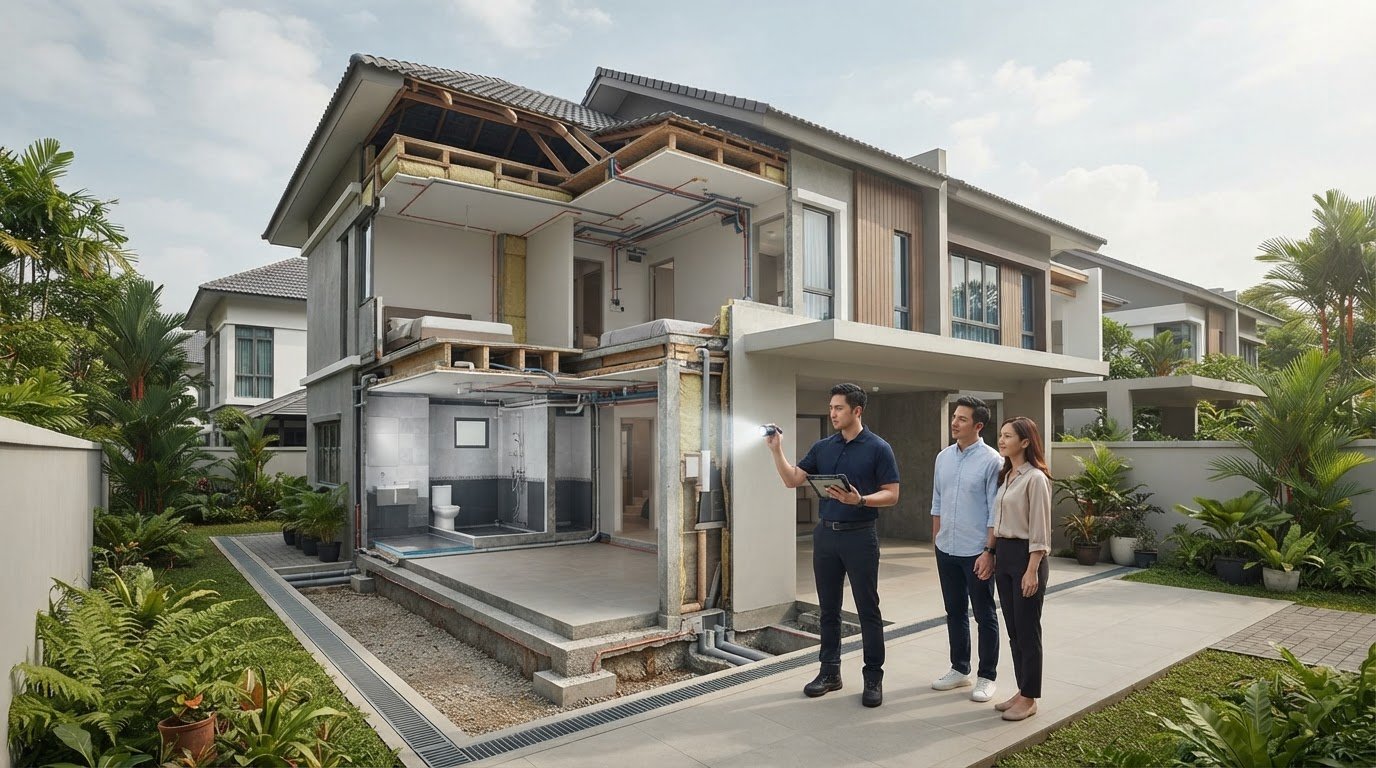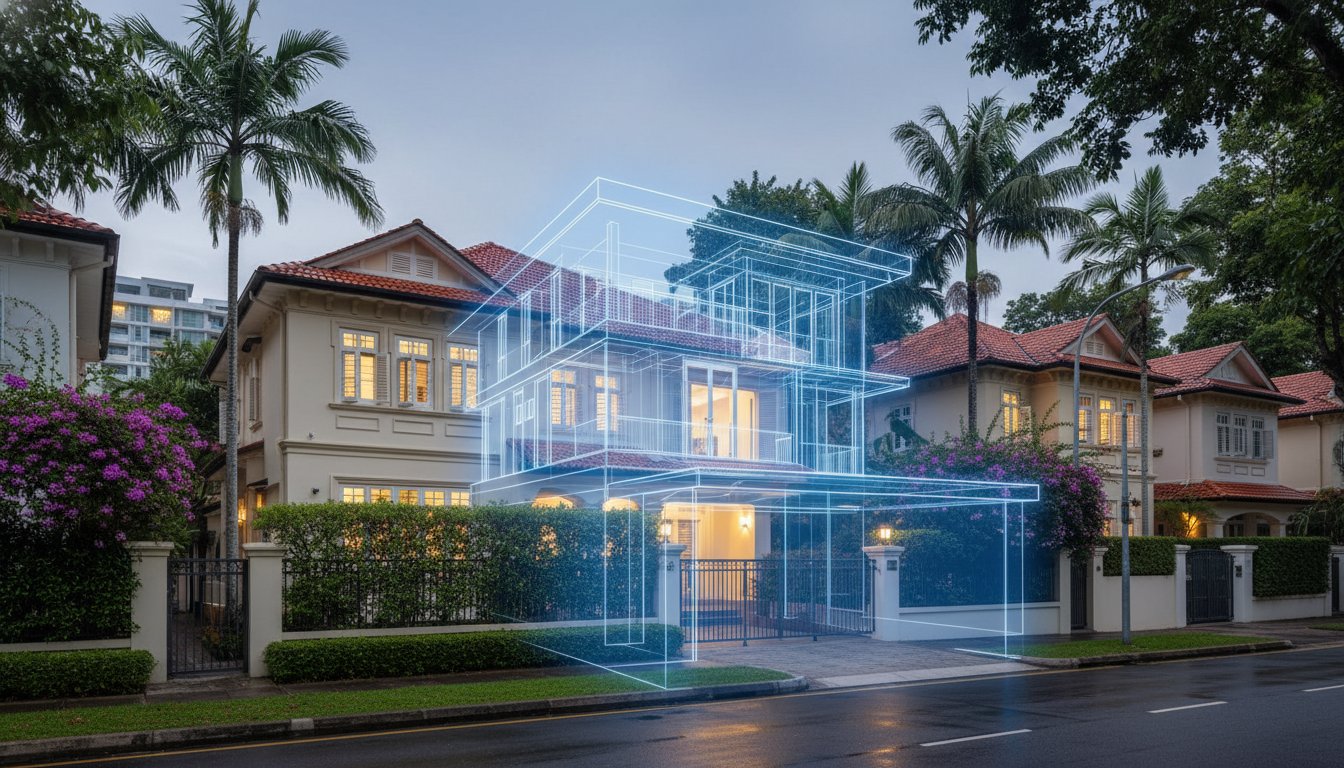
What if the most significant value of your home isn’t found in its current architecture, but in the invisible volume of space defined by URA guidelines? For many owners of terrace, semi-detached, or detached houses, the true landed property redevelopment potential remains locked behind a veil of regulatory complexity. You likely recognize the immense financial upside of a well-executed rebuild, yet the fear of overpaying for a plot with limited build-up potential often creates a paralyzing uncertainty. With Land Betterment Charge rates for landed residential sectors rising by an average of 4.0% in early 2026, the margin for error has never been thinner.
You deserve a clear, strategic framework that transforms these regulatory hurdles into a competitive advantage. This guide provides the precision needed to master envelope control rules and evaluate the financial feasibility of reconstruction versus additions and alterations. We’ll examine the essential steps to identify high-potential plots, navigate the upcoming mandatory CORENET-X submission requirements arriving this October, and ultimately secure the long-term equity your investment deserves.
Key Takeaways
- Identify hidden equity by evaluating untapped Gross Floor Area (GFA) typically found in legacy landed homes across Singapore.
- Navigate the URA Envelope Control system to define the maximum buildable 3D volume allowed for your specific property type.
- Distinguish between cost-effective Additions & Alterations (A&A) and full reconstruction based on the critical 50% structural threshold.
- Master a framework to assess landed property redevelopment potential by uncovering hidden site constraints like drainage reserves and sewerage easements.
- Learn why partnering with an elite strategist is essential to coordinate the complex network of architects, builders, and regulatory submissions.
The Strategic Value of Redevelopment Potential in 2026
Redevelopment potential is the quantifiable capacity of a plot to support a larger, more functional structure than what currently exists. In the context of Singapore’s limited land mass, this potential is primarily measured by the ability to enhance a property’s Gross Floor Area (GFA). While a brand-new home offers immediate utility, older landed properties often hold significantly more hidden value. These legacy plots frequently feature single-story or two-story structures situated on land zoned for three-story envelope control. This discrepancy between the current build-up and the maximum permissible volume represents untapped equity for the discerning investor.
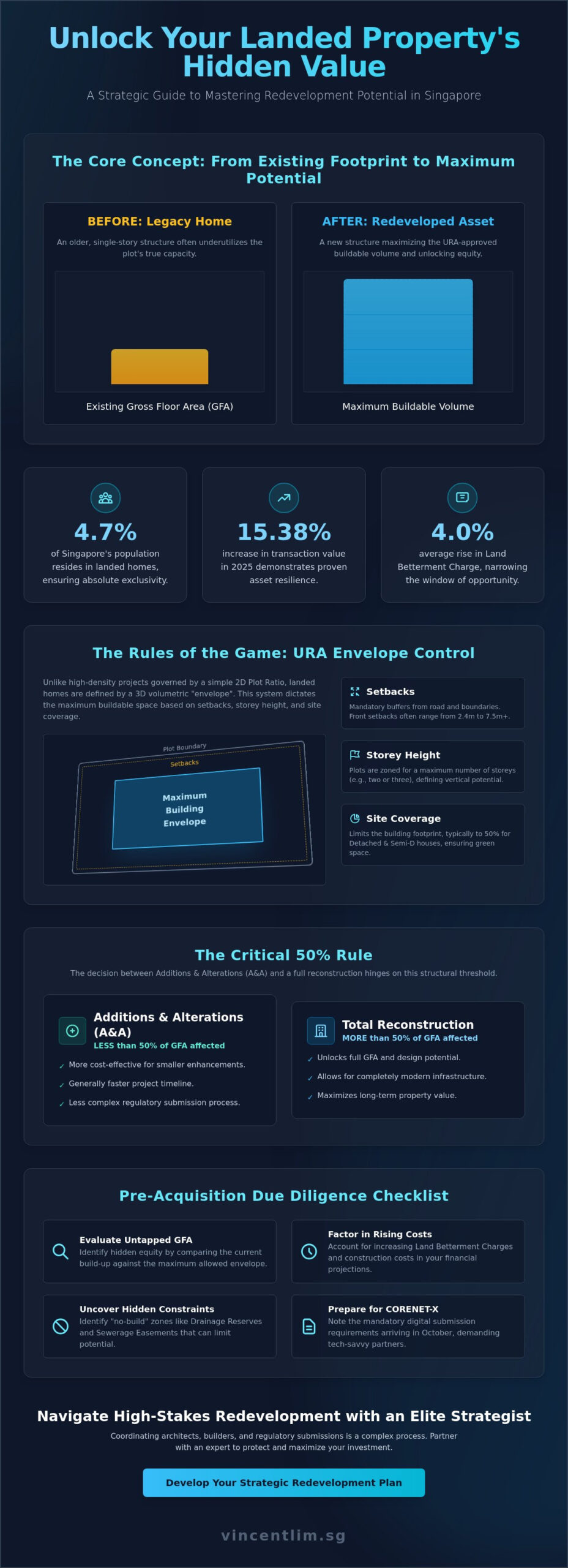
The 2026 market is defined by a persistent scarcity of prime land and a growing demand for multi-generational living spaces. With only 4.7% of Singapore’s population residing in landed homes, the exclusivity of the asset class is absolute. Strategic land acquisition serves as the foundation for asset progression, allowing owners to transition from mere space consumption to active wealth creation. By identifying plots with high landed property redevelopment potential, you aren’t just buying a residence; you’re acquiring the right to develop a bespoke legacy asset.
Why Landed Assets Outperform in Wealth Preservation
Freehold landed properties demonstrate a historical resilience that often eludes the luxury condominium market. While high-end apartments are subject to the ebbs and flows of international investment sentiment, the intrinsic value of land remains anchored by its finite supply. This scarcity is a central pillar of Urban renewal in Singapore, where land use is meticulously planned to maximize efficiency. For those considering upgrading from condo to landed, the move represents a shift toward an asset class that recorded a 15.38% increase in transaction value in 2025 alone. The physical land remains the ultimate hedge against inflation and currency fluctuations.
Redevelopment as a Hedge Against Market Volatility
A well-executed rebuild acts as a powerful hedge against market volatility. Through a process known as forced appreciation, you can increase a property’s market value by expanding its usable square footage, regardless of broader economic plateaus. In a 2026 environment where interest rates are easing but construction costs remain elevated, the ability to identify under-utilised plots is vital. These are sites where the existing footprint is significantly smaller than the URA-allowed envelope. By maximizing the buildable volume, you protect your equity and ensure the home remains a high-performance financial instrument. It’s about ensuring that every square meter of your landed property redevelopment potential is fully realized to meet the standards of modern luxury.
Technical Determinants of Landed Redevelopment Potential
Mastering the technical constraints of a plot is the first step in unlocking its true value. While many investors focus solely on the total land area, the landed property redevelopment potential is actually dictated by a three-dimensional framework known as Envelope Control. Unlike high-density residential projects where the “Plot Ratio” determines the total floor area, landed homes are governed by a volumetric approach. This system defines a maximum building envelope based on storeys, setbacks, and height limits. It ensures that while you maximize your living space, the neighborhood maintains a consistent and aesthetic streetscape.
Site coverage is another critical metric. It limits the percentage of land that the building footprint can occupy. For most detached and semi-detached houses, this is typically capped at 50% of the site area. This requirement ensures adequate ventilation and green space, but it also means that a larger plot doesn’t always translate into a proportionally larger ground floor. Understanding these nuances is essential when reviewing the URA Master Plan, as it provides the statutory basis for what can legally be constructed on any given parcel.
Setback requirements further refine the buildable area. These mandatory buffer zones separate your home from the road and neighboring boundaries. In Singapore, front setbacks are often determined by the road buffer, which can range from 2.4 meters to 7.5 meters or more. If you’re unsure how these technicalities affect your specific investment goals, consulting with a professional who specializes in Semi-Detached House Sales can provide the clarity needed before committing to a purchase.
Zoning and Housing Type Restrictions
The URA designates specific enclaves as 2-storey or 3-storey landed housing areas. Building a third storey in a 2-storey zone is strictly prohibited, which can severely limit the upside of an older property. Additionally, certain enclaves have restrictions on sub-dividing semi-detached houses into smaller terrace units. In Good Class Bungalow (GCB) areas, the rules are even more stringent, requiring a minimum land size of 1,400 square meters and a maximum site coverage of 35% to preserve the low-density character of these elite estates.
Site Attributes That Impact Buildability
Physical characteristics like land shape and topography play a decisive role in construction efficiency. Regular rectangular plots are highly sought after because they minimize “dead space” created by setbacks. In contrast, pie-shaped or irregular plots often result in awkward internal layouts. Topography is equally important; a sloping site might allow for a “walk-out” basement that doesn’t count towards the official storey height, effectively adding an extra level of luxury. However, you must also account for road widening reserves. These are portions of land the government may claim for future infrastructure, which can permanently reduce your effective land area and building footprint.
Additions & Alterations (A&A) vs. Total Reconstruction
Deciding between a targeted renovation and a total rebuild is a pivotal choice that shapes your final return on investment. Additions and Alterations (A&A) involve modifications where the proposed increase in Gross Floor Area (GFA) and the replacement of external walls or structural floors don’t exceed 50% of the existing structure. In contrast, reconstruction is defined as any work that surpasses this 50% threshold or involves a change in the housing type, such as converting a terrace house into a semi-detached unit. While A&A offers a faster route to modernization, it often forces you to work within the limitations of an aging foundation. Total reconstruction allows you to fully exploit the landed property redevelopment potential by designing a home from the ground up to modern standards.
The regulatory path for each varies significantly. A&A works typically face less stringent requirements regarding setbacks and certain URA guidelines, provided the original structure is largely retained. However, once the 50% threshold is crossed, the project is treated as a new building, requiring full compliance with contemporary envelope control rules and prevailing setback distances. This distinction is critical because an incorrect classification can lead to project delays or unexpected costs during the submission process to the Building and Construction Authority (BCA).
The Financial Tipping Point
The decision to rebuild often rests on a calculated cost-benefit analysis. In 2026, the average cost per square foot for a full rebuild reflects the high demand for construction services, with total contracts in Singapore projected to reach between S$47 billion and S$53 billion this year. While reconstruction requires a higher initial capital outlay and potentially triggers a Land Betterment Charge (LBC), which saw an average increase of 4.0% for landed residential sectors in March 2026, it adds significant long-term value. A new build accommodates modern necessities like passenger lifts, expansive basements, and high-clearance attic levels that older structures simply can’t support. You should also consider the tax implications; owner-occupied property tax rates remain progressive up to 32% in 2026, making a highly efficient, modern home a more sensible long-term hold than a patched-up legacy property. For precise data on land titles and baseline queries, the Singapore Land Authority remains the definitive resource for verifying your plot’s history.
Timeline and Logistics
Logistical planning is essential as the industry prepares for the mandatory adoption of CORENET-X in October 2026. This digital shift aims to streamline building plan submissions, but the transition period requires meticulous coordination. A typical reconstruction project can span 18 to 24 months, whereas A&A works might be completed in under a year. You must factor in the cost of alternative housing during this period. With current interest rates for private property easing toward a 1.40% fixed rate for two years, financing the construction phase has become more manageable. However, the scarcity of skilled labor continues to influence lead times for bespoke finishes. Managing these moving parts requires a disciplined approach to ensure the project reaches the Temporary Occupation Permit (TOP) stage without unnecessary delays. By understanding the landed property redevelopment potential early, you can choose the path that best aligns with your timeline and financial objectives.
Assessing a Property’s ‘Hidden’ Potential Before Acquisition
Evaluating a property through the lens of its current state is a fundamental oversight for the strategic investor. The true value of a legacy home lies in its “Highest and Best Use” study, a rigorous analysis that determines the most profitable and legally permissible use of the site. When you examine a plot, you must look beyond the weathered facade to identify the landed property redevelopment potential that others might miss. This involves a meticulous assessment of the neighborhood’s build-up trend. If surrounding neighbors have already successfully transitioned to 3.5-storey structures with attics, it serves as a strong indicator that the URA is receptive to similar intensifications in that specific enclave.
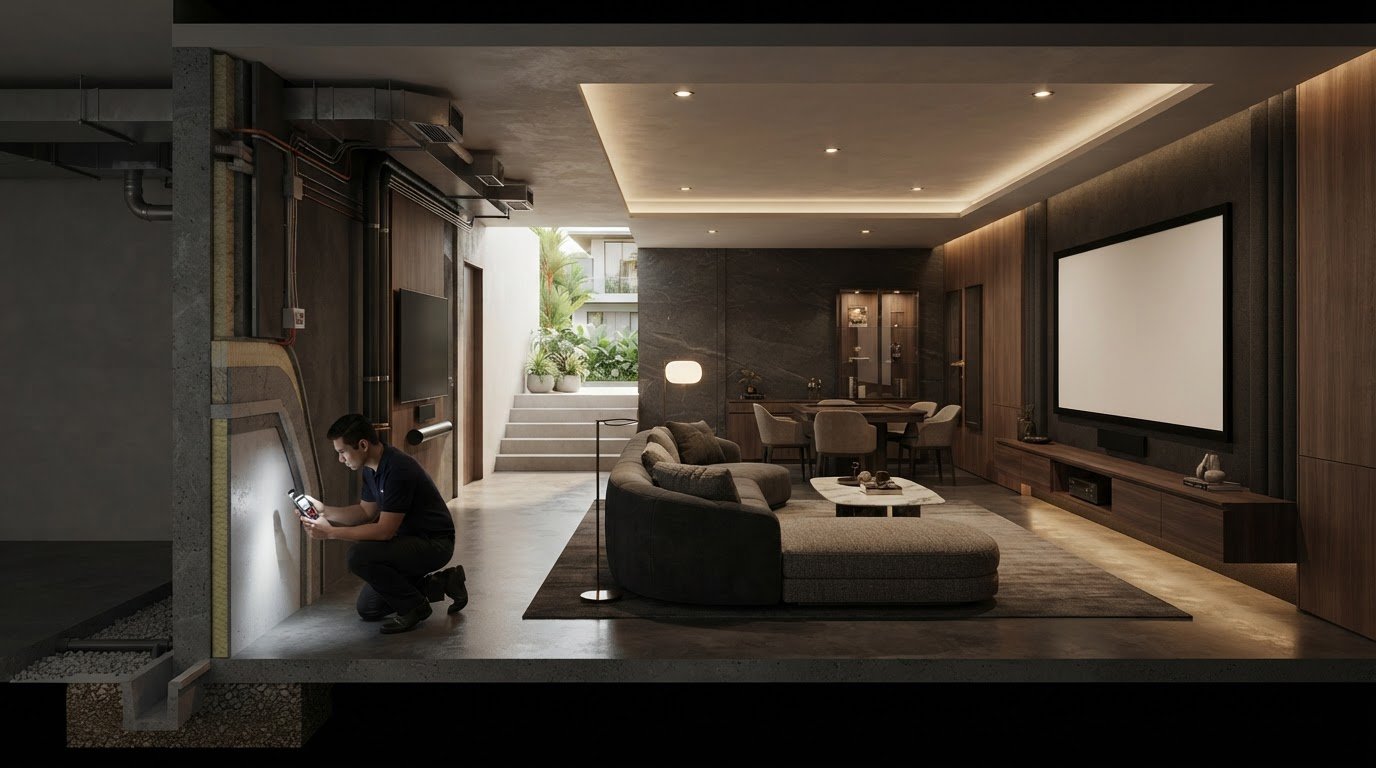
Technical “invisible” constraints often dictate the feasibility of a rebuild. You must verify the existence of drainage and sewerage reserves, as these easements can severely restrict your ability to construct a basement or certain structural footings. A basement adds significant premium floor area without increasing the perceived height of the building, but a poorly positioned sewer line can render this option cost-prohibitive. Similarly, you must calculate the “effective” land area. The figure on the title deed may include land earmarked for road widening reserves. These portions of land are essentially “lost” to future infrastructure, reducing your actual buildable footprint and impacting your final setback calculations.
The Due Diligence Checklist
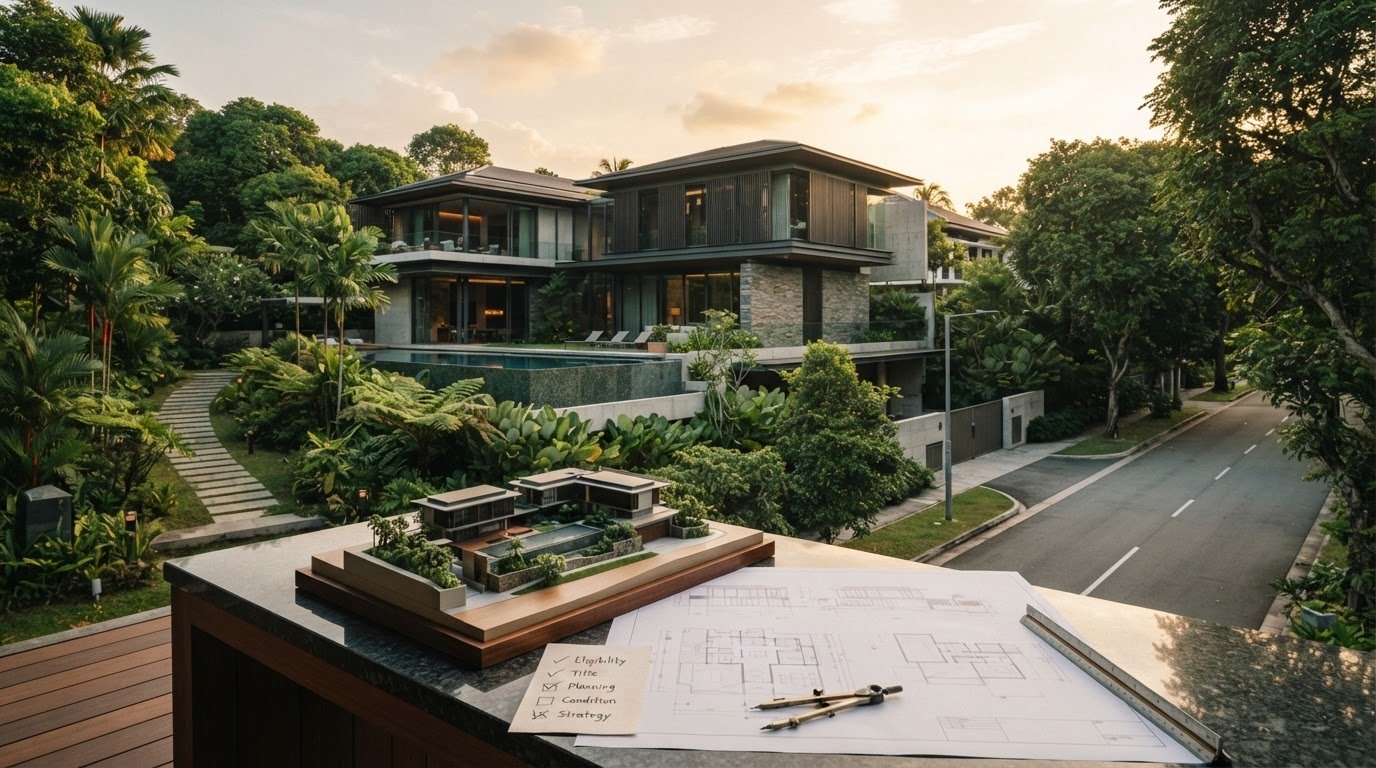
Precision in the pre-purchase phase prevents expensive errors during construction. You should always request the “Certified Plan” from the Singapore Land Authority to verify exact boundary dimensions rather than relying on marketing brochures. Engaging an architect for a preliminary massing study is equally vital. This study provides a volumetric visualization of what can be built within the envelope control rules, ensuring your vision aligns with regulatory reality. Integrating these findings into your broader investing in singapore landed property strategy allows for more accurate wealth planning and risk mitigation.
Spotting Sub-division Opportunities
The most lucrative way to maximize landed property redevelopment potential is through land sub-division. If a detached house sits on a plot exceeding 400 square meters, it may be possible to split the land into two smaller semi-detached units. URA guidelines require minimum plot sizes of 150 square meters for terrace houses, 200 square meters for semi-detached, and 400 square meters for detached homes. The “Sub-division Premium” can be substantial; the combined exit value of two semi-detached homes often far exceeds the value of a single large bungalow. If you are targeting plots with these specific characteristics, reviewing our current portfolio of Detached house listings can help you identify high-yield opportunities before they reach the open market.
Navigating High-Stakes Redevelopment with an Elite Strategist
Redeveloping a landed asset in Singapore is a sophisticated undertaking that demands more than a simple real estate transaction. A standard property agent often focuses on the aesthetic appeal or the immediate market price of a home. However, extracting the maximum landed property redevelopment potential requires a technical depth that spans urban planning, architectural feasibility, and financial modeling. Working with the best landed property agent means engaging a high-level partner who coordinates the complex interactions between architects, builders, and the URA to ensure every regulatory query is handled with calculated precision.
Consider the strategic advantage of a recent project involving a legacy detached plot in a prime enclave. The owner initially perceived the property through the lens of a standard sale. By conducting a detailed massing study and identifying a significant gap between the current GFA and the URA envelope, we repositioned the asset entirely. We managed the value-add transition by presenting a clear redevelopment framework to potential buyers, ultimately securing a premium that reflected the land’s future utility rather than its aging structure. This level of active management defines a white-glove service, ensuring that no equity is left on the table during the transition.
A Bespoke Approach to Landed Sales
Meticulous planning is the only definitive safeguard against buyer’s remorse in the landed market. In the high-stakes environment of 2026, where Landed Residential LBC rates have increased by an average of 4.0%, transparency is paramount. I leverage long-term industry experience to negotiate based on the latent value of the land, whether the transaction involves Terrace House Sales, Semi-Detached House Sales, or elite Good Class Bungalows. My approach ensures that you never overpay for a plot with hidden constraints, such as road widening reserves or restrictive sewerage easements that could compromise your vision.
Your Next Steps in Landed Asset Progression
Asset progression is a journey of intentional, methodical moves. We begin with an initial consultation to assess your current portfolio and long-term wealth goals against the 2026 economic landscape, including easing interest rates where the 3-month compounded SORA is projected between 1.0% and 1.5%. From there, I curate a shortlist of properties specifically selected for their high landed property redevelopment potential. This disciplined process ensures your capital is deployed into assets that offer both immediate prestige and sustainable equity growth. Contact Vincent Lim for a professional assessment of your landed property’s potential and take the first step toward securing a bespoke legacy residence.
Secure Your Legacy Through Strategic Land Acquisition
Mastering the intricacies of the URA envelope control system and distinguishing between a targeted A&A and a full reconstruction are the hallmarks of a sophisticated investor. By conducting rigorous due diligence on site constraints like drainage reserves and road widening, you transform a simple property purchase into a calculated wealth-building event. The true landed property redevelopment potential of a plot is rarely visible to the untrained eye. It requires a disciplined analysis of technical guidelines and market trends to unlock hidden equity.
Navigating these high-stakes transactions demands a partner who operates with seasoned authority and meticulous precision. Since 2004, I’ve specialized in the GCB and luxury landed market, providing a bespoke “Elite Strategist” approach that prioritizes your long-term success. As an Executive Associate Director at OrangeTee & Tie, I provide the transparency and expertise needed to refine your property portfolio with confidence. Partner with Vincent Lim to identify your next high-potential landed investment. You’re ready to secure a refined, high-yield landed legacy today.
Frequently Asked Questions
What is the difference between a total rebuild and A&A in Singapore?
The primary distinction lies in the structural threshold; Additions & Alterations (A&A) involve modifications where the increase in Gross Floor Area and structural changes remain below 50% of the existing building. Reconstruction, or a total rebuild, applies when these changes exceed the 50% limit or involve a change in housing type. A total rebuild allows you to fully maximize the landed property redevelopment potential by adhering to modern envelope control rules from the ground up.
How do I know if my terrace house can be converted into a semi-detached?
Conversion typically requires your property to be a corner terrace with a minimum land area of 200 square meters. Alternatively, two adjacent terrace houses can sometimes be merged and re-zoned as a pair of semi-detached units if they meet the minimum width and depth requirements set by the URA. This transition often unlocks significant capital appreciation by moving the asset into a more exclusive housing category.
Does URA allow a basement level for all landed properties?
Most landed properties in Singapore are permitted to have a basement level, provided it remains within the allowable building envelope and doesn’t exceed the site coverage limits. However, technical constraints like deep sewerage lines or drainage reserves can physically prevent excavation. You must verify these invisible encumbrances through a detailed site survey before finalizing your architectural plans.
What is the ‘Envelope Control’ guideline and how does it affect my build height?
Envelope Control is a volumetric framework that defines the maximum 3D space a building can occupy, rather than just relying on a fixed height in meters. For landed homes, this is guided by the designated storey height of the enclave, such as 2-storey or 3-storey zones. It allows for greater design flexibility, including mezzanine levels and attics, as long as the structure stays within the prescribed building volume.
Is it worth buying a 99-year leasehold landed property for redevelopment?
Investing in a leasehold plot for redevelopment can be viable if the entry price reflects the shorter tenure and the remaining lease is sufficient to secure financing. However, most elite investors prefer freehold or 999-year titles for redevelopment projects to ensure long-term wealth preservation. You should calculate the leasehold discount against the projected construction costs to determine if the projected exit value justifies the investment.
How much of my land can I actually build on (Site Coverage)?
Site coverage refers to the percentage of your land that the building footprint can occupy at the ground level. For most detached and semi-detached houses, the limit is 50%, while Good Class Bungalows are restricted to 35% to maintain a lush, low-density environment. This ensures adequate space for setbacks, ventilation, and landscaping, which are essential components of high-end residential living.
Can I rebuild my landed property if there is a road widening reserve?
You can still rebuild on a property affected by a road widening reserve, but your setbacks and building footprint must be calculated from the new vested boundary. The land within the reserve is essentially surrendered to the state for future infrastructure, which reduces your usable land area. This reduction can significantly impact the landed property redevelopment potential, especially for smaller terrace or semi-detached plots.
What are the minimum land size requirements for a Good Class Bungalow (GCB)?
A Good Class Bungalow must occupy a minimum land area of 1,400 square meters and be located within one of the 39 designated GCB areas in Singapore. These elite estates are subject to the most stringent planning controls, including a maximum site coverage of 35% and a height limit of two storeys. These regulations preserve the exclusivity and prestige associated with Singapore’s most coveted residential assets.