
For a Singapore Permanent Resident, the sale of a landed asset is never just a transaction; it’s a high-stakes regulatory exit where a single miscalculation in timing can cost hundreds of thousands in Seller’s Stamp Duty. You likely recognize that owning a terrace house or semi-detached home as a PR is a significant achievement, yet the path to divesting that asset in 2026 feels increasingly complex. When you’re a singapore pr selling landed property, the interplay between Land Dealings Approval Unit (LDAU) conditions and the current 16% first-year SSD rate requires a level of precision that goes beyond standard real estate marketing.
This guide provides the strategic clarity you need to navigate these hurdles while positioning your property to capture maximum value from an exclusive buyer pool. We’ll examine the updated 2026 tax frameworks, the nuances of buyer eligibility, and the methodical steps required to ensure your capital gains are protected for your next legacy move. By aligning your exit with current market data, you can transition your wealth with the confidence that every detail has been refined for success.
Key Takeaways
- Understand the non-negotiable 5-year Minimum Occupation Period and the 2026 Seller’s Stamp Duty tiers to protect your investment returns from unnecessary erosion.
- Navigate the Residential Property Act with precision, ensuring every aspect of a singapore pr selling landed property transaction aligns with Singapore Land Authority (SLA) mandates.
- Strategically target the right buyer demographic, recognizing that Singapore Citizens form your most fluid market due to the stringent LDAU restrictions placed on fellow PRs.
- Enhance your property’s market positioning by identifying redevelopment potential and optimizing land-use narratives to justify a premium exit price.
- Formulate a clear asset progression roadmap to transition your liquidated equity into high-performing luxury condominiums or legacy-focused property portfolios.
The Landscape for a Singapore PR Selling Landed Property in 2026
Owning Landed property in Singapore is a mark of significant economic contribution, yet for a Permanent Resident, it also places you within a specific regulatory category. Under the Residential Property Act (RPA), PRs are classified as “foreign persons.” This means your ownership is conditional, and your exit strategy must be handled with more foresight than a typical residential sale. When singapore pr selling landed property, you aren’t just engaging with a buyer; you’re operating within a framework overseen by the Singapore Land Authority (SLA).
Understanding Your Restricted Asset Status
Your property is classified as a restricted asset, a status that dates back to your initial purchase. At that time, you had to secure a grant from the Land Dealings Approval Unit (LDAU), which typically requires a minimum of five years of residency and proof of exceptional economic value to the nation. These conditions don’t disappear when you decide to sell. Instead, they dictate the rhythm of your transaction. Because you’re dealing with a restricted class of real estate, the SLA ensures that the subsequent transfer maintains the integrity of Singapore’s land-use policies, making your role as a seller one of regulatory stewardship as much as financial negotiation.
The 2026 Market Outlook for Landed Sellers
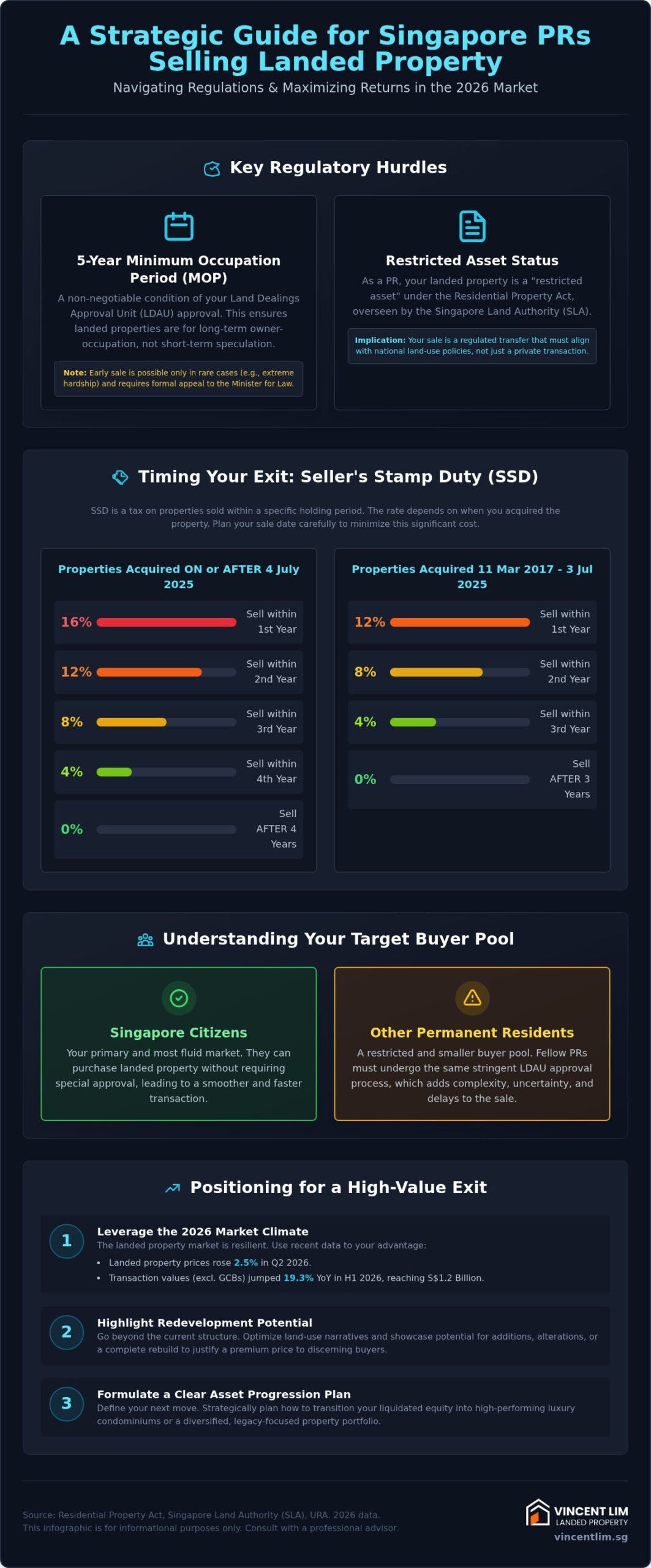
The market climate in 2026 has proven remarkably resilient for landed assets. While non-landed segments have seen price moderations, landed homes have hit new record highs. Data from the Urban Redevelopment Authority (URA) indicates that landed property prices rose by 2.5% in the second quarter of 2026 alone. This follows a robust first half of the year where transaction values for landed homes, excluding Good Class Bungalows, jumped 19.3% year-on-year, reaching nearly S$1.2 billion. This scarcity-driven growth makes it an opportune time for PRs to liquidate assets, provided they understand the “pricing stand-off” currently observed between firm sellers and cautious buyers.
Executing a singapore pr selling landed property move in this environment requires a “Strategic Exit” mindset. It’s not about finding any buyer; it’s about identifying the specific profile of Singapore Citizen or high-net-worth PR who can navigate the LDAU’s stringent requirements. A strategic approach ensures that you don’t just achieve a high sale price, but that the transaction proceeds smoothly without regulatory friction or delays that could impact your next property move.
Regulatory Compliance: SSD, MOP, and LDAU Conditions
Precision in compliance is the only way to safeguard your home equity. For a singapore pr selling landed property, the transaction isn’t merely a matter of private contract; it’s a regulated process overseen by the Land Dealings Approval Unit (LDAU). Failure to adhere to the specific conditions attached to your original purchase grant can lead to significant legal complications or the rejection of your sale application altogether. You must treat these regulatory milestones as non-negotiable pillars of your exit strategy.
The 5-Year MOP Rule for PRs
Unlike luxury condominiums, which offer high liquidity, landed assets owned by PRs are subject to a strict five-year Minimum Occupation Period (MOP). This requirement ensures that landed homes remain owner-occupied by those committed to Singapore’s long-term growth. You cannot treat these properties as short-term speculative instruments. If you attempt to sell before this period concludes, you risk breaching the terms of your LDAU approval. While exceptions for early sale exist for cases of extreme hardship or matrimonial proceedings, these require a formal appeal to the Minister for Law. Attempting an unauthorized sale can result in a denial of future property applications in Singapore.
Calculating Seller’s Stamp Duty (SSD) in 2026
Timing your exit is critical to maximizing your net proceeds. Seller’s Stamp Duty (SSD) functions as a cooling measure designed to prevent short-term speculation and maintain market stability. For properties purchased on or after 4 July 2025, a four-year holding period applies. If you sell within the first year, the SSD is a substantial 16%. This drops to 12% in the second year, 8% in the third, and 4% in the fourth. If your property was acquired between 11 March 2017 and 3 July 2025, a three-year window applies with rates of 12%, 8%, and 4% respectively. Factoring these percentages into your financial modeling is essential to avoid an unexpected erosion of your capital gains.
Before you list your property, you must formally notify the SLA of your intent to sell. This is also the ideal time to audit your property’s structural history. Ensure all renovation works, extensions, or attic conversions have the necessary BCA and URA permits. Missing “Grant of Written Permission” documents can stall a high-value transaction during the due diligence phase. To ensure your documentation is as polished as your property, it’s wise to consult with a specialist who understands the intricacies of PR-specific exit conditions. Meticulous preparation here prevents administrative friction from derailing your timeline.
Buyer Pool Dynamics: Who Can Purchase Your Property?
Identifying the right buyer is the most critical phase of a singapore pr selling landed property campaign. While the luxury condominium market is open to global investors, the landed segment is restricted by design. Your potential buyers are almost exclusively Singapore Citizens (SC) and a select group of Permanent Residents who have secured their own LDAU grants. Understanding the friction points for each group allows you to tailor your marketing and valuation expectations to the reality of the 2026 market.
Targeting Singapore Citizen Buyers
Singapore Citizens represent the path of least resistance for your exit strategy. They don’t require LDAU approval to purchase a terrace house, semi-detached home, or detached property. This translates to a faster completion timeline and a significantly lower risk of the deal collapsing during the legal process. To capture this segment, you must position your home as a legacy asset. Local families often view landed property as a multi-generational store of value rather than a mere residence. Highlighting the land’s redevelopment potential or its proximity to elite schools aligns with the long-term planning goals of local high-net-worth individuals. You can find deeper insights on positioning in the strategic guide to selling your landed property, which outlines how to maximize value in the current climate.
Selling to Another Permanent Resident
You may encounter interested buyers who are fellow PRs. While their interest is valid, these transactions are inherently more complex. A PR buyer must secure their own LDAU approval before they can legally own your property. This process can be lengthy, and the outcome is never guaranteed. The authorities assess the buyer’s economic contribution and residency duration with high scrutiny. If you choose to proceed with a PR buyer, your Option to Purchase (OTP) must include a specific LDAU Approval contingency. This clause protects both parties if the government rejects the application. Vet these buyers rigorously before granting an OTP; a buyer who has been a PR for less than five years or lacks a strong economic profile is a high-risk candidate for your transaction.
The current tax regime further narrows your audience. With Additional Buyer’s Stamp Duty (ABSD) for foreigners standing at 60% as of August 2026, the pool of viable buyers is focused on those with domestic ties. While a fellow PR might offer a compelling price, the speed and certainty offered by a Singapore Citizen buyer often provide better net value when you factor in the holding costs of a delayed sale. A strategic approach balances the offered price against the probability of a successful, compliant closing.
Preparing for a High-Value Exit: Valuation and Staging
Achieving a premium price for your landed asset requires more than a standard listing; it demands a meticulous refinement of your property’s narrative. While the compliance steps discussed earlier ensure a legal sale, your valuation and presentation strategy will determine the actual capital gains you realize. For a singapore pr selling landed property, the goal is to justify a “scarcity premium” to a buyer pool that is increasingly discerning in the 2026 market. You must move beyond the basic price-per-square-foot metrics and highlight the intrinsic, irreplaceable qualities of your land.
Accurate Valuation in the 2026 Market
Online valuation tools often fail for unique landed properties because they rely on broad averages that ignore the specific nuances of restricted assets. A terrace house or semi-detached home is valued primarily on its land plot rather than its built-up area. Freehold and 999-year leasehold properties continue to command a significant premium over 99-year leasehold counterparts due to their status as “generational wealth” assets. The physical geometry of the plot, including land shape and frontage, significantly impacts the market value of GCBs and terrace houses. A wide frontage or a regular-shaped plot offers superior redevelopment potential, allowing a future owner to maximize the allowable Gross Floor Area (GFA). As a singapore pr selling landed property, you must also ensure the LDAU-approved land use remains clear and unencumbered, as any ambiguity here can deter sophisticated buyers who prioritize a seamless transfer of rights.
Staging for the Elite Buyer
In the luxury segment, buyers don’t just purchase a structure; they invest in a lifestyle. Professional home staging is essential to create an emotional connection through “white-glove” presentation. You should highlight functional spaces that resonate with high-net-worth individuals, such as dedicated home offices, expansive car porches, and seamless outdoor entertainment zones. In 2026, many buyers suffer from “viewing fatigue” due to the volume of listings available online. High-production photography and immersive video tours are no longer optional; they are strategic tools that filter for serious prospects before they even step onto your driveway. This methodical approach reduces unnecessary foot traffic and ensures that every viewing is a high-probability encounter.
To ensure your property stands out in a competitive landscape, you need a marketing plan that is as disciplined as it is creative. If you are ready to refine your property’s market positioning, you should engage an elite strategist who specializes in the nuances of landed transactions. Meticulous staging and accurate valuation are the final steps in securing the exit value your asset deserves.
Beyond the Sale: Asset Progression and Legacy Planning
A successful singapore pr selling landed property transaction is more than a financial conclusion; it’s a strategic pivot toward future wealth preservation. Once the legal transfer is complete, you must ensure your LDAU exit is formally acknowledged by the SLA, effectively clearing your record for future residential acquisitions. This liquidity allows you to move from a singular, restricted asset into a diversified portfolio that aligns with your evolving lifestyle and legacy goals. It’s the moment where “property ownership” matures into “active asset management.”
Strategic Asset Progression for PRs
Reinvesting your sale proceeds requires a calculated approach to Singapore’s 2026 tax environment. Many PRs find that transitioning from a landed home into high-yield luxury condominiums in Prime Districts offers superior flexibility and ease of management. While your landed property served as a significant store of value, luxury penthouses in the Core Central Region (CCR) often provide higher rental demand and capital liquidity. You must, however, remain mindful of the Additional Buyer’s Stamp Duty (ABSD) implications. As of August 2026, PRs pay 5% on their first residential property and 30% on their second. This tax structure often dictates whether you should consolidate your gains into one ultra-luxury residence or split them across multiple assets. For those who view this as a tactical move before a future upgrade, understanding the asset progression to landed property remains vital for a future return to the landed segment under different market conditions.
The proceeds from your sale also offer a unique opportunity for legacy planning. By liquidating a large landed asset, you can provide the necessary capital to jumpstart your children’s property journeys in Singapore. This methodical distribution of wealth often proves more efficient than passing down a single, restricted property that may carry its own set of future LDAU challenges for the next generation. It allows you to fund their entry into the market while maintaining your own financial independence.
Why Partner with Vincent Lim?
Navigating the transition from landed assets to luxury non-landed portfolios requires a partner who understands the intricacies of both markets. Vincent Lim offers over 20 years of seasoned expertise, specializing in everything from terrace houses to the most exclusive Good Class Bungalows. Since 2004, he has acted as an Elite Strategist for high-net-worth clients, ensuring that every transaction meets the gold standard of compliance and profitability. His bespoke approach ensures that your property is not just listed, but strategically positioned to attract the most qualified buyers in Singapore’s competitive landscape.
To ensure your next move is as successful as your last, you need a guide who values integrity and transparency. Consult with Vincent Lim for a strategic valuation of your landed property today.
Executing Your Strategic Exit with Confidence
Navigating the sale of a landed asset as a Permanent Resident requires more than just market timing; it demands a disciplined adherence to SLA mandates and a sharp eye for buyer eligibility. By mastering the 2026 SSD tiers and positioning your property as a legacy asset for Singapore Citizens, you protect your capital gains and ensure a frictionless transition. The complexities of singapore pr selling landed property transactions mean that precision is your greatest asset in preserving home equity.
As you look toward your next legacy move, partnering with a veteran professional ensures every regulatory hurdle is cleared with ease. Vincent Lim, an Executive Associate Director at OrangeTee & Tie and a specialist in GCB and luxury landed sales, brings over 20 years of real estate expertise to your transaction. He provides the “white-glove” service and strategic foresight necessary for high-stakes divestments. Secure a Strategic Exit Strategy for Your Landed Property with Vincent Lim and transition your wealth with total peace of mind. Your successful exit is the foundation for your next great investment.
Frequently Asked Questions
Can a Singapore PR sell their landed property to a foreigner?
You cannot sell your landed property to a foreigner, as the Residential Property Act restricts such ownership to Singapore Citizens and approved Permanent Residents. Foreigners are generally prohibited from owning landed homes on the mainland. If you’re a singapore pr selling landed property, your marketing efforts must focus on local citizens or high-net-worth PRs who have already secured their own Land Dealings Approval Unit (LDAU) grant.
What happens if I sell my landed property before the 5-year MOP?
Selling before the five-year Minimum Occupation Period (MOP) is considered a breach of the LDAU conditions attached to your purchase. You’ll need to submit a formal appeal to the Minister for Law for an early sale, which is only granted under exceptional circumstances like financial hardship or divorce. Unauthorized sales can lead to the rejection of the transfer and potential restrictions on your future property acquisitions in Singapore.
Do I need SLA approval to sell my landed house if I am a PR?
You must notify the Singapore Land Authority (SLA) of your intention to sell as part of the conditions in your initial LDAU approval. While you don’t need a new “approval” to sell like a buyer needs to buy, you must ensure you’ve fulfilled all ownership conditions, such as the MOP. Your legal counsel will coordinate with the SLA to ensure the restricted title is correctly transferred to the next eligible owner.
Is the Seller’s Stamp Duty (SSD) different for PRs compared to Citizens?
The Seller’s Stamp Duty (SSD) rates are identical for both Singapore Citizens and Permanent Residents. The duty is calculated based on your holding period and the date of purchase. For properties acquired on or after 4 July 2025, the 2026 rates are 16% if sold within the first year, 12% in the second, 8% in the third, and 4% in the fourth. Strategic timing is essential to avoid these high costs.
What is the typical timeline for a PR selling a landed home in 2026?
A typical transaction timeline spans three to six months from the point of listing to legal completion. If your buyer is a Singapore Citizen, the process is standard and follows the usual 10 to 12-week conveyancing period. However, if you’re a singapore pr selling landed property to another PR, the timeline will extend significantly. You must account for the additional two to three months required for the buyer to obtain their LDAU approval.
Can I buy a HDB flat immediately after selling my landed property as a PR?
You cannot purchase a non-subsidized HDB resale flat immediately after selling your landed home. Current regulations impose a 15-month wait-out period for former private property owners before they’re eligible to buy a resale flat. This rule applies to all PRs and Citizens, though seniors aged 55 and above moving to smaller flats are exempt. You’ll need to plan your interim housing carefully to avoid high rental costs during this transition.
Will my buyer need LDAU approval if they are also a PR?
Every Permanent Resident buyer must obtain fresh LDAU approval before they can legally purchase your landed property. Their approval is not guaranteed and is based on their individual economic contribution and residency status. It’s vital to include a clause in the Option to Purchase (OTP) that makes the deal contingent on the buyer receiving this grant. This protects you from a failed transaction if their application is eventually rejected by the authorities.
How do I calculate my net proceeds after the sale in 2026?
To calculate your net proceeds, subtract your outstanding mortgage, legal fees, and agency commissions from the final sale price. You must also factor in any applicable Seller’s Stamp Duty (SSD) and the refund of CPF funds used, including accrued interest. Because landed transactions often involve higher price points, these “invisible” costs can be substantial. A professional financial breakdown ensures you have a clear understanding of the equity available for your next acquisition.