While the broader private residential market grew by a modest 3.4% in 2025, the landed property segment surged by 7.6%, proving that land remains the ultimate defensive asset in a volatile economy. This performance reinforces why many high-net-worth individuals are refining their portfolios to prioritize long-term land banking. If you’re currently holding a luxury condominium, you might be questioning if the window for asset progression to landed property singapore is narrowing or if the 2026 market presents a rare strategic entry point.
You likely understand that while high-end condominiums offer lifestyle and liquidity, they lack the structural scarcity and multi-generational wealth-preservation power of a landed home. It’s natural to feel concerned about the perceived illiquidity of detached houses or the complexities of redevelopment costs. This guide provides a clear financial roadmap to help you transition your capital with precision and confidence. We’ll examine the 2026 regulatory environment, including the latest ABSD rates and TDSR requirements, to ensure your move from a high-end condominium to a landed estate is both seamless and secure.
Key Takeaways
- Understand how Singapore’s finite land supply establishes landed property as a premier defensive asset class for long-term capital preservation.
- Master the systematic framework for asset progression to landed property singapore by timing your luxury condominium exit to capture peak market value.
- Learn to look beyond Price Per Square Foot (PSF) to identify landed assets with significant redevelopment potential and high land-value ratios.
- Navigate the 2026 financial landscape with precision by managing Loan-to-Value (LTV) limits and Total Debt Servicing Ratio (TDSR) requirements effectively.
- Discover the strategic advantage of identifying undervalued, off-market opportunities to secure a robust legacy for future generations.
The Strategic Case for Landed Property in Singapore’s 2026 Market
Asset progression to landed property singapore isn’t merely a move toward a larger residence. It represents a disciplined, systematic reallocation of capital from high-density residential units into the country’s scarcest and most resilient property class. While most Singaporeans begin their wealth-building journey within public housing in Singapore, the elite strategist recognizes that the ultimate goal is the acquisition of land. In a city-state where land is the only truly finite resource, owning the ground beneath your feet is the most effective way to insulate your portfolio from market volatility.
Data from 2025 confirms this thesis. While the broader private residential market saw a modest gain of 3.4%, the landed property segment outperformed significantly with a 7.6% price increase. This disparity highlights the resilience of landed assets compared to the mass-market condominium segment. Condominiums are often subject to the pressures of new supply and shifting cooling measures that affect a wider buyer pool. Landed property, however, benefits from a structural supply cap of approximately 73,000 homes. This scarcity creates a natural floor for prices, even during periods of economic uncertainty.
Transitioning to this level of ownership requires a psychological shift. You must move from being a lifestyle buyer who prioritizes communal amenities to an asset strategist who prioritizes land-to-building ratios and redevelopment potential. The strategist understands that while a luxury condo offers convenience, it doesn’t provide the same level of autonomy or long-term wealth preservation as a freehold landed estate.
Why Land is the Ultimate Defensive Asset
The widening historical price gap between landed and non-landed properties is driven by the concept of intrinsic land value. A condominium’s value is inextricably linked to its building structure, which inevitably depreciates over time. In contrast, the value of a terrace house or bungalow is primarily held in the land itself. As the structure ages, the land remains a finite, appreciating asset. This makes landed property the gold standard for high-net-worth legacy planning. It offers the unique ability to rebuild or renovate according to future needs, ensuring the asset remains relevant and valuable for the next generation.
The 2026 Market Context: Opportunities and Realities
Current supply-demand dynamics in 2026 are shaped by a market that’s predominantly local. With the 60% ABSD effectively deterring foreign speculative interest, the landed sector has become a stable environment for Singapore Citizens to grow their wealth. However, the high entry price points mean that a “wait and see” approach is often a losing strategy. Success in this environment requires the “Elite Strategist” approach, which focuses on identifying undervalued plots or properties with inefficient layouts that can be optimized for capital gain. To master these nuances, you should consider the broader implications of investing in Singapore landed property to ensure your capital is positioned for maximum growth in the years ahead.
The Asset Progression Roadmap: Transitioning from High-End Condos to Landed Homes
Moving from a high-end condominium to a landed estate is a transition that requires more than just capital; it demands a tactical roadmap. While many owners wait for a subjective feeling to sell, the elite strategist relies on official private property price data to time their exit. Executing a successful asset progression to landed property singapore involves capturing peak capital gains from your luxury condo and redeploying that equity before the landed market moves out of reach.
Managing the transition period is critical to protecting your liquidity. Under current 2026 regulations, a Singapore Citizen faces a 20% ABSD on their second residential property. To avoid tying up significant cash in taxes, you must decide whether to sell your existing asset first or utilize specific legal structures to bridge the acquisition gap. This decision directly impacts your Loan-to-Value (LTV) limits, which remain at 75% for your first home loan. Careful planning ensures you don’t overleverage while waiting for your condominium sale to complete.
Step 1: Capital Gains Realisation and Portfolio Audit
Your journey begins with a rigorous audit of your current holdings. You need to calculate your investible surplus to understand your actual acquisition power. Investible surplus is the total liquid capital available after settling outstanding mortgages and CPF refunds. Relying on automated bank estimates is often insufficient for high-stakes decisions. A professional valuation provides the precision needed to determine if you should target a terrace house or if a semi-detached house is within your financial reach. This clarity allows you to move quickly when the right opportunity appears.
Step 2: Identifying the ‘Progression-Ready’ Asset
The most lucrative opportunities often lie in what others overlook. Strategists frequently prioritize ‘old’ houses over ‘newly renovated’ ones because the latter includes a premium for someone else’s aesthetic choices. You’re buying the land, not the wallpaper. Focus on the land’s fundamentals: frontage width, plot depth, and zoning potential. Evaluating the landed property redevelopment potential allows you to manufacture equity by building a modern home on an undervalued plot.
Asset selection also involves a long-term view on tenure. While freehold and 999-year leasehold properties are the gold standard for legacy planning, 99-year leasehold landed homes can offer higher rental yields for those focusing on immediate cash flow. If you’re unsure which path aligns with your wealth goals, consulting with a specialist can help refine your selection criteria and identify off-market gems.
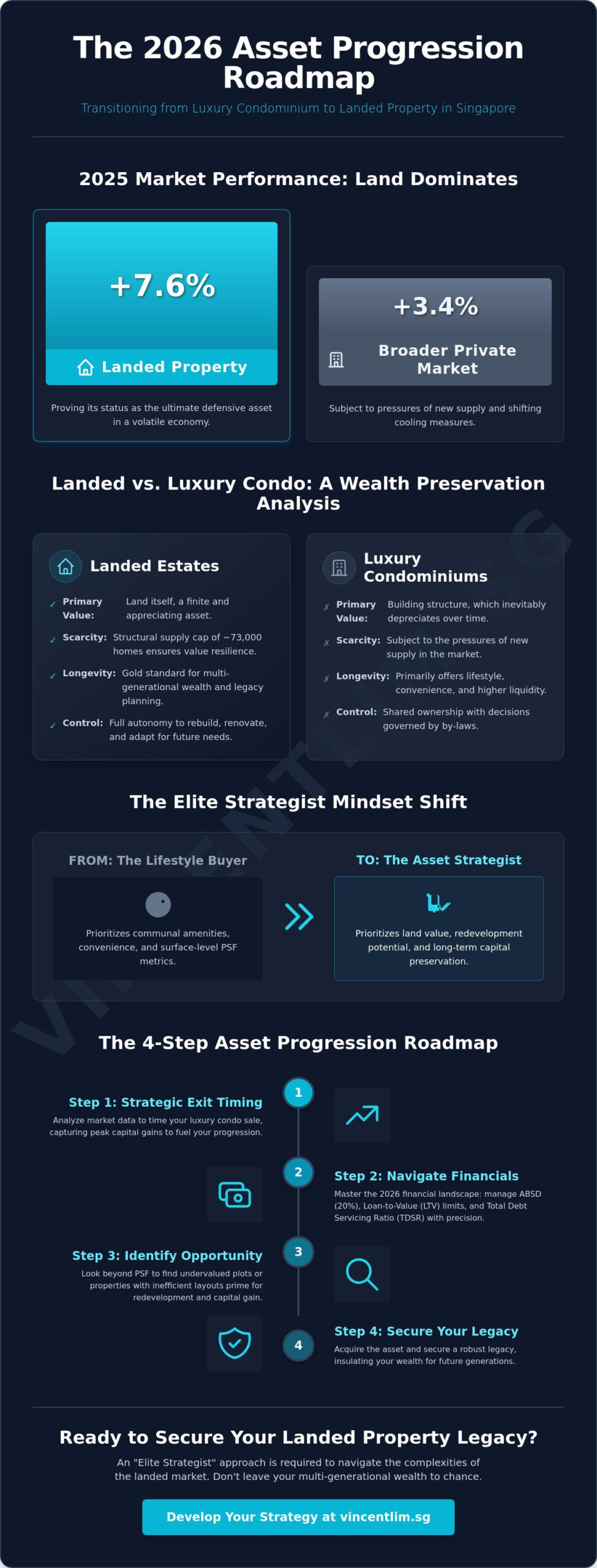
Landed vs. Luxury Condominiums: A Comparative Wealth Preservation Analysis
The decision to transition from a luxury condominium to a landed home often hinges on a fundamental shift in how you view control. In a high-end development, your influence is limited by the decisions of the Management Corporation Strata Title (MCST). As a landed owner, you possess absolute authority over the building’s facade, internal structure, and the timing of any major capital improvements. This autonomy is a cornerstone of the asset progression to landed property singapore, allowing you to manage your wealth without the constraints of communal consensus.
Many investors get caught in the “Price Per Square Foot” (PSF) trap. A luxury condo in a prime district might command a staggering PSF, but that value is heavily weighted toward the building’s premium finishes and communal facilities. These elements depreciate. In contrast, landed property focuses on the land quantum. While the PSF might appear lower on paper, the intrinsic value lies in the square footage of the plot itself. Land doesn’t wear out, and it doesn’t go out of style, making it a far more stable vessel for capital over long horizons.
Don’t let the myth of high maintenance costs deter you from making the move. While a detached house requires active management, you aren’t paying for the overhead of a massive security team or the upkeep of ten swimming pools you rarely use. Your expenditures are intentional and efficient. Every dollar spent on your roof, garden, or facade is a direct investment in your own asset’s value, rather than a non-recoverable monthly fee paid into a communal fund that covers shared areas you may never visit.
Wealth Preservation: The 10-Year Outlook
Looking at the URA Private Property Price Index over the last decade reveals a clear trend of landed assets consistently outpacing non-landed counterparts in long-term capital preservation. Landed homes serve as a powerful hedge against inflation because they represent only about 5% of Singapore’s total housing stock. This extreme scarcity ensures that demand from the global elite remains concentrated on a very small pool of available assets, driving sustained price resilience even during broader market corrections.
Operational Control and Redevelopment
One of the most significant advantages of land ownership is the ability to realize “en-bloc” value on your own terms. You don’t need an 80% majority vote to decide when to redevelop your property or unlock its latent value. This autonomy allows you to capitalize on shifting URA zoning regulations the moment they become favorable. When upgrading from condo to landed, you gain the flexibility to create a bespoke living environment that evolves with your family’s needs, securing both your lifestyle and your multi-generational legacy.
Navigating the Financial Mechanics of a Landed Property Acquisition
Precision in financial planning is what separates the elite strategist from the average buyer. When executing your asset progression to landed property singapore, you aren’t just managing a purchase; you’re coordinating a complex capital redeployment. The 2026 regulatory environment demands a high degree of discipline, particularly regarding the Total Debt Servicing Ratio (TDSR). With the TDSR capped at 55% of your gross monthly income, every existing liability, from car loans to credit lines, directly reduces your borrowing capacity for a multi-million dollar asset. Ensuring your debt profile is lean before application is essential to securing the 75% Loan-to-Value (LTV) limit allowed for your first residential mortgage.
Strategic use of your CPF funds is equally critical. While you can utilize your Ordinary Account (OA) for the purchase, you must account for the valuation gap. For older landed properties, bank valuations occasionally fall short of the agreed purchase price. Because CPF and bank loans only cover up to the lower of the purchase price or valuation, any “cash-over-valuation” must be settled in cash. A seasoned strategist maintains a liquid reserve to cover these contingencies, ensuring the transaction doesn’t stall due to a valuation shortfall.
Stamp Duty Strategies for 2026
Managing the Additional Buyer’s Stamp Duty (ABSD) is often the most significant hurdle for those with existing portfolios. For Singapore Citizens, the 20% ABSD on a second property represents a substantial capital outlay that doesn’t contribute to the asset’s equity. Permanent Residents face an even steeper 30% for their second acquisition. To mitigate this, many strategists utilize a ‘Sell-First, Buy-Later’ approach. By completing the sale of your luxury condominium before signing the Option to Purchase (OTP) for your landed home, you can qualify for the 0% ABSD rate as a Singapore Citizen. If you choose to buy before selling, you must follow a strict checklist to qualify for ABSD remission:
- The landed property must be purchased as a matrimonial home by a married couple.
- At least one spouse must be a Singapore Citizen.
- The first property must be sold within six months of the landed property’s TOP or purchase date.
Decoupling remains an option for some, though it’s increasingly complex under current scrutiny. Transferring a share of a property to a spouse to “free up” a name requires a full settlement of the existing mortgage and a fresh buyer’s stamp duty payment on the transferred share. You should calculate the total costs of decoupling against the potential ABSD savings to ensure the move is financially viable.
Financing the Redevelopment
If your strategy involves purchasing an older plot to build a bespoke residence, you’ll need to secure a construction loan. These facilities are structured differently from standard mortgages, often involving progressive disbursements as building milestones are met. Construction loans typically cover up to 75% of the total construction cost, subject to bank valuation. Managing cash flow during this phase is vital, as you’ll be servicing interest on the disbursed amounts while potentially paying for alternative housing. To ensure your financing structure is robust enough for a major project, speak with a specialist who can coordinate between your architects and lenders.
Legacy Planning: Securing Your Future with Vincent Lim’s Elite Strategist Approach
A landed home in Singapore is more than a residence; it’s the cornerstone of a multi-generational legacy. While condominiums serve as excellent vehicles for capital growth, the structural scarcity of land ensures that a freehold bungalow or terrace house remains the ultimate defensive asset for your family’s future. Achieving a successful asset progression to landed property singapore requires a transition from short-term market speculation to long-term wealth preservation. This journey, which begins with a rigorous audit of your luxury condominium portfolio, culminates in the acquisition of an asset that will appreciate across generations.
Identifying the right opportunity in the 2026 market demands more than just access to public listings. In the Good Class Bungalow (GCB) and luxury landed segments, the most valuable transactions often occur behind closed doors. A professional landed property specialist leverages a deep network to identify these off-market deals before they reach the open market. These undervalued assets, often held by long-term owners, provide the strategist with a unique entry point to manufacture equity through renovation or redevelopment. By securing land before it is broadly marketed, you avoid the premium often associated with competitive bidding wars.
The Vincent Lim Difference: Precision and Authority
Navigating the complexities of high-stakes real estate requires a partner with seasoned authority. With over 20 years of industry experience, Vincent Lim provides a white-glove service level that handles every facet of the progression journey. This includes meticulous financial modeling to ensure your TDSR and LTV limits are optimized, as well as aggressive negotiation to secure the best possible land quantum. The Elite Strategist approach is designed to minimize risk by providing transparency and calculated competence at every turn. You aren’t just hiring a service provider; you’re engaging a high-level partner who values integrity and your long-term success above all else.
Next Steps: Your Personal Asset Progression Audit
Mastering your real estate roadmap starts with a clear understanding of your current position. We invite you to a bespoke consultation where we will review your existing holdings and identify the most efficient path toward land ownership. This wealth planning session is grounded in hard data and strategic insight, providing you with a tailored plan that aligns with your financial goals and legacy aspirations. You’ll receive a comprehensive analysis of your investible surplus and a curated selection of assets that meet the criteria for high redevelopment potential. Don’t leave your portfolio’s growth to chance. Schedule your strategic property audit with Vincent Lim today to secure your place in Singapore’s most prestigious asset class.
Mastering Your Path to Landed Ownership in 2026
Landed property remains the gold standard for wealth preservation in Singapore due to its structural scarcity and inherent land value. Success in this segment requires a disciplined roadmap that balances capital gains from existing luxury assets with the technicalities of current financing regulations. By focusing on land quantum and redevelopment potential, you transform a residential purchase into a multi-generational legacy that withstands market volatility.
Navigating the nuances of asset progression to landed property singapore demands more than just capital; it requires a partner who understands the intricacies of off-market acquisitions and rigorous financial modeling. As an Executive Associate Director at OrangeTee & Tie with over 20 years of proven results, Vincent Lim specializes in Good Class Bungalows (GCB) and luxury landed estates. His Elite Strategist approach ensures that every transaction is handled with the precision and authority your portfolio deserves.
Secure your legacy with a bespoke Landed Property Strategy session with Vincent Lim. Your journey toward Singapore’s most prestigious asset class begins with a single, calculated step.
Frequently Asked Questions
Can a Singapore Permanent Resident (PR) buy landed property for asset progression?
Singapore Permanent Residents must obtain approval from the Land Dealings Approval Unit (LDAU) of the Singapore Land Authority before purchasing mainland landed property. Approval is generally granted to those who have made significant economic contributions to Singapore and is usually restricted to a single property for owner-occupation. Sentosa Cove remains the only location where PRs can purchase landed homes without prior LDAU approval.
How much cash downpayment is typically required for a S$5 million terrace house?
A minimum cash downpayment of S$250,000 is required for a S$5 million terrace house, representing 5% of the purchase price. The remaining 20% of the downpayment can be settled using CPF funds or additional cash. This calculation assumes you qualify for the maximum 75% Loan-to-Value (LTV) limit and that the bank valuation matches the purchase price exactly.
Is it better to buy a brand new landed home or an old one for redevelopment?
Strategists often prefer older properties for redevelopment because they allow you to manufacture equity by building a bespoke home on an undervalued plot. While brand new homes offer immediate move-in convenience, they often include a significant premium for the developer’s profit and architectural finishes. Buying an older asset focuses your capital on the land, which is the primary driver of long-term capital appreciation.
What is the difference between a Semi-Detached and a Corner Terrace in terms of progression value?
Semi-detached houses typically offer higher progression value due to larger land plots and the prestige of having only one shared wall. However, a corner terrace can occasionally offer similar land area at a more accessible entry price. The elite strategist evaluates the land-to-building ratio and frontage width rather than the classification alone to determine the true investment potential of the asset.
How does the ABSD remission work if I am upgrading from a condo to a landed property?
ABSD remission is available to married couples where at least one spouse is a Singapore Citizen, provided the first property is sold within six months of the landed property’s purchase date or TOP. This mechanism is vital for a smooth asset progression to landed property singapore, as it prevents your capital from being locked in taxes. You must pay the ABSD upfront and apply for a refund after the sale of your previous home is completed.
What are the common pitfalls to avoid when progressing to a landed asset in 2026?
A common pitfall in 2026 is underestimating the valuation gap between the purchase price and the bank’s assessment. If the valuation is lower than the price, you’ll need to cover the difference entirely in cash. Additionally, failing to account for rising construction costs or URA zoning restrictions can significantly impact the feasibility of a redevelopment strategy.
Can I use my CPF to pay for the monthly mortgage of a landed property?
You can use your CPF Ordinary Account (OA) funds to service the monthly mortgage of a landed property, subject to the Valuation Limit and Withdrawal Limit. It’s important to remember that using CPF involves an accrued interest of 2.5%, which must be refunded upon the eventual sale of the property. Many high-net-worth individuals choose to use cash for installments to preserve their CPF for retirement.
Is there a minimum land size requirement for a property to be classified as a Good Class Bungalow?
A property must have a minimum plot size of 1,400 square meters to be classified as a Good Class Bungalow (GCB). These elite assets are located within 39 designated GCB Areas and are restricted to Singapore Citizens only. The strict building height and site coverage requirements ensure these homes remain the pinnacle of privacy and prestige in the Singapore residential market.