Could your aging family home actually be worth more as a vacant plot than a standing structure? For many owners of landed assets, the true value isn’t found in the architecture, but in the latent potential of the soil beneath it. You’ve likely noticed that the 2026 property market rewards those who look past the facade to the redevelopment capacity of the site. However, the path to successfully selling a house for land value singapore is often clouded by technical complexities. It’s understandable to feel a sense of hesitation when facing the latest Land Betterment Charge (LBC) revisions or the intricacies of URA Envelope Control.
You deserve a clear, data-driven path that replaces uncertainty with a calculated strategy for your legacy. We’ll master the technical and financial variables that transform an aging landed house into a high-yield redevelopment asset. This framework clarifies the critical ROI differences between Additions & Alterations (A&A) and full reconstruction, while identifying sub-division potential that others might overlook. By the end of this guide, you’ll possess the elite insight required to maximize your teardown premium and secure a transaction that reflects the absolute highest and best use of your land.
Key Takeaways
- Identify the latent redevelopment potential that allows you to command a significant scarcity premium in the 2026 landed market.
- Navigate the technical nuances of URA Envelope Control and site topography to visualize the maximum permissible floor area for prospective buyers.
- Determine the precise financial tipping point between A&A and total reconstruction when selling a house for land value singapore to optimize your ROI.
- Master the due diligence process by accurately calculating the Land Betterment Charge and identifying hidden sub-division possibilities.
- Leverage the expertise of an elite strategist to mitigate technical risks and present your property as a high-yield redevelopment asset.
The Strategic Value of Selling a House for Land Value
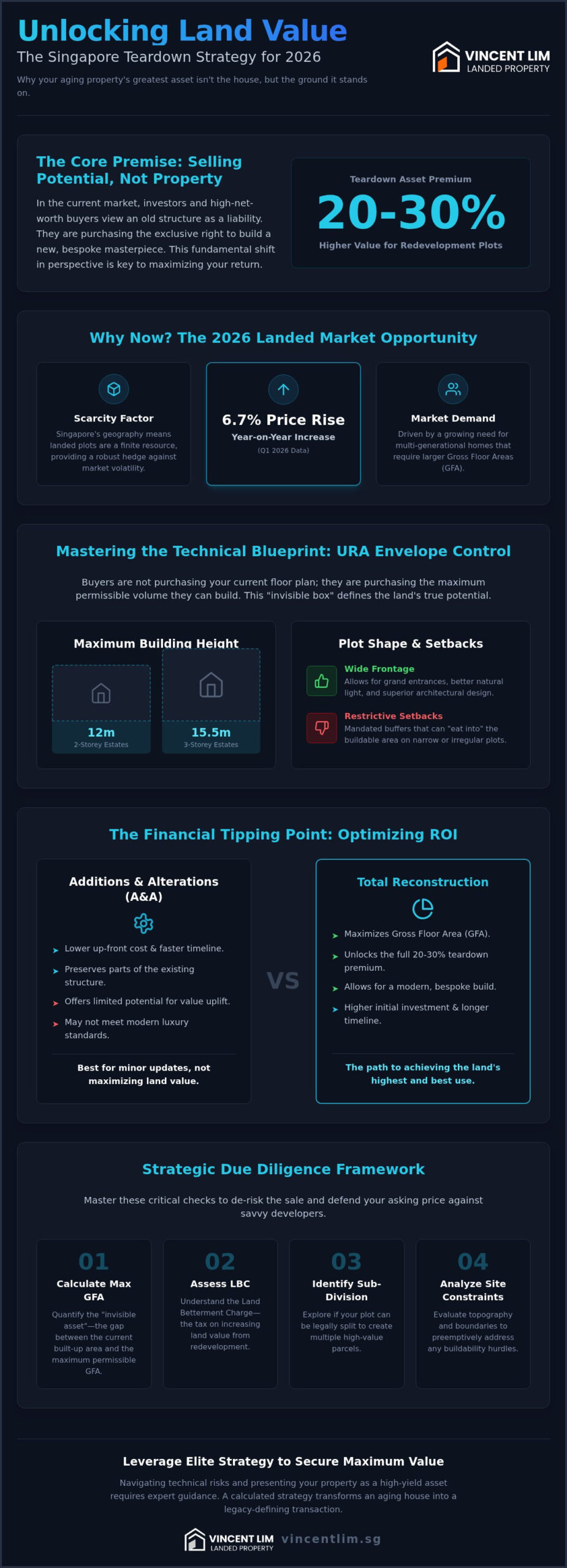
In the 2026 property climate, the most valuable component of a landed estate isn’t the architecture. It’s the dirt underneath. Many owners struggle to reconcile their emotional attachment to a family home with the reality that a developer or high-net-worth buyer views the building as a liability. When you’re selling a house for land value singapore, you’re pivoting from selling a residence to selling a development opportunity. This shift is essential because the market currently prizes “teardown” assets. Investors often pay a premium of 20% to 30% for these plots. They aren’t paying for the structure. They’re paying for the right to build a bespoke, modern masterpiece that meets today’s luxury standards.
Landed assets serve as a robust hedge against inflation and luxury market volatility. While high-rise prices may fluctuate based on cooling measures or global shifts, the inherent scarcity of land provides a reliable floor for your wealth. Owners who understand this dynamic can exit their positions with significantly higher yields than those who try to market an aging property as “move-in ready.” Successfully selling a house for land value singapore requires a sophisticated understanding of how to present this latent potential to the right buyer pool.
The Scarcity Factor in Singapore’s 2026 Market
Singapore’s geography dictates a fixed supply of landed plots. The foundation of Urban planning in Singapore ensures that these parcels remain the ultimate finite resource. As of the first quarter of 2026, landed property prices recorded a 6.7% year-on-year increase. This resilience exists because buyers increasingly seek multi-generational living solutions. They need larger Gross Floor Areas (GFA) that older houses simply don’t provide. Consequently, an old terrace or semi-detached house often outperforms a five-year-old “new build” in capital appreciation because the older property sits on land with untapped potential.
Quantifying the Invisible Asset
Redevelopment potential is the latent capacity of land to host a superior structure. To unlock this value, you must calculate the gap between the current built-up area and the maximum permissible GFA allowed under URA guidelines. This invisible asset acts as a price floor. Even if the broader market experiences a temporary dip, the redevelopment capacity ensures your property retains its elite status. Identifying this potential requires a technical lens. It’s about recognizing how site topography or a wider frontage can transform a standard plot into a high-yield asset for a savvy developer. You’re not just selling a home; you’re selling a future footprint.
Technical Determinants: Mastering URA Guidelines and Envelope Control
Success when selling a house for land value singapore depends on your ability to articulate the “invisible box” defined by the Urban Redevelopment Authority (URA). Prospective buyers are not purchasing your current floor plan; they are purchasing the maximum permissible volume they can inhabit. Since the URA updated its envelope control guidelines in August 2026, the focus has shifted from rigid storey counts to a more flexible, 3D volumetric approach. For properties in two-storey designated estates, the maximum height is 12 meters, while three-storey estates allow for 15.5 meters. Understanding these limits is crucial because every centimeter of height translates into luxury features like high ceilings or mezzanine levels that drive up the land’s premium.
Plot width and depth play equally decisive roles in determining a site’s redevelopment potential. A wide frontage allows for more grand entrances and better natural lighting, which are hallmarks of Singapore prime property buys. Conversely, deep but narrow plots may face restrictive setbacks that “eat” into the buildable area. These setbacks are invisible lines mandated by the URA to ensure privacy and fire safety. Identifying how these lines interact with your specific plot boundaries is the first step in defending your asking price against savvy developers who may try to undervalue the site based on perceived buildability hurdles.
Envelope Control Rules Explained for 2026
The 2026 framework has refined how we visualize the 3D volume of a plot. Unlike old regulations that penalized attic spaces, current guidelines allow for creative mezzanine floors that do not count as additional storeys if they stay within the envelope. This is particularly lucrative for terrace and semi-detached plots where space is at a premium. Additionally, the latest updates have streamlined the process for maximizing basement potential. If your land has a natural slope, you can often incorporate a “walk-out” basement that provides significant additional square footage without breaching height limits. Navigating these technical nuances is where a bespoke site analysis becomes an essential part of your sales strategy.
Site Attributes That Limit Buildability
Beyond the URA envelope, physical site constraints can act as hidden no-build zones. Drainage reserves and sewerage lines often run beneath older landed estates; these require specific clearances that can shrink your effective building footprint. Road line setbacks are another critical factor. If the authorities have plans for future road widening, a portion of your front garden might be “sterilized” for construction. However, topography can also work in your favor. High-ground plots command a significant premium because they naturally facilitate better drainage and offer unblocked views, factors that investors prioritize when looking for high-yield redevelopment assets. You must verify these details before the Option to Purchase (OTP) is even discussed.
The Financial Tipping Point: A&A vs. Total Reconstruction
When selling a house for land value singapore, the most frequent question from owners is whether to market the property as a renovation project or a total teardown. This decision hinges on a precise financial tipping point where the costs of preservation no longer justify the potential resale value. In 2026, buyers are increasingly sophisticated; they calculate the “all-in” cost of acquisition plus development before signing an OTP. If your property’s existing structure is sound but outdated, it might qualify for Additions & Alterations (A&A). However, you must navigate the “50% Rule” mandated by the URA. If proposed works replace or modify more than 50% of the existing gross floor area, external walls, or columns, the project is legally classified as reconstruction.
This classification is critical. Reconstruction triggers modern requirements for setbacks and height limits, which we analyzed through the lens of envelope control in the previous section. A brand new build in 2026 typically commands a significantly higher price per square foot on the resale market compared to a renovated older home. While the capital outlay for a new build is higher, the ROI often justifies the investment. For a standard new-build terrace or semi-detached house, construction costs currently range from S$280 to S$380 per square foot of GFA for mid-specifications, rising to S$700 for premium finishes. For GCB grade builds, these costs can exceed S$1,000 per square foot.
When A&A Makes Strategic Sense
A&A remains a viable strategy when the existing house possesses “grandfathered” attributes. Some older properties were built with setbacks that are more generous than current URA guidelines allow. By keeping the core structure, you preserve this non-conforming GFA that would be lost in a total reconstruction. This path also offers a timeline advantage. A typical A&A project can be completed much faster than a full build, which is a tangible asset for families looking for a quick move-in. Costs for A&A are generally 15% to 25% lower per square foot than new construction, typically ranging from S$300,000 to S$1.5 million depending on the scope.
The Case for Total Reconstruction
Total reconstruction is the preferred route for those aiming to maximize the site’s 3D envelope to its absolute limit. It allows for the integration of modern sustainable features like solar arrays and smart-home infrastructure that are difficult to retrofit into older frames. When selling a house for land value singapore, emphasizing the potential for a 50-year legacy home is a powerful selling point. A new build ensures that every square inch of the plot is optimized for the 2026 lifestyle, including high-ceilinged living areas and basement entertainment suites that define modern luxury. This approach creates a high-yield asset that appeals to the most discerning buyer pool.
Identifying Diamonds in the Rough: A Strategic Due Diligence Framework
Precision is the hallmark of a successful exit. When selling a house for land value singapore, your ability to provide a clean, verified technical profile of your plot can be the difference between a standard offer and a record-breaking premium. Savvy buyers in 2026 aren’t just looking at the land; they’re looking at the Land Betterment Charge (LBC). This tax, payable to the Singapore Land Authority when upgrading land use or increasing intensity, directly impacts a developer’s bottom line. With the LBC rate revisions scheduled for March 1 and September 1, 2026, timing your sale around these hikes is a critical strategic move. If you can prove that your land has significant untapped intensity with a manageable LBC liability, you hold the upper hand in negotiations.
Due diligence isn’t merely a hurdle for the buyer. It’s a marketing tool for the seller. By proactively identifying the “buildable” area, you remove the friction that often stalls high-stakes transactions. This involves looking beyond the fence line to the neighbor’s built-up height and the specific zoning of your street. A plot that allows for a three-storey build while surrounded by two-storey homes offers a rare privacy and sunlight advantage that developers will pay to secure. You’re effectively presenting a de-risked asset that’s ready for immediate redevelopment.
The Pre-Sale Checklist for Owners
Before listing your property, you must conduct a forensic examination of the site’s legal and technical standing. This goes beyond a simple valuation. Use these key pillars to build your data room:
- URA SPACE Verification: Confirm your property’s designation on the Landed Housing Area plan. A shift in zoning can overnight transform a terrace plot into a semi-detached opportunity.
- Title Deed Audit: Check for registered easements or encumbrances. A hidden drainage reserve or a right-of-way for a neighbor can significantly shrink the buildable footprint.
- Topographical Survey: Identify the “platform level” of your land. In Singapore’s undulating terrain, high-ground plots are prized for their natural drainage and superior views.
Sub-division: The Ultimate Value Play
The most lucrative strategy for owners of large plots is sub-division. If your detached house sits on a plot exceeding 400 square meters, you may be able to split it into two semi-detached units. This “two-for-one” play effectively doubles your exit value by appealing to a broader pool of buyers. Understanding the minimum plot sizes-200 square meters for semi-detached and 150 square meters for Terrace I-is essential for this calculation. This level of strategic planning is a core component of Asset progression to landed property singapore. When you’re selling a house for land value singapore, demonstrating this sub-division potential turns a single asset into a multi-unit development project. Schedule a comprehensive site potential audit to uncover the hidden yield in your land before you go to market.
Navigating High-Stakes Redevelopment with an Elite Strategist
High-stakes real estate transactions in Singapore’s landed market demand a level of precision that transcends traditional brokerage. Generalist agents often focus on aesthetic appeal or recent transaction prices, failing to identify the technical redevelopment hurdles that can stall a sale or lead to undervaluation. When selling a house for land value singapore, you need a partner who views the property through the lens of an urban planner. Vincent Lim (OrangeTee & Tie)’s methodology integrates two decades of industry experience with a rigorous analysis of technical URA guidelines, ensuring that every square foot of latent potential is accounted for in your asking price.
This white-glove acquisition and sale process is designed to provide peace of mind in a land-scarce environment. It’s about moving beyond the surface to coordinate complex tasks such as verifying drainage reserves or calculating the impact of 2026 LBC rate hikes. By acting as an elite strategist rather than just a service provider, Vincent Lim (OrangeTee & Tie) ensures that your property is positioned as a high-yield asset, attracting serious investors who value transparency and technical accuracy. This meticulous approach secures your legacy and facilitates long-term wealth planning through disciplined asset selection.
The Value of a Veteran Specialist
A veteran specialist provides more than just market data; they offer a gateway to off-market opportunities that are never visible to the public. Coordinating with a network of architects and surveyors during the due diligence phase ensures that no technical “blind spots” jeopardize the transaction. This level of coordination is particularly vital for high-value assets like a Detached house for sale singapore, where the difference between a standard plot and a subdividable site can represent millions in unrealized gains. Trusting a professional active since 2004 means you’re leveraging a gold standard of expertise refined through multiple market cycles.
Your Next Steps in Landed Asset Progression
As you refine your investment criteria for the remainder of 2026, the focus must remain on identifying sites with superior buildability and resilient capital growth potential. The journey toward maximizing your yield begins with a clear understanding of your property’s current standing within the URA framework. Whether you’re looking to exit a legacy home or acquire a new redevelopment plot, a bespoke site potential analysis is the first step toward a calculated and successful transaction. Consult with Vincent Lim (OrangeTee & Tie) for a strategic evaluation of your landed property potential. and take the first step toward refining your portfolio with an elite strategist.
Securing Your Legacy in a Land-Scarce Market
Securing a record-breaking exit in the 2026 market requires a fundamental shift from viewing your property as a home to seeing it as a high-yield development plot. We’ve explored how technical URA guidelines and calculated financial modeling serve as the true drivers of value. Successfully selling a house for land value singapore depends on your ability to articulate this latent potential to a sophisticated buyer pool. By identifying sub-division possibilities and timing your sale around Land Betterment Charge revisions, you position yourself at the peak of the market. Navigating these complexities alone often leads to unrealized gains.
With over 20 years of specialized experience in high-value landed transactions, I offer a methodical, data-driven approach that prioritizes your financial legacy. You’re entitled to a transaction that reflects the absolute highest and best use of your soil. Partner with an Elite Strategist for your next landed acquisition or sale to ensure your asset is refined with the precision it deserves. The path to a superior return is clear when you have the right technical insight guiding your journey.
Frequently Asked Questions
How do I check the redevelopment potential of my landed property?
You should begin by consulting the URA Master Plan via the URA SPACE portal to verify your property’s specific landed housing designation. This platform confirms if your plot is zoned for terrace, semi-detached, or bungalow use. Beyond zoning, you must assess site-specific factors like plot width, depth, and the presence of any drainage reserves. These technical attributes determine the maximum buildable volume and are essential for calculating your property’s true market worth.
What is the difference between A&A and Reconstruction in Singapore?
The distinction lies in the “50% Rule” mandated by the URA. Additions & Alterations (A&A) involve works that don’t replace or modify more than 50% of the existing gross floor area, external walls, or structural columns. If your renovation exceeds this threshold, it’s legally classified as Reconstruction. This classification is vital because Reconstruction requires the entire building to comply with the latest prevailing setbacks and envelope control height limits.
Can I rebuild a 2-storey terrace into a 3-storey house?
This depends entirely on the designated landed housing area plan for your specific street. If the URA has zoned your area for three-storey housing, you can certainly rebuild to that height. However, if you’re in a two-storey designated zone, your new build must remain within the 12-meter height limit. You can still incorporate a mezzanine or an attic, provided the total structure stays within the permissible 3D building envelope.
How much is the Land Betterment Charge (LBC) for redevelopment in 2026?
The LBC is not a fixed fee; it’s a tax on the increase in land value resulting from a development permit. Rates are revised twice yearly, with the 2026 revisions scheduled for March 1 and September 1. The exact amount depends on your property’s geographical sector and the specific “use group” change. Accurately projecting this cost is a critical step when selling a house for land value singapore to ensure your net proceeds are maximized.
What is the minimum plot size for sub-dividing a detached house?
To sub-divide a detached house into two smaller units, the original plot must be large enough to meet minimum size requirements for the new housing types. A detached house requires at least 400 square meters. If you intend to split it into two semi-detached plots, each new plot must be at least 200 square meters with a minimum width of 8 meters. These dimensions are strictly enforced to ensure adequate setbacks and fire safety.
Do I need URA approval for an attic extension?
Yes, URA approval is required for an attic extension as it typically involves an increase in gross floor area and changes to the building’s external profile. Under the 2026 envelope control guidelines, the attic must fit within the defined 3D volumetric limit. If the extension is part of a larger renovation, you must also ensure the works don’t inadvertently trigger the 50% threshold that would reclassify the project from A&A to a full reconstruction.
How does envelope control affect the height of my new home?
Envelope control regulates the maximum allowable building volume rather than just the number of storeys. For a two-storey designated house, the maximum height is 12 meters; for a three-storey house, it’s 15.5 meters. This framework allows for greater internal flexibility, such as higher ceilings or mezzanine levels, as long as the structure doesn’t breach the 3D “envelope.” It’s a more sophisticated approach that rewards clever architectural design while maintaining neighborhood character.
Is it better to buy a freehold or leasehold property for redevelopment?
Freehold properties are generally superior for redevelopment because they lack the “lease decay” that affects long-term capital appreciation. When selling a house for land value singapore, a freehold title acts as a significant value multiplier. Developers and high-net-worth buyers prefer freehold assets for legacy planning, as they can justify the high costs of a premium reconstruction without the pressure of a ticking lease clock. This title type offers the most resilient exit strategy.