A buyer’s agent isn’t the only route to buying luxury property in Singapore, but independent representation can offer market insight and negotiation support. Whether a buyer’s agent is necessary for luxury property depends on the guidance you want and who represents you during the transaction.
It’s reasonable to focus on finding the right home and negotiating a sound purchase. Just as important is knowing whose interests an agent represents: in Singapore, an agent cannot represent more than one party in the same property transaction.
This guide explains how an agent can support your search and negotiations, how buyer representation works, and what to consider before agreeing to an agency arrangement. It also outlines how a specialist in Singapore’s luxury and landed-property market can provide practical support, helping you approach a high-value purchase with greater clarity.
Key Takeaways
- Use comparable sales from the past three months to help assess an offer, and consider desktop valuations when relevant comparables are unavailable.
- Clarify who the agent represents and review the commission terms before signing an estate agency agreement.
- Use a buyer’s agent for market insight, negotiation support and help coordinating the purchase process.
- Match your search to the property type and the guidance you need, from luxury condominiums to landed homes.
Real estate professionals’ role in market insight and negotiations
An agent’s market knowledge can help you assess value, shape an offer and coordinate key purchase steps. Whether a buyer’s agent is necessary depends partly on the advice and representation you need.
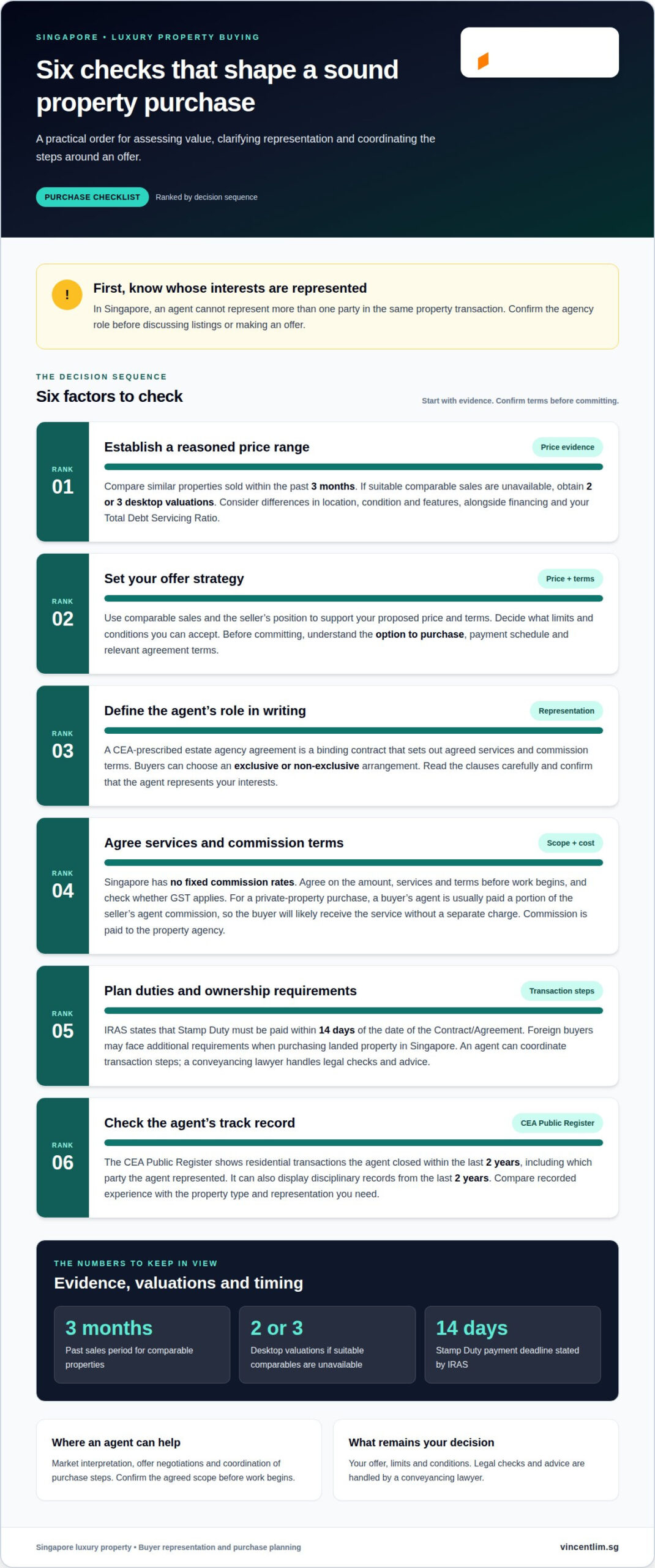
- Compare similar properties sold within the past three months before making an offer. If comparable sales are unavailable, obtain two or three desktop valuations to establish a reasoned price range. An agent can interpret differences in location, condition and features, then relate them to your priorities. Also consider financing and your Total Debt Servicing Ratio when estimating how much you can borrow.
-
Negotiate Offers
Set your offer strategy with the agent, using comparable sales and the seller’s position to support your proposed price and terms. Ask the agent to present the offer clearly and manage counteroffers, while you decide which limits and conditions you can accept. Before committing, understand the option to purchase, payment schedule and any agreement terms that affect your decision.
-
Review Agent Services and Charges
Agree on the agent’s services, commission amount and terms before work begins. Singapore has no fixed commission rates or prescribed guidelines for the amount an agent may charge; an agreed commission is payable to the property agency, and you should check whether GST applies. For a private-property purchase, a buyer’s agent is usually paid a portion of the seller’s agent commission, so the buyer will likely receive the service without a separate charge. Clarify what negotiation and transaction coordination involve.
- Plan for duties and ownership requirements before proceeding. IRAS states that Stamp Duty must be paid within 14 days of the date of the Contract/Agreement. Foreign buyers may face additional requirements when purchasing landed property in Singapore. An agent can coordinate transaction steps, while a conveyancing lawyer handles legal checks and advice.
Property agent representation and dual representation
- Identify whom the real estate agent represents before discussing listings or making an offer. In Singapore, an agent cannot represent more than one party in the same property transaction; doing so is an offence under the Estate Agents Act. This rule applies to private residential transactions, including executive residences. Clear representation helps you understand whose interests the agent is authorised to advance in negotiations.
- Use a written estate agency agreement to define the relationship. The Council for Estate Agencies (CEA) provides prescribed agreement templates that form binding contracts and set out agreed services and commission terms. Buyers can choose an exclusive or non-exclusive arrangement. Read every clause, especially the commission provisions, before signing so the agreed scope and payment obligations are clear.
- Clarify who pays the buyer’s agent commission before work begins. For a Singapore private-property purchase, the buyer’s agent is usually paid a portion of the commission received by the seller’s agent, so the buyer will likely receive the service without a separate charge. Commission rates aren’t fixed, so agree on the amount and terms. The agent’s commission is paid to the property agency, not directly to the agent.
- Use the CEA Public Register to review an agent’s registration and transaction record. It shows residential transactions the agent closed within the last two years and identifies which party the agent represented. It can also display disciplinary records from the last two years. Compare the agent’s recorded experience with the property type and representation you need, rather than relying on listings alone.
- Confirm representation again if the transaction structure changes. For example, if the seller’s agent also speaks with you directly, make sure the agency roles remain clear and that your own interests have independent representation. An exclusive seller agreement may require commission even when a property sells directly or through another agent. For a focused discussion of luxury property representation, consider the level of guidance your purchase requires.
Benefits of engaging a buyer’s agent
Decide what support your Singapore residential purchase requires before choosing representation. A buyer’s agent can provide market insight and negotiation assistance, while a direct purchase leaves those tasks to you.
- Compare the two approaches against your experience and available time. Buying directly can mean fewer parties to coordinate, but you’ll need to assess listings, negotiate with the seller’s representative and manage the transaction steps yourself. Engaging an agent adds professional support; clarify the agreed services and commission arrangement before work begins.
-
Compare Buying with an Agent or Directly
List the tasks you can confidently handle, such as reviewing resale listings or preparing an offer, then identify where an agent could add value. For a luxury condominium purchase, an agent can help interpret comparable transactions and shape negotiations around your priorities. If you buy directly, plan how you’ll coordinate the process and assess the seller’s position.
-
Consider Risks of Buying Without an Agent
Assess the risks of handling each stage yourself before proceeding without buyer representation. You may have less access to professional market interpretation and negotiation support, and could overlook a transaction step or misunderstand a contract term. A conveyancing lawyer can explain paperwork and legal requirements, but does not replace an agent’s market guidance or role in offer negotiations.
- Use an agent when the purchase calls for coordinated market and transaction support. In Singapore, property agents facilitating transactions must conduct customer due diligence under the Guide on Estate Agents (Prevention of Money Laundering, Proliferation Financing and Terrorism Financing) Regulations 2021. The agent’s process can help organise the transaction, while your lawyer handles legal checks and advice.
- Choose the arrangement that matches your capacity to manage the purchase. Registered real estate agents in Singapore are covered by Professional Indemnity Insurance, which relates to professional liability. It doesn’t remove the need to understand your contract, financing commitments or agreed agent services. If you proceed without an agent, have a trusted conveyancing lawyer guide you on paperwork and transaction matters.
What services does a buyer’s agent provide for luxury property buyers in Singapore?
- Define your brief with the agent before reviewing properties. Specify the property type, preferred locations, intended use and essential features. For example, a buyer seeking a private residence may prioritise privacy and layout, while an investor may focus on rental suitability. A clear brief helps the agent filter listings against your objectives instead of simply forwarding available properties.
- Ask the agent to identify and assess suitable listings. The agent can explain how a property’s location, configuration, condition and facilities relate to your priorities. For a luxury condominium, this could mean distinguishing between units with different outlooks or layouts. The agent can organise viewings and help you compare practical trade-offs among shortlisted homes.
- Use the agent to prepare for viewings and structure your evaluation. Discuss what matters most before each appointment, then record how each property meets your requirements. An agent can clarify property details with the seller’s representative and identify questions that need input from a conveyancing lawyer or another professional. This keeps market guidance separate from legal or technical advice.
- Develop an offer strategy with the agent before making an approach. The agent can communicate your proposed terms, handle counteroffers and coordinate responses with the seller’s representative. You decide your preferred price and conditions. Review the option to purchase and payment obligations with the relevant professionals so your offer strategy aligns with the transaction documents.
- Use the agent to coordinate the moving parts after an offer is accepted. This can include keeping communication organised between the parties and tracking transaction milestones, while your conveyancing lawyer conducts legal checks and advises on documents. For buyers considering a luxury condominium, discuss your property purchase priorities to shape a focused search and negotiation plan.
Vincent Lim (OrangeTee & Tie): Luxury Condominium Sales
Vincent Lim (OrangeTee & Tie) can be a relevant next step if you’re considering a luxury condominium in Singapore. His Luxury Condominium Sales offering connects your property search with a professional focused on luxury residences. Discuss the type of home you’re considering, your preferred location and the features that matter most. This helps frame a more focused conversation about the purchase and the property options that may suit your priorities.
If your search extends beyond condominiums, his services also include Terrace House Sales, Semi-Detached House Sales and Detached House Sales. Get in touch when you’re ready to discuss a specific property type or refine your buying priorities. Contact Vincent Lim (OrangeTee & Tie) to discuss your luxury property search.
Set your next purchase up with clarity
Whether a buyer’s agent is necessary for a luxury property purchase depends on the market guidance and transaction coordination you want. Before engaging representation, define your priorities: property type, location, intended use and the decisions where you want professional input. This gives the conversation a clear focus and helps you assess how an agent’s role should fit your purchase. It also gives you a practical basis for deciding what matters most in your search.
For Singapore buyers considering landed homes, Vincent Lim (OrangeTee & Tie) offers Terrace House Sales, Semi-Detached House Sales and Detached house sales. These offerings may suit buyers whose search extends beyond condominiums to landed property. Take time to shape your requirements and consider the level of support you want throughout the purchase. Contact Vincent Lim (OrangeTee & Tie) to discuss your property requirements and the representation that suits your next step. A clear plan can help you approach your search with confidence.
Frequently Asked Questions
Do Homebuyers Need a Real Estate Agent to Purchase a House?
No, Singapore does not require homebuyers to engage an agent to buy an HDB flat. For other property purchases, weigh the support you need against the work you’re prepared to manage. Buying directly, for example, means coordinating discussions with the seller and arranging professional help with legal paperwork. A conveyancing lawyer can advise on transaction documents, while an agent provides market and negotiation support.
Doesn’t it make sense to just skip the middleman?
Buying directly can make sense if you’re comfortable managing the search, discussions and transaction coordination yourself. But an agent isn’t simply an extra party: their value lies in the work they do for you. If you’re comparing several properties, for example, an agent can help organise the options and shape your offer strategy. Decide based on the support you need, not the label “middleman.”
Is an agent necessary for me to find and buy a house?
An agent isn’t essential for every buyer. Consider your familiarity with the property type, the time you have to manage viewings and your confidence in handling negotiations. If you can assess the options and coordinate the process, you may prefer to proceed directly while still using a conveyancing lawyer for legal advice. If you want help interpreting the market or managing offer discussions, an agent can provide that support.
Is a buyer’s agent necessary when buying luxury property in Singapore?
A buyer’s agent isn’t mandatory simply because a property is luxurious. Whether a buyer’s agent is necessary for luxury property depends on your need for independent market guidance, offer support and help coordinating a high-value purchase. A buyer experienced with the property type may choose to manage the search directly. Someone entering an unfamiliar segment may value an agent’s focused perspective and transaction support.
How can a buyer’s agent help negotiate prices for Singapore luxury homes?
A buyer’s agent can help you frame an offer and manage discussions with the seller’s representative. Beyond price, consider how your proposed conditions and timing fit your priorities. For instance, you might prefer a particular completion schedule or need clarity about items included in the sale. The agent can communicate those points and handle counteroffers, while you decide which terms you’re willing to accept.