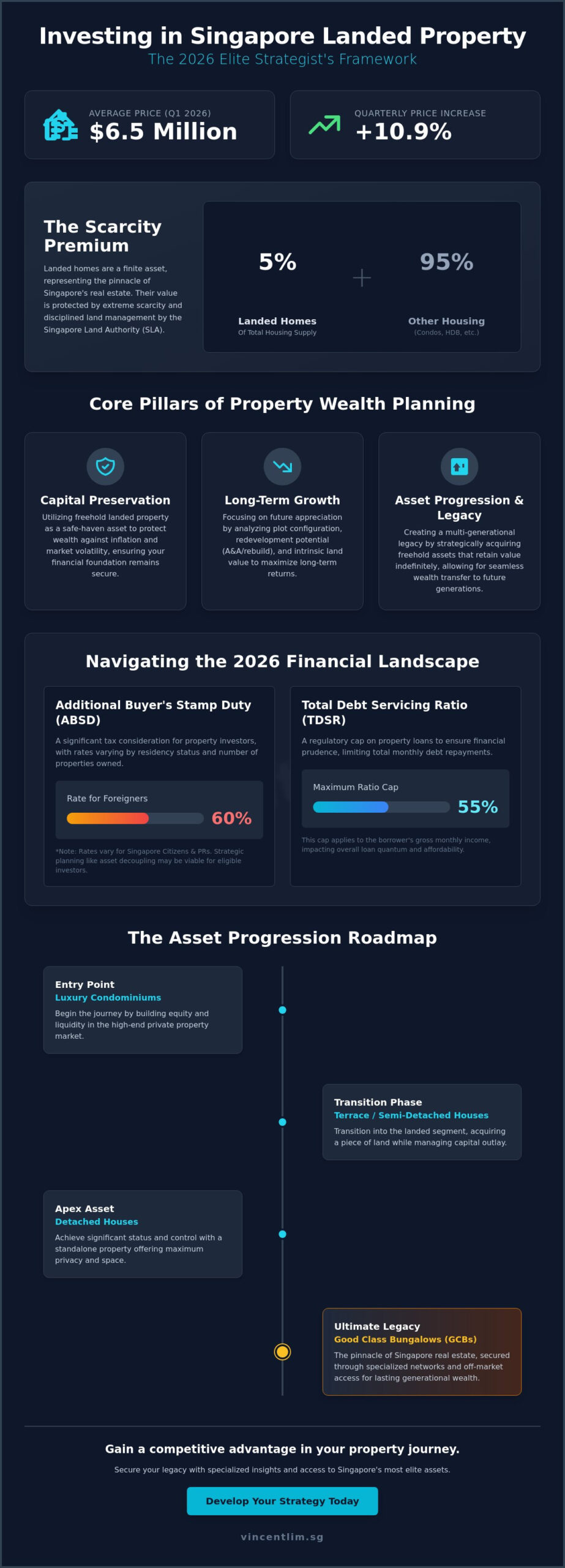
While transaction volumes saw a seasonal dip in early 2026, the average price of a landed home in Singapore climbed to $6.5 million, a 10.9% increase in just one quarter. You likely recognize that acquiring such a rare asset is no longer just a lifestyle choice. It’s a high-stakes financial maneuver where the margin for error is increasingly thin. You’re likely feeling the pressure of the 60% ABSD for foreigners or the scarcity of prime freehold plots, making the entry barriers feel higher than ever.
I understand the weight of these decisions when you’re focused on capital preservation and long-term legacy building. This guide offers a clear roadmap for investing in singapore landed property using an elite strategist’s framework to manage complex regulations and tax structures. We’ll examine the 2026 landscape of Buyer’s Stamp Duty rates, the 55% TDSR cap, and the specific wealth planning advantages of high-potential assets like Good Class Bungalows. You’ll gain the precise insights needed to transition from a cautious observer to a confident owner of Singapore’s most prestigious real estate.
Key Takeaways
- Understand why landed homes remain a premier safe-haven asset, representing a finite 5% of Singapore’s total housing supply.
- Identify the three strategic pillars of property wealth planning to ensure your portfolio prioritizes capital preservation and long-term legacy building.
- Master the technical criteria for investing in singapore landed property by analyzing how plot configuration and land value influence future appreciation.
- Explore the 2026 financial landscape with precise insights into current ABSD rates and the strategic viability of asset decoupling.
- Gain a competitive advantage through off-market access and the specialized networking required to secure elite assets like Good Class Bungalows.
The Strategic Appeal of Investing in Singapore Landed Property in 2026
Landed property represents the pinnacle of Singapore’s real estate hierarchy. It isn’t just about the physical structure; it’s about the exclusive ownership of the land itself. In a city-state where land is the most precious resource, this asset class accounts for only about 5% of the total housing stock. This extreme scarcity creates a natural price floor that few other investments can match. While luxury condominiums are often subject to market fluctuations driven by new project launches and cooling measures, landed homes have historically shown a more consistent upward trajectory. For those considering investing in singapore landed property, the primary draw is this structural imbalance between stagnant supply and growing demand.
The global economy in 2026 continues to face pockets of volatility, reinforcing Singapore’s status as a premier safe haven for capital. Landed assets, specifically Detached houses and Good Class Bungalows, serve as a defensive hedge against inflation and currency instability. The Singapore Land Authority (SLA) maintains a disciplined approach to land management, ensuring that residential zones are protected and supply remains tightly controlled. This regulatory environment provides investors with peace of mind, knowing their asset’s value isn’t threatened by sudden oversupply in their immediate vicinity.
Understanding the Scarcity Premium
The URA Master Plan rarely designates new areas for landed housing, focusing instead on high-density developments to accommodate a growing population. This policy means that the number of Terrace houses, Semi-Detached houses, and Detached plots is effectively capped. This limited supply translates directly into resilient capital preservation. In the current market, we define the scarcity premium as the inherent value added to a property simply because it’s impossible to manufacture more land within Singapore’s borders. Owners aren’t just buying a home; they’re acquiring a piece of a finite map.
Landed Property as a Multi-Generational Asset
Legacy planning is at the heart of most landed transactions in 2026. Unlike 99-year leasehold properties that face lease decay and financing restrictions as they age, freehold land retains its value across generations. This makes investing in singapore landed property a core strategy for families looking to build multi-generational wealth. There’s a profound emotional and social prestige attached to a family estate that can be passed down without the looming expiration of a leasehold title. It’s a tangible legacy that provides both financial security and a permanent sense of place for future descendants.
Core Pillars of Property Wealth Planning Singapore
Property wealth planning is a sophisticated methodology designed to optimize a real estate portfolio for long-term growth and stability. It moves beyond the basic transactional mindset of buying and selling; instead, it treats real estate as a strategic financial instrument. When investing in singapore landed property, this framework becomes essential for navigating a high-stakes environment. A well-structured plan rests on three fundamental pillars: capital preservation, yield optimization, and asset progression. By aligning these pillars, you ensure that your property isn’t just a residence, but a performing asset that anchors your entire financial legacy.
The role of landed property as an “anchor” cannot be overstated. While other asset classes may offer higher short-term volatility, the inherent scarcity of land in Singapore provides a unique level of stability. Success in this arena depends heavily on market timing and the precision of your entry price. Buying at the right point in the cycle ensures that your long-term ROI remains robust, even after accounting for the significant Additional Buyer’s Stamp Duty (ABSD) rates that apply to multiple property owners. A disciplined approach to entry prices prevents the erosion of equity that can occur when investors overpay during periods of market euphoria.
The Asset Progression Roadmap
Most investors don’t leap directly into the highest tier of the market. They follow a calculated journey, often starting with luxury condominiums before transitioning into Terrace Houses or Semi-Detached Houses. This middle stage is critical for maintaining liquidity while building the necessary equity for a Detached house or a Good Class Bungalow. If you’re currently holding a high-end apartment, you should examine the strategic steps for upgrading from condo to landed to understand how to time your exit and entry for maximum gain.
Risk Management in Landed Investments
Strategic risk management is paramount when dealing with the high-quantum loans associated with investing in singapore landed property. You must account for interest rate cycles and their impact on your monthly debt obligations. Diversification within your property holdings, such as balancing a residential Detached house with commercial assets, can provide a hedge against sector-specific downturns. It’s also vital to maintain a “holding power” buffer. This financial reserve ensures you can withstand temporary economic shifts without being forced into a premature sale, allowing your land to appreciate over the decades as intended. You might find it beneficial to consult with a specialist to stress-test your portfolio against various market scenarios.
Evaluating Investment Potential: Land Size, Tenure, and Redevelopment
Evaluating the technical merits of a plot requires a disciplined eye and a deep understanding of urban planning guidelines. When investing in singapore landed property, you must prioritize the configuration of the land. Regular shapes, such as rectangular or square plots, facilitate efficient architectural design and maximize the usable built-up area. Conversely, irregular or “wedge-shaped” plots often result in significant setbacks and wasted space, which can diminish the overall redevelopment potential. Soil value is the true driver of long-term wealth in this sector. In many older properties, the existing structure has depreciated significantly; the real value lies in the soil and the potential to transform the site into a modern residence. Understanding how to accurately assess landed property redevelopment potential through URA envelope control rules and financial feasibility analysis is essential before committing to any acquisition.
Redevelopment potential is particularly lucrative in the terrace house segment. Many investors target older, single or double-storey units with the intention of rebuilding them into three-storey modern homes with attics and basement car parks. This strategy effectively triples the floor area, significantly increasing the property’s market value. If you’re exploring this asset class, you can find specific acquisition tips in this guide to terrace house for sale singapore. By focusing on the land’s intrinsic qualities rather than its current aesthetics, you position yourself for substantial capital gains.
Freehold vs. Leasehold: The 2026 Perspective
Tenure choice is a cornerstone of legacy planning. In 2026, the price gap between freehold/999-year leasehold and 99-year leasehold properties continues to widen as buyers become more sensitive to lease decay. High-net-worth individuals consistently prioritize freehold assets because they don’t face the financing restrictions or value plateaus associated with aging leases. Industry data indicates that freehold assets typically command a 15% to 20% premium over their leasehold counterparts. This premium is a small price to pay for an asset that serves as a permanent vessel for family wealth.
The GCB Factor: The Pinnacle of Landed Investment
The Good Class Bungalow (GCB) remains the absolute pinnacle of investing in singapore landed property. To qualify as a GCB, a property must be located within one of the 39 designated GCB areas and possess a minimum land area of 1,400 square meters. These assets are incredibly resilient during economic downturns due to their extreme scarcity and the high financial caliber of their owners. For those looking to understand the nuances of these elite estates, our detailed guide on detached house for sale singapore provides deeper insights into acquisition and legacy planning for the most prestigious plots in the Core Central Region.
Navigating Financial Complexity: ABSD and Financing Strategies
Mastering the financial architecture of a high-value acquisition is as critical as selecting the right plot. In 2026, the Additional Buyer’s Stamp Duty (ABSD) remains a primary consideration for anyone investing in singapore landed property. Singapore Citizens currently face a 20% ABSD on their second residential property and 30% on subsequent purchases. For Permanent Residents, the rates are 5% for the first home and a steep 30% for the second. These figures represent significant upfront capital outlays that must be factored into your total cost of acquisition. To mitigate these costs, many savvy couples employ a “decoupling” strategy, where one party transfers their share to the other to free up a name for a new purchase. While legal, this requires careful navigation of the Seller’s Stamp Duty and existing mortgage terms.
Financing a landed home involves more stringent criteria than the condominium market. The Loan-to-Value (LTV) limit for a first housing loan is capped at 75%, but the high quantum of landed assets means the remaining 25% downpayment often runs into millions. The Total Debt Servicing Ratio (TDSR) is strictly maintained at 55% of your gross monthly income. Banks are required to use a 4% interest rate stress test to calculate your eligibility, ensuring you have sufficient liquidity to manage potential rate hikes. Trust structures have also become more complex. Trustees now face a 65% ABSD rate upfront, subject to specific remission conditions. You can secure a strategic financial consultation to evaluate which structure best aligns with your long-term wealth objectives.
Eligibility and Regulatory Hurdles
Permanent Residents must obtain approval from the Land Dealings (Approval) Unit (LDAU) of the Singapore Land Authority before investing in singapore landed property. This process is rigorous. It typically requires the applicant to have been a PR for at least five years and demonstrate an exceptional economic contribution to Singapore. Foreigners are generally restricted from buying landed homes on the mainland. Sentosa Cove remains the only exception where they can acquire Detached houses. A PR application checklist should include:
- Proof of at least five years of Permanent Residency.
- Detailed record of professional and economic contributions.
- A signed declaration that the property is for owner-occupation only.
Tax Planning for Landed Homeowners
Holding a landed asset requires an ongoing strategy for managing property taxes. Owner-occupied rates are significantly lower than non-owner-occupied rates. However, the Annual Value (AV) of landed homes is often revised upwards due to rising market rents. For Detached houses and Semi-Detached houses, these AV revisions can lead to substantial annual tax bills. It’s prudent to maintain a dedicated sinking fund to cover these recurring costs. This ensures your cash flow remains healthy even as the property’s paper value appreciates. Effective tax planning prevents your legacy asset from becoming a liquidity burden during periods of economic transition.
Securing Your Legacy with a Landed Property Specialist
Navigating the upper echelons of the real estate market requires more than just capital; it demands access. When investing in singapore landed property, many of the most desirable assets never reach public portals. High-net-worth sellers prioritize privacy, meaning Terrace Houses, Semi-Detached Houses, and especially Good Class Bungalows are often traded through “silent” listings. Securing these opportunities depends on deep industry networking and a reputation for handling high-stakes transactions with discretion. A specialist acts as your eyes and ears, identifying off-market gems that align with your specific wealth preservation goals. Understanding what separates a true strategist from a generalist salesperson is critical, and our guide on finding the best landed property agent explains precisely why the elite strategist approach delivers superior outcomes in 2026.
Vincent Lim serves as an elite strategist for clients who demand a white-glove approach to acquisition. With over 20 years of experience in the luxury market, he provides a level of seasoned authority that ensures your interests are protected at every turn. His affiliation with OrangeTee & Tie grants him access to robust market data and a vast network, allowing him to refine searches with surgical precision. This isn’t merely about finding a house; it’s about coordinating a complex asset acquisition that serves as a cornerstone of your family’s legacy.
The Vincent Lim Advantage
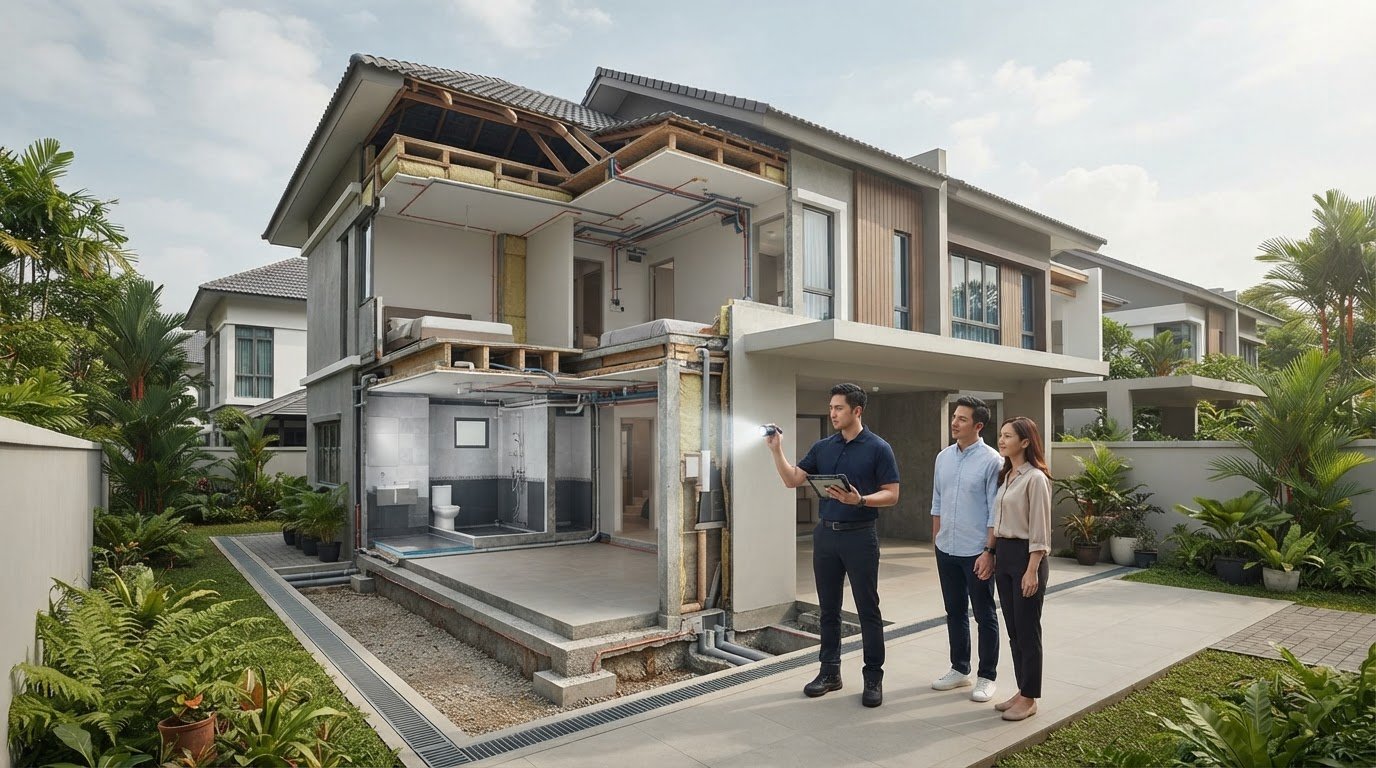
Success in the GCB and luxury Detached house segments requires a bespoke strategy. Vincent’s track record includes managing some of Singapore’s most prestigious addresses, where he matches discerning buyers with exclusive properties that aren’t visible to the general public. He conducts thorough professional valuations and utilizes a disciplined process for detecting hidden defects. This meticulous attention to detail ensures that the built-up quality matches the intrinsic value of the land, providing you with absolute peace of mind before you commit to a multi-million dollar investment.
Next Steps in Your Wealth Journey
The 2026 market presents unique opportunities for those who know where to look. Identifying undervalued landed assets requires a proactive approach and a clear understanding of current urban planning shifts. We invite you to begin your journey by scheduling a private wealth planning consultation. During this session, we’ll analyze your current portfolio and identify strategic entry points that prioritize capital growth and intergenerational transfer. Consult with Vincent Lim on your property wealth plan today to ensure your next move is as calculated as it is successful.
Mastering Your Property Wealth Strategy
The 2026 landscape for investing in singapore landed property requires a blend of technical precision and financial foresight. You’ve seen how the extreme scarcity of land, comprising only 5% of Singapore’s housing stock, creates an unparalleled foundation for capital preservation. Success in this elite market depends on more than just identifying a plot. It requires navigating the 55% TDSR cap and optimizing your portfolio against current ABSD rates to ensure long-term viability. By prioritizing freehold assets and redevelopment potential, you transform a residential purchase into a resilient multi-generational legacy.
As an Executive Associate Director at OrangeTee & Tie with over 20 years of experience, I specialize in the strategic acquisition of Good Class Bungalows and luxury detached homes. My bespoke approach ensures you gain access to the off-market opportunities that define the pinnacle of Singapore real estate. I invite you to take the next step in your wealth journey with a partner committed to your success. Secure your legacy—Partner with Singapore’s elite landed property specialist. Your journey toward a refined and protected property portfolio starts with a single, strategic decision.
Frequently Asked Questions
Can a Singapore PR buy a landed property for investment?
Singapore Permanent Residents must obtain approval from the Land Dealings (Approval) Unit (LDAU) before they can acquire landed residential property. This approval is typically granted only for properties intended for owner-occupation. Purchasing a landed home purely for rental yield or speculative investment is generally restricted for PRs, as the government prioritizes these assets for those with significant economic contributions who intend to make Singapore their primary home.
Is investing in a terrace house better than a luxury condo in 2026?
Terrace houses offer superior long-term capital preservation because you own the underlying land, which accounts for only 5% of Singapore’s housing stock. While luxury condominiums may provide higher rental yields, they often face lease decay and competition from new launches. When investing in singapore landed property, the scarcity of the asset class provides a price resilience that high-rise developments rarely match over a ten-year horizon.
What is the minimum land size required for a Good Class Bungalow (GCB)?
A Good Class Bungalow must have a minimum land plot size of 1,400 square meters, or approximately 15,070 square feet. Additionally, these properties must be located within one of the 39 designated GCB areas specified by the Urban Redevelopment Authority. These strict criteria ensure that GCBs remain the most exclusive and prestigious tier of real estate in the city-state.
How does ABSD affect my property wealth planning strategy?
Additional Buyer’s Stamp Duty (ABSD) acts as a significant entry barrier that requires a precise capital allocation strategy. For instance, a Singapore Citizen buying their second property faces a 20% tax, which necessitates a longer holding period to break even. Wealth planning involves evaluating structures like decoupling or legal trusts to manage these upfront costs while ensuring your portfolio remains compliant with 2026 regulatory standards.
Are freehold landed properties always better than leasehold for investment?
Freehold properties are preferred for legacy planning because they don’t suffer from lease decay or financing restrictions as the building ages. In early 2026, freehold landed homes averaged $2,223 psf, reflecting a significant premium over the $1,554 psf seen in 99-year leasehold plots. While leasehold units might offer a lower entry point, they’re less effective for multi-generational wealth transfer.
What are the hidden costs of owning a detached house in Singapore?
Ownership costs extend beyond the initial purchase price to include substantial property taxes and maintenance. Property tax is calculated based on the Annual Value (AV) of the home, which can be high for large detached houses. You should also account for recurring costs such as landscaping, pest control, and structural upkeep, which are significantly higher than the monthly maintenance fees found in luxury condominiums.
How do I identify a landed property with high redevelopment potential?
Focus on the plot’s configuration and the URA Master Plan’s zoning for the area. Regular, rectangular plots are easier to rebuild into modern, three-storey structures with attics, which maximizes the built-up area. Properties with wide frontages and a level topography also command higher redevelopment premiums because they offer greater architectural flexibility and lower construction costs. For a comprehensive framework on evaluating these factors, our guide on maximizing landed property redevelopment potential covers the precise URA guidelines and financial feasibility steps you need to apply.
Why should I use a specialized landed property agent instead of a generalist?
Landed transactions involve technical complexities regarding land titles, setbacks, and drainage reserves that generalists may overlook. A specialist provides access to “silent” listings and off-market GCBs that aren’t available to the public. When investing in singapore landed property, having an elite strategist ensures you receive accurate valuations and a disciplined analysis of a plot’s true redevelopment potential. To understand the full scope of what distinguishes a true expert from a generalist, our detailed breakdown of what makes the best landed property agent in 2026 reveals the precise criteria you should use when selecting your acquisition partner.