In the 2026 market, a terrace house is far more than a residence; it’s a strategic land-banking asset that requires a disciplined and calculated approach to acquisition. You’ve likely noticed that securing a prestigious landed home has become increasingly complex, especially with entry-level prices for a terrace house for sale singapore now approaching the S$5 million mark. Navigating the 55% TDSR limit and the nuanced ABSD rates, which remain at 0% for a Singapore Citizen’s first property, can feel like a daunting task even for the most seasoned investor.
I will provide you with an elite strategist’s perspective to help you master these nuances, ensuring you select a property that offers both a refined lifestyle and exceptional land value. We’ll examine the specific financial implications of landed ownership in 2026, from calculating the progressive Buyer’s Stamp Duty to identifying the technical attributes that signal true redevelopment potential. By prioritizing plot quality over interior aesthetics, you can transform a high-stakes transaction into a cornerstone of your family’s multi-generational wealth.
Key Takeaways
- Learn to distinguish between Inter-Terrace and Corner Terrace classifications to align your acquisition with specific SLA regulatory requirements.
- Evaluate the “Land Value” to “Total Price” ratio to ensure your property functions as a high-growth asset rather than just a residence.
- Master the 2026 financial landscape, including updated ABSD and LTV limits, to streamline your search for a terrace house for sale singapore.
- Execute a disciplined acquisition strategy that prioritizes rigorous title searches and land surveys to uncover a property’s true redevelopment potential.
- Identify why a specialized, strategist-led approach is vital for mitigating risks and securing premium landed assets in a competitive market.
Understanding the Terrace House Landscape in Singapore
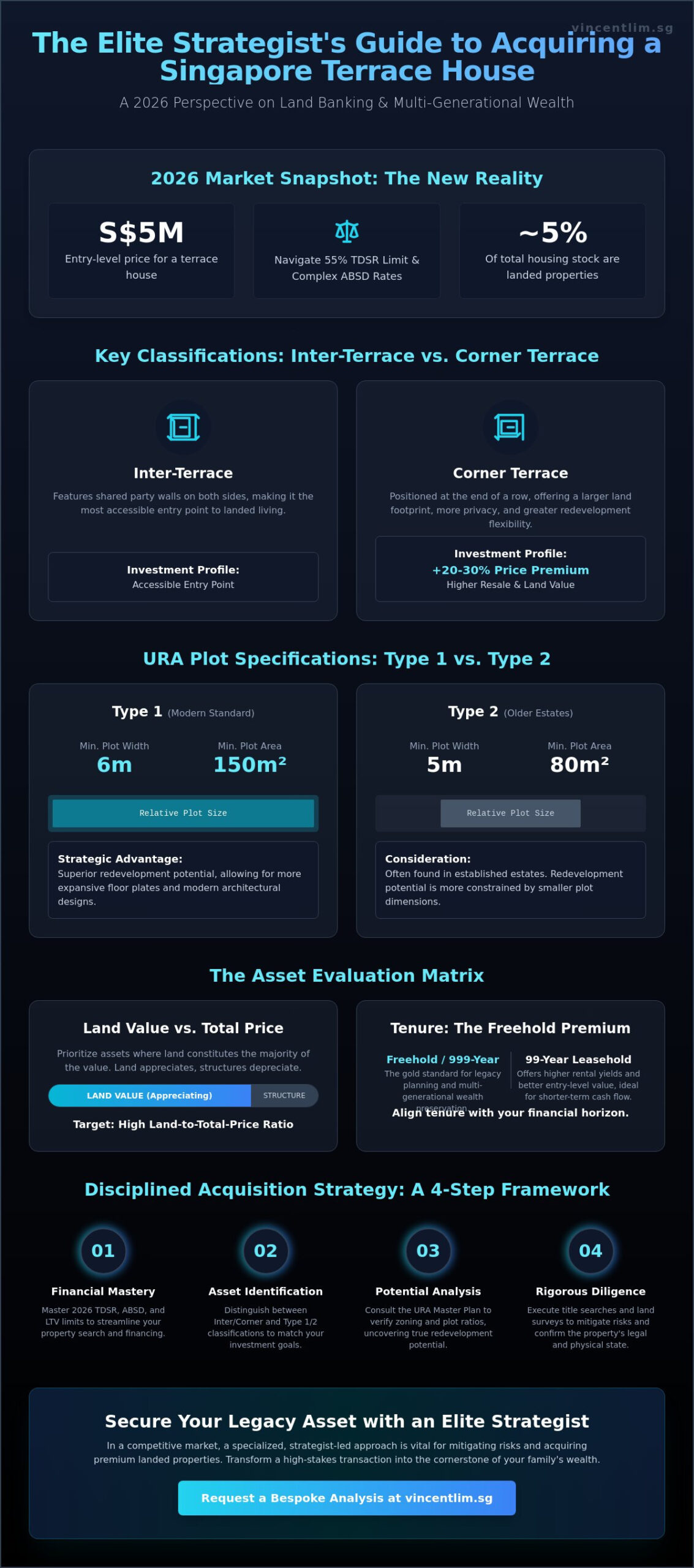
The Terraced house is a cornerstone of Singapore’s residential heritage, evolving from colonial-era rows into high-value modern assets. In a nation where land is the ultimate finite resource, landed properties represent only about 5% of the total housing stock. This inherent scarcity ensures that any terrace house for sale singapore remains a highly sought-after commodity for affluent families and strategic investors alike. The Singapore Land Authority (SLA) and URA maintain strict classifications to preserve the character of these neighborhoods, ensuring your investment is protected by a robust regulatory framework. While the government has committed to releasing land for 25,000 new private homes through 2027, the proportion of new landed supply remains exceptionally low, reinforcing the “flight to quality” trend observed in the 2026 market.
Inter-Terrace vs. Corner Terrace: Architectural and Investment Differences
Selecting between an inter-terrace and a corner terrace involves a choice between entry-level accessibility and premium land value. An inter-terrace property features shared walls on both sides, making it the most accessible entry point for those transitioning from high-end condominiums. Conversely, corner terraces sit at the end of a row, offering a larger land footprint and significantly more privacy. These corner units often command a 20-30% premium because they provide greater flexibility for architectural expression and redevelopment. When you evaluate a terrace house for sale singapore, consider that the extra land on a corner plot isn’t just for garden space; it’s a strategic buffer that enhances the property’s future resale value and redevelopment potential.
Terrace House Type 1 and Type 2 Classifications
Understanding URA guidelines regarding Type 1 and Type 2 classifications is essential for assessing a property’s true ceiling. Type 1 terrace houses are the standard for modern landed living, requiring a minimum plot width of 6 meters and an area of 150 square meters for inter-units. Type 2 houses, which are often found in older estates, have smaller minimum requirements, such as a 5-meter width and 80-square-meter plot. This distinction is critical for your long-term exit strategy. A Type 1 plot offers superior redevelopment potential, allowing for more expansive floor plates and higher ceiling volumes during a total reconstruction. Choosing the right classification ensures the home can adapt to your family’s multi-generational needs while maintaining a competitive edge in the secondary market.
Evaluating Asset Quality: Tenure and Redevelopment Potential
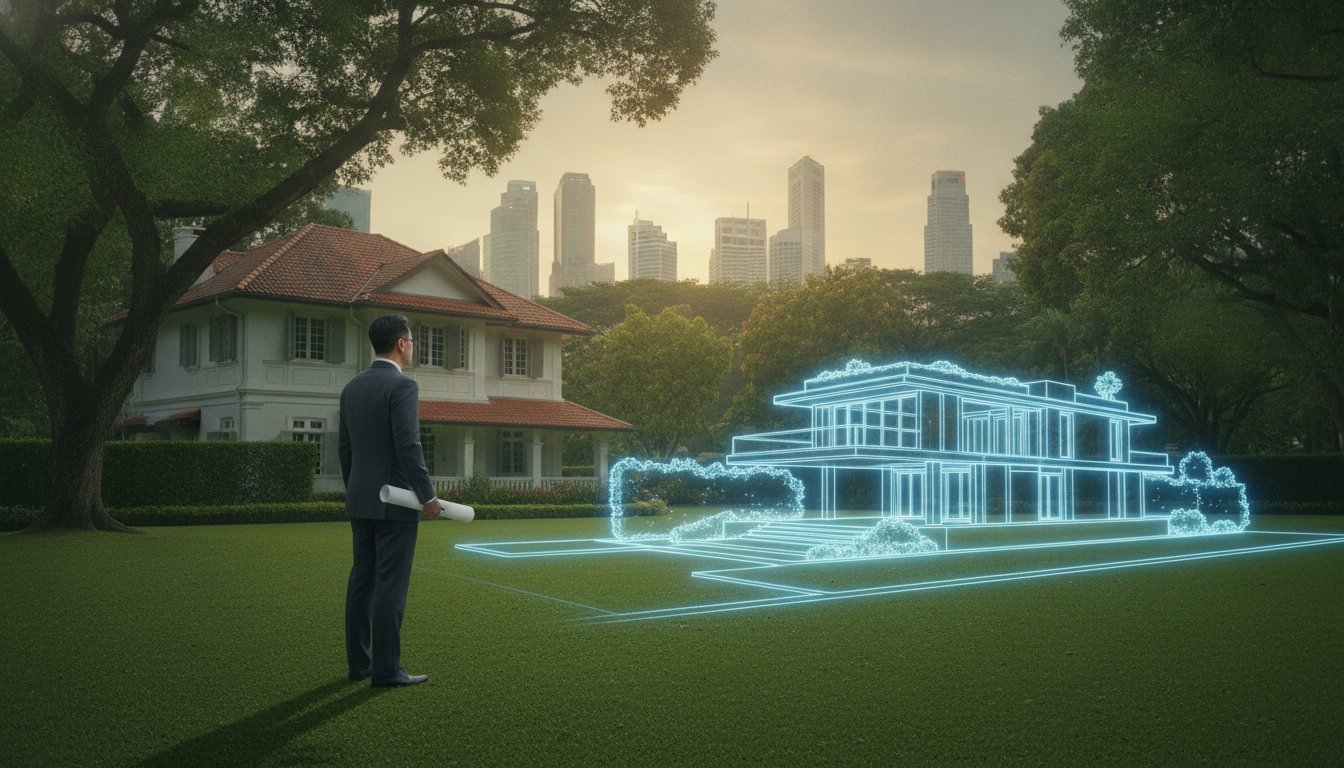
Evaluating a terrace house for sale singapore requires a shift from emotional attachment to clinical asset analysis. You must prioritize the underlying land value over the temporary appeal of interior decor. In the first quarter of 2026, landed property prices experienced a minor correction of 0.4%, creating a strategic window for savvy buyers to identify “unpolished gems” where the land-to-total-price ratio is exceptionally high. A high ratio suggests that the majority of your investment is parked in the appreciating land rather than a depreciating structure. To maximize this, you should consult the URA Master Plan to verify zoning and plot ratios. These technical specifications dictate whether a modest single-story unit can be transformed into a three-story modern residence, effectively doubling your floor area and future resale appeal.
The Freehold Premium: Is it Always Justified?
Freehold tenure remains the gold standard for Singaporean families focusing on legacy planning and wealth preservation. While 99-year leasehold properties often offer higher rental yields, the 2026 price gap continues to reflect a significant premium for the peace of mind that comes with perpetual ownership or a 999-year lease. Your choice of tenure should align with your specific financial horizon. If your goal is multi-generational wealth, freehold is the logical choice. However, for those focused on shorter-term cash flow, certain leasehold plots in prime districts may offer better entry-level value. For a bespoke analysis of how tenure affects your long-term capital appreciation, consulting with a dedicated landed strategist can provide the necessary clarity for such a high-stakes decision.
Assessing Structural Integrity and Renovation Costs
Distinguishing between a “move-in condition” home and a property requiring major Additions & Alterations (A&A) is vital for accurate budgeting. Older terrace houses often harbor hidden costs in aging electrical systems, outdated plumbing, or compromised foundations that are not immediately visible during a walkthrough. While professional home staging can mask these flaws to enhance perceived value, your focus must remain on the actual structural worth. Factoring in these potential renovation costs early ensures that your acquisition remains a sound investment. A property that appears expensive but requires no work may actually be more cost-effective than a cheaper “fixer-upper” that demands an unexpected S$1 million in structural reinforcement. Understanding the benefits of buying a renovated terrace house can help you weigh whether a turnkey asset offers superior financial arbitrage compared to taking on a full reconstruction project in today’s cost environment. Before committing to any purchase, reviewing a comprehensive terrace house renovation budget framework will help you accurately account for 2026 construction costs and URA compliance requirements.
Successful acquisition in the 2026 market depends on identifying these nuances before the contract is signed. By focusing on the land’s intrinsic potential and the structure’s physical reality, you secure an asset that is resilient against market volatility.
Financial and Regulatory Strategic Planning
Acquiring a terrace house for sale singapore in 2026 requires more than just capital; it demands a sophisticated understanding of the current regulatory framework. The Total Debt Servicing Ratio (TDSR) remains capped at 55%, a threshold that necessitates meticulous income documentation and debt management. For a standard S$5 million entry-level property, the 75% Loan-to-Value (LTV) limit means you’ll need at least S$1.25 million for the downpayment, with a minimum of 5% (S$250,000) required in cash. While you can utilize CPF Ordinary Account funds for the remainder of the downpayment and the progressive Buyer’s Stamp Duty (BSD), it’s vital to account for the CPF withdrawal limits to avoid unexpected liquidity gaps during the transaction.
Transitioning from a luxury condominium to a landed estate often involves complex property wealth planning. If you’re a Singapore Citizen purchasing your first residential property, your Additional Buyer’s Stamp Duty (ABSD) is 0%. However, if you intend to retain your existing home, the ABSD rate for a second property is 20% as of May 2026. Strategic timing is essential here; many owners utilize the ABSD concession for matrimonial home “upgrading” to manage cash flow. You should also consider the Seller’s Stamp Duty (SSD) if you’ve held your current asset for less than four years, as rates can be as high as 16% within the first year of ownership. If you are also considering a lateral move within the landed segment, understanding the average price of semi detached house in Singapore provides a critical benchmark for evaluating how terrace house valuations compare across the broader landed property spectrum.
Eligibility Rules: Who Can Buy a Terrace House?
Singapore Citizens enjoy the most straightforward path to landed ownership. Permanent Residents (PRs) are generally restricted and must seek approval from the Land Dealings Approval Unit (LDAU) of the Singapore Land Authority. This process evaluates the applicant’s economic contribution to Singapore and typically requires a minimum of five years as a PR. Foreigners are generally restricted from owning landed property, unless they obtain special government approval. Furthermore, purchasing through an entity or trust has become significantly more expensive, with the 2026 ABSD rate for entities set at 65%.
Calculating the Total Cost of Ownership
The financial commitment extends far beyond the initial purchase price. For 2026, owner-occupied properties face progressive tax rates up to 32%, though a one-off 10% rebate (capped at S$500) applies to the tax bill. You must also budget for maintenance, which is considerably higher than condominium fees since you’re responsible for the roof, facade, and pest control. If you’re eyeing a terrace house for sale singapore with redevelopment potential, factor in construction costs. Current 2026 estimates for rebuilding a terrace house can vary significantly based on architectural complexity and material choices, making it essential to have a dedicated contingency fund for your A&A or reconstruction projects.
The Acquisition Process: From Selection to Keys
Moving from financial planning to physical execution requires a methodical approach. The search for a terrace house for sale singapore begins with a clearly defined mandate that prioritizes your specific goals, whether they involve immediate occupancy or long-term land banking. This initial phase ensures you don’t waste time on plots that lack the technical attributes required for your vision. Once a potential plot is identified, we move into rigorous due diligence. This stage involves professional land surveys and title searches to verify easements, encroachments, or legal encumbrances that could restrict your future redevelopment plans or impact the property’s resale value.
Securing the property involves managing the legal timeline with absolute precision. Once the Option to Purchase (OTP) is signed, you typically have two weeks to exercise it, followed by a standard completion period of 10 to 12 weeks. During this window, your legal counsel coordinates with the Singapore Land Authority to ensure a clean title transfer while you finalize your financing. Post-completion, the focus shifts to move-in logistics. If you’re planning Additions & Alterations (A&A) as discussed in previous sections, coordinating with architects and contractors during the completion period is essential to minimize the downtime of your asset.
Effective Viewing Strategies for Landed Homes
Viewings should be conducted at different times of the day to assess environmental factors that aren’t visible on a floor plan. A morning visit reveals natural light levels and neighborhood traffic patterns, while a nighttime visit exposes potential noise issues from nearby arterial roads or suburban hubs. You must also inspect external drainage systems and the condition of boundary walls, as these are common maintenance pain points in older estates. Checking the URA Master Plan for the neighboring plot is non-negotiable to ensure a future residential development won’t overshadow your home or compromise your privacy.
Negotiation Tactics in the Luxury Market
In the luxury market, price is rarely the only factor influencing a successful deal. Understanding the seller’s motivation allows you to structure an offer that provides the certainty of completion they desire. Using a formal valuation report as a tactical lever can justify your bid based on current 2026 market data, which saw landed prices soften by 0.4% in the first quarter. A clean offer, backed by a pre-approved loan and a clear timeline, often outweighs a slightly higher but more complex bid. To ensure your negotiation strategy is airtight and your interests are protected, partner with an elite strategist who specializes in high-stakes landed transactions.
Partnering with a Landed Property Specialist
Finding a terrace house for sale singapore is a simple task; identifying a high-growth asset requires the eye of a veteran strategist. Generalist agents often focus on aesthetic appeal, yet they may overlook critical technical details like the 2026 property tax rebate implications or specific URA plot ratio restrictions discussed in previous sections. Vincent Lim (OrangeTee & Tie) provides a bespoke, white-glove approach that prioritizes your long-term success over a single transaction. This partnership grants you access to off-market “pocket deals” that never reach public portals, giving you a distinct advantage in a land-scarce environment. By operating with a high degree of discipline and seasoned authority, we ensure your acquisition is both legally sound and financially optimized.
Our commitment extends beyond the initial handover of keys. We act as a high-level partner in your property wealth journey, coordinating the complex tasks that follow a high-stakes purchase. Whether you’re transitioning from a luxury condominium or expanding an existing landed portfolio, our focus remains on calculated competence. We translate technical requirements into clear, actionable advice, allowing you to move forward with peace of mind. This methodical approach ensures that every decision you make is backed by data and years of industry-leading experience.
The Value of a Bespoke Strategy
A bespoke strategy is essential for aligning your real estate portfolio with your family’s 10-year financial goals. We provide customized property wealth planning that considers everything from future exit strategies to multi-generational living requirements. Leveraging deep industry networks, we offer trusted referrals for specialized architects and legal professionals who understand the nuances of landed property law in 2026. This ecosystem of excellence ensures transparency and integrity in every interaction. You aren’t just buying a home; you’re executing a refined plan designed to improve your net worth while securing a prestigious lifestyle.
Securing Your Legacy in Singapore
Owning a piece of Singapore’s land is a rare privilege that offers both emotional and financial rewards. In a market where landed property prices saw a slight decrease of 0.4% in early 2026, the opportunity to secure a cornerstone for generational wealth is significant. The right terrace house serves as a resilient asset that appreciates over time, providing a solid foundation for your family’s future. It’s an investment in stability, privacy, and legacy. Contact Vincent Lim (OrangeTee & Tie) today to begin your landed property journey and discover how a strategic approach can transform your vision of landed ownership into a reality.
Securing Your Multi-Generational Legacy
Success in the 2026 landed market requires a transition from viewing properties as mere residences to analyzing them as high-performance land-banking assets. You now understand that identifying a high-potential terrace house for sale singapore hinges on assessing redevelopment potential and navigating the 55% TDSR limit with clinical precision. Precision is paramount. By prioritizing plot quality and tenure over temporary interior trends, you ensure your capital is parked in an asset that remains resilient against market fluctuations.
As an Executive Associate Director at OrangeTee & Tie with over 20 years of real estate expertise in Singapore, I specialize in the acquisition of Good Class Bungalows and luxury landed assets. I provide the institutional knowledge and white-glove service necessary to uncover off-market opportunities and mitigate high-stakes risks. Consult with Vincent Lim for a Bespoke Landed Property Strategy to refine your portfolio and secure a foundational legacy for your family. Your journey toward prestigious landed ownership deserves the guidance of a dedicated strategist who values transparency and results above all else.
Frequently Asked Questions
Can a Singapore PR buy a terrace house for sale in Singapore?
Permanent Residents can purchase a terrace house only after obtaining formal approval from the Land Dealings Approval Unit (LDAU) of the Singapore Land Authority. The government typically requires the applicant to have been a PR for at least five years and demonstrate a significant economic contribution to the nation. Each application is assessed on its individual merits, and approval is never guaranteed, making it essential to secure this clearance before committing to a purchase.
What is the difference between a Type 1 and Type 2 terrace house?
The primary distinction lies in the minimum plot size and width requirements dictated by URA guidelines. A Type 1 terrace house requires a minimum plot width of 6 meters and a land area of 150 square meters for intermediate units. Type 2 houses are more compact, allowing for a 5-meter width and a minimum land area of 80 square meters. These classifications directly impact your redevelopment potential and the eventual floor plate of any new construction.
Is a corner terrace house worth the price premium?
A corner terrace house for sale singapore often justifies its 20% to 30% price premium through superior privacy and enhanced land value. These units provide additional garden space and more flexible architectural options for future redevelopment. From a land-banking perspective, the larger footprint of a corner plot serves as a more resilient asset that tends to appreciate faster than standard intermediate units in the same estate.
How much downpayment is required for a landed property in 2026?
You’ll need a minimum downpayment of 25% of the purchase price for your first residential bank loan. At least 5% of this must be paid in cash, while the remaining 20% can be funded through your CPF Ordinary Account or additional cash. With entry-level prices for a terrace house for sale singapore approaching the S$5 million benchmark in 2026, you should prepare at least S$1.25 million in liquid capital for the downpayment alone.
What are the ABSD rates for Singaporeans buying their second landed property?
As of May 2026, Singapore Citizens must pay an Additional Buyer’s Stamp Duty (ABSD) of 20% on the purchase of their second residential property. This rate increases to 30% for a third and any subsequent property. If you’re purchasing your first landed home and don’t own any other residential assets, your ABSD rate remains at 0%, which significantly reduces your initial capital outlay.
How do I check the redevelopment potential of a terrace house?
You should start by consulting the URA Master Plan to verify the specific zoning and allowable plot ratio for the area. A professional land survey is also necessary to identify any easements, such as sewerage lines or drainage reserves, that could restrict your building footprint. These technical constraints determine whether you can maximize the built-up area through Additions & Alterations or a complete reconstruction.
Should I buy a freehold or a leasehold terrace house?
Freehold properties are the preferred choice for legacy planning and long-term wealth preservation because they don’t face the risks of lease decay. However, 99-year leasehold terrace houses can be strategic if the entry price is significantly lower and the remaining tenure is sufficient to cover your holding period. Your decision should depend on whether you prioritize cash flow and rental yield or the stability of a perpetual asset.
What is the minimum land size for a terrace house in Singapore?
The minimum land size depends on the property type and its position in the row. For a standard Type 1 inter-terrace, the minimum land area is 150 square meters. Corner units require a larger plot of at least 200 square meters. In older estates classified as Type 2, the minimum land area for an intermediate unit can be as small as 80 square meters, though these are becoming increasingly rare in the modern market.