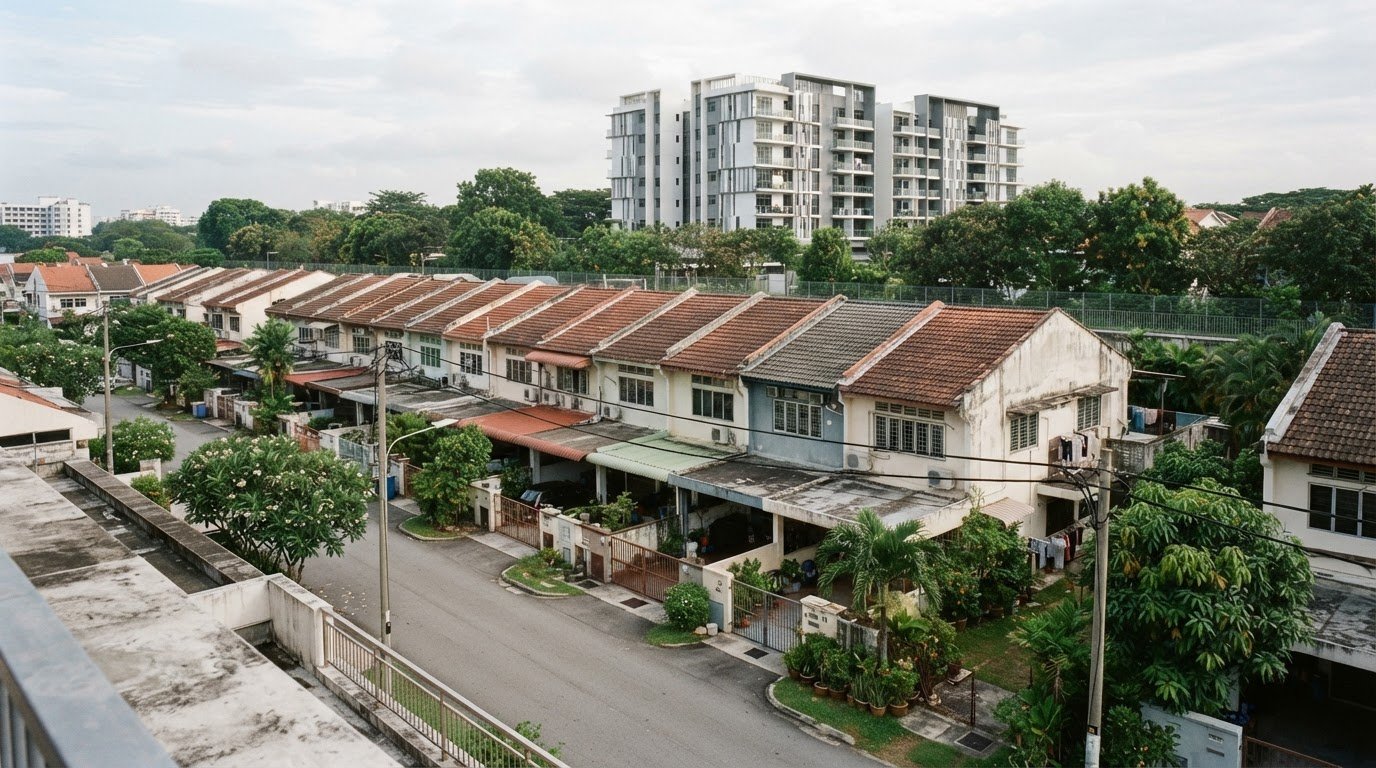
A high land value alone does not establish en-bloc potential for landed estates. In Singapore, the assessment depends on whether adjoining land can form a viable site, what planning controls permit, and whether owners can align on a collective sale. The answer is a measured assessment, not a yes-or-no conclusion based on one feature.
It is understandable to look for visible clues, such as nearby redevelopment or rising sale expectations. These may be relevant, but they do not guarantee a sale or determine what owners might receive. Expectations can change before a sale is agreed, so distinguish early indications from confirmed outcomes.
This article explains how collective sales work and how land, planning, neighbourhood and ownership factors shape an estate’s prospects. It also looks at how early en-bloc activity may influence expectations, helping you assess the signs carefully when considering a landed property in Singapore.
Key Takeaways
- Understand the consent framework that shapes whether a collective sale can proceed in Singapore.
- Assess how land size, plot ratio and surrounding development may affect a site’s redevelopment prospects.
- Separate early market signals from confirmed outcomes when considering anticipative effects.
- Use a landed-property sales perspective to weigh the signs and consider your next move.
But first… what is collective sale?
A collective sale brings multiple property owners together to sell a site to a common developer. In Singapore, owner consent, statutory procedures and redevelopment economics all affect whether a proposal can proceed.
Consent and Statutory Thresholds
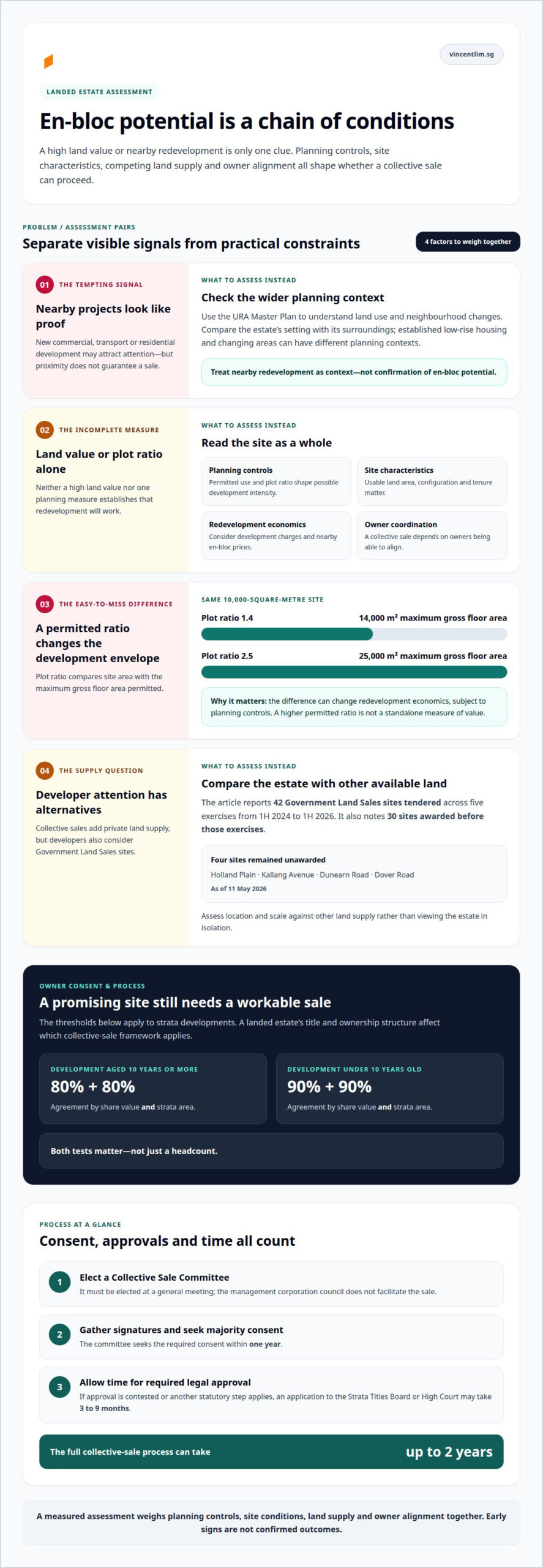
Consent thresholds set the minimum owner support needed for a strata development’s collective sale. According to Singapore Statutes Online, owners of developments aged 10 years or more generally need agreement from at least 80% by share value and strata area. Property tax on an en-bloc sales site is levied at 10% of its annual value. Developments under 10 years old require 90% by both measures. These thresholds matter because support must satisfy both tests, not just a headcount. A landed estate’s ownership and title structure also affects which collective-sale framework applies.
Approvals and Sale Process
The process organizes owner approval, marketing and, where required, legal approval. A Collective Sale Committee must be elected at a general meeting, according to Singapore Parliament; the management corporation council does not facilitate the sale. The committee gathers signatures and seeks majority consent within one year. If the required approval is contested or another statutory step applies, an application to the Strata Titles Board or High Court may take 3 to 9 months. The full process can take up to two years.
Historical values show how sharply collective-sale activity can vary. Singapore collective sales totalled S$8.7 billion in 2017 and S$10.8 billion in 2018; the highest annual total in the five years referenced was S$3.6 billion in 2022. These figures describe market activity, not a forecast for an individual estate.
Developer costs also shape bids. Since 27 April 2023, developers pay 40% Additional Buyer’s Stamp Duty on residential land purchases, with 35% remittable if they complete and sell out within five years, and 5% non-remittable. Property tax on an en-bloc sales site is levied at 10% of its annual value, according to the Inland Revenue Authority of Singapore. Owners’ proceeds are typically apportioned using share value and strata built-up size; reserve-price estimates also consider plot ratio, development charges and nearby en-bloc prices. Owners should account for transaction-related legal fees alongside applicable taxes; amounts vary with the sale arrangements.
Location, land size and neighbourhood development
In Singapore, a landed site’s prospects depend on its location, usable land area and planning context. Owners can consider these factors together to understand how redevelopment opportunities and competing land supply may affect its appeal.
Location and Neighbourhood Development
Neighbourhood development can affect how a site fits wider land-use plans and whether it attracts redevelopment interest. Singapore’s Urban Redevelopment Authority Master Plan provides information about land use and neighbourhood changes. An estate near changing commercial, transport or residential areas may have a different planning context from one surrounded by established low-rise housing. Consider surrounding development alongside the estate’s location, rather than treating proximity to new projects as proof of sale potential.
Land Supply from Collective Sales
Collective sales of older multi-family buildings are one source of Singapore’s private land supply, alongside the Government Land Sales programme. A collective sale can bring privately held land into redevelopment, so private supply does not depend solely on government land releases. For landed owners, the wider supply picture helps frame developer interest: assess a site’s location and scale against other available land, not in isolation. The estate’s strata and ownership arrangements also affect how owners can coordinate a sale.
Plot Ratio and Land-Use Intensification
Plot ratio compares a site’s land area with the maximum gross floor area permitted, indicating how intensively land may be developed. On a 10,000-square-metre site, a plot ratio of 1.4 allows a maximum gross floor area of 14,000 square metres; a ratio of 2.5 allows 25,000 square metres. The difference can change redevelopment economics, subject to planning controls. Government Land Sales also competes for developer attention: 42 sites were tendered across five exercises from 1H 2024 to 1H 2026, while 30 sites had been awarded before those exercises. Four sites at Holland Plain, Kallang Avenue, Dunearn Road and Dover Road remained unawarded as of 11 May 2026. The 2025 to 2027 Government Land Sales pipeline was planned to add more than 25,000 private homes, while en-bloc activity was more selective in 2024 and 2025. A focused landed property assessment can help owners interpret these location and supply factors.
En bloc potential, yay or nay?
En-bloc potential means the prospect of a site being collectively sold and redeveloped. To assess en-bloc potential for landed estates in Singapore, consider planning controls, plot ratio, tenure and owner alignment together.
Plot Ratio and Redevelopment Potential
Plot ratio compares a site’s land area with the maximum gross floor area permitted, indicating potential development intensity. A higher permitted ratio can allow more residential floor area and influence a developer’s tender assessment. The practical question is whether planning controls allow more intensive use than the estate’s current use. Consider plot ratio alongside development charges and nearby sale prices, rather than treating it as a standalone measure of value.
Redevelopment Prospects of Older Estates
Older estates may attract attention when their existing layout leaves room for a different use under current planning conditions. Age alone does not establish redevelopment value: site configuration, tenure, permitted use and coordination among owners also matter. Older multi-family properties contribute private land through Singapore’s collective-sale market, but landed estates have distinct title and ownership characteristics. A balanced assessment separates physical redevelopment scope from the practical challenge of assembling the site.
Redevelopment Option Premiums
A redevelopment option premium is the value buyers may attach to the possibility of future collective redevelopment. A Singapore property study estimated en-bloc premiums of 21.1% to 26.6% after controlling for endogeneity. With planning-region and postal-sector fixed effects, estimates ranged from 20.2% to 29.2%. These findings describe observed property effects, not a valuation formula for a particular landed estate. They help explain why redevelopment expectations can influence pricing before a collective sale proceeds.
Tenure and En-Bloc Potential
Freehold, 999-year and 99-year tenure influence how owners and developers assess land, but tenure alone cannot rank redevelopment prospects. Singapore’s Government Land Sales residential sites have 99-year leases; new freehold condominium units have been reported at a 10% to 15% premium over comparable leasehold units in the same area. Property tax on an en-bloc sales site is levied at 10% of its annual value. That comparison concerns condominium units, not landed collective-sale values. A sound view of en-bloc potential for landed estates also considers URA zoning and plot ratio, which guide permitted land use and development intensity.
Anticipative effects before en-bloc sales
Market expectations can influence nearby property prices before a collective sale is completed. For landed owners, the key distinction is between an early indication and a completed transaction.
Research on Singapore properties found that en-bloc premiums increased by 3.6% to 8.1% after a Collective Sale Committee was established. This suggests that formal collective-sale activity may affect expectations before a site changes hands. It does not mean every nearby home gains the same amount: location, property type and the development’s sale prospects influence how buyers interpret the signal.
Transaction timing also matters. With planning-region and postal-sector fixed effects, one estimate found resale prices rose by an average of 0.05% per month as transactions moved closer to en-bloc sale events. Another estimate under those controls reported 0.03% per month. These figures describe observed patterns, not a forecast for an individual landed estate or a guaranteed monthly increase.
Separate a local price movement from a direct en-bloc effect. Compare transactions near the estate with similar properties in the surrounding neighbourhood, considering differences in tenure, land area and amenities. Then place any movement in context: a committee’s formation, owner support approaching the 80% threshold, a tender launch and a completed sale are distinct stages. Each can influence expectations differently.
A failed attempt can reverse the mood. In Singapore, prices fell after an en-bloc attempt failed, as expected gains diminished. That shift matters if a buyer has priced in redevelopment prospects before owners reach agreement. The practical takeaway is to treat anticipative effects as one input alongside planning capacity and ownership alignment, not as proof that a sale will proceed. For a considered view of how these market signals relate to a landed property decision, discuss your landed property options.
Vincent Lim (OrangeTee & Tie)
Vincent Lim (OrangeTee & Tie) helps landed-property owners assess their options when collective-sale signals raise questions about timing, value or a potential individual sale. A measured review can distinguish redevelopment expectations from the property’s current market position, while considering the estate’s location, land characteristics and ownership context.
Vincent Lim handles sales of terrace houses, semi-detached houses, detached houses and Good Class Bungalows. For owners considering a sale, this provides a practical way to understand how the wider market relates to their property and consider a sale strategy without treating en-bloc prospects as certain.
Contact Vincent Lim (OrangeTee & Tie) to discuss your landed property and the options you are considering.
Make Your Next Property Decision Deliberately
Redevelopment prospects are one factor in a landed-property decision, not a decision in themselves. Consider which outcome suits your plans, how much uncertainty you are prepared to accept, and whether you would prefer to explore an individual sale. This keeps your priorities at the centre instead of letting market expectations set the pace. For investors and owners looking at alternative property disposal models or exploring overseas opportunities, Auction Property Ltd offers a look at how residential and commercial real estate is traded through structured auctions.
En-bloc potential for landed estates can change as planning prospects, owner intentions and market conditions evolve. A practical next step is to discuss how those possibilities relate to your property and the options you may wish to consider. Vincent Lim (OrangeTee & Tie) handles landed-property sales, including terrace, semi-detached and detached homes, and can help you frame a considered sale discussion around your circumstances.
Contact Vincent Lim (OrangeTee & Tie) to discuss your property and possible next steps. A clear view of your priorities can make the decision ahead feel more manageable.
Frequently Asked Questions
What Does En-bloc Mean?
An en-bloc sale combines owners’ interests in a property site for a collective transaction, rather than each owner selling separately. Proceeds are apportioned among owners according to the applicable arrangements. The key distinction for a homeowner is that the outcome depends on a collective process and shared decisions, not solely on an individual buyer’s offer for one house. For homeowners who ultimately prefer a private route and bespoke representation for prime residential assets, luxury agencies like Nikki Homes demonstrate how a consultancy-led approach can guide high-value individual property sales.
Which Singapore landed estates have recently undergone or are considering en-bloc sales?
Named Singapore collective-sale examples include Loyang Valley and Pearl Bank Apartments, but these are condominium developments, not landed estates. They are not direct precedents for landed property. For any landed estate, distinguish a completed transaction from an announced proposal, owner discussions or a tender. These stages reflect different levels of progress and do not, by themselves, mean a collective sale has been completed.
What is the minimum consent threshold for a collective sale of landed housing in Singapore?
For strata developments aged 10 years or more, owners generally need at least 80% agreement by share value and strata area, according to Singapore Statutes Online. Developments under 10 years old generally require 90% by both measures. These are strata collective-sale thresholds. The applicable process for landed housing depends on its title and ownership structure, so the thresholds should not be applied automatically to every group of adjoining homes.
What recent en-bloc prices per square foot have Singapore landed estates achieved?
A single recent per-square-foot figure cannot represent Singapore landed estates, and the collective-sale examples above are not landed-property benchmarks. For a specific completed transaction, an indicative land rate can be calculated by dividing the sale consideration by the relevant site area. Comparisons are meaningful only when the land-area basis and transaction terms align, as headline rates alone can obscure differences between sites.
What risks can delay or derail a landed estate en-bloc sale in Singapore?
Insufficient owner support can stop a proposal before a sale, while objections or approval proceedings can extend the process. If a tender does not meet its reserve price, private-treaty negotiations may follow instead of an immediate sale. A failed attempt can also trigger a two-year restriction before the process restarts. Distinguish a tender launch from a completed transaction, as they have different implications.
How do access roads, drainage, conservation status, and infrastructure affect landed estate redevelopment potential?
These conditions affect how a site can be accessed, serviced and redeveloped. Road access and drainage can shape site layout and construction practicality, while conservation controls may limit changes to protected buildings or areas. Existing and planned infrastructure can influence a site’s planning context and appeal. Together, these factors help determine whether theoretical redevelopment capacity can become a workable proposal.