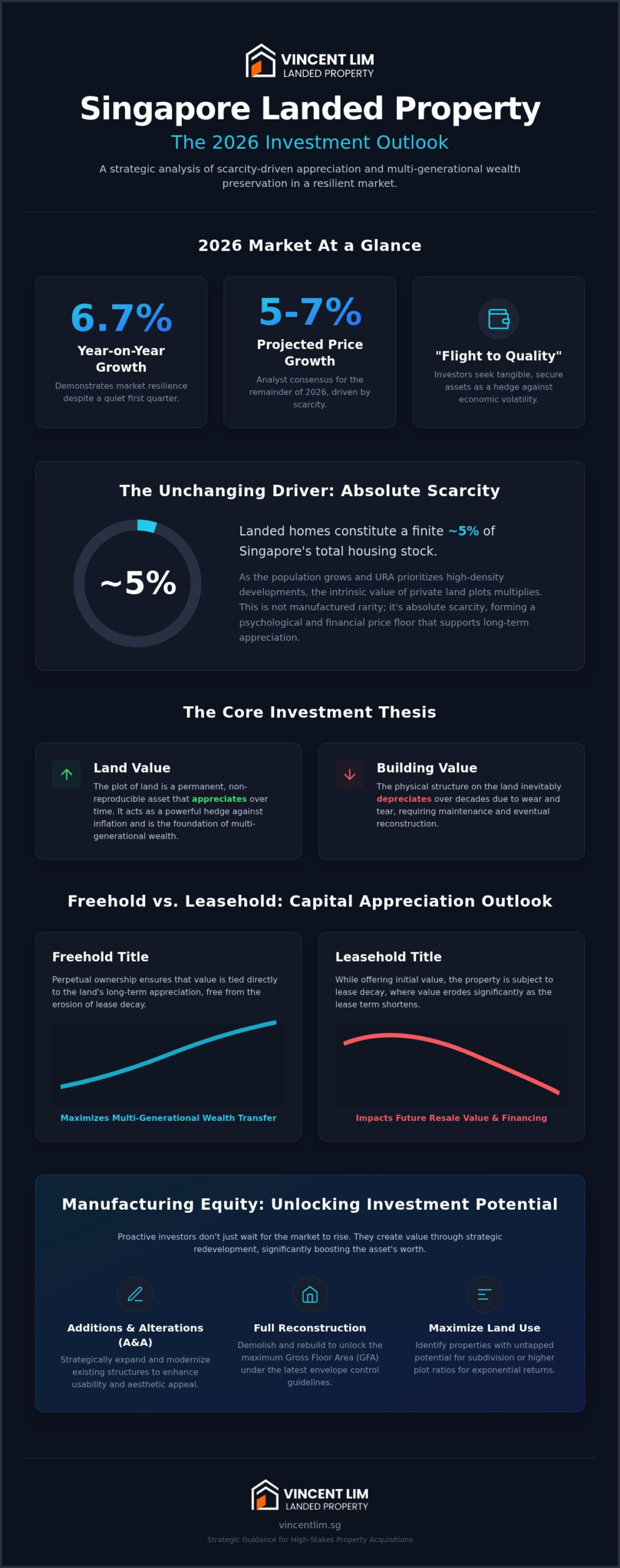
In a landscape of increasing urban densification, a plot of land in Singapore is no longer just a home; it’s a finite, defensive currency. With year-on-year growth holding at 6.7% despite a quiet first quarter, many high-net-worth individuals are asking: is buying a landed property a good investment 2026? You’re likely weighing the fear of buying at a market peak against the risk of being priced out of a dwindling supply. It’s natural to feel concerned about the impact of ABSD and the long-term performance of leasehold versus freehold titles when the stakes involve significant capital.
This strategic analysis provides the definitive outlook for the current year, focusing on scarcity-driven appreciation and multi-generational wealth preservation. We’ll examine why analysts project a price growth of 5% to 7% for the remainder of 2026 and how to identify properties with genuine redevelopment potential. You’ll gain a clear understanding of capital appreciation trends and the tactical steps required to secure a legacy asset for your family. We’ll guide you through the data, ensuring your next acquisition is based on seasoned expertise rather than market speculation.
Key Takeaways
- Examine why the 2026 landed market is characterized by a “flight to quality,” offering a resilient hedge against inflation and broader economic shifts.
- Determine if buying a landed property is a good investment 2026 by analyzing the intrinsic value of land over building structures in long-term wealth preservation.
- Evaluate the financial implications of freehold versus leasehold titles, specifically regarding capital appreciation and the impact of lease decay on future resale.
- Identify high-yield opportunities for manufacturing equity through strategic additions, alterations, and reconstruction under the latest envelope control guidelines.
- Understand how a strategic specialist provides access to exclusive off-market listings and ensures a disciplined approach to high-stakes acquisitions.
Landed Property Investment in 2026: Analyzing Market Resilience
The current year has solidified a distinct trend among sophisticated investors: a decisive “flight to quality.” As global economic shifts create volatility in traditional paper assets, the Singapore landed market remains a steadfast pillar of stability. Investors are moving beyond speculative gains, seeking the tangible security that only land ownership provides. When considering if buying a landed property a good investment 2026, one must look at the underlying strength of the asset class. While other sectors may fluctuate, the landed segment continues to command premium valuations due to its status as the pinnacle of the local real estate hierarchy.
This resilience is primarily driven by a specific buyer demographic. Permanent Residents and new citizens, who view Singapore as a long-term safe haven for their capital, are the dominant forces in recent transactions. Unlike the luxury condominium market, which often faces supply pressure from new launches, the landed market operates on a different set of rules. Landed homes offer a level of privacy and autonomy that high-rise living cannot replicate, making them a preferred choice for those focused on wealth preservation and legacy building. Understanding the fundamentals of real estate investing is essential when evaluating these high-stakes assets; the focus here is on the intrinsic value of the ground itself rather than just the structure atop it.
The Impact of 2026 Cooling Measures
Despite mortgage rates hovering around 6.90% for a 30-year fixed term, the landed market hasn’t seen the sharp corrections some predicted. Instead, a psychological floor price has emerged. Sellers of these prestigious assets are often well-capitalized and under no pressure to liquidate, which maintains price integrity across the board. While the Additional Buyer’s Stamp Duty (ABSD) remains a significant consideration, it has refined the pool of buyers to those with a serious, long-term commitment to the market. For these individuals, the question isn’t just about the entry cost, but whether buying a landed property a good investment 2026 for protecting their family’s financial future against inflation.
Supply Scarcity as a Price Floor
The primary driver of value in this sector is a simple, unchangeable fact: supply is finite. Landed homes constitute approximately 5% of Singapore’s total housing stock, a figure that is unlikely to increase significantly. As the Urban Redevelopment Authority (URA) continues to prioritize high-rise, high-density developments to accommodate a growing population, the existing land becomes exponentially more valuable. This creates a situation where demand consistently outstrips availability. In the context of Singaporean land, absolute scarcity is the reality where a growing population competes for a strictly capped number of private plots that can never be replicated.
The Investment Thesis: Scarcity, Land Value, and Wealth Preservation
The core of any sophisticated investment thesis in 2026 lies in the distinction between land and building value. While a structure inevitably depreciates over decades, the plot beneath it remains a permanent, non-reproducible asset. For those evaluating if buying a landed property a good investment 2026, this ratio is the most critical metric. High-net-worth investors focus on the land value because it acts as a premier hedge against inflation; it’s a hard asset that maintains its real-world value even as currency values fluctuate. Owning a landed home is essentially holding a “limited edition” asset in a global financial hub. This prestige isn’t just about social status. It’s about legacy planning. Freehold land allows for multi-generational wealth transfer that isn’t subject to the same lease decay concerns found in the broader residential market.
Landed Property vs. Luxury Condos: A Wealth Perspective
A significant shift is occurring in 2026 as investors move capital from luxury condominiums to landed assets. The primary driver is autonomy. High-rise owners are often at the mercy of collective “en bloc” decisions, which can be unpredictable and tax-inefficient. In contrast, a landed owner possesses total control over the asset’s timeline and redevelopment. This independence is why many are seeking a Luxury Condo vs Landed: The Wealth Perspective to better understand the long-term capital trajectory. When you own the ground, you own the decision-making power. This fundamental difference makes landed property a superior vehicle for those looking to “park” wealth in a stable, appreciating environment.
The Role of Good Class Bungalows (GCBs) in 2026
Good Class Bungalows represent the absolute “Gold Standard” of Singaporean real estate. These are the most defensive assets in any portfolio because their entry requirements and strict conservation guidelines ensure they remain exceptionally rare. In 2026, GCBs continue to attract the elite who prioritize privacy and capital preservation above all else. For a deeper definition of what constitutes these premier estates, investors often consult a Good Class Bungalow Guide to navigate the specific planning constraints. These properties aren’t just homes; they are institutional-grade assets that have historically shown remarkable resilience during economic downturns. If you’re refining your long-term strategy, a bespoke market analysis can help identify which specific plots offer the best defensive qualities. Ultimately, determining if buying a landed property a good investment 2026 requires looking past current price points and focusing on the enduring value of the land itself.
Freehold vs. Leasehold: Evaluating 2026 Capital Appreciation
The choice between freehold and leasehold tenure is perhaps the most significant fork in the road for any 2026 investor. Freehold properties naturally command a substantial price premium, often 20% or more compared to their leasehold counterparts. This premium reflects the market’s valuation of perpetuity. When evaluating if buying a landed property a good investment 2026, you must consider how tenure affects your exit strategy. While leasehold assets can face financing restrictions as the remaining lease dips below 60 years, freehold assets remain liquid and bankable indefinitely. This makes them the ultimate vehicle for capital preservation in an environment where every percentage point of appreciation counts.
The Freehold Advantage for Multi-Generational Planning
For families focused on legacy, freehold land is the only logical choice. It provides a permanent stake in Singapore’s limited geographical footprint, unaffected by the ticking clock of lease expiry. Historically, freehold landed prices have shown remarkable resilience during market downturns, often holding their value better than leasehold assets that are more sensitive to sentiment shifts. This stability is a cornerstone of Freehold vs Leasehold Landed Property comparisons. By removing the “lease decay” variable, you ensure that the wealth you build today remains intact for the next generation. It’s a disciplined approach to asset progression that prioritizes long-term security over short-term yield.
When Leasehold Landed Becomes a Strategic Play
There are specific scenarios where a 99-year leasehold property serves as a sophisticated tactical tool. If your primary goal is high rental yield or immediate lifestyle enhancement at a lower entry price, leasehold can be the superior choice. Because the purchase price is lower, the rental yield as a percentage of capital is often significantly higher. This is a lifestyle play where you trade perpetual ownership for a more impressive residence today. When evaluating a leasehold opportunity in 2026, use this checklist to ensure the asset remains viable:
- Confirm at least 65 to 70 years remain on the lease to ensure future buyers can still secure full bank financing.
- Analyze the surrounding master plan to ensure no competing high-density developments will overshadow the property’s appeal.
- Verify that the entry price is at least 20% lower than comparable freehold assets in the same vicinity.
- Assess the potential for future redevelopment or collective sale before the lease decay accelerates.
For most high-net-worth individuals, the 2026 outlook favors freehold for its risk-adjusted returns. However, a well-timed leasehold acquisition can still provide excellent cash flow for a balanced portfolio, provided the entry price is calculated with a clear understanding of the eventual exit timeline.
Identifying Redevelopment Potential: Maximizing Investment Returns
One of the most effective ways to determine if buying a landed property a good investment 2026 is by examining the concept of “manufactured equity.” This proactive strategy involves identifying plots where the land’s latent potential significantly exceeds the current built-up area. An elite strategist doesn’t just look at the existing house; they look at the soil. You’re searching for properties with a high land-to-built ratio, typically older, single-story structures sitting on substantial plots. By executing a full reconstruction or sophisticated Additions & Alterations (A&A), you can transform a dated asset into a modern residence, instantly boosting its market valuation well beyond the construction costs.
Professional valuation plays a critical role in this process. It isn’t merely about comparing recent transaction prices in the neighborhood. It involves a forensic analysis of the plot’s characteristics. When buyers ask is buying a landed property a good investment 2026, the answer often lies in their ability to see past the peeling paint of an old bungalow to the modern homes that could stand in its place. An undervalued gem often reveals itself through specific physical traits, such as a wide frontage that might allow for a future subdivision or a plot depth that permits a significant rear extension. Identifying these opportunities requires a disciplined approach and a deep understanding of how physical improvements translate into financial gains.
Understanding URA Planning Parameters
Success in redevelopment depends on a precise mastery of URA zoning and envelope control guidelines. These regulations dictate exactly how much of the plot you can build on and the maximum height the structure can reach. For instance, the potential to convert a 2-storey terrace into a 3-storey semi-detached residence, where zoning permits, can yield exceptional returns. Redevelopment potential is fundamentally defined by the land’s width and depth, as these dimensions must meet strict minimum frontage requirements for specific house types. If a plot doesn’t meet these benchmarks, its “manufactured equity” potential is significantly capped.
The Costs and ROI of Reconstruction
In 2026, construction costs for high-end landed homes require meticulous financial planning. While material prices have stabilized compared to previous years, professional coordination and high-quality finishes remain substantial investments. However, the capital gain from a well-executed project often justifies the initial outlay. A full reconstruction effectively resets the property’s “depreciation clock,” making it a highly attractive legacy asset for the next generation. For a detailed breakdown of how these improvements impact your long-term exit price, consulting a Landed Property Valuation specialist is a necessary step. If you’re ready to identify an undervalued plot with high growth potential, book a strategic consultation to review exclusive off-market opportunities that align with your wealth goals.
Strategic Acquisition in 2026: Why the Right Specialist Matters
Acquiring a landed home in 2026 requires a strategic rather than a merely transactional approach. In a market where supply is strictly capped, the most lucrative opportunities often never reach public portals. Identifying these off-market gems requires a deep network and a reputation for integrity. For high-net-worth individuals, the question of whether is buying a landed property a good investment 2026 often depends on their access to exclusive information and the caliber of the guidance they receive. Transparent communication is the bedrock of these luxury transactions. You need a partner who provides a clear-eyed assessment of risks and potential, ensuring every decision is based on data rather than emotion.
Vincent Lim serves as your dedicated partner in this journey. As an Executive Associate Director at OrangeTee & Tie with over 20 years of experience, he brings a level of seasoned authority that’s essential for high-stakes transactions. Having been recognized as a Top 6 Transactor at the EdgeProp Excellence Awards in both 2022 and 2023, Vincent operates with a high degree of discipline. He moves beyond the role of a service provider to act as an elite strategist who’s deeply invested in your long-term success.
The Elite Strategist’s Roadmap to Landed Ownership
The journey to securing a premier landed asset follows a methodical, five-step progression designed to ensure precision at every stage:
- Comprehensive Financial and Portfolio Assessment
- Strategic Identification of Undervalued or Off-Market Plots
- Forensic Due Diligence and Planning Parameter Verification
- Disciplined Negotiation and Transaction Management
- Seamless Handover and Post-Acquisition Planning
This white-glove service ensures you navigate the 2026 legal landscape and ABSD requirements with absolute peace of mind. For those looking to build a multi-generational portfolio, Vincent’s Asset Progression Guide provides the necessary framework for long-term capital growth and risk mitigation. It’s about moving beyond a single purchase to a life-long wealth strategy.
Securing Your Legacy in a Competitive Market
Landed property remains the ultimate 2026 investment because it offers something no other asset class in Singapore can: absolute scarcity. As the city continues its vertical expansion, the value of private land will only intensify. If you’ve been wondering if buying a landed property a good investment 2026, the data points to a resounding yes for those who prioritize wealth preservation. The current price growth forecast of 5% to 7% suggests that acting on scarcity now is a prudent move before the next price cycle begins. Don’t leave your legacy to chance. Consult with Vincent Lim for a Strategic Landed Property Review to ensure your next acquisition is a cornerstone of your family’s financial future.
Securing Your Family’s Legacy in a Finite Market
The 2026 market landscape confirms that landed property remains the ultimate defensive asset for wealth preservation. We’ve explored how absolute scarcity and strategic redevelopment potential create a price floor that high-rise developments simply cannot match. Determining is buying a landed property a good investment 2026 depends on your ability to identify undervalued plots and navigate complex planning parameters. It’s a journey that demands a disciplined approach and access to off-market opportunities that aren’t visible to the general public.
Success in this elite segment requires a partner who combines seasoned authority with transparent analysis. Vincent Lim brings over 20 years of real estate expertise and is a recognized specialist in Good Class Bungalows and luxury landed homes. As a Top Landed Transactor and recipient of the EdgeProp Excellence Awards in 2022 and 2023, he offers the white-glove service necessary for high-stakes acquisitions. You don’t have to navigate these complexities alone. Consult with Vincent Lim for a Strategic 2026 Landed Investment Review to refine your portfolio and secure an enduring asset for the next generation. Your path to a resilient legacy starts with a single, calculated decision.
Frequently Asked Questions
Is it better to buy a luxury condo or a landed property in 2026?
Choosing between a luxury condominium and a landed property depends on your specific wealth goals. Landed homes offer absolute autonomy and ownership of the ground, which acts as a superior inflation hedge over time. While luxury condos provide lifestyle amenities, they’re subject to collective en bloc decisions and lack the scarcity value of private land. In 2026, the limited supply of landed homes continues to drive stronger long-term capital appreciation for those seeking a defensive asset.
Can PRs and foreigners buy landed property in Singapore in 2026?
Foreigners and Permanent Residents are generally restricted from purchasing landed property on mainland Singapore. PRs may apply for approval from the Land Dealings Approval Unit (LDAU), which evaluates the applicant’s economic contribution to the country. This regulatory framework ensures that the finite supply of landed homes remains primarily in the hands of citizens, further tightening availability and supporting the long-term question of whether is buying a landed property a good investment 2026.
What is the minimum downpayment for a landed property in 2026?
For a first residential property loan in 2026, the minimum downpayment is 25% of the purchase price or valuation, whichever is lower. This typically consists of a 5% mandatory cash component and 20% that can be paid via cash or CPF. If you have existing housing loans, the Loan-to-Value (LTV) limits become more restrictive. Navigating these financing requirements is a critical step in the strategic acquisition process for high-stakes residential assets.
Is a 99-year leasehold landed property a bad investment?
A 99-year leasehold landed property isn’t a bad investment if the entry price accounts for the lease decay. It often provides higher rental yields and a more spacious lifestyle at a lower capital outlay compared to freehold. However, it requires a clear exit strategy before the remaining lease falls below 60 years. For most investors, is buying a landed property a good investment 2026 focuses on freehold assets due to their perpetual value and multi-generational benefits.
How much has the price of landed property in Singapore increased in 2026?
Market data for 2026 indicates a resilient growth trajectory despite broader economic cooling. While prices saw a marginal dip of 0.4% in the first quarter, they remained 6.7% higher on a year-on-year basis. Current forecasts from industry analysts project a full-year price growth between 5% and 7%. This steady appreciation reflects the ongoing “flight to quality” as high-net-worth individuals continue to prioritize stable, land-based assets over more volatile investment classes.
What are the additional costs of owning a landed property compared to a condo?
Owning a landed home shifts the responsibility of maintenance from a management corporation to the individual owner. You’ll need to budget for periodic costs such as roof inspections, garden upkeep, and pest control services. While you won’t pay monthly MCST management fees, property taxes are generally higher due to the significant Annual Value of the land. These operational costs are a necessary trade-off for the total autonomy and privacy that a landed residence provides.
How do I identify if a landed property has redevelopment potential?
Identifying redevelopment potential requires a forensic look at the plot ratio and envelope control guidelines. You should look for properties with a high land-to-built ratio, typically older houses on large plots. Key indicators include a wide frontage that meets URA minimum requirements for subdivision or a plot depth that allows for significant expansion. Verifying the zoning and height restrictions is essential, as these factors dictate the maximum “manufactured equity” you can create through reconstruction.
Why are GCBs considered the most resilient asset class in 2026?
Good Class Bungalows (GCBs) are the most resilient asset class because they represent the absolute pinnacle of scarcity in Singapore. With only approximately 2,800 such plots in existence, they’re insulated from the supply fluctuations that affect other market segments. Their large land sizes and strict conservation requirements ensure they remain defensive assets during economic downturns. For the elite investor, GCBs serve as the ultimate vehicle for long-term capital preservation and high-status legacy building.