Is the dream of owning a private estate in Singapore truly reserved for citizens, or is there a sophisticated path for the global investor? While the headlines often focus on the 60% Additional Buyer’s Stamp Duty (ABSD), the regulatory environment surrounding selling landed property to foreigners singapore is far more nuanced than a simple tax figure. It’s natural to feel that the Residential Property Act’s requirements are daunting. The fear of a rejected application from the Land Dealings (Approval) Unit (LDAU) often stalls even the most ambitious acquisition plans, leaving many to believe the gates to this asset class are permanently locked.
This strategic guide clarifies the complexities of the 2026 market, offering you a clear trajectory toward ownership. You’ll gain a comprehensive understanding of the LDAU’s specific criteria, including the economic contributions and residency milestones necessary for a successful application. We’ll explore the rare exceptions found in certain designated areas and provide a methodical roadmap to ensure your acquisition strategy is both legally sound and financially prudent. By the end of this article, you’ll possess the expert insights needed to navigate the luxury landed market with the confidence of a seasoned insider.
Key Takeaways
- Identify the legal parameters of the Residential Property Act to determine how foreign entities and trusts qualify for property ownership in 2026.
- Explore the designated luxury enclaves where international buyers can legally acquire landed assets through specific regulatory exemptions.
- Master the LDAU application process for Permanent Residents by understanding the residency and economic contribution benchmarks required for approval.
- Evaluate the 2026 financial framework, including the 60% ABSD rates and specific Free Trade Agreement exemptions for eligible nationalities.
- Learn the specific regulations governing selling landed property to foreigners singapore, allowing you to identify compliant investment opportunities with precision.
Decoding the Residential Property Act: Why Landed Ownership is Restricted
The Residential Property Act (RPA) functions as a fundamental pillar of Singapore’s legal system, designed to ensure that the nation’s limited land remains primarily in the hands of its citizens. This protectionist stance isn’t merely bureaucratic; it’s a strategic preservation of national identity and social stability. By restricting land ownership, the government maintains a stable housing market where citizens can afford a stake in their own country. This legislation ensures that landed homes don’t become speculative assets for global capital at the expense of the local population.
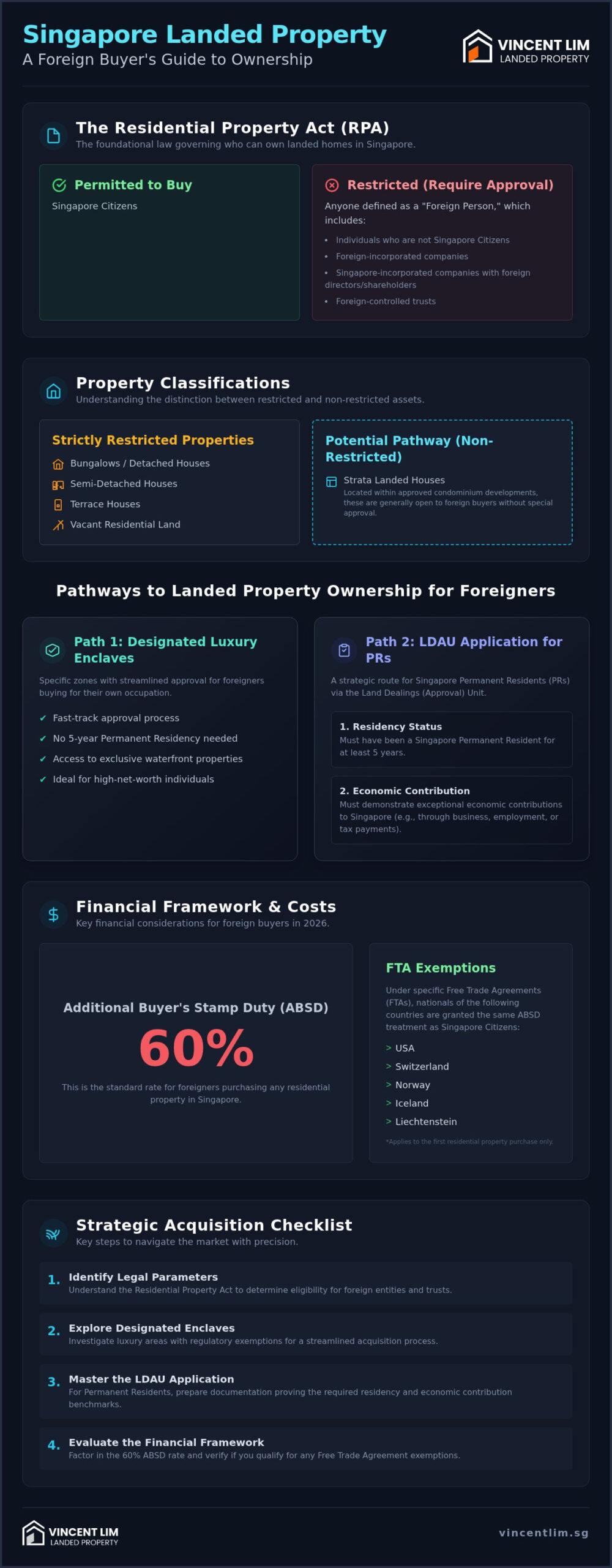
Under the Act, a “Foreign Person” is clearly defined to prevent any ambiguity. It includes anyone who isn’t a Singapore citizen, as well as foreign companies and foreign-controlled trusts. Even if a company is registered locally, it’s considered foreign if its directors or shareholders are non-citizens. This broad definition ensures the spirit of the law remains intact, closing off potential loopholes that might otherwise dilute the intent of the RPA. Because landed property is a restricted asset class, it possesses an inherent scarcity that condominiums don’t share. While high-rise units are abundant, there’s a fixed number of landed plots. This scarcity ensures that when you’re selling landed property to foreigners singapore, you’re dealing with a highly coveted, elite asset class that has historically shown resilient value appreciation.
Restricted vs. Non-Restricted Residential Properties
Not all residential assets are treated equally under the law. Standard terrace houses, semi-detached houses, and bungalows are strictly restricted. However, strata landed properties within approved condominium developments offer a unique legal pathway, as they’re often classified as non-restricted. This distinction is vital for sellers to understand, as it significantly broadens the potential buyer pool. It’s also worth noting that land zoned “commercial and residential” was reclassified in 2023, meaning it now falls under the same RPA restrictions as pure residential land, requiring LDAU approval for foreign acquisition.
The Role of the Singapore Land Authority (SLA)
The Singapore Land Authority (SLA) acts as the vigilant custodian of these regulations. Through the Land Dealings Approval Unit (LDAU), the SLA meticulously vets every application from non-citizens seeking to acquire restricted property. The SLA maintains a rigorous national registry to ensure every transaction complies with the RPA. Unauthorized acquisition or holding of restricted land isn’t just a civil matter; it carries severe legal consequences, including heavy fines and the potential forced sale of the property. When selling landed property to foreigners singapore, verifying the buyer’s eligibility through the LDAU is a non-negotiable step for a secure transaction.
Designated Exceptions: Where Foreigners Can Acquire Landed Assets
While the Residential Property Act 1976 establishes a rigorous baseline for restriction, specific geographical exemptions exist to cater to the global elite. These designated enclaves operate under a unique legal framework, effectively creating a “gateway” for international investors. Unlike mainland properties where the Land Dealings (Approval) Unit (LDAU) applies stringent criteria regarding residency and economic contribution, these zones offer a streamlined, fast-track approval process. This administrative efficiency makes the prospect of selling landed property to foreigners singapore significantly more viable in these specific locales. Approval is typically granted within a much shorter timeframe, provided the applicant intends to use the property for their own occupation.
The Appeal of Designated Luxury Enclaves
For the global high-net-worth individual, these enclaves provide more than just a home; they offer a curated resort-living lifestyle. The primary draw is the ability to own expansive waterfront bungalows and land plots that are otherwise inaccessible on the mainland. These assets serve as a strategic entry point for investors who don’t yet meet the five-year Permanent Residency requirement but wish to establish a tangible footprint in Singapore’s luxury market. Owners in these zones enjoy ownership rights that mirror those of citizens, allowing them to build bespoke architectural masterpieces. If you’re considering a high-stakes acquisition or need help selling landed property to foreigners singapore within these zones, consulting an experienced luxury real estate strategist can ensure your transaction remains compliant and profitable.
Ownership Tenure and Leasehold Considerations
A critical distinction between these designated zones and many mainland landed properties is the tenure. While many mainland bungalows are freehold, properties in these luxury enclaves are almost exclusively 99-year leaseholds. This structure requires a sophisticated valuation approach. Investors must weigh the lifestyle benefits and immediate ownership rights against the long-term legacy planning implications of a depleting lease. However, the strategic advantage lies in the capital preservation these prime areas offer. Even with a leasehold status, the unique nature of these “restricted-exempt” assets often leads to robust secondary market demand. The scarcity of such opportunities ensures that these properties remain highly liquid compared to other leasehold assets in less prestigious districts.
The LDAU Application: A Strategic Path for Permanent Residents
For many Singapore Permanent Residents (SPRs), the transition from a luxury condominium to a terrace house or a detached home represents a significant milestone. While the law is restrictive, it isn’t impassable. The Land Dealings (Approval) Unit (LDAU) evaluates each case on its individual merits, looking for individuals who have significantly integrated into the fabric of Singaporean society. When you’re considering selling landed property to foreigners singapore, understanding these criteria is essential for qualifying potential buyers and ensuring a smooth transaction.
The eligibility framework requires a minimum of five years as a Permanent Resident. However, residency is merely the baseline. The unit places immense weight on an applicant’s “exceptional economic contribution.” This refers to taxable employment income, the scale of local business investments, and the specialized skills the individual brings to the workforce. Meticulous documentation of these factors is non-negotiable; even minor omissions can lead to lengthy delays or outright rejection.
Criteria for Approval: Beyond Residency
Approval rests on a holistic assessment of the applicant’s profile. The authorities look for a deep-seated commitment to the nation, often evidenced through several key pillars:
- Professional Excellence: High-level qualifications or niche expertise that benefits local industries.
- Local Investment: Substantial capital committed to Singapore-based enterprises or the local financial markets.
- Social Integration: Strong family ties within the country and a history of local philanthropic contributions.
These factors demonstrate that the applicant isn’t just seeking a lifestyle upgrade but is genuinely invested in the country’s long-term prosperity. Professional representation is often critical during the appeal or clarification stage, as it ensures that the applicant’s contributions are framed with the necessary precision and authority.
The Step-by-Step Application Workflow
A strategic approach begins long before the formal submission. Conducting a feasibility study helps determine if the applicant’s profile meets the current benchmarks for approval. This prevents the disappointment of a rejected offer and protects the seller’s timeline. Once the profile is refined, the formal application is submitted via the SLA portal. Navigating the nuances of selling landed property to foreigners singapore requires a deep understanding of these administrative hurdles. During the waiting period, the LDAU may issue specific queries regarding the source of funds or professional history. Responding with accuracy and speed is vital to maintaining momentum. In 2026, the typical processing time for an LDAU application for restricted residential property is approximately three months.
Financial Implications: ABSD and Costs of Foreign Ownership in 2026
High-stakes acquisitions in the Singapore market demand a meticulous financial audit. While the headline 60% Additional Buyer’s Stamp Duty (ABSD) for foreigners often deters the uninformed, it’s merely one variable in a broader strategic equation. For the elite investor, the focus shifts from the cost of entry to the long-term value of the asset. Beyond the ABSD, buyers must account for the standard Buyer’s Stamp Duty (BSD), which follows a tiered structure based on the property’s purchase price or market value. Legal fees for restricted property transactions are also typically higher, reflecting the complexity of LDAU compliance and the specialized conveyancing required for landed titles.
Long-term holding costs also require careful planning. Singapore’s property tax system differentiates between owner-occupied and non-owner-occupied residential properties. Since the LDAU typically grants approval on the condition that the property is for the buyer’s own occupation, most foreign owners benefit from the lower owner-occupier tax rates. These rates are calculated based on the property’s Annual Value (AV). Understanding these recurring costs is essential when selling landed property to foreigners singapore, as it allows you to present a transparent and comprehensive financial roadmap to prospective buyers.
FTA Exemptions and Strategic Tax Planning
A critical advantage exists for nationals of specific countries. Under various Free Trade Agreements (FTAs), nationals and permanent residents of the United States, Switzerland, Norway, Iceland, and Liechtenstein are accorded the same ABSD treatment as Singapore Citizens. This means for their first residential purchase, the ABSD rate is 0%. This exemption radically changes the investment profile of a property. When selling landed property to foreigners singapore, identifying buyers from these jurisdictions can significantly shorten the negotiation phase. If you need to verify a buyer’s eligibility or optimize your own exit strategy, it’s vital to consult a specialist in luxury asset transitions who understands these nuances.
Financing a Landed Acquisition as a Foreigner
Financing restricted property involves stricter parameters than the condominium market. Loan-to-Value (LTV) limits for non-citizen borrowers are generally capped at 75% for the first housing loan, though this can vary based on the borrower’s age and the loan tenure. Local and international private banks offer bespoke mortgage solutions, but they require a robust financial health check. The LDAU often reviews the applicant’s financial standing to ensure they have the means to maintain the property. A pre-approved credit facility from a reputable institution isn’t just a financial tool; it’s a signal of credibility that can strengthen an LDAU submission.
Strategic Acquisition: Navigating the Luxury Market with Expert Guidance
Landed property acquisition requires a fundamentally different mindset than the condominium market. High-rise units are often commoditized, but landed assets are individualistic and deeply tied to the land they occupy. Success in this sector depends on a proactive, network-driven search strategy. Many of the most prestigious transactions, particularly in the Good Class Bungalow segment, never reach public listing portals. Instead, they’re handled through private networks where discretion is paramount. Coordinating with specialized lawyers, tax consultants, and the SLA is essential for a seamless transition. This disciplined approach ensures your acquisition isn’t just a transaction but a cornerstone of a multi-generational wealth plan.
Selecting the Right Landed Asset Class
Choosing the correct property type is the first step in building a resilient portfolio. For those seeking entry-level ownership, terrace houses offer a practical introduction to the market. These properties provide the benefits of land ownership with a more accessible footprint. In contrast, Good Class Bungalows represent the pinnacle of Singapore real estate, offering unmatched prestige and scarcity value. For investors looking for redevelopment potential, detached houses provide the necessary land area to build bespoke residences tailored to specific family needs. When selling landed property to foreigners singapore, understanding these distinctions is vital for matching the right asset to the right buyer profile.
The Role of a Landed Property Specialist
Navigating the nuances of restricted property demands a partner who operates with a high degree of discipline. Vincent Lim’s 20+ years of industry experience refines the acquisition process, transforming a complex legal journey into a structured and predictable path. As an Elite Strategist, he excels in negotiating multi-party deals where interests must be meticulously aligned. This “white-glove” service level ensures peace of mind, allowing you to focus on your long-term goals while the technical complexities are managed with calculated competence. Transparent and disciplined transaction management is the gold standard when selling landed property to foreigners singapore, ensuring every regulatory requirement is met without compromise. By acting as a high-level partner, he ensures that your investment remains a secure and appreciating legacy for decades to come.
Securing Your Position in Singapore’s Elite Property Market
Ownership of landed assets remains a hallmark of success for the global investor in 2026. While the Residential Property Act sets a high bar for entry, the combination of a strategic LDAU application and identifying FTA-exempt status can unlock significant opportunities. The current landscape rewards those who move with precision and deep market intelligence. Navigating the legalities of selling landed property to foreigners singapore requires more than just a basic search; it demands a partnership with a veteran who understands every nuance of the law.
As an Executive Associate Director at OrangeTee & Tie with specialized experience in GCB and luxury landed assets since 2004, Vincent Lim provides the white-glove service necessary for high-stakes transactions. His deep expertise in the complex LDAU and RPA legal frameworks ensures your acquisition is handled with calculated competence and absolute transparency. This disciplined approach protects your interests while refining your path toward a prestigious home.
Secure Your Legacy: Consult with Vincent Lim on Foreign Landed Ownership. Your path to a private estate in Singapore is a journey of methodical, strategic steps. With professional guidance, the gates to this exclusive asset class are well within your reach.
Frequently Asked Questions
Can a foreigner buy a terrace house in Singapore?
Foreigners can acquire a terrace house only after obtaining formal approval from the Land Dealings (Approval) Unit (LDAU). The applicant must typically be a Permanent Resident for at least five years and demonstrate an exceptional economic contribution to the nation. Without this specific approval, the Residential Property Act prohibits non-citizens from owning mainland landed homes. This restriction ensures that such finite assets remain accessible to Singaporean citizens for their primary residence.
Which nationalities pay the same ABSD rates as Singaporeans?
While annual property tax rates are based on usage rather than nationality, certain foreigners enjoy the same Additional Buyer’s Stamp Duty (ABSD) treatment as Singapore Citizens under Free Trade Agreements. This includes citizens and permanent residents of the United States, Switzerland, Norway, Iceland, and Liechtenstein. For these individuals, the ABSD rate for their first residential property purchase is 0%, a significant advantage when selling landed property to foreigners singapore.
What is the success rate for LDAU applications for PRs?
The Singapore Land Authority doesn’t publish specific success rates for LDAU applications. Each case is evaluated on its unique merits, focusing on the applicant’s professional qualifications and commitment to the country. Approval is discretionary and depends heavily on the strength of the submitted documentation. Working with an experienced strategist helps refine the application by highlighting the relevant economic and social contributions that the authorities prioritize during their meticulous review process.
Can a foreigner inherit landed property in Singapore?
A foreigner can inherit landed property, but they can’t retain ownership without LDAU approval. If the beneficiary is a non-citizen and doesn’t receive approval to hold the restricted property, the executor must sell the asset within a specified timeframe. This period is typically six years from the date of the owner’s death. The proceeds from the sale are then distributed to the foreign beneficiary in accordance with the instructions in the deceased’s will.
Are there any landed properties foreigners can buy without SLA approval?
Foreigners can purchase strata landed houses within an approved condominium development without seeking SLA approval. These properties are classified as non-restricted because they’re part of a larger multi-unit project rather than standing on an individual plot of land. Additionally, condominium units and apartments are generally non-restricted. However, for traditional terrace, semi-detached, or detached houses, the LDAU application remains a mandatory legal requirement for all non-citizens looking to enter the market.
How much is the ABSD for a foreigner buying a landed home in 2026?
In 2026, the Additional Buyer’s Stamp Duty (ABSD) for foreigners purchasing any residential property is 60%. This rate applies to the purchase price or the market value of the home, whichever is higher. This significant tax is a primary consideration when selling landed property to foreigners singapore. It’s essential for buyers to verify if they qualify for lower rates under specific Free Trade Agreements before committing to any high-stakes transaction or signing an option to purchase.
Can a foreign-owned company buy landed property for staff housing?
Foreign-owned companies are generally prohibited from purchasing landed property for the purpose of staff housing. The Residential Property Act defines a foreign company as any entity not incorporated in Singapore or any local company with non-citizen directors or shareholders. Such entities must apply for a qualifying certificate and obtain LDAU approval, which is rarely granted for residential use. Approval is typically reserved for companies that contribute significantly to Singapore’s industrial or economic development.
What happens if a foreigner buys landed property without approval?
Purchasing restricted property without the necessary LDAU approval is a serious legal offense under the Residential Property Act. The transaction is considered null and void, and the buyer may face heavy fines or imprisonment. The authorities have the power to force the sale of the property to a qualified citizen or approved person to rectify the breach. It’s critical to ensure all legal clearances are in place before any funds are transferred or legal contracts are signed.