In the world of ultra-prime real estate, a single square meter isn’t just space; it’s the definitive line between a premier asset and a regulatory complication. The 1,400 square meter threshold for gcb land size represents more than a boundary. It’s the foundation of an asset class that remains Singapore’s most resilient store of value. You likely recognize that while any Good Class Bungalow is a status symbol, not every plot offers the same strategic flexibility for redevelopment or capital growth.
It’s natural to feel concerned about the complexity of URA site coverage rules or the fear of overpaying for land that lacks usable potential. This guide will help you master the technical nuances of land dimensions to unlock long-term prestige and ensure your capital remains preserved. We’ll examine the 40% site coverage mandate, analyze valuation tiers across the 39 gazetted areas, and provide a framework for evaluating the true redevelopment potential of a site before you commit to a high-stakes acquisition.
Key Takeaways
- Recognize the critical 1,400 sqm threshold that defines the GCB asset class and serves as the primary differentiator for long-term capital preservation.
- Gain clarity on URA site coverage regulations to accurately assess the buildable footprint and ensure the land supports your desired architectural vision.
- Master the market dynamics behind gcb land size tiers to identify the strategic price-per-square-foot advantages inherent in different plot dimensions.
- Establish a framework for deciding between property enhancement and total redevelopment by analyzing how plot size dictates the feasibility of premium amenities.
- Access a bespoke methodology for navigating high-stakes transactions with the precision and transparency required for elite real estate investments.
The Strategic Importance of GCB Land Size in Singapore
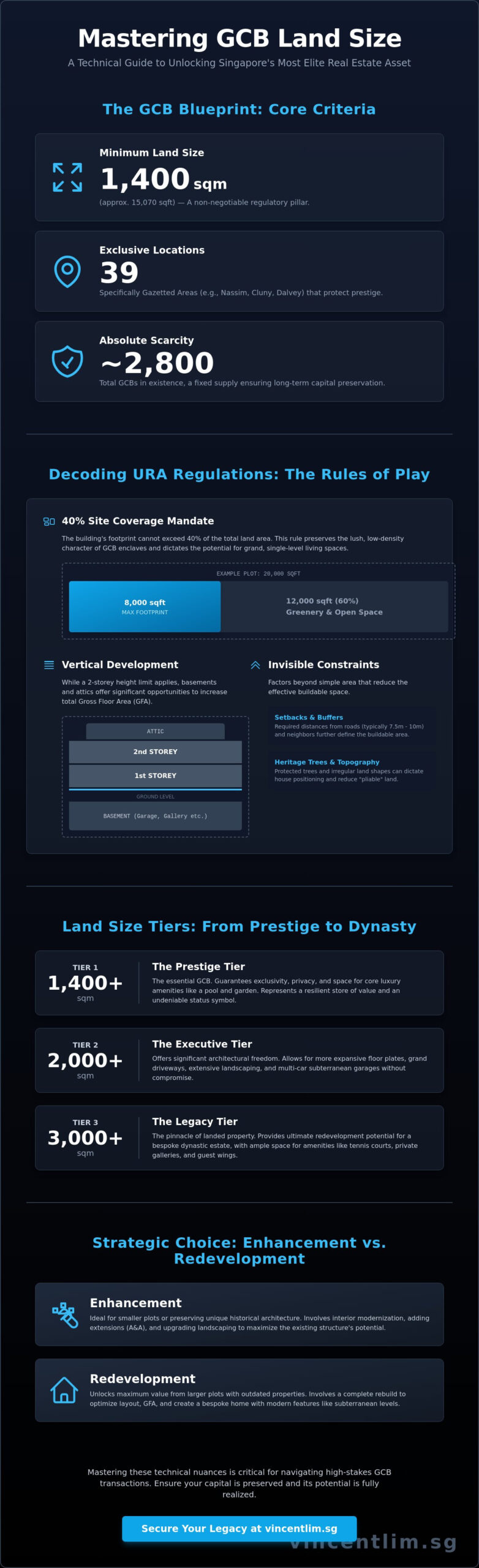
In the hierarchy of Singaporean real estate, the Good Class Bungalow (GCB) sits at the pinnacle, not merely because of its architecture, but because of its strictly mandated plot. The gcb land size acts as the primary differentiator between standard landed properties and these elite assets. With only approximately 2,800 GCBs existing nationwide as of 2026, the scarcity is absolute. This fixed supply creates a formidable barrier to entry, ensuring that ownership remains reserved for the most disciplined investors who prioritize capital preservation above all else.
The 1,400 sqm Benchmark: More Than Just a Number
The Urban Redevelopment Authority (URA) enforces a rigid 1,400 square meter (approximately 15,070 square feet) minimum for any property to be classified as a GCB. This isn’t a guideline; it’s a non-negotiable regulatory pillar. These properties must also reside within 39 specifically gazetted areas, such as Nassim, Cluny, or Dalvey. Understanding Urban Planning in Singapore helps clarify why these enclaves are protected so fiercely. A “large bungalow” outside these zones might share similar dimensions, but it lacks the legal GCB designation. This distinction is vital for valuation, as true GCB status preserves the low-density character that defines Singapore’s most prestigious neighborhoods.
Why Minimums Define Market Exclusivity
These minimum land requirements serve a dual purpose: they protect the city’s “green lungs” and prevent the fragmentation of prime land. By prohibiting sub-division into smaller plots, the authorities maintain the integrity of these expansive estates. It’s a strategy that has historically protected property values during market volatility. When you acquire a GCB, you aren’t just buying a home. You’re securing a piece of land that cannot be replicated or diluted. This inherent scarcity is the engine behind long-term capital appreciation, making the gcb land size a foundational metric for any serious investment analysis.
Investors who master these technicalities can better anticipate the asset’s trajectory. The 1,400 sqm threshold ensures that even the “entry-level” GCB maintains a level of grandeur that smaller detached houses cannot match. It guarantees privacy, space for bespoke luxury amenities, and a level of prestige that remains untarnished by urban densification. In a city-state where land is the ultimate luxury, these dimensions are the true measure of wealth and legacy. For investors evaluating the broader spectrum of premium plots, exploring landed property for sale in Singapore provides essential context on how GCBs compare to other landed asset classes across the island’s finite land bank.
Navigating URA Planning Constraints and Site Coverage
Understanding the total gcb land size is only the first step in a sophisticated valuation. The true utility of a plot is determined by site coverage, which is the ratio of the building’s footprint to the total land area. In Singapore’s 39 gazetted areas, URA regulations are stringent. Currently, the building footprint cannot exceed 40% of the total land area. This rule ensures that these elite enclaves retain their lush, low-density character and prevents the over-development of sensitive residential zones.
The 40% Site Coverage Rule Explained
If you acquire a 20,000 sq ft plot, your maximum ground-level footprint is limited to 8,000 sq ft. While this might seem restrictive, larger land sizes offer significantly more flexibility for expansive floor plates and grand entrance halls. This regulation also dictates the potential for subterranean levels. A larger footprint allows for more extensive basement excavations, which are often used for private galleries or multi-car garages without infringing on the 40% limit. It’s helpful to review GCB market trends to see how these planning parameters influence current valuations and buyer appetites.
Attics and basements provide additional floor area while maintaining the two-storey height limit. However, the “Central Tree Conservation Area” adds another layer of complexity. Large plots often contain gazetted heritage trees that cannot be removed. These natural features can dictate the positioning of the house, effectively reducing the “pliable” area of the land. This is where a strategic approach to site selection becomes invaluable, as the interaction between greenery and concrete determines the property’s ultimate livability.
Setbacks and Buffer Zones: The Invisible Constraints
Beyond site coverage, setbacks from roads and common boundaries act as invisible borders that further restrict construction. Typically, a GCB requires a 7.5m to 10m setback from the front road and specific buffers from neighboring plots. Irregular land shapes, such as “wedge” or “flag” lots, can be particularly challenging. On these plots, the effective buildable area might be significantly lower than the nominal gcb land size would suggest.
A professional survey and a deep dive into the URA’s master plan are non-negotiable steps before any acquisition. Miscalculating these buffers can lead to overpaying for land that cannot support your specific architectural ambitions. For those seeking a meticulous evaluation of a specific site’s potential, consulting an elite strategist ensures that every square foot is accounted for before the transaction proceeds. This level of due diligence is what separates a standard purchase from a legacy-building investment.
Analyzing GCB Land Size Tiers and Market Valuation
Valuation in the GCB market isn’t a simple linear calculation. While the baseline is the mandated 1,400 sqm, the 2026 market segments these properties into three distinct strategic tiers. Entry-level plots typically range from 15,000 to 25,000 sq ft. Mid-tier assets occupy the 25,000 to 40,000 sq ft bracket. Finally, trophy assets exceed 40,000 sq ft. Each tier attracts a specific profile of ultra-high-net-worth investor, and recognizing these divisions is essential for accurate capital allocation.
Standard Plots vs. Mega-Mansions
The 15,000 to 25,000 sq ft tier remains the most liquid segment of the market. These properties offer a “manageable” scale for single-family residences while still providing the prestige of the GCB title. In contrast, trophy assets exceeding 40,000 sq ft are prized for their extreme rarity. These mega-mansions command a prestige premium because they represent a contiguous land parcel that’s nearly impossible to assemble in modern Singapore. Owning a plot of this magnitude is the ultimate statement of legacy and wealth preservation.
Plot geometry also dictates the premium. A square or rectangular gcb land size is significantly more valuable than a wedge-shaped or irregular plot of the same total area. Regular shapes allow for a more efficient application of the 40% site coverage rule. This efficiency results in a larger building footprint and more versatile options for bespoke landscaping, such as private tennis courts or expansive pavilion wings.
Price-per-square-foot (PSF) Dynamics in 2026
Investors must navigate the inverse relationship between land size and PSF. As the total plot size increases, the PSF often softens, even as the absolute price quantum reaches record highs. This occurs because the buyer pool for a $100 million asset is naturally smaller than for an entry-level GCB priced between $10 million and $15 million. Understanding this “quantum effect” prevents investors from overpaying for mega-plots based on the PSF benchmarks of smaller, more liquid properties.
For those focused on a “redevelopment play,” the land-to-built ratio is the most telling metric. A property where the land value constitutes 80% or more of the total acquisition price offers the highest potential for value creation through a total rebuild. When you evaluate a potential acquisition, focus on the land’s intrinsic value rather than the existing structure. This approach ensures that your investment floor is protected by the absolute scarcity of the gcb land size itself, regardless of future architectural trends. Investors who want a comprehensive walkthrough of the full acquisition process, including stamp duty implications and SLA compliance, will find the detailed steps on how to buy a GCB in Singapore an indispensable resource before committing capital.
Redevelopment Potential: Size as a Catalyst for Value
The transition from a standard residence to a GCB is a leap in scale that requires a shift in investment mindset. For many owners, the value isn’t found in the current architecture but in the “highest and best use” of the plot. The decision to undertake a total rebuild versus a major Additions & Alterations (A&A) project depends heavily on the gcb land size and the existing structure’s placement. While a rebuild requires a significant capital outlay, it allows you to reset the property’s lifecycle and maximize modern design standards that older builds simply cannot accommodate.
A&A vs. New Build: A Land-Centric Approach
A total rebuild is often the most strategic path when the land value accounts for a high percentage of the acquisition cost. If a plot exceeds 20,000 sq ft, the ROI on a multi-million dollar construction project is often justified by the massive uplift in the eventual resale price. Conversely, the “sweet spot” for A&A usually lies in plots closer to the 15,070 sq ft minimum. In these cases, preserving the original structure while modernizing the interiors can yield a faster turnaround. Some heritage GCBs on expansive plots also benefit from A&A to maintain their historical character while integrating modern comforts.
Optimizing Large Footprints for Modern Luxury
Large land sizes act as a catalyst for amenities that define 2026 luxury standards. With a 40% site coverage limit, a 30,000 sq ft plot provides a massive 12,000 sq ft ground floor footprint. This scale allows for dedicated entertainment wings, separate guest suites, and professional-grade car galleries. Topography plays a crucial role here. While flat land offers lower construction costs, hilly terrain allows for “daylight basements.” These levels don’t count towards the two-storey height limit but provide immense additional square footage for gyms or private cinemas.
When evaluating a plot’s redevelopment potential, use this checklist:
- Shape and Efficiency: Is the plot regular enough to maximize the 40% footprint?
- Topography: Does the slope allow for a functional walk-out basement?
- Tree Conservation: Are there gazetted trees that will obstruct the new building envelope?
- Setback Impact: How much of the gcb land size is consumed by the required 7.5m to 10m buffers?
Determining the optimal path for a specific property requires a blend of regulatory knowledge and market foresight. To explore how your current or prospective plot can be transformed into a high-value asset, consult with a GCB sales specialist who understands the intricacies of redevelopment strategy.
Securing Your Legacy with Expert GCB Brokerage
Acquiring a Good Class Bungalow is a complex undertaking that extends far beyond a standard property transaction. It is a strategic move into Singapore’s most exclusive asset class, requiring a level of due diligence that accounts for both current regulations and future market shifts. Success in this arena depends on more than just capital. It requires an Elite Strategist who can decode URA and SLA data to identify the true potential of a gcb land size before the first offer is made. Vincent Lim provides this specialized oversight, ensuring that every acquisition aligns with a client’s long-term wealth preservation goals.
The Value of a Strategic Real Estate Partner
With over 20 years of experience in the luxury sector, Vincent Lim’s approach is built on the foundation of seasoned authority and calculated competence. Navigating a GCB deal involves coordinating a sophisticated team of architects, lawyers, and tax advisors. This “white-glove” service level ensures that technical risks, such as hidden easements or restrictive conservation orders, are mitigated early in the process. A strategic partner doesn’t just find a property. They refine the entire transaction to protect the buyer’s interests and provide total peace of mind during high-stakes negotiations.
Beyond the Transaction: Wealth and Legacy Planning
In the context of multi-generational planning, the specific gcb land size serves as a critical hedge against urban densification. These expansive plots are essentially private land banks that secure a family’s legacy for decades. Because the supply of these properties is strictly capped, the value is inherently tied to the land’s rarity and its future redevelopment potential. Discretion is paramount in this market. Many of the most significant GCB land parcels never reach the public portals. Accessing these off-market opportunities requires a broker with deep-rooted connections and a reputation for unwavering integrity.
Ownership of a GCB is the ultimate statement of success in Singapore, but it also carries the responsibility of managing a significant portion of one’s portfolio. By viewing these assets through the lens of estate planning and asset progression, investors can ensure their holdings remain resilient across generations. Professional guidance is the bridge between a simple purchase and a legacy-defining investment. To explore the strategic possibilities of your next acquisition, consult with Vincent Lim for a bespoke GCB land analysis.
Advancing Your Strategic Position in the 2026 GCB Market
The 1,400 square meter threshold is more than a regulatory requirement; it is the definitive floor for prestige and long-term capital preservation in Singapore. By navigating the complexities of URA site coverage and the nuances of plot geometry, you ensure that your acquisition remains a resilient store of value. Mastering the technicalities of gcb land size allows you to look beyond current structures and identify the true redevelopment potential of a site before committing significant capital.
Securing a legacy of this magnitude requires a partner with the discipline and market access to uncover exclusive off-market opportunities. Vincent Lim serves as an Executive Associate Director at OrangeTee & Tie, bringing over 20 years of luxury landed expertise to every transaction. As a specialist in off-market GCB transactions, he provides the transparency and strategic foresight necessary for high-stakes decision making. This professional oversight ensures that your interests are protected at every stage of the acquisition process.
Partner with Vincent Lim to acquire your GCB legacy and move forward with the confidence that your wealth is anchored in Singapore’s most elite land parcels. Your journey toward multi-generational security begins with a calculated and informed first step.
Frequently Asked Questions
What is the absolute minimum land size for a GCB in Singapore?
The absolute minimum gcb land size is 1,400 square meters, which is approximately 15,070 square feet. This is a rigid regulatory requirement set by the Urban Redevelopment Authority (URA) for any property within the 39 gazetted areas to be classified as a Good Class Bungalow. Any plot falling below this threshold is generally classified as a standard bungalow, even if it resides within a prestigious enclave.
Can I subdivide a large GCB plot into two smaller GCBs?
Subdivision is permissible only if each resulting plot maintains a minimum size of 1,400 square meters. For example, a “mega-plot” of 3,000 square meters could potentially be split into two separate GCB titles. This strategy is often utilized by investors to unlock significant capital value, provided the new plots meet all URA planning and setback requirements.
How does the 40% site coverage rule affect my building design?
The 40% site coverage rule limits the ground-level footprint of your home to less than half of the total land area. This mandate encourages the preservation of green space and low-density living. To maximize floor area, owners often incorporate expansive basements and attic levels, which provide additional functional space without violating the two-storey height restriction or the footprint limit.
Is land size the most important factor in GCB valuation?
While gcb land size is a foundational pillar of valuation, it works in tandem with location and plot shape. A smaller, regular-shaped plot in a “Trophy” area like Nassim Road often commands a higher price-per-square-foot than a larger, irregular plot in a secondary GCB zone. The efficiency of the land, or how much of it is actually buildable after setbacks, is what truly determines its market worth.
Are there GCB areas where land size requirements are different?
No, the 1,400 square meter minimum is a standardized requirement across all 39 gazetted GCB areas in Singapore. While the character and market pricing of these neighborhoods vary significantly, from the lush hills of Bukit Timah to the exclusive lanes of District 10, the URA planning constraints regarding minimum plot size remain consistent to protect the asset class’s integrity.
How does topography affect the usable land size of a GCB?
Topography can significantly impact the “pliable” area of a plot. While steep slopes might reduce the flat area available for traditional gardens, they offer unique architectural opportunities for daylight basements. These subterranean levels can be designed to open directly onto lower-tier landscaping, effectively increasing the internal square footage without encroaching on the mandated site coverage limits.
Can a foreigner buy a GCB if the land size is below 1,400 sqm?
Foreigners and Permanent Residents are generally restricted from purchasing any GCB, regardless of the land size. Under the Residential Property Act, only Singapore citizens are eligible to own these landed assets. Rare exceptions are made by the Singapore Land Authority (SLA) for individuals who have made exceptional economic contributions, but these approvals are extremely infrequent and subject to stringent conditions.
What happens if my GCB land size is slightly under 15,070 sq ft?
Some historical plots that were gazetted before the current 1,400 square meter rule was established are considered “legacy” GCBs. These properties retain their GCB status and prestige despite being slightly undersized. However, owners of these plots cannot subdivide the land, and any new redevelopment must strictly adhere to the most current URA planning guidelines for that specific area.