Is the 20% price premium for a freehold title truly the safest bet for your capital, or is it a luxury that might limit your immediate ROI? Many Singaporean investors view the freehold vs leasehold landed property debate through the lens of permanent ownership; however, in 2026, market data suggests that location and entry price often outweigh tenure for medium-term gains. You likely feel the pressure to secure a legacy home while fearing the impact of lease decay on your future resale value.
This guide provides a clear framework to evaluate these assets based on capital appreciation, legacy planning, and current market trends. It details how to balance the high entry costs of freehold estates against the strategic advantages of well-located leasehold properties. We’ll examine why the landed market saw a 15.38% transaction value increase in 2025 and how you can position your portfolio to benefit from this continued scarcity.
Key Takeaways
- Understand the legal nuances between perpetual ownership and SLA-managed leases to ensure your property aligns with your long-term wealth preservation goals.
- Identify the specific inflection points on the lease decay curve where the value of freehold vs leasehold landed property begins to diverge significantly.
- Utilize Bala’s Table to accurately assess the land value of older leasehold titles and determine the viability of potential lease top-ups.
- Apply our selection framework to determine if your financial profile favors the “Legacy Builder” approach or the “Lifestyle Maximizer” strategy for higher immediate utility.
- Discover why accessing off-market data is essential for securing fair market value when transacting Terrace houses, Semi-Detached homes, and Good Class Bungalows.
Understanding the Fundamentals: Freehold vs Leasehold Definitions
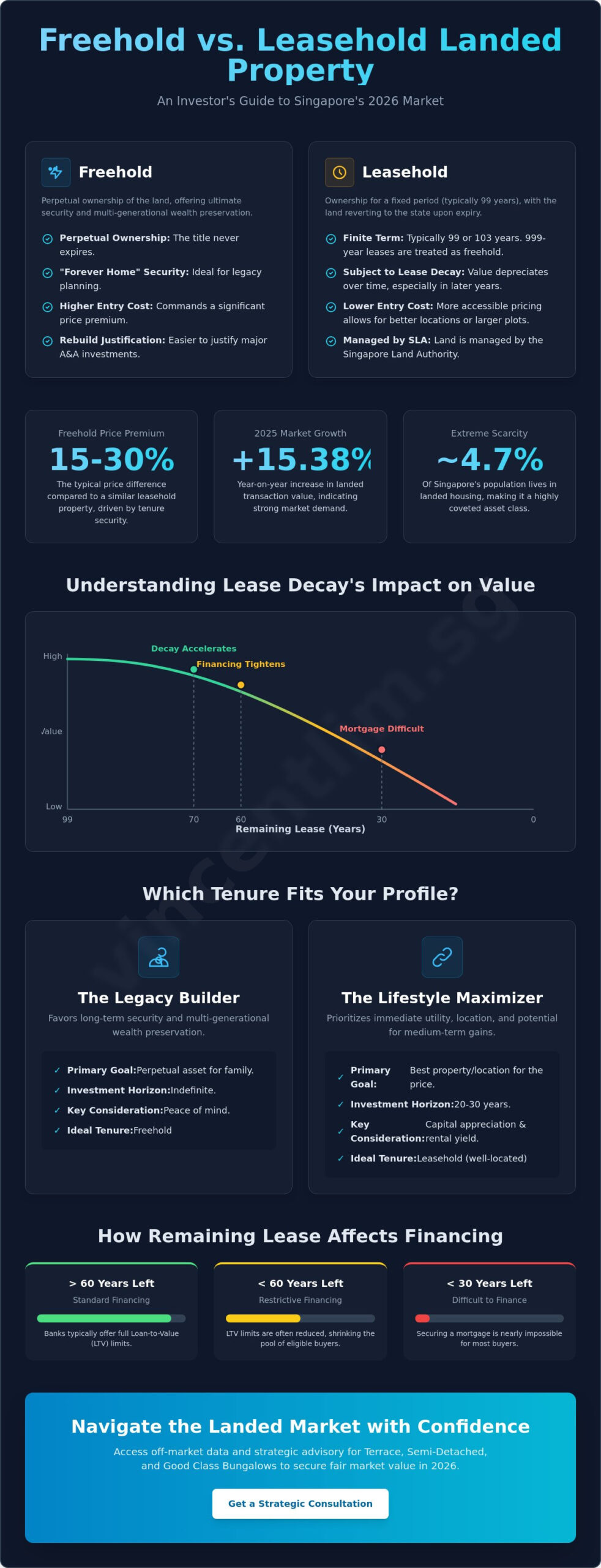
Selecting a freehold vs leasehold landed property isn’t just a financial calculation; it’s a strategic decision about the permanence of your legacy. Freehold status grants you perpetual ownership of the land, meaning the title doesn’t expire. This tenure offers a significant psychological premium, as it removes the anxiety of lease expiration and provides the ultimate “forever home” for your family. In a land-scarce nation like Singapore, the peace of mind that comes with absolute ownership is a primary driver for the luxury segment.
Leasehold properties, typically issued for 99 or 103 years, are managed by the Singapore Land Authority (SLA). These assets are finite. At the end of the term, the land reverts to the state unless an extension is granted. You’ll also encounter 999-year leases, which are historical remnants. In the current market, these are effectively treated as freehold assets because their expiration date is so distant that it doesn’t impact current valuations or bank financing protocols.
The Legal Nuances of Land Ownership in Singapore
The State Lands Act serves as the foundation for all property rights in Singapore. Understanding Land Tenure is vital because it dictates your bundle of rights, including redevelopment potential and collective sale prospects. Most landed homes carry a Land Title, giving you direct control over the plot. In contrast, strata landed homes involve shared land ownership similar to condominiums. Freehold ownership remains the gold standard for multi-generational wealth preservation.
Why Tenure Matters More for Landed Than Condos
In the landed segment, tenure carries more weight than in the condominium market due to absolute scarcity. Only about 4.7% of the population lives in landed housing, making these plots high-value assets. Tenure directly influences your ability to undertake major structural Additions & Alterations (A&A) to your Terrace or Semi-Detached house. Your investment in a massive rebuild is easier to justify when you own the land forever.
Financial institutions also view tenure with a critical eye. As a lease shortens, particularly below the 60-year mark, banks often reduce Loan-to-Value (LTV) limits. For a property with less than 30 years remaining, securing a mortgage becomes nearly impossible for most buyers. This restriction can shrink your pool of future buyers, making tenure a critical factor in your exit strategy. When you choose a freehold vs leasehold landed property, you’re essentially choosing between a permanent asset and a structured timeline for capital recovery.
Price Performance Trends: Analyzing the Capital Appreciation Gap
Historical data reveals that landed property values have entered a structurally higher pricing band in 2026. Over the last 20 years, freehold assets have generally outpaced leasehold counterparts in capital appreciation, though the gap isn’t always linear. In 2025 alone, the landed segment recorded a 15.38% year-on-year increase in transaction value, driven by extreme scarcity and rising replacement costs. When evaluating freehold vs leasehold landed property, investors must recognize that leasehold assets often perform well in the first 20 to 30 years before the “Lease Decay” curve begins to exert downward pressure on prices.
This decay typically accelerates once the remaining lease drops below 70 years. By the time a property has only 60 years left, bank financing becomes more restrictive, which naturally limits the pool of eligible buyers and dampens resale value. However, a prime leasehold property in highly sought-after central locations can still outperform a fringe freehold property if the entry price allows for significant rental income or if the location is near reputable educational institutions. Scarcity remains the primary driver; there simply aren’t enough Terrace houses or Semi-Detached homes to meet the demand of Singapore’s wealthiest 4.7%.
The Premium Gap: How Much More Should You Pay for Freehold?
The choice between tenures often comes down to the price you pay at the start. Research into freehold property price premiums indicates that buyers are often willing to pay more for the security of perpetual ownership. The freehold premium usually ranges from 15% to 30% depending on the remaining lease. In prime districts, this gap can narrow if a leasehold development offers superior land size or architectural merit that a smaller freehold plot cannot match. Proximity to MRT stations and reputable primary schools often acts as a price floor, protecting leasehold values even as the clock ticks down.
Rental Yield vs. Capital Growth
Investors seeking immediate cash flow often find leasehold landed homes more attractive. Because the entry price is lower, the gross rental yields are frequently higher than those of freehold equivalents. For example, a leasehold terrace house might achieve a 2.5% yield, while a freehold version in the same area struggles to hit 1.8% due to its higher capital outlay. The trade-off is clear: you exchange long-term capital preservation for better monthly cash flow. If you’re unsure which path suits your financial timeline, you can review current market listings to compare real-time yield data across different districts.
Current interest rates in 2026 have made buyers more discerning about the tenure premium. While the “flight to safety” keeps freehold prices resilient, the high cost of borrowing has led some savvy investors to look at newer 99-year leasehold properties as a tactical 10-year play. This strategy allows them to enjoy the lifestyle of a landed home without the massive capital lock-in required for a freehold Good Class Bungalow or Detached house. Ultimately, your exit strategy should dictate whether you prioritize the “forever” title or the immediate lifestyle benefits of a more affordable leasehold entry. Beyond tenure, it is equally critical to account for your full tax liability; understanding the ABSD for landed property in 2026 is an essential part of calculating your true cost of acquisition before committing to either tenure type.
Debunking the “Wasting Asset” Myth of Leasehold Landed Homes
The fear that a leasehold title is a rapidly depreciating asset often stems from a misunderstanding of how land value is actually calculated in Singapore. While the clock is technically ticking, the decline in value is not a straight line. The government and financial institutions utilize Bala’s Table, a discounted cash flow model, to determine the present value of a leasehold interest. According to this principle, a property with 50 years remaining on a 99-year lease still retains approximately 74.7% of its land value compared to an identical freehold plot. This non-linear decay means that for the first several decades, the price performance of freehold vs leasehold landed property can remain surprisingly competitive.
Many High Net Worth Individuals (HNWIs) intentionally select leasehold titles for Detached houses or Semi-Detached homes to maximize their immediate lifestyle. By opting for a leasehold tenure, buyers can often secure a significantly larger land plot or a more prestigious location within prime districts for the same capital outlay required for a smaller freehold Terrace house. These buyers prioritize current utility and space over a 100-year legacy, recognizing that the capital “saved” at entry can be deployed into other high-yield investments. While lease top-ups through the Singapore Land Authority are not guaranteed, they remain a viable pathway for owners during major redevelopment or en-bloc exercises, provided the proposal aligns with the latest urban planning requirements.
Financing remains the most practical concern for leasehold owners as the property ages. The 60-year mark is a critical threshold; once a lease drops below this point, banks typically tighten Loan-to-Value (LTV) limits and the use of CPF funds for the purchase becomes restricted. This doesn’t make the property a “wasting asset” overnight, but it does shift the profile of the future buyer toward those with higher cash reserves. Understanding this timeline is essential for maintaining the liquidity of your real estate portfolio.
Strategic Entry and Exit Points for Leasehold
The “sweet spot” for leasehold investment generally lies in properties with at least 70 to 80 years of remaining lease. This window provides ample time for capital appreciation while ensuring that future buyers can still secure maximum bank financing. A common exit strategy involves selling the asset before it hits the 60-year mark, allowing you to capture gains and “recycle” your capital into a newer property. This high-leverage stepping stone approach can accelerate your asset progression more effectively than holding a slower-growing freehold asset in a less desirable location.
The Role of En-Bloc and Redevelopment Potential
Redevelopment potential is a significant value protector for leasehold land. The Master Plan 2024/2025 has introduced updated zoning and plot ratios that can make older leasehold plots highly attractive to developers. Identifying “undervalued” leasehold plots with high land-to-built ratios is a sophisticated way to play the landed market. If a cluster of leasehold Terrace houses is situated on land that can be intensified into more units, the en-bloc potential can provide a lucrative exit that defies the standard lease decay curve.
The Selection Framework: Which Tenure Fits Your Profile?
Deciding between freehold vs leasehold landed property requires an honest assessment of your financial timeline and family objectives. There’s no universal “better” option; instead, there is only the tenure that best serves your specific stage of life. By categorizing your goals into distinct profiles, you can strip away market noise and focus on the metrics that matter for your portfolio.
- The Legacy Builder: This profile prioritizes multi-generational wealth preservation. If you intend to pass your home to your children and grandchildren, freehold is the only logical choice. It provides a permanent asset base that remains immune to the pressures of lease decay and financing restrictions decades from now.
- The Lifestyle Maximizer: These buyers seek the prestige and space of a detached house for sale in Singapore or a Good Class Bungalow in prime districts but at a more accessible entry point. Leasehold allows you to enjoy a superior location or a larger land plot for roughly 20% less capital than a freehold equivalent.
- The Tactical Investor: This buyer focuses on immediate utility and rental yield. They often target leasehold Terrace houses in areas with high demand, such as those near international schools or major business hubs, to maximize monthly cash flow while planning to exit within 10 to 15 years.
The role of your Central Provident Fund (CPF) is a critical, often overlooked factor. Your ability to use retirement funds is tied to the property’s remaining lease. If the lease doesn’t cover the youngest owner until at least age 95, your CPF usage will be prorated. This can significantly increase your cash outlay and impact the future resale liquidity of the asset. Equally important is ensuring your acquisition strategy accounts for stamp duty obligations; a comprehensive review of ABSD rates and remission strategies for landed property purchases can prevent costly miscalculations that erode your returns regardless of which tenure you select.
Age and Investment Horizon Considerations
Your current age should dictate your risk tolerance regarding leasehold land. Younger buyers should generally lean toward freehold titles to avoid the stress of relocation in their later years. Conversely, retirees often find value in “right-sizing” from a large freehold estate into a luxury leasehold landed property. This move allows them to unlock significant liquidity for retirement while maintaining the lifestyle benefits of a landed home. If you’re currently evaluating options, it’s helpful to consult a Terrace House for Sale Singapore: A Strategic Guide to Landed Property Acquisition in 2026 to see how these profiles apply to current listings.
Comparison Table: Freehold vs. Leasehold at a Glance
| Feature | Freehold | Leasehold (99-Year) |
|---|---|---|
| Upfront Cost | High (15-30% premium) | Lower (Market entry level) |
| Financing | Standard LTV (75%) | Restricted if lease < 60 yrs |
| Legacy Value | Infinite / Permanent | Wasting (Time-limited) |
| Rental Yield | Typically lower | Often superior (higher ROI) |
Interpreting this data requires a nuanced understanding of the 2026 market. While freehold offers security, the higher interest rate environment makes the lower entry cost of leasehold attractive for those who prioritize cash flow. To receive a bespoke analysis of how these tenures impact your specific financial situation, you can book a private portfolio review with our team today.
Strategic Advisory: Navigating the 2026 Landed Market with Vincent Lim
Success in the Singaporean landed segment requires more than just checking a title deed. A “one-size-fits-all” approach often leads to missed opportunities or overpayment in the luxury market. While the freehold vs leasehold landed property debate provides a foundational starting point, seasoned investors know that the highest returns are found in the details that don’t appear on a standard listing. Every plot of land carries unique characteristics that can either enhance or diminish the value of its tenure over time.
Vincent Lim (OrangeTee & Tie)’s extensive experience in transacting Good Class Bungalows (GCBs) provides a unique vantage point for all landed property tiers. Whether you’re acquiring a Terrace house or a Semi-Detached home, the same rigorous standards used for S$50 million estates are applied to your acquisition. This includes leveraging proprietary off-market data that isn’t accessible to the public. By analyzing private transaction records and real-time sentiment, we ensure you’re valuing a property based on current market velocity rather than lagging indicators from months ago.
Beyond Tenure: Evaluating Land Shape, Facing, and Zoning
Tenure is a legal status, but land utility is what drives long-term resale appeal. A “bad” freehold plot, perhaps one that is triangular, narrow, or significantly below street level, might actually be a weaker asset than a “good” leasehold plot with a wide frontage and a regular shape. Vincent Lim (OrangeTee & Tie) provides deep-dive technical analysis beyond simple tenure checks, examining how URA zoning changes or plot ratio intensifications could unlock future value for your specific plot. Understanding how the Master Plan 2024/2025 affects your neighborhood is essential before committing to a high-stakes purchase.
Securing Your Legacy in Singapore Real Estate
Acquiring a detached house for sale in Singapore is often an emotional milestone, but it must be grounded in cold financial logic to be a successful investment. A specialist agent doesn’t just find a house; they act as a strategic partner to negotiate premiums and identify undervalued gems that others overlook. By crafting a bespoke “Asset Progression” roadmap, you ensure that your property portfolio grows in tandem with your family’s evolving needs. This methodical approach alleviates the stress of high-stakes transactions, providing you with the confidence that your capital is deployed effectively. Consult Vincent Lim (OrangeTee & Tie) for a tailored landed property strategy to secure your position in Singapore’s most exclusive real estate segment.
Mastering Your Position in the 2026 Landed Market
Navigating the complexities of the current real estate landscape requires a shift from viewing tenure as a binary choice to seeing it as a strategic alignment with your wealth objectives. Whether you prioritize the absolute permanence of a legacy estate or the tactical advantages of a high-utility leasehold plot, your decision should be informed by meticulous data and long-term exit planning. Success in this segment isn’t found in generic market trends; it’s found in the specific nuances of land shape, zoning, and future redevelopment potential.
Choosing between freehold vs leasehold landed property is only the first step in a larger narrative of asset progression. As the market enters a period of structural scarcity, having an expert who understands the intricacies of Good Class Bungalows and prime landed tiers is essential. With over 20 years of industry experience as an Executive Associate Director at OrangeTee & Tie, I offer a white-glove service level that translates complex land laws into clear, actionable results.
Partner with Vincent Lim to find your ideal landed home and secure a property that truly reflects your standards of excellence. Your journey toward a refined legacy starts with a single, calculated step.
Frequently Asked Questions
Can foreigners buy freehold landed property in Singapore?
Foreigners must obtain approval from the Land Dealings Approval Unit (LDAU) of the Singapore Land Authority to purchase any landed residential property. This requirement applies to Terrace houses, Semi-Detached houses, and Detached houses regardless of tenure. Approval is generally reserved for those who’ve made significant economic contributions to Singapore, and they’re subject to a 60% Additional Buyer’s Stamp Duty (ABSD).
Is a 999-year leasehold property exactly the same as a freehold one?
Legally, a 999-year lease is still a leasehold title, but the market treats it as equivalent to freehold. The price premium for freehold over 999-year leasehold is typically below 5% because the expiration date is too distant to impact bank financing or valuation models. For your investment portfolio, both tenures offer essentially the same level of long-term security.
How much more expensive is a freehold landed house compared to a leasehold one?
Freehold properties typically command a price premium of 10% to 20% over comparable leasehold properties. This gap reflects the value of perpetual ownership and the absence of lease decay. When evaluating freehold vs leasehold landed property, you’re essentially deciding whether the long-term capital preservation justifies this higher upfront investment.
What happens to a leasehold landed property when the lease expires?
The land reverts to the State, managed by the Singapore Land Authority, once the lease term ends. Owners don’t receive compensation at the point of expiration. While you can apply for a lease extension or top-up, approval isn’t guaranteed and depends heavily on the government’s future urban planning requirements for that specific area.
Does the bank provide full loans for older leasehold landed properties?
Banks usually restrict financing for properties with less than 60 years remaining on the lease. The maximum Loan-to-Value (LTV) limit of 75% might be reduced, and the loan tenure will likely be shortened to ensure the mortgage is cleared before the lease ends. This restriction ensures the bank’s collateral maintains sufficient value throughout the loan period.
Can I use my CPF to buy a leasehold landed property with 40 years left?
You can use your CPF, but the amount will be prorated if the remaining lease doesn’t cover the youngest buyer until at least age 95. For a property with only 40 years left, the allowable CPF usage is significantly limited. This results in a much higher cash outlay, which you must factor into your financial planning.
Is it harder to sell a leasehold landed property in the future?
Selling becomes more challenging as the lease decays, particularly once it drops below the 60-year threshold. The pool of potential buyers shrinks because many cannot secure full bank loans or use their full CPF amount. To maintain liquidity, many savvy owners choose to exit their leasehold positions while at least 70 years remain on the title.
Which tenure is better for a Good Class Bungalow (GCB) investment?
Freehold is the gold standard for the GCB segment. Because Good Class Bungalows are exclusively for Singapore Citizens and represent the most prestigious asset class, buyers almost always prioritize perpetual ownership. Most GCBs are freehold or 999-year leasehold, as the primary value lies in the absolute scarcity of the land itself.