Treating your terrace house renovation budget as a mere expense list rather than a strategic asset upgrade is a fundamental mistake that can erode your property’s long-term resale potential. You likely recognize that updating a landed property in Singapore’s 2026 market involves more than just aesthetic choices; it requires a meticulous balancing act between modern luxury and strict URA and BCA compliance. With construction material prices rising by up to 15% this year, a lack of precision in your initial planning often leads to significant financial leakage.
This guide empowers you to master these complexities by providing expert insights on current costs, regulatory hurdles, and high-yield investment strategies. We’ll provide a clear framework for categorizing your scope, whether you’re planning a cosmetic facelift or a full-scale reconstruction. By the end of this article, you’ll have the peace of mind that your renovation is a protected investment, fully accounted for against hidden structural costs and legal requirements.
Key Takeaways
- Learn to distinguish between cosmetic upgrades and structural Additions & Alterations to navigate URA regulations with professional precision.
- Establish a robust terrace house renovation budget that accounts for 2026 market fluctuations and the unique structural demands of older landed properties.
- Identify the primary cost drivers of GFA expansion and legacy utility upgrades to prevent unforeseen financial overhead during your project.
- Focus your investment on high-yield areas like ensuite bathrooms and multi-generational layouts to enhance both your daily lifestyle and future property marketability.
- Gain a clear understanding of BCA safety requirements and URA Envelope Control to optimize your property’s footprint within a secure legal framework.
Categorizing Your Scope: Facelift, A&A, or Reconstruction?
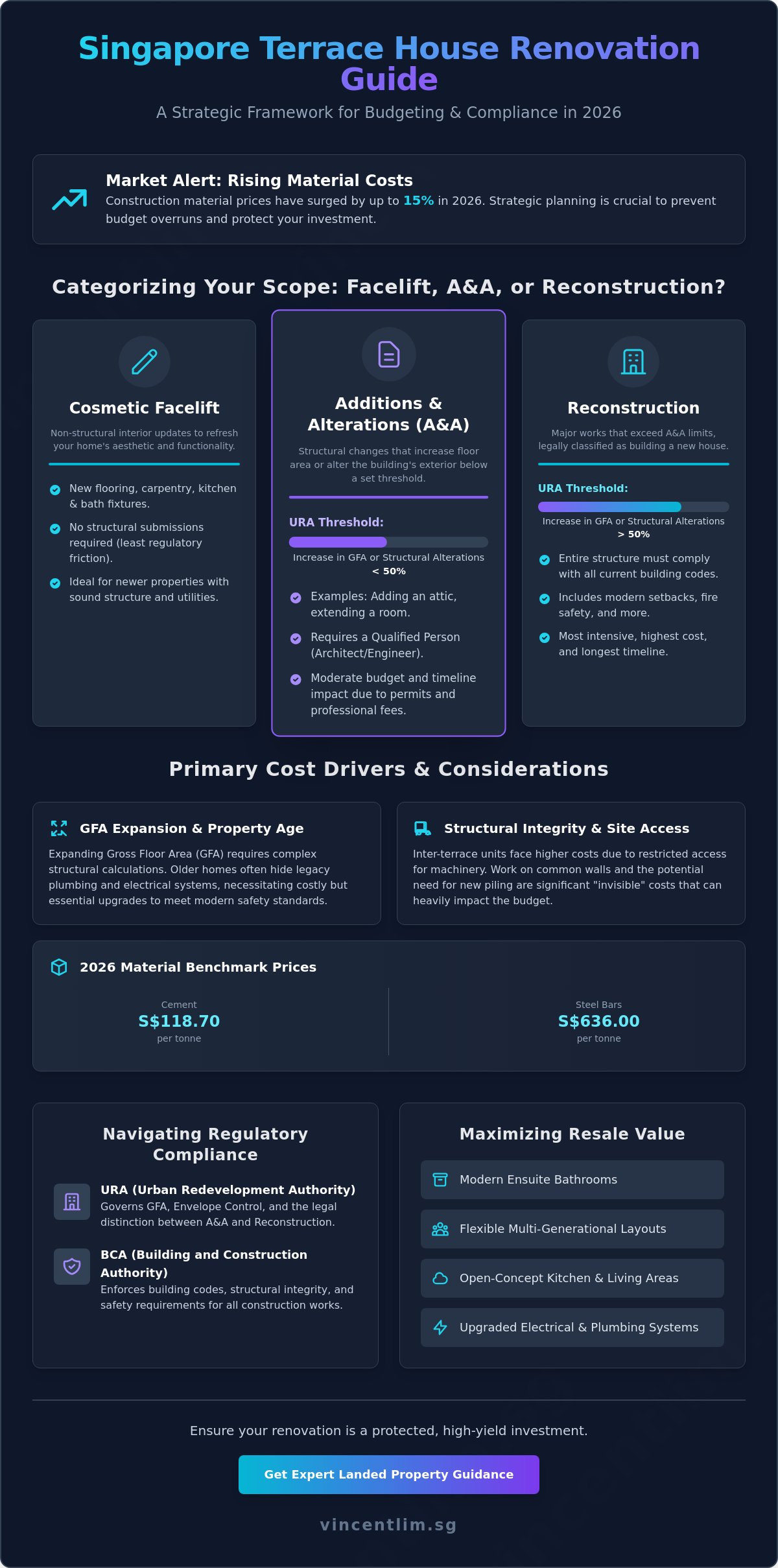
Identifying the legal scope of your project is the most critical factor in establishing a realistic terrace house renovation budget. Singapore’s regulatory framework distinguishes strictly between cosmetic facelifts, Additions & Alterations (A&A), and full reconstruction. These categories aren’t merely industry jargon; they represent legal thresholds set by the Urban Redevelopment Authority (URA) and the Building and Construction Authority (BCA) that dictate your project’s baseline cost and timeline.
A facelift involves interior works that don’t impact the building’s structural integrity. This includes replacing floor finishes, installing new carpentry, or updating kitchen and bathroom fixtures. Because these works don’t require structural submissions, they involve the least amount of regulatory friction. However, the History of Terrace Houses in Singapore shows that many older properties eventually require more intensive intervention to remain functional for modern living.
If your plans involve structural changes, you’ll likely move into the A&A or Reconstruction category. Under URA guidelines, A&A is defined as works where the increase in Gross Floor Area (GFA) is less than 50%, and alterations to external walls or structural elements also stay below the 50% threshold. If your project exceeds these limits, it’s legally classified as Reconstruction. This distinction is vital because a reconstructed house must comply with all current building codes, including modern setback requirements and fire safety standards, which can significantly influence your financial planning.
When a Facelift is Sufficient
A facelift is the most efficient choice for newer terrace houses where the foundation and utility lines are in excellent condition. You can focus your resources on high-impact areas like bespoke carpentry, premium flooring, and modernizing the kitchen. This path avoids the complexities of structural permits, making it the fastest way to refresh your space. It’s the ideal route if you’re satisfied with the existing layout and want to avoid the overhead of professional fees for engineers or architects. Alternatively, homeowners who prefer to bypass the renovation process entirely may find that the benefits of buying a renovated terrace house offer a compelling, cost-certain path to achieving a turnkey luxury home.
The Complexity of A&A and Reconstruction
Expanding your floor area or adding an attic level requires a more substantial terrace house renovation budget due to the need for a Qualified Person (QP), such as a registered architect or engineer. Reconstruction is the most intensive path; it requires the entire structure to meet current building standards. With construction material prices having risen by 5% to 15% as of March 2026, these structural choices carry significant weight. You’ll need to account for professional fees, specialized labor, and the potential need to upgrade the entire property’s electrical and plumbing infrastructure to meet modern safety codes.
Primary Cost Drivers for Terrace House Renovations
Understanding the variables that influence your terrace house renovation budget is essential for maintaining financial control. While floor area is a primary factor, the distinction between total land area and Gross Floor Area (GFA) is where many homeowners encounter surprises. Expanding your GFA requires more than just additional materials; it necessitates precise structural calculations and strict adherence to the BCA Renovation Guidelines to ensure safety and compliance.
Property age remains a silent budget escalator. Older terrace houses often harbor legacy plumbing and electrical systems that no longer meet modern safety standards. When you peel back the layers of a 30 year old inter terrace unit, you aren’t just paying for new tiles. You’re investing in a complete overhaul of concealed utilities to prevent future leaks or circuit overloads. These essential upgrades form the foundation of a high value home, much like the meticulously maintained properties found in our landed property listings.
Structural Integrity and Site Access
Logistical challenges significantly impact the final bill. Inter terrace units often face higher costs due to restricted site access; machinery must often be craned over roofs or moved through narrow passages. This is contrasted with corner terrace units that offer more maneuverability. With cement prices at S$118.70 per tonne and steel bars at S$636.00 per tonne as of early 2026, the baseline for structural work is higher than in previous years. Additionally, any work involving common walls requires careful coordination with neighbors and potentially expensive structural reinforcement. If your site requires new piling, these “invisible” costs will consume a significant portion of your terrace house renovation budget before any finishes are applied.
Customization vs. Off-the-Shelf Solutions
Your choice of materials defines the “budget floor” of the project. While standard porcelain tiles are durable and cost-effective, opting for bespoke imported marble can triple your flooring expenses instantly. Bespoke cabinetry designed for high-ceiling terrace houses also commands a premium. Modern homeowners in 2026 are increasingly integrating smart home systems and high-end kitchen appliances. These features don’t just add to the purchase price; they often require specialized electrical load upgrades, which must be factored into your early planning stages to avoid mid-project delays.
Estimated Budget Framework for 2026
Establishing a precise terrace house renovation budget in 2026 requires a disciplined approach to current market data. As material costs have risen by 5% to 15% according to the Singapore Contractors Association Limited (SCAL), your financial framework must be both precise and flexible. A standard tier renovation typically ranges from S$50,000 to S$200,000, focusing on essential repairs and aesthetic updates. For homeowners seeking significant layout optimization or Additions & Alterations (A&A), the premium tier often spans S$180,000 to over S$360,000. If your vision involves a complete architectural statement, full reconstruction starts at approximately S$2.5 million and can reach S$5 million.
Maintaining a 15% to 20% contingency fund is non-negotiable for landed properties. Unlike high-rise apartments, terrace houses often present unique structural surprises once demolition begins, from legacy foundation issues to unexpected common wall complications. For additional context on financing these high-stakes projects, consulting a comprehensive Renovation Cost Guide can provide further clarity on how to structure your capital allocation effectively.
Budgeting by Renovation Intensity
Reconstruction costs are typically calculated on a per square foot (PSF) basis, currently ranging from S$350 to S$700 or more depending on the complexity of the design. Corner terrace units often incur higher expenses than inter-terrace units because they possess larger external facades and more extensive garden areas that require landscaping. You shouldn’t overlook the car porch and roof terrace; these outdoor zones require specialized waterproofing and structural Grade 40 pump concrete, which currently costs S$128.80 per cubic metre.
The “Soft Costs”: Professional and Authority Fees
Beyond physical construction, your terrace house renovation budget must account for professional and authority fees. These are essential line items that ensure your project remains legally compliant and structurally sound. You should budget for the following:
- Architectural and Interior Design (ID) consultancy fees, typically ranging from 8% to 15% of the total project cost, though homeowners can often minimize these expenses by partnering with Direct Renovation Contractor Singapore to manage the project without middleman markups.
- Professional Engineer (PE) and Qualified Person (QP) endorsements for all structural alterations.
- BCA plan fees, which as of April 17, 2026, include a deviation fee of S$200 per storey for general building works.
- URA submission fees for A&A or reconstruction approvals, which are mandatory for any GFA expansion.
By accounting for these soft costs early, you avoid the common pitfall of over-allocating funds to finishes while neglecting the regulatory requirements that protect your property’s legal status.
Navigating Regulatory Compliance and Hidden Hurdles
Expertly managing your terrace house renovation budget requires a deep understanding of the regulatory environment. In Singapore, the Urban Redevelopment Authority (URA) and the Building and Construction Authority (BCA) act as the primary gatekeepers for landed property development. URA’s Envelope Control Guidelines dictate the maximum permissible height and volume of your building, ensuring it stays within the aesthetic and density requirements of your specific neighborhood. Ignoring these boundaries isn’t just a design error; it’s a legal liability that can lead to costly demolition orders or heavy fines.
A professional legal survey is an essential first step before any groundwork begins. In many older landed estates, property boundaries may have shifted over decades due to informal fencing or previous unrecorded works. Confirming your exact plot dimensions prevents encroachment disputes with neighbors that could halt your project indefinitely. If you’re currently evaluating a terrace house for sale in Singapore for its redevelopment potential, our expert property advisory services can help you identify these risks before you commit to a purchase.
URA and BCA: The Gatekeepers of Your Build
BCA focuses on structural integrity, which is particularly sensitive in terrace rows where units share common party walls. Any structural alteration requires a Professional Engineer (PE) to endorse the plans, ensuring that your renovation doesn’t compromise the safety of adjacent homes. Approval timelines typically span several months; you must factor these into your carrying costs, including loan interest and temporary housing. Failure to secure these permits before starting work is a high-risk gamble that no seasoned homeowner should take.
Utility Upgrades and External Works
Modernizing a terrace house often necessitates a significant upgrade to its utility infrastructure. If you’re adding high-capacity air conditioning systems or smart home technology, you’ll likely need to increase your electrical load. This requires engaging a Licensed Electrical Worker (LEW) to handle the SP Services application and installation, adding several thousand dollars to your terrace house renovation budget. External works also demand attention. Widening a driveway or reconstructing a car porch involves PUB drainage clearances and potentially new sewerage connections if you’re adding bathrooms. These technical requirements often come with “hidden” costs like soil testing for foundation stability or asbestos removal for houses built before the late 1980s. Addressing these hurdles early ensures a seamless transition from planning to execution.
Maximizing Resale Value Through Strategic Renovation
Finding the “sweet spot” between personal comfort and market appeal is the hallmark of a savvy homeowner. While it’s tempting to customize every corner of your property, over-capitalizing on niche features can lead to diminishing returns during resale. A well-allocated terrace house renovation budget focuses on high-impact zones that potential buyers prioritize. In the 2026 market, these areas include modern, high-specification kitchens and ensuite bathrooms. We’ve observed that buyers are increasingly willing to pay a premium for multi-generational layouts that offer privacy and accessibility, reflecting Singapore’s evolving demographic needs. Exploring proven terrace house layout ideas that maximize perceived square footage and indoor-outdoor continuity can help you identify which spatial investments deliver the strongest returns in today’s market. For those who prefer to sidestep the renovation process altogether, understanding the benefits of buying a renovated terrace house in Singapore’s supply-constrained market can reveal a compelling alternative path to securing a premium landed asset.
A documented renovation history is a powerful tool for justifying a higher asking price. When you maintain a meticulous record of structural works, utility upgrades, and authority approvals, you provide potential buyers with peace of mind. Transparency regarding the quality of concealed works, such as waterproofing and electrical rewiring, distinguishes your property in a competitive market. This level of diligence ensures that your renovation is viewed as a verified asset rather than a liability with hidden issues.
Renovating with an Exit Strategy
Current trends in the luxury terrace market favor “move-in ready” homes that utilize timeless architecture over fleeting interior design fads. Buyers in 2026 are looking for sustainable materials and smart home integration that doesn’t require immediate replacement. Prioritizing natural light and efficient ventilation through strategic A&A can significantly enhance the perceived value of your home. Vincent Lim assists clients by evaluating a property’s renovation potential before the first brick is laid, ensuring the design aligns with future market demands.
Asset Progression: From Terrace to Semi-Detached
Strategic renovation serves as a financial bridge for those looking to move up the property ladder. By carefully managing your terrace house renovation budget, you can increase your property’s equity to facilitate your next upgrade to a semi-detached or detached home. We have seen cases where a well-executed A&A, which expands the Gross Floor Area (GFA) while maintaining modern aesthetic standards, has increased a terrace house’s market value by approximately 30%. This capital appreciation is not accidental; it’s the result of disciplined planning and a deep understanding of landed property dynamics. To ensure your project delivers the maximum return on investment, speak with Vincent Lim to assess your property’s redevelopment potential.
Securing Your Property’s Future Value
Managing a terrace house renovation budget in 2026’s dynamic market requires more than just a list of materials. It’s a process that demands a sophisticated understanding of legal thresholds, structural integrity, and long-term asset progression. By distinguishing between cosmetic facelifts and extensive reconstructions early, you protect your capital from regulatory friction and unforeseen structural overhead. Every decision, from material selection to utility upgrades, should ultimately serve to enhance both your daily lifestyle and your property’s eventual resale appeal.
Expert guidance is essential when managing high-value landed assets. Vincent Lim, an Executive Associate Director at OrangeTee & Tie, brings over 20 years of Singapore real estate expertise to your project. As a specialist in luxury landed properties and GCBs, he provides the seasoned authority needed to align your renovation goals with market realities. Consult Vincent Lim for a professional valuation and asset progression strategy to ensure your home remains a high-performing asset. Your journey toward a refined, compliant, and valuable landed home begins with precise planning today.
Frequently Asked Questions
How much does a full reconstruction of a terrace house cost in 2026?
A full reconstruction in 2026 is estimated to cost between S$2.5 million and S$5 million. This investment reflects the total teardown and rebuilding of the structure to meet modern standards. On a per square foot basis, construction costs typically range from S$350 to S$700 or more, depending on the complexity of the architectural design and the quality of the selected finishes.
What is the difference between A&A and reconstruction for a terrace house?
The distinction is defined by the Urban Redevelopment Authority’s 50% rule regarding structural changes and floor area expansion. An Additions & Alterations (A&A) project stays below this 50% threshold for both Gross Floor Area (GFA) and alterations to external walls. If your project exceeds these limits, it’s legally classified as a reconstruction, which requires the entire house to comply with all current building codes, significantly impacting your terrace house renovation budget.
Do I need an architect for a terrace house renovation in Singapore?
You must engage a Qualified Person (QP), typically a registered architect or structural engineer, for any renovation that involves structural changes or GFA expansion. These professionals are legally required to manage submissions to the BCA and URA. While a cosmetic facelift doesn’t strictly mandate an architect, their involvement ensures that the project is executed with professional precision and adheres to all safety regulations.
How long does a typical terrace house renovation take?
Project durations vary based on the intensity of the work and the required authority approvals. A cosmetic facelift usually takes three to five months to complete. An A&A project typically requires six to twelve months, while a full reconstruction is a more extensive undertaking that can span eighteen to twenty-four months from the design phase to the issuance of the Temporary Occupation Permit (TOP).
Can I stay in my terrace house during an A&A renovation?
Staying in the property during an A&A project is generally not recommended due to safety hazards and significant lifestyle disruptions. Major renovations involve heavy dust, noise, and frequent interruptions to water and electricity services. Most homeowners find it necessary to include temporary housing costs in their terrace house renovation budget to ensure the construction site remains safe and the work proceeds without delay.
How much should I set aside for authority submission fees (URA/BCA)?
Authority fees are calculated based on the scope of your project and the number of storeys involved. For example, the BCA charges a deviation fee of S$200 per storey for general building works as of April 2026. You should also account for URA processing fees and the professional fees charged by your QP for managing the submission process. Allocating several thousand dollars for these administrative requirements is a prudent planning step.
Does a corner terrace renovation cost significantly more than an inter-terrace?
Corner terrace projects often incur higher costs because they possess a larger external facade and more land area for landscaping. While inter-terrace units only have two external faces, a corner unit requires more cladding, windows, and perimeter works. However, corner units often provide better site access for construction machinery, which can sometimes mitigate some of the logistical costs associated with the restricted access of inter-terrace units.
Will a luxury renovation guarantee a higher resale price for my terrace house?
A premium renovation increases market appeal but doesn’t always guarantee a full recovery of costs upon resale. To maximize your return, you should focus on timeless designs and high-ROI areas like modern kitchens and ensuite bathrooms. Avoiding over-capitalization on highly personalized features ensures the property remains attractive to a wider range of buyers. Most importantly, ensuring all works are fully compliant with URA and BCA regulations protects your property’s legal and financial value.