A 999-year lease is still leasehold, while a 99-year lease runs for a much shorter fixed term. Neither tenure alone tells you whether a property will appreciate faster: location, purchase price and resale demand also shape its prospects. A clear understanding of the 99 vs 999 year leasehold distinction starts with separating a very long lease from freehold ownership.
It’s reasonable to see a longer lease as more reassuring, especially when you’re weighing how long you may hold a home and how easily you could sell it later. But lease length also affects how much time remains for future buyers and how CPF use is assessed. This comparison explains what each tenure means for ownership, appreciation, CPF use, declining value and resale in Singapore’s private residential market. It also shows which factors deserve closer attention when deciding whether a 99-year or 999-year property better fits your plans.
Key Takeaways
- A 999-year lease is technically leasehold, not freehold; distinguish legal tenure from how long the lease is likely to serve your ownership plans.
- Compare appreciation prospects using more than tenure alone: location, entry price, remaining lease and resale demand all matter.
- CPF use for a private residential property depends on the remaining lease and whether it covers the youngest CPF-using owner until age 95.
- Assess resale flexibility alongside lease decay, then match the property’s tenure and holding period to your priorities.
Does freehold property in Singapore actually appreciate faster than 99-year leasehold?
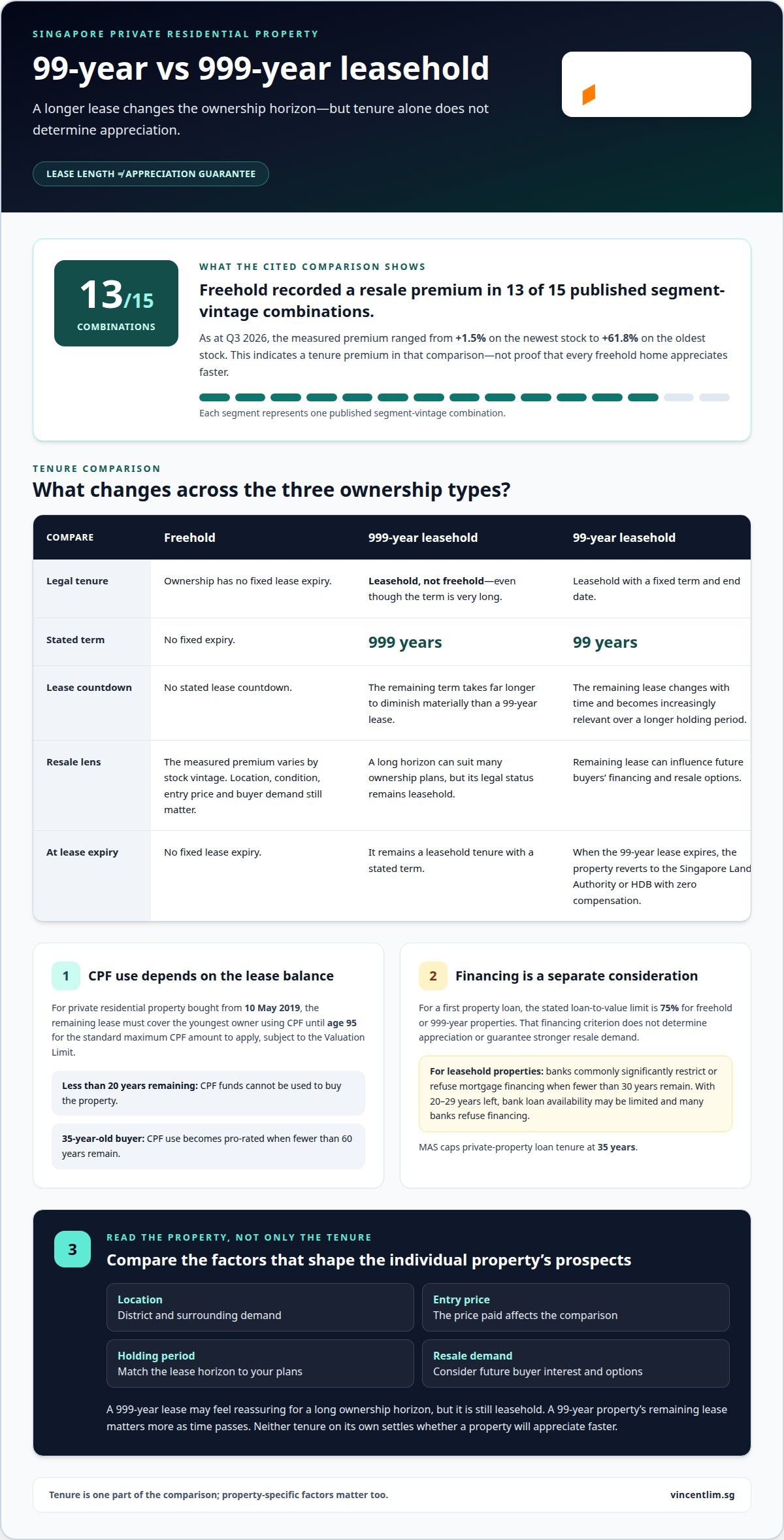
Freehold recorded a resale premium in 13 of 15 published segment-vintage combinations as at Q3 2026. That comparison shows a tenure premium, not proof that every freehold home appreciates faster.
Freehold Tenure
Freehold ownership has no fixed lease expiry, unlike 99-year and 999-year leasehold tenure. That distinction can matter to buyers planning long-term ownership, since the land is not subject to a stated lease countdown. Resale outcomes still depend on the property’s location, condition, entry price and buyer demand. As at Q3 2026, the measured freehold premium ranged from +1.5% on the newest stock to +61.8% on the oldest stock in the cited resale comparison.
99-Year Leasehold Tenure
A 99-year leasehold property has a fixed term, so its remaining lease changes with time. HDB flats are also sold on 99-year leases, though this comparison concerns private residential property. The lease balance can influence a future buyer’s financing and resale options. Buyers considering a shorter holding period may weigh location and purchase price alongside tenure; a longer period makes the remaining lease increasingly relevant.
999-Year Leasehold Tenure
A 999-year lease is technically leasehold, not freehold, but its long term can function much like perpetual ownership for many buyers’ planning horizons. It differs from a 99-year lease because the remaining term takes far longer to diminish materially. For a first property loan, the stated loan-to-value limit is 75% for freehold or 999-year properties. That financing criterion does not determine appreciation or guarantee stronger resale demand. Beyond financing, multi-unit leasehold developments also require structured oversight; in markets with established leasehold systems, resident management companies and freehold entities frequently turn to specialists like Winfields Block Management for professional estate administration.
| Tenure | Lease term | Ownership horizon | Resale consideration |
|---|---|---|---|
| Freehold | No fixed expiry | Indefinite | Measured premium varies by stock vintage |
| 999-year leasehold | 999 years | Very long lease term | Leasehold, despite its long horizon |
| 99-year leasehold | 99 years | Fixed lease term | Remaining lease affects buyer considerations |
Choose a tenure that suits your expected holding period, financing needs and resale priorities. Then assess the individual property’s district, price and buyer demand.
How a 99-year lease differs from perpetual ownership
Freehold ownership in Singapore lasts indefinitely, while a 99-year lease has a fixed end date. When that lease expires, the property reverts to the Singapore Land Authority or HDB with zero compensation. More than 80% of land in Singapore is state-owned, and all new Government Land Sales land is granted on a 99-year lease. Since 1967, private residential sites have been sold on leases no longer than 99 years.
This distinction affects ownership duration, but not every investment outcome. Leasehold properties generally have upfront costs approximately 15% to 20% lower than freehold properties. That difference can affect the purchase budget, while rental demand and investment returns still depend on the property and its market. A 99-year lease does not mean that rental income or resale value follows a fixed pattern. For buyers and investors seeking perpetual ownership without lease decay concerns, exploring international freehold options through sansavproperties.com offers a view of luxury residential and off-plan investment opportunities abroad.
Collective sales can provide another route to redevelopment before a lease ends, but owner approval thresholds apply. In Singapore, a development at least 10 years old requires agreement from owners holding at least 80% of share value. For developments less than 10 years old, the threshold is 90%. An en bloc sale therefore depends on the owners’ collective decision, not tenure alone.
CPF rules also make the youngest buyer’s age relevant. For private residential property bought from 10 May 2019, CPF use depends on whether the remaining lease can cover the youngest owner using CPF until age 95. If it does, the standard maximum CPF amount applies. This links the lease balance to the buyer’s age, rather than treating every 99-year property identically.
For buyers comparing freehold, leasehold, rental potential and long-term ownership, assess the property’s remaining lease alongside its price and resale prospects. A landed-home sale also calls for a careful view of tenure and buyer demand; explore Terrace House Sales for a relevant property transaction perspective.
Remaining lease and CPF use for private residential property
For a Singapore leasehold property, calculate the remaining lease from its lease start date: subtract the elapsed period from the original term. The title and contract should identify that start date and tenure. A 99-year or 999-year label describes lease duration; it does not by itself state the applicable tax or stamp-duty amount. Keep tenure distinct from transaction charges.
For private residential purchases made from 10 May 2019, CPF use depends on whether the remaining lease covers the youngest owner using CPF until age 95. If it does, the standard maximum CPF amount applies, subject to the Valuation Limit. CPF funds cannot be used to buy a property with less than 20 years remaining. For a 35-year-old buyer, CPF use becomes pro-rated when fewer than 60 years remain. HDB buyers also face restrictions when the lease cannot cover the youngest buyer until age 95.
Lease length also affects financing. Banks commonly significantly restrict or refuse mortgage financing for leasehold properties with less than 30 years remaining. A property with 20-29 years left may have limited bank loan availability, and many banks refuse financing. MAS caps private-property loan tenure at 35 years. The shorter the remaining lease, the more financing can narrow the pool of practical buyers at resale.
Upfront funding matters too: the stated private-property downpayment is 25%, with 5% paid in cash. Residents of a private development may collectively request the Singapore Land Authority for a lease top-up that resets the remaining lease to 99 years. This is a collective request, not an automatic feature of leasehold properties.
Before buying, have a lawyer conduct a title search to check that the title in the contract matches the Land Titles Registry record. This confirms the registered tenure and lease details used to assess CPF eligibility and financing.
Declining value and resale difficulties
Lease length can affect Singapore property prices and resale value because buyers weigh the remaining term alongside location and demand. Properties with fewer than 40 years remaining generally face steeper depreciation unless their location is exceptional. For buyers focused on understanding the 99 vs 999 year leasehold, the key resale issue is how the remaining term fits their likely buyer pool.
Lease Decay and Resale Liquidity
Lease decay describes how a finite lease loses remaining years over time. For a 99-year property, each passing year reduces the term available to later owners. Fewer than 40 years remaining is a key point: depreciation generally steepens unless the location is exceptional. As the lease shortens, the future buyer pool may narrow because buyers assess ownership horizon and financing options.
Resale liquidity depends on whether buyers can make the purchase work, not just on the property’s condition. A home with a shorter remaining lease may suit buyers with a shorter holding period, while those planning to own across generations may prefer a longer term. The same property can fit one buyer’s timeline but not another’s.
Lease Length and Property Prices
Remaining lease is one pricing factor, not a standalone forecast. Location, property condition, purchase price and buyer demand also influence resale value. Compare similar homes in the same area and consider their lease balances; ignoring tenure can obscure meaningful price differences. A 999-year lease has a much longer term than a 99-year lease, but neither guarantees appreciation. A fuller understanding of the 99 vs 999 year leasehold helps frame that comparison without treating tenure as the only measure.
Rental yield compares rental income with the purchase price; resale value reflects what a future buyer is willing to pay. Strong rental performance does not automatically offset lease decay. Assess rental demand and resale prospects separately, particularly when redevelopment potential may affect buyer interest.
For a resale decision, weigh the remaining lease, likely buyer profile and holding period together. Review resale prospects for a property with these factors in view.
Vincent Lim (OrangeTee & Tie)
Vincent Lim (OrangeTee & Tie) helps buyers and sellers factor tenure into landed-property decisions. Whether you are comparing ownership horizons or preparing a home for resale, the remaining lease, buyer priorities and property’s market position all matter.
For a transaction involving a terrace house, semi-detached house, detached house or Good Class Bungalow, Vincent Lim’s sales services offer a practical next step. Consider tenure and resale prospects in the context of your decision, rather than treating lease length as the sole measure of value.
If you’re considering buying or selling landed property in Singapore, contact Vincent Lim (OrangeTee & Tie) to discuss your plans.
Make Your Next Property Decision with Clarity
A tenure decision is most useful when it supports a wider plan: the property you want, the period you expect to hold it, and the options you may need later. Understanding the 99 vs 999 year leasehold is one part of that assessment. The next step is to define which trade-offs matter most to your household, then apply them to the specific property and transaction.
Vincent Lim (OrangeTee & Tie) handles Terrace House Sales, Semi-Detached House Sales and Detached house sales. Discuss your priorities and how they relate to the sale or purchase process, without treating tenure as the only consideration.
When you’re ready to discuss a landed-property decision, contact Vincent Lim (OrangeTee & Tie). A considered next step can help you move forward with greater clarity.
Frequently Asked Questions
Does tenure affect my ability to get a bank loan in Singapore?
Yes. Remaining lease can affect whether a bank will finance a leasehold purchase. Banks commonly significantly restrict or refuse financing when fewer than 30 years remain. For a buyer, this may make the financing plan and eventual resale audience more constrained than for a property with a longer lease. Include the lease balance in affordability planning rather than assessing the purchase price alone.
What happens if I outlive the 99-year lease?
Your lifespan does not extend a property’s lease. When it expires, ownership ends under the lease terms and the property reverts to the Singapore Land Authority or HDB, depending on the property, with no compensation. Living in a home beyond the lease term does not create a right to keep it or receive an extension. The lease end date remains central to planning.
What is the difference between a 99-year and 999-year leasehold in Singapore?
The difference is the length of the lease, not whether either tenure is freehold. A 99-year lease has a much shorter fixed term; a 999-year lease remains leasehold but has a far longer term. Buyers comparing two homes should consider the actual remaining lease, since a property’s age affects how much time is left for ownership and resale.
What happens when a 99-year lease expires in Singapore?
At expiry, leasehold ownership ends and the property reverts to the relevant authority without compensation. For private property, that is the Singapore Land Authority; for an HDB flat, it is HDB. An en bloc sale before expiry is a separate possibility that depends on the required owners’ approval. It does not, by itself, change the scheduled lease end date.
Can a 99-year leasehold property be extended or renewed in Singapore?
A lease extension is not automatic. Residents of a private development may collectively request a lease top-up from the Singapore Land Authority, which would reset the remaining term to 99 years. This is a collective request, rather than an individual owner’s guaranteed renewal. For a purchase decision, base your assessment on the existing registered lease, not on an assumed future top-up.
How do 99-year and 999-year properties compare in financing and CPF usage?
For CPF use, the key test is the remaining lease and whether it can cover the youngest CPF-using owner until age 95. The 999-year term may leave a long balance, while a 99-year property’s eligibility depends on its remaining years and the buyer’s age. CPF use is not permitted for a purchase with fewer than 20 years remaining.