The tax implications of selling a second property in Singapore depend on whether the profit is treated as a capital gain or taxable income from property-trading activity. A sale does not automatically result in a capital gains tax bill, but the transaction’s nature and circumstances matter. This distinction also affects whether losses can reduce the amount subject to tax.
It is understandable to focus on the sale price, but calculating the gain may also involve the property’s purchase cost and eligible expenses. This guide explains how to work out the gain, when losses may be relevant, and which details can lead to reporting mistakes.
You will also learn what to consider if the property was rented out or held alongside other investments, and what the reporting and payment process involves if tax is due. The aim is to give you a clear framework for assessing the sale before making your next property decision.
Key Takeaways
- Separate the sale proceeds from the property’s adjusted cost basis to understand how a gain is calculated.
- Review improvement records and eligible selling costs, as they can affect the gain figure.
- Understand how the property’s use and the nature of the transaction may affect tax treatment and reporting.
- Keep sale and cost documents organised so you can follow the relevant reporting and payment steps accurately.
Can I Offset Capital Gains with Losses?
Singapore does not generally impose capital gains tax, so a capital loss is not usually offset against a capital gains tax bill from a property sale. The separate question is whether profit is treated as taxable income from property-trading activity. That classification depends on the transaction’s circumstances, not simply on whether the property was a second residence.
Seller’s Stamp Duty (SSD) is separate from capital gains tax. The applicable SSD rate depends on the property’s acquisition date and holding period before sale. You cannot determine the applicable rate from the sale date alone: the purchase date and length of ownership must be considered together.
The acquisition date matters because it determines which SSD schedule applies. Compare the relevant purchase and sale dates against that schedule to establish the holding period and applicable rate. Keep purchase documents and sale records together, as an incorrect acquisition date can lead to an incorrect duty calculation.
SSD may be reduced or waived only if the circumstances meet the applicable relief conditions. It is not generally reduced simply because the sale produces a loss or the owner has losses elsewhere. Assess any relief separately from the profit calculation, and retain documents that support the circumstances of the transaction.
Cost records still help explain the sale’s financial result. A property’s basis generally starts with its acquisition cost, while eligible capital improvements may affect the calculation. Keep improvement invoices separate from routine repair records. This distinction helps create a clear account of the transaction, even when capital gains tax is not the relevant charge.
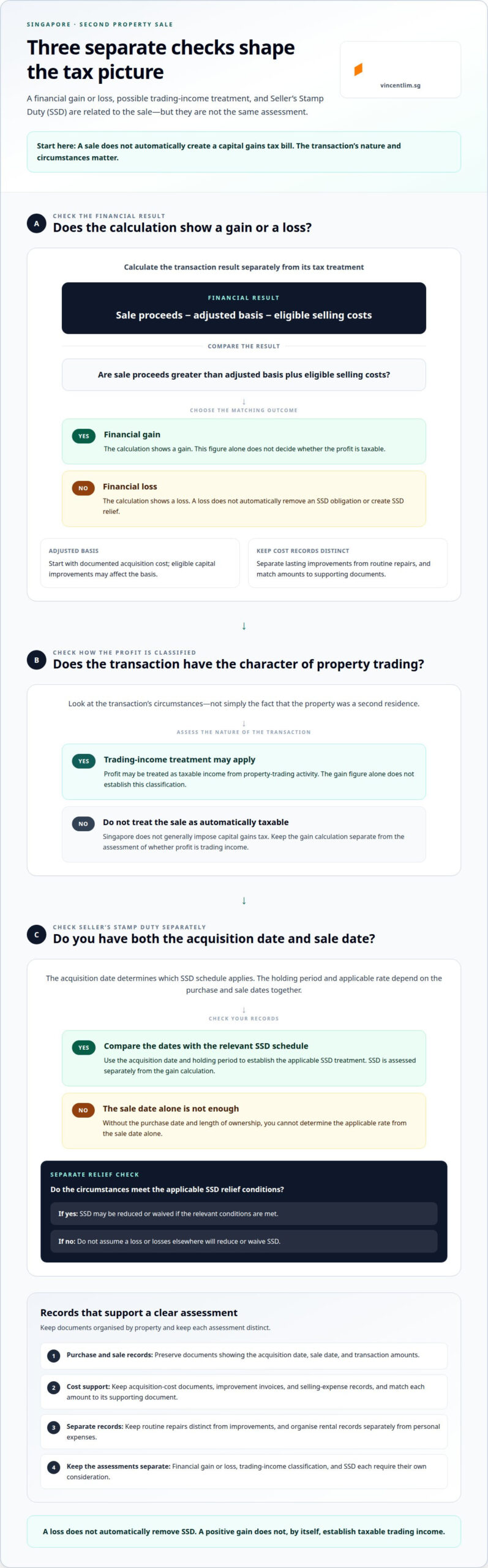
For a second property sale, assess three matters separately: the financial gain or loss, whether profit is treated as taxable trading income, and whether SSD applies. A loss does not automatically remove an SSD obligation. Likewise, the fact that a property is a residence does not, by itself, establish an exemption. Separate records for each matter support a more accurate assessment.
Calculating gain from sale proceeds, basis and selling costs
For a Singapore property sale, separate the financial gain calculation from the tax classification and any Seller’s Stamp Duty assessment. These figures describe the transaction, but do not alone determine whether its profit is taxable.
Calculating a Second Home’s Basis
A property’s basis is its documented acquisition cost, adjusted for eligible capital improvements. It provides a comparison point for sale proceeds and helps explain the transaction’s financial result.
Organise purchase records and improvement invoices by property. Separate lasting improvements from routine repairs, and keep rental records apart from personal expenses. For inherited property, preserve estate and transfer documents alongside available purchase and valuation records. These documents help establish the ownership history without assuming that an overseas basis rule applies in Singapore.
Sale Proceeds and Selling Costs
To estimate the gain, subtract the adjusted basis and eligible selling costs from the sale proceeds. This shows how transaction expenses affect the amount left from the sale.
Record the sale price, documented acquisition costs, improvements, and selling expenses as separate items. Match each amount to its supporting document before calculating the result. Do not assume every expense qualifies or that a loss can automatically offset taxable income. Keep the gain calculation separate from the question of whether profit is treated as trading income.
For private property and HDB flats, distinguish the sale calculation from the rules and conditions that apply to each property type. Do not assume the same sale or duty treatment simply because both transactions involve residential property.
In Singapore, sale profit may be treated as taxable trading income when the transaction has the character of property trading. The profit figure alone does not establish that classification.
Seller’s Stamp Duty is calculated separately from a gain. The acquisition date and holding period are key to determining the applicable treatment, so retain accurate purchase and sale dates.
For non-residents, the Singapore property transaction and any tax obligations connected to tax residence elsewhere are separate considerations. Keep the relevant records distinct when assessing each jurisdiction’s treatment.
For help coordinating a Singapore property sale, plan a property sale with the transaction details in view.
Common reporting and tax calculation mistakes
A common error is treating the gross sale price as profit. Prepare a separate schedule for proceeds, acquisition costs, improvements, and selling expenses. If a document or cost is missing, the apparent gain may not match the transaction records. The tax implications of selling a second property depend partly on keeping these figures separate from the assessment of any tax liability.
Another mistake is combining personal and property records. A renovation invoice, for example, may include improvement work as well as routine repairs. Separate the line items rather than treating the entire invoice as an addition to basis. If the property was rented out, organise those records separately to avoid confusing rental expenses with personal-use costs.
- Omitting a cost: Match each claimed amount to an invoice, completion record, or sale document so the calculation is traceable.
- Counting an item twice: Reconcile the purchase schedule, improvement records, and sale statement before totaling costs.
- Confusing profit with tax: A positive calculation does not, by itself, determine the tax treatment. Keep the gain separate from its classification.
- Mixing currencies: If documents use another currency, record the exchange rate and date used in the working schedule.
Do not apply another country’s tax bracket, exclusion, or exchange strategy to a Singapore calculation. A rule for a primary residence in another jurisdiction does not establish the treatment of Singapore property. Keep overseas guidance separate when it applies to another country, while consulting wealth and tax professionals such as Timothy Roberts & Associates, LLC if you need to coordinate broader financial planning and tax filings in jurisdictions like the United States.
Before relying on a figure in a filing or calculation, reconcile it with its source document. A property-by-property schedule helps prevent costs from one transaction being assigned to another. Clear records make the tax implications of selling a second property easier to assess and show how each amount contributes to the reported profit.
Reporting and paying CGT after a sale
For a Singapore property sale, distinguish capital gains tax from Seller’s Stamp Duty (SSD). Singapore does not generally impose capital gains tax, but profit treated as trading income may be taxable. Whether profit is taxable depends on the transaction’s nature and circumstances, not simply on the property being described as a second residence.
SSD is a separate duty. To manage the payment process, establish the acquisition and sale dates, determine whether the applicable holding-period rules bring the sale within SSD, and calculate the duty using the relevant transaction details. Arrange payment through the sale’s conveyancing process and follow the deadline associated with the transaction documents. Keep the assessment and payment records with the sale file.
Do not assume that a loss or deductible expense removes an SSD obligation. A capital gain calculation and an SSD calculation answer different questions. Likewise, a foreign tax rate or primary-residence exclusion does not establish the Singapore tax treatment. If an overseas property or non-resident owner is involved, consider each relevant jurisdiction separately—for instance, investors handling cross-border assets with regional agencies like Cornerstone in Trinidad and Tobago should keep local sale and management documentation distinct. An estate sale may also require distinct reporting.
- Classify the profit: Distinguish a capital gain from income arising from property-trading activity before treating the amount as taxable.
- Separate duties: Record SSD independently from any income-tax assessment or overseas tax liability.
- Retain evidence: Keep the sale contract, acquisition documents, expense records, tax correspondence, and payment confirmation together.
- Reconcile amounts: Match the assessed duty and payment to the transaction records so the tax file shows what was paid and why.
There is no general CGT rate to apply to every Singapore second-property sale. The relevant tax treatment depends on whether the profit is capital or taxable income, while SSD depends on the sale’s applicable holding-period rules. Clear records of both assessments help prevent one payment from being mistaken for the other.
For support coordinating a Singapore property sale, discuss your property sale.
Confirm the acquisition and sale dates, check whether the applicable holding-period rules make the sale subject to SSD, and calculate the duty using the relevant transaction details. Arrange payment through the conveyancing process by the deadline associated with the transaction documents, and keep the assessment and payment confirmation with the sale records.
SSD is assessed separately from any capital-gain or income-tax calculation. Whether it applies depends on the sale’s applicable holding-period rules, and the duty is calculated using the relevant transaction details.
Vincent Lim (OrangeTee & Tie)
Vincent Lim (OrangeTee & Tie) helps owners plan the sale of Singapore landed homes and luxury residences, where timing and transaction details can affect the overall decision. His service is relevant when you are preparing to sell and need support with the property transaction alongside your tax and duty considerations.
His property sales include terrace houses, semi-detached houses, detached houses, and other prime residential properties. A clear sale plan can help you organise transaction details and coordinate decisions around timing and the sale process. Tax classification and filing obligations remain separate considerations, so keep those calculations distinct from the sale arrangements.
If you are considering selling a property, contact Vincent Lim (OrangeTee & Tie) to discuss your sale.
Plan the Sale Around Your Next Move
The tax implications of selling a second property deserve a place in your wider plans, not just in the final paperwork. Consider how the timing of a sale fits your next property decision and which records you will need to support it. A clear plan helps you approach the transaction deliberately, considering tax treatment and sale arrangements as separate but connected matters.
For a significant property decision, start by defining what you need from the sale: a change in ownership, a different home, or a more suitable portfolio. Vincent Lim (OrangeTee & Tie) facilitates property sales in Singapore, helping owners bring the transaction into focus. Tax advice and property-sale coordination serve different purposes, so keep each within its proper scope.
When you’re ready to discuss the sale itself, contact Vincent Lim (OrangeTee & Tie). A considered next step can make the process clearer and help you move forward with confidence.
Frequently Asked Questions
Taxes on selling a second home: how do I avoid a huge bill?
Start by separating possible Seller’s Stamp Duty from any income-tax treatment of the sale profit. Singapore does not generally charge capital gains tax, but profit may be taxable if the sale is treated as property-trading income. For example, keep purchase, improvement, rental, and sale records in separate groups. This helps you identify the transaction facts relevant to the calculation and avoid treating every cost as deductible.
What if I earn rental income on the property?
Rental income and proceeds from selling the property are separate amounts, so keep their records distinct. For example, organise tenancy agreements, rent statements, and expense records by rental period, then keep the sale contract and transaction documents separately. Rental history can also help explain how the property was used. Do not treat rental receipts as sale profit or assume rental expenses automatically reduce the gain from disposal.
What taxes apply when selling a second property in Singapore?
Singapore does not generally impose capital gains tax, but profit may be treated as taxable income if the sale has the character of property trading. Seller’s Stamp Duty may also apply, depending on the property’s acquisition date and holding period. These are separate considerations: a gain calculation does not determine whether the sale is trading income, and the property’s purchase and sale dates matter when assessing duty.
How do outstanding property tax and rental income affect a property sale?
Keep outstanding property-tax amounts and rental-income records separate from the sale-gain calculation. For example, reconcile the property-tax account balance independently, while recording rent received and related expenses for the relevant rental periods. This prevents an unpaid amount or rental receipt from being mistaken for a sale cost or capital gain. Keep separate supporting documents for sale proceeds, property-tax records, and rental accounts.
When is property sale profit treated as taxable trading income in Singapore?
Profit may be treated as taxable income when a transaction has the character of property-trading activity. The circumstances of the transaction matter; being a second residence alone does not determine the classification.
How is Singapore Seller’s Stamp Duty calculated for a second property sale?
SSD is assessed separately from the financial gain. Use the acquisition date and holding period to identify the applicable schedule and rate, then calculate the duty using the transaction details.