In Singapore’s elite real estate circles, a landed transaction is never just a sale; it’s a sophisticated transfer of land titles that demands the foresight of a seasoned strategist. With the average price of a landed home climbing to $6.5 million in early 2026, you understand that the landed property transaction process leaves no room for oversight. It’s natural to feel the pressure of managing massive capital flows while navigating the intricacies of the Residential Property Act and potential legal encumbrances. You deserve a transition that’s defined by calm, calculated competence rather than administrative friction.
This guide provides the methodical, step-by-step framework you need to move forward with absolute confidence. We’ll examine how to secure a seamless transfer of title while ensuring full compliance with the latest 2026 BSD and ABSD regulations. By following this strategic roadmap, you’ll learn to optimize your financial timing and protect your legacy in Singapore’s most exclusive property sectors, from terrace houses to Good Class Bungalows.
Key Takeaways
- Distinguish between structure and land title transfers to protect your long-term interest in freehold or leasehold tenures.
- Navigate the landed property transaction process using a structured timeline that manages the critical window between the Option to Purchase and legal completion.
- Calculate your 2026 financial obligations with precision, accounting for the latest Buyer’s Stamp Duty and ABSD rates for properties exceeding $3 million.
- Execute advanced due diligence through professional land surveys to identify boundary encroachments or hidden legal encumbrances before they become liabilities.
- Coordinate a multi-disciplinary team of experts to ensure a seamless title transfer and full regulatory compliance throughout the deal.
Understanding the Unique Nature of the Landed Property Transaction Process
Landed property represents the pinnacle of Singapore real estate. Unlike high-rise apartments where you own a share of the common property, the landed property transaction process involves a comprehensive transfer of the physical structure and the specific plot of land it occupies. This distinction is rooted in Singapore’s common law system, where the type of tenure defines the true value of your asset.
An “Estate in Fee Simple,” commonly known as freehold, offers the most enduring form of ownership. It stands in contrast to 999-year or 99-year leasehold titles. The Singapore Land Authority (SLA) meticulously maintains the Land Register to ensure every square meter is accounted for. Because you’re acquiring land, the due diligence period is naturally more extensive than that of a luxury condominium. You aren’t just checking the walls; you’re verifying the ground beneath them. This methodical approach prevents future legal disputes over boundary lines or land rights.
The Regulatory Landscape for Landed Assets
The Residential Property Act strictly governs who can own these assets. Foreigners and even permanent residents must seek specific SLA approval, a process that considers economic contributions and a minimum five-year residency. Beyond eligibility, savvy buyers must consult the URA Master Plan. This document dictates the plot ratio and permissible height for future redevelopments, which directly impacts the property’s long-term appreciation.
Understanding the difference between “land area” and “built-up area” is also critical. A large plot with a small house offers significant redevelopment potential, while a fully built-up terrace may have reached its maximum density. These metrics create distinct valuation and legal challenges that require precise calculation to avoid overpaying for “air space” that cannot be developed.
Key Stakeholders in a Successful Transfer
A seamless transition requires a multi-disciplinary team. Conveyancing lawyers lead the way by conducting exhaustive title searches to ensure no hidden encumbrances exist. While a standard agent might handle a condo sale, a high-value landed deal requires an elite strategist to manage complex negotiations and financial coordination. You’ll also need qualified surveyors. They perform boundary checks to ensure your neighbor’s fence or roof isn’t encroaching on your title. These professionals work in concert to protect your capital and ensure the landed property transaction process remains transparent, secure, and aligned with your portfolio goals.
The Step-by-Step Timeline: From Option to Legal Completion
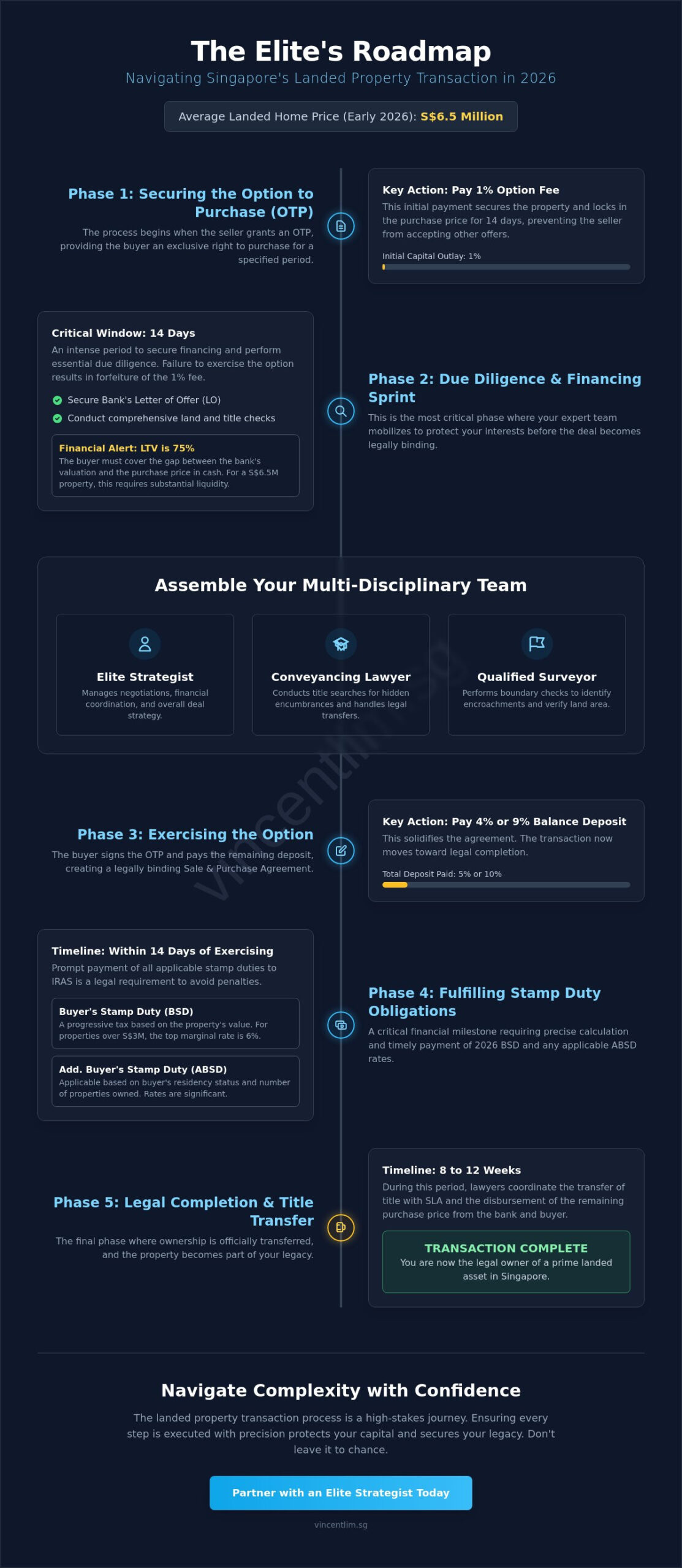
Execution requires precision. The landed property transaction process follows a rigid legal sequence designed to protect high-value capital. It begins when the seller grants the Option to Purchase (OTP) in exchange for a 1% option fee. This fee secures the property and prevents the seller from negotiating with other parties for a set duration, which is typically 14 days in Singapore’s private market.
Once the buyer decides to proceed, they “exercise” the option by signing the document and paying the remaining deposit. Depending on the agreement, this is usually an additional 4% or 9% of the purchase price. This action creates a binding Sale & Purchase Agreement. Within 14 days of exercising the option, the buyer must fulfill their Stamp Duty obligations. This includes the Buyer’s Stamp Duty and any applicable Additional Buyer’s Stamp Duty based on the 2026 tax rates. The final phase is the completion period, an 8-to-12 week window where lawyers coordinate the legal transfer of the title.
The Critical First 14 Days: The Option Period
The 14-day window is the most intense phase of the landed property transaction process. Buyers must move quickly to secure a formal Letter of Offer from their bank. Because the Loan-to-Value limit for a first housing loan is 75%, any discrepancy between the purchase price and the bank’s official valuation must be settled in cash. If the bank’s valuation falls short of a $6.5 million purchase price, the buyer must bridge that gap immediately. Failing to exercise the option usually results in the forfeiture of the 1% fee. For those navigating these high-stakes windows, partnering with an experienced landed property strategist ensures that your financing and due diligence are perfectly synchronized before the clock runs out.
The Completion Phase: Finalising the Transfer
As the legal completion date approaches, the focus shifts to financial settlement and the redemption of existing mortgages. The seller’s bank must be paid off to release the title, a task coordinated entirely by the conveyancing lawyers. A final “Statement of Accounts” is generated to apportion property taxes and any outstanding maintenance costs. On the day of completion, the buyer’s lawyer receives the title deed and the keys. The physical handover involves a thorough check against the inventory list to ensure all fixtures and fittings are present as agreed. Once the final payment is disbursed, the transition is complete, and the new owner takes full possession of the land and structure.
Financial Obligations and Stamp Duties in 2026
Precision in the landed property transaction process extends beyond legal paperwork to the meticulous management of tax liabilities. In 2026, the financial landscape for high-value assets remains rigorous. For a landed property priced at the Q1 2026 average of $6.5 million, Buyer’s Stamp Duty (BSD) is a significant consideration. The progressive rates reach 6% for the portion of the purchase price exceeding $3 million. This means the top tier of your capital is taxed at the highest bracket, making accurate upfront calculations essential for liquidity planning.
Additional Buyer’s Stamp Duty (ABSD) adds another layer of complexity. As of January 2026, Singapore Citizens purchasing their second residential property face a 20% rate, while third and subsequent purchases attract 30%. Permanent Residents pay 5% on their first home, rising sharply to 30% for a second. If you are selling a landed asset, you must also account for Seller’s Stamp Duty (SSD) if the holding period is less than three years. These rates, which scale down from 12% to 4% depending on the year of sale, directly impact your net proceeds and overall portfolio strategy.
Optimising the Financial Timeline
Strategic timing of the OTP exercise can significantly influence your cash flow. Many elite owners face the “Sell First vs Buy First” dilemma. Selling your current residence before exercising the OTP for a new one can eliminate the need to pay ABSD upfront, preserving capital for the transaction itself. When using CPF funds, remember that the amount you can withdraw is tied to the property’s remaining lease. If the lease doesn’t cover the youngest owner until age 95, the withdrawal limit is pro-rated. Budgeting for a “white-glove” transaction also requires accounting for specialized legal fees, which are typically higher for landed titles due to the intensive land-specific searches required.
Valuation and Price Discovery
Banks approach the property valuation for landed house with a focus on land scarcity rather than just built-up area. An indicative valuation provides a preliminary estimate, but a formal appraisal is non-negotiable for high-value loans. This appraisal considers the land’s PSF, the condition of the structure, and the potential for redevelopment. Because land prices increased by 6.7% year-on-year by early 2026, lenders are meticulous in their assessments. Factoring in these variables ensures that the transacted price aligns with the property’s true market value and its future potential as a legacy asset.
Strategic Due Diligence: Mitigating Land-Specific Risks
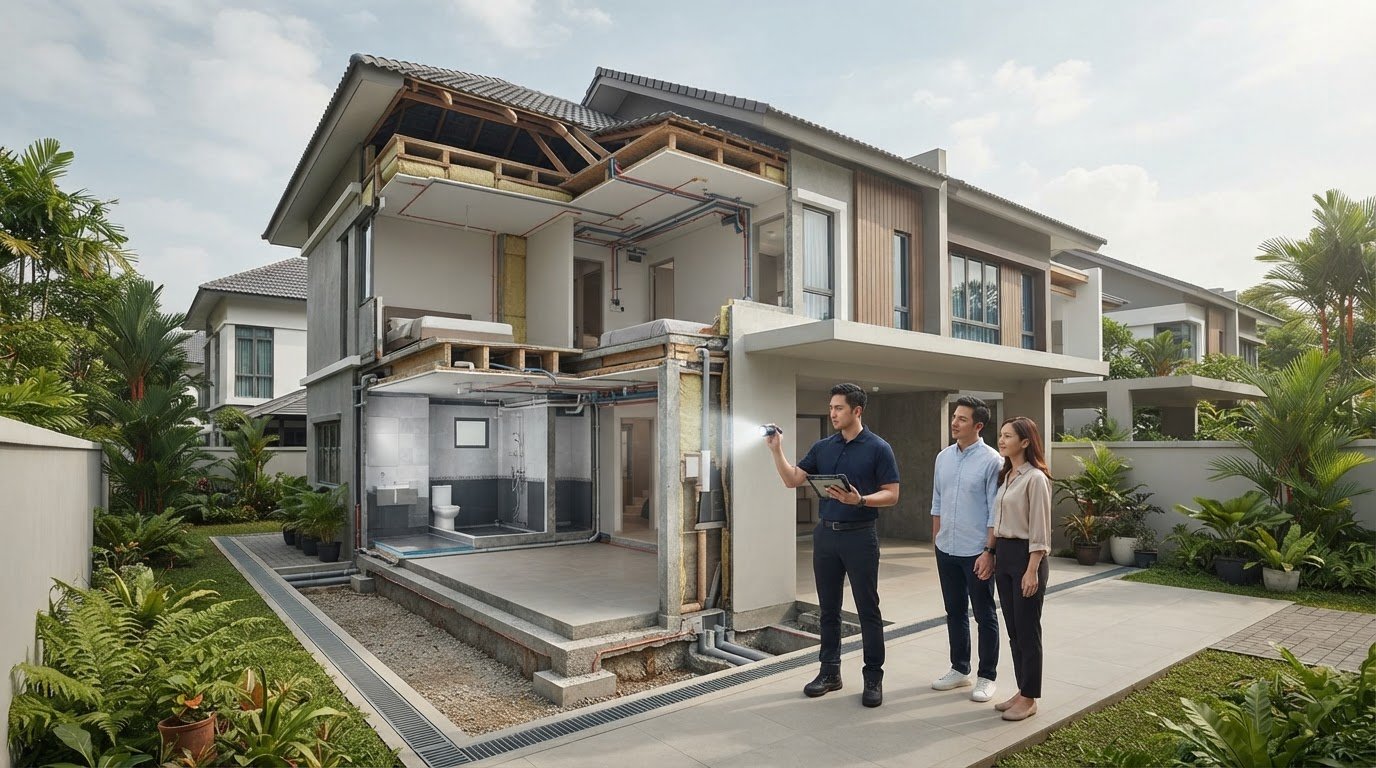
Expertise in the landed property transaction process requires looking beyond the aesthetic appeal of a home to the legal and physical realities of the land itself. While strata-titled properties share common land, a landed owner is solely responsible for the plot’s compliance. A professional land survey is a non-negotiable step in this phase. It verifies that the boundary lines on the ground match the official records held by the Singapore Land Authority. You don’t want to inherit a legal dispute because a neighbor’s roof overhangs your property or a fence was misplaced decades ago. Identifying these encroachments early allows for rectification before the title officially transfers.
Strategic buyers must also investigate Road Line Plans (RLP) and Drainage Reserves. These government-imposed setbacks can significantly restrict your ability to rebuild or extend the property. If a portion of the land is earmarked for future road widening, that area cannot be built upon; this effectively reduces your usable plot size. When assessing an older terrace house for sale Singapore, structural integrity is paramount. Professional inspections safeguard you against hidden defects in the foundation or party walls that could lead to exorbitant repair costs after completion.
Legal and Title Searches
Your legal team must perform a deep dive into the root of title. This ensures the seller has the absolute right to sell and that the property is free from restrictive covenants. Easements are another critical check; these are legal rights that allow others, such as utility companies, to access parts of your land. A “clean” title means the property is free from caveats that could stall the landed property transaction process at the eleventh hour. This meticulous verification provides the peace of mind necessary for high-value acquisitions.
Technical and Planning Checks
Future-proofing your investment requires understanding URA’s “envelope control” guidelines. These rules dictate the permissible building height and volume based on the specific Landed Housing Area. You must also verify that any previous additions and alterations (A&A) were officially sanctioned. Unauthorized works can result in legal notices from the authorities, requiring you to restore the property at your own expense. For a bespoke assessment of a property’s redevelopment potential, consult an elite landed strategist who can coordinate these technical reviews on your behalf.
The Value of an Elite Strategist in Landed Transactions
The complexity of a multi-million dollar land transfer demands more than a standard real estate agent. While a typical agent facilitates a sale, an elite strategist manages a high-value project from inception to legal handover. The landed property transaction process involves a delicate orchestration of legal professionals, land surveyors, and financial institutions. Vincent Lim (OrangeTee & Tie) employs a methodical framework that ensures these stakeholders work in unison, preventing the administrative friction that often stalls high-stakes deals. This level of personal accountability provides the peace of mind necessary when moving large capital sums across tight regulatory timelines.
For sellers, this means moving beyond simple listings to bespoke marketing strategies. When positioning a semi-detached house in Singapore, the strategy focuses on land value, redevelopment potential, and scarcity rather than just built-up area. This data-driven approach ensures your asset is presented as a sophisticated investment to the right caliber of buyers, protecting your equity through superior market positioning and refined presentation. Understanding how to prepare your luxury home for sale with elite staging techniques further amplifies this positioning, ensuring your landed asset commands the premium it deserves in the eyes of high-net-worth buyers.
Navigating High-Stakes Negotiations
Negotiation in the landed sector isn’t just about the final price; it’s about the terms and the timing. Vincent Lim (OrangeTee & Tie) uses real-time market data and historical transaction trends to secure the optimal transacted price while managing the emotional weight of multi-generational legacy assets. By acting as a high-level partner rather than a mere service provider, he ensures that every clause in the Option to Purchase protects your long-term interests. This partnership approach transforms a stressful transaction into a disciplined execution of your financial objectives, ensuring that every detail is refined to your advantage.
Your Next Step in the Landed Journey
Every successful acquisition or sale begins with a clear understanding of your current position. A comprehensive portfolio review allows us to identify the most tax-efficient path forward, whether you’re upgrading to a detached home or consolidating your assets. Proactive planning reduces friction and ensures that your next move is both strategic and fully compliant with current 2026 regulations. To secure your legacy and navigate the landed property transaction process with absolute confidence, schedule a professional consultation with Vincent Lim (OrangeTee & Tie) today. Moving with controlled momentum and meticulous planning is the gold standard for your next real estate milestone.
Secure Your Legacy Through Strategic Execution
Navigating the landed property transaction process in 2026 requires more than just market awareness; it demands a disciplined, multi-disciplinary approach to land titles and tax obligations. You’ve seen how meticulous due diligence on boundary lines and a clear understanding of the 12-week completion timeline can prevent costly legal encumbrances. By aligning your financial timing with current BSD and ABSD regulations, you protect your capital and ensure a seamless transfer of these high-value assets.
Successful transfers in the GCB and luxury landed sectors are built on a foundation of trust and technical precision. Vincent Lim (OrangeTee & Tie) serves as an Executive Associate Director and has specialized in GCB and luxury landed assets since 2004. He brings a methodical “Elite Strategist” approach to every transaction, ensuring your interests are guarded with the highest level of personal accountability. This white-glove service is designed to alleviate the stress of high-stakes movements, allowing you to focus on the long-term value of your portfolio.
Partner with Vincent Lim (OrangeTee & Tie) for a Methodical and Strategic Landed Transaction and move forward with the confidence that your real estate goals are in the hands of a seasoned professional. Your journey toward a successful landed acquisition or sale starts with a single, strategic step.
Frequently Asked Questions
How long does the entire landed property transaction process typically take in Singapore?
A standard landed property transaction process typically takes between 10 and 12 weeks from the date the option is exercised to legal completion. This window allows for title searches, mortgage redemption, and the final settlement of accounts. While some transactions might be expedited, the complexity of land titles usually requires this full duration for thorough legal and financial coordination.
Can a foreigner purchase a landed property in Singapore under the current 2026 regulations?
Foreigners are generally restricted from purchasing landed property unless they obtain specific approval from the Land Dealings Approval Unit (LDAU). Applicants are assessed on a case-by-case basis. Common requirements include being a Singapore Permanent Resident for at least five years and demonstrating exceptional economic contributions to the nation. Without this approval, ownership is legally prohibited under the Residential Property Act.
What happens if a buyer discovers a property encroachment after signing the Option to Purchase?
Discovering an encroachment after signing the OTP requires immediate legal intervention through your conveyancing lawyer. Your lawyer will typically issue a requisition to the seller’s solicitor to rectify the issue or negotiate a price reduction. If the encroachment is deemed a material defect that affects the title’s merchantability, you may have grounds to rescind the contract, though this depends on the specific terms of your agreement.
Is the 1% option fee refundable if the buyer decides not to proceed with the landed purchase?
The 1% option fee is strictly non-refundable if the buyer chooses not to exercise the Option to Purchase. This fee serves as consideration for the seller to remove the property from the market during the option period. If you don’t proceed, the seller is legally entitled to forfeit the full amount. It’s vital to secure your indicative bank valuation before paying this fee to avoid losing capital.
How is the Seller’s Stamp Duty (SSD) calculated if I sell my landed house within two years?
If you sell a landed property within the second year of ownership, you’ll incur a Seller’s Stamp Duty of 8% on the transacted price or market value, whichever is higher. The SSD rates scale down from 12% in the first year to 4% in the third year. After a three-year holding period, no SSD is payable. This timeline is calculated from the date of the Option to Purchase exercise.
What are the common pitfalls to avoid when upgrading from a condo to a landed property?
One common pitfall is underestimating the valuation vs price gap, which requires significant cash outlay since bank loans are capped at 75% of the valuation. Unlike condominiums, landed homes don’t have an MCST to manage external repairs or pest control. Buyers must also account for land-specific restrictions like the Road Line Plan, which can drastically reduce the buildable area during future renovations.
Do I need a separate lawyer for the bank and for the property transfer?
You don’t necessarily need separate lawyers as one law firm can often represent both you and your financing bank. This is possible if the chosen firm is on the bank’s approved panel of solicitors. If your preferred lawyer isn’t on that specific panel, you’ll need to engage separate legal representation for the bank’s mortgage interest and the property transfer, which increases your overall legal costs.
What is the difference between an ‘Additions & Alterations’ (A&A) and a ‘Reconstruction’ in landed property?
Additions and Alterations involve minor works where the total increase in Gross Floor Area is less than 50% and structural changes are limited. Reconstruction is defined as any works where the increase in floor area exceeds 50% or where significant structural elements, such as the roof or floor slabs, are replaced. Understanding this distinction is critical for navigating the landed property transaction process when planning future redevelopments.