The 10% to 20% premium typically commanded by a corner terrace isn’t merely a tax on privacy; it’s often a calculated play for semi-detached utility at a significantly lower entry price. Many investors hesitate when comparing an inter terrace vs corner terrace singapore, fearing they might overpay for land that remains restricted by rigid Urban Redevelopment Authority (URA) setback requirements. You’ve likely felt this same uncertainty, wondering if the additional capital outlay will truly translate into superior resale liquidity or if the 150 square meter minimum plot size for Type I inter-terraces offers a more efficient path to growth.
This guide provides the clarity you need to master the critical structural and financial differences between these landed archetypes. We’ll examine how the 2026 regulatory environment, including updated Buyer’s Stamp Duty (BSD) tiers and URA Type II plot guidelines, impacts your acquisition strategy. By the end of this analysis, you’ll possess a clear framework for evaluating land-to-built-up ratios and a definitive financial justification for your next high-stakes property move. We’ll begin by dissecting the current market data to see exactly where the value lies in today’s resilient landed landscape.
Key Takeaways
- Assess the financial justification for typical market premiums when evaluating an inter terrace vs corner terrace singapore to ensure your capital is strategically deployed.
- Master the URA plot size and setback regulations that dictate the maximum built-up efficiency and redevelopment potential of different terrace types.
- Explore the architectural nuances of “end-cap” units, such as three-sided ventilation, that allow corner terraces to function as a cost-effective alternative to semi-detached homes.
- Learn to identify technical encumbrances like drainage reserves and road lines that can quietly erode the developable land area of a terrace property.
- Develop a clear framework for matching specific landed archetypes to your long-term asset progression and legacy planning objectives.
Defining the Landscape: URA Guidelines for Inter and Corner Terraces
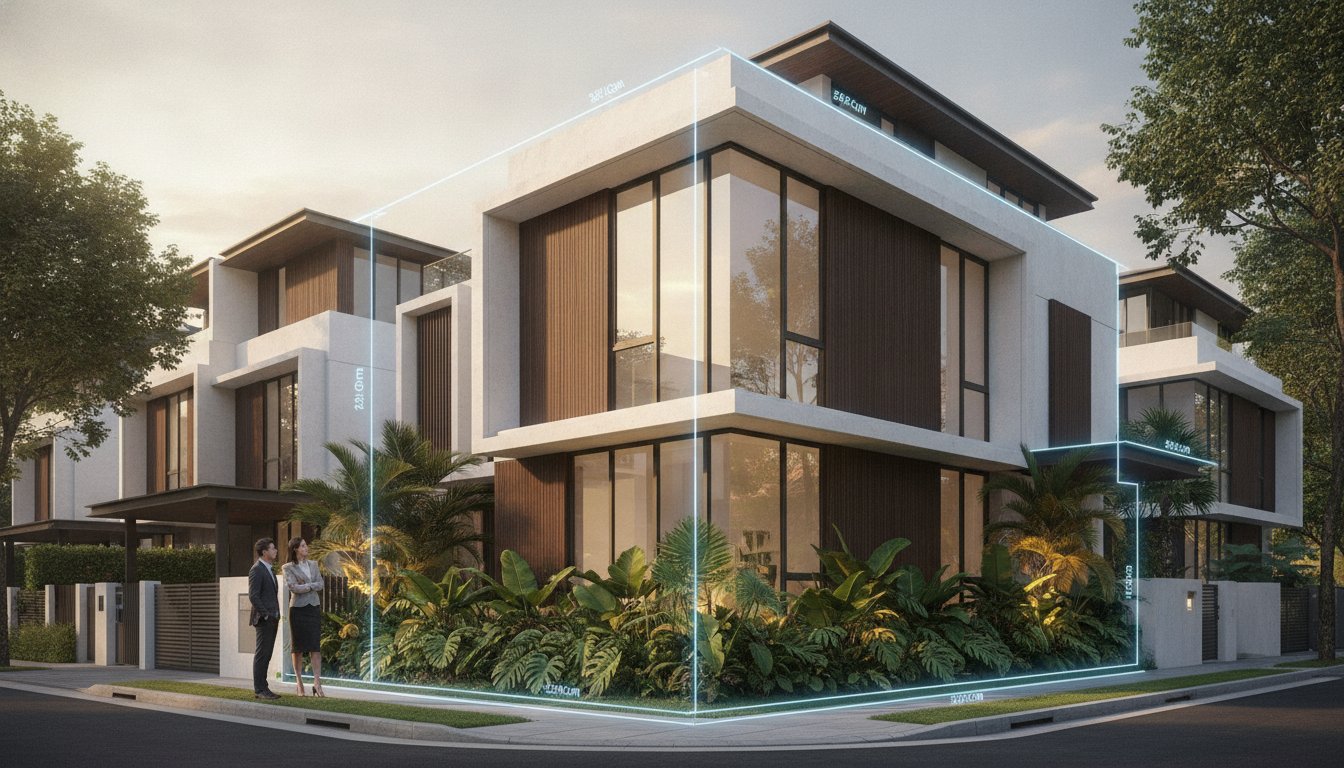
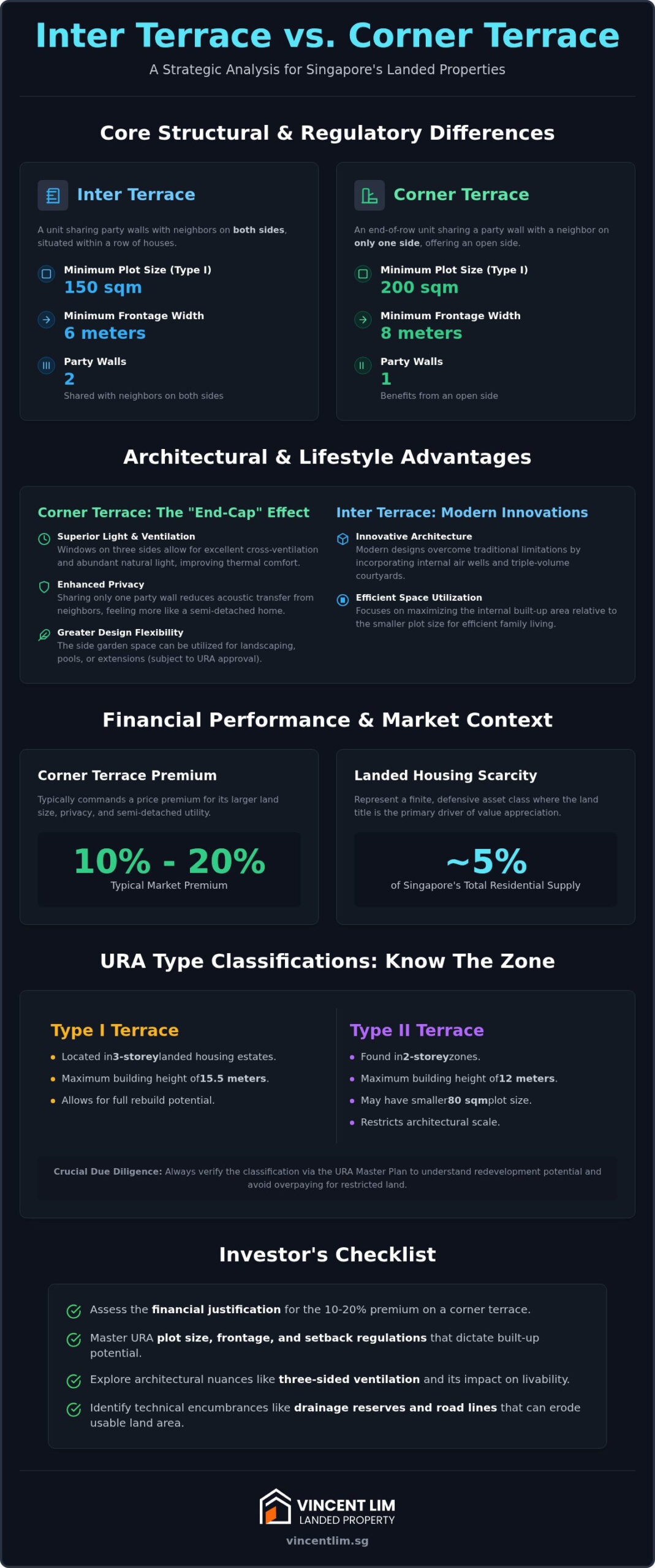
Understanding the fundamental distinction between an inter terrace vs corner terrace singapore requires a precise look at Urban Redevelopment Authority (URA) classifications. In the context of Singapore’s urban fabric, a Terraced house is defined by its shared structural boundaries. An inter-terrace is a unit sharing party walls with neighbors on both sides. Conversely, a corner terrace occupies the prestigious end-of-row position, sharing only one party wall and offering an open side that fundamentally alters its development potential. As of June 2026, URA guidelines dictate that a Type I inter-terrace must occupy a minimum plot size of 150 square meters, while its corner counterpart requires a larger 200 square meter footprint to satisfy regulatory standards.
Minimum Plot Sizes and Width Requirements
Frontage width is often the silent architect of a property’s value. For an inter-terrace, a minimum width of 6 meters is mandatory. Corner terraces, however, require a wider 8-meter frontage to accommodate the necessary side setbacks. These 2 meters aren’t just aesthetic; they dictate the maximum built-up potential and internal layout efficiency. If a plot fails to meet these width requirements, it may be classified as a Type II terrace, which allows for a smaller 80 square meter plot but significantly restricts the architectural scale of the home.
URA Type 1 vs Type 2 Classifications
Investors must distinguish between Type 1 and Type 2 designations to avoid overpaying for restricted land. Type 1 terraces are typically located in designated three-storey landed housing estates, allowing for a building height of up to 15.5 meters. Type 2 terraces are found in two-storey zones with a 12-meter height cap. Identifying these classifications through the URA Master Plan is a non-negotiable step in your due diligence. These types dictate whether you can execute a full rebuild or if you’re limited to minor additions and alterations, directly impacting the asset’s future resale liquidity.
The Scarcity Factor in Singapore Landed Housing
Landed properties represent a mere 5% of Singapore’s total residential supply, a statistic that underscores their status as defensive assets. This extreme scarcity ensures that the underlying land title, rather than the structure itself, carries the bulk of the property’s valuation. The land title for these assets is governed by the Land Titles Act, which ensures that the finite nature of freehold and 999-year leasehold plots remains a primary driver of capital appreciation. When you acquire a terrace, you aren’t just buying a home; you’re securing a fractional share of Singapore’s limited terrestrial footprint.
The Architectural Advantage: Privacy, Light, and Ventilation Nuances
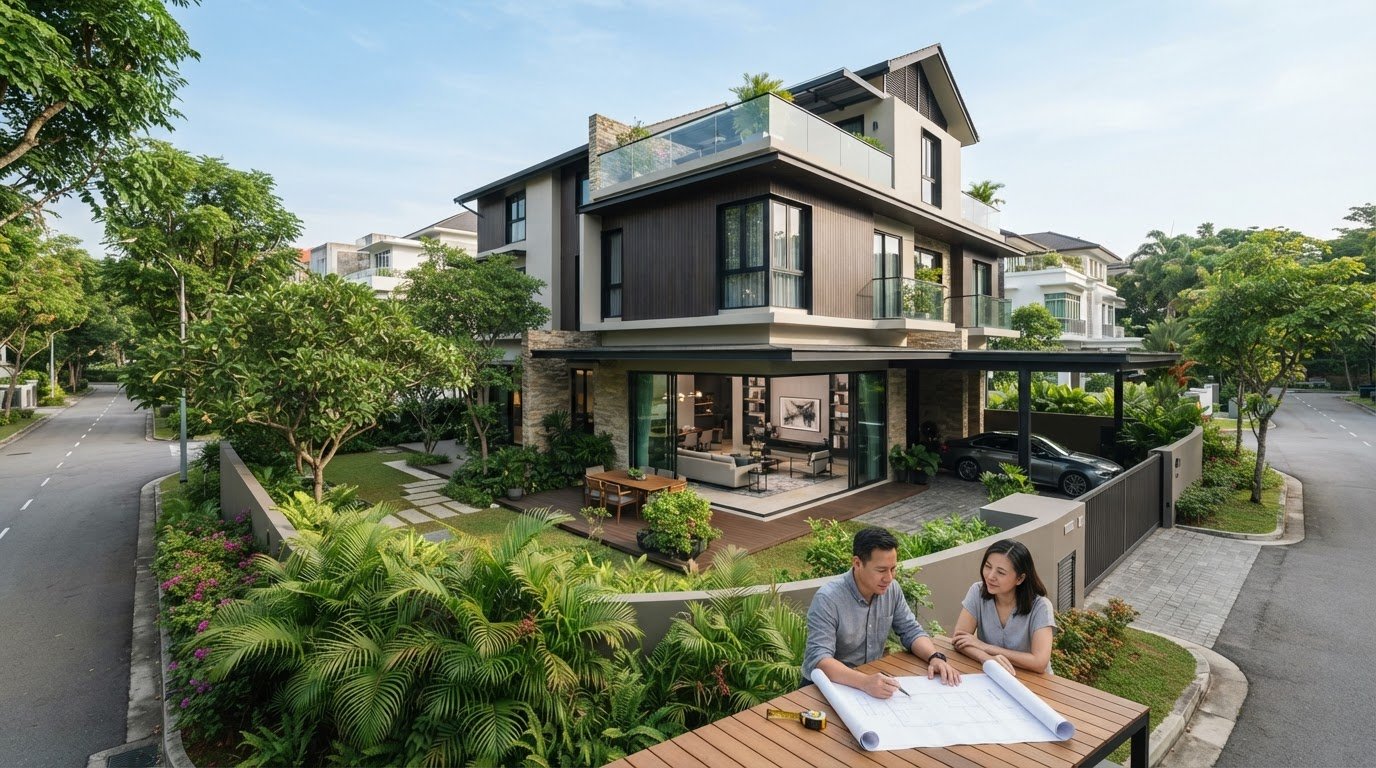
The environmental performance of a home often dictates the daily well-being of its occupants. While both property types offer the prestige of landed living, the architectural experience of an inter terrace vs corner terrace singapore differs significantly in terms of light penetration and thermal comfort. A corner terrace, positioned at the end of a row, benefits from what architects call the “end-cap” effect. This allows for windows on three sides, creating a porous living environment that facilitates superior cross-ventilation compared to the two-sided exposure of an inter-terrace.
Privacy is another critical factor for the discerning buyer. Sharing only one party wall reduces acoustic transfer from neighbors, providing a sanctuary that feels more like a semi-detached home. However, modern architecture has effectively challenged the misconception that inter-terraces are inherently dark or stagnant. Innovative designs now incorporate internal air wells and triple-volume courtyards to pull natural light into the deepest parts of the floor plan. If you’re evaluating a specific plot, consulting a landed property specialist can help you visualize how these architectural features impact the unit’s long-term livability and value.
Maximizing Natural Light and Airflow
The side garden of a corner unit acts as a dedicated ventilation corridor. This side-setback, mandated by URA, ensures that breezes aren’t blocked by adjacent structures. In contrast, inter-terraces often rely on the “stack effect” through internal voids to circulate air. While a corner unit offers lateral light, a well-designed inter-terrace can offer dramatic vertical light that many find equally appealing. Both strategies contribute to higher resale desirability by creating a sense of volume and openness that buyers crave.
Land Utilization and Outdoor Potential
A corner terrace offers a “lifestyle footprint” that more closely resembles a semi-detached house. The additional land width allows for wrap-around patios, private lap pools, or even a small edible garden. These features are difficult to execute in an inter-terrace where outdoor space is usually restricted to a front car porch and a small rear yard. For buyers with young children or pets, this extra perimeter space often becomes the deciding factor in the acquisition process.
Maintenance and Facade Considerations
Strategic buyers must also weigh the operational realities of a larger plot. A corner terrace has a more extensive external facade, which means higher costs for periodic repainting and waterproofing. Larger garden areas also require more intensive pest control and landscaping maintenance. It’s a trade-off between the prestige of an expansive end-unit and the efficiency of a more compact inter-terrace. Balancing these lifestyle perks against the increased upkeep effort is essential for a sustainable long-term investment strategy.
Financial Performance: Analyzing Premiums and Resale Value Retention
The financial logic underpinning a landed acquisition requires more than a simple comparison of list prices. In the 2026 market, the decision between an inter terrace vs corner terrace singapore often hinges on the buyer’s tolerance for a premium that reflects both land scarcity and lifestyle utility. While the median price of landed properties reached S$4,650,000 in 2025, the distribution of that value varies significantly based on the unit’s position within the terrace row. Corner units act as a strategic middle ground, capturing the essence of semi-detached living without the full capital commitment required for a Semi-D title.
The Corner Premium: Is it Justified?
Quantifying the “corner premium” reveals a consistent 10% to 20% price gap over neighboring inter-terraces. This surplus isn’t just a “view tax”; it’s a reflection of the larger 200 square meter minimum plot size required for Type I corner units. Analyzing the PSF gap between corner terraces and semi-detached houses shows that corner units often trade at a significant discount to Semi-Ds in the same district, even when the internal built-up area is comparable. This makes the corner terrace a high-efficiency asset for those seeking maximum utility per dollar.
Historical Capital Appreciation Trends
Historical data confirms the resilience of the landed segment, with prices growing 6.73% year-on-year as of Q1 2026. Over a 10-year horizon, corner terraces have frequently outperformed inter-units in capital preservation because their larger land plots offer greater redevelopment flexibility. During market volatility, these units serve as a hedge; their rarity ensures that even when transaction volumes dip, asking prices remain firm. Tenure remains the ultimate arbiter of long-term value, with freehold titles commanding a distinct “legacy premium” over 99-year leasehold counterparts as the lease decays.
Rental Yield and Tenant Appeal
From an investment perspective, corner terraces typically attract a higher tier of expatriate and local professional tenants who prioritize privacy and outdoor space. The potential for a side garden or private patio allows landlords to command a rental premium that often offsets the higher maintenance costs associated with the larger facade. When calculating your net yield, it’s essential to account for the 2026 property tax rates, which range from 12% to 36% for non-owner-occupied properties. Despite these costs, the superior tenant retention rates of corner units often result in more stable long-term cash flow compared to standard inter-terraces.
Strategic Selection: Matching Your Home to Your Asset Progression Goals
Strategic acquisition isn’t just about the current structure; it’s about the plot’s future role in your portfolio. When weighing the benefits of an inter terrace vs corner terrace singapore, you must look beyond the immediate floor plan to the asset’s trajectory over the next decade. For many, this choice represents the first step in a multi-generational wealth strategy designed to preserve capital in a land-scarce environment. It’s about positioning your capital where it can grow most efficiently while serving your family’s evolving needs.
The Inter-Terrace as an Entry-Level Landed Asset
First-time landed buyers often prioritize location over land size. An inter-terrace allows you to enter prestigious districts at a more accessible price point while still enjoying the autonomy of a land title. These units offer high efficiency, as every square meter of land is utilized for internal living space rather than side setbacks. Mastering the Asset Progression to Landed Property Singapore requires understanding the trade-offs of an inter terrace vs corner terrace singapore to build equity for future acquisitions. By focusing on a well-located inter-unit, you can maximize your internal built-up area on a smaller land footprint.
The Corner Terrace as a Bridge to Semi-Detached
The corner terrace functions as a strategic “Semi-D Lite” option. It provides the three-sided exposure and side garden of a semi-detached house while maintaining a terrace property title. This distinction is vital for buyers who want the prestige and lifestyle of a larger home but aren’t yet ready for the capital commitment of a semi-detached or detached house. Identifying corner plots with “Semi-D sized” land area, often exceeding 215 square meters, can lead to superior value retention. If you’re planning your next move, consulting with an elite strategist can help you time your exit to maximize capital gains.
Redevelopment and Extension Potential
Maximizing your asset’s value often involves physical transformation. URA’s “envelope control” guidelines allow for significant redevelopment, often expanding a two-storey structure into a three-storey home with an attic. Rebuilding costs in 2026 typically range from S$1 million to S$1.6 million, making it a substantial investment that requires a clear financial justification. By identifying plots with high redevelopment potential, you can effectively increase your Gross Floor Area (GFA) and future-proof the property as a legacy asset for the next generation. This proactive approach ensures your home remains a high-performing component of your overall wealth plan.
Executing the Acquisition: Why Specialized Market Intelligence Matters
Transitioning from market analysis to a successful acquisition requires a shift in perspective. While the choice between an inter terrace vs corner terrace singapore is grounded in financial data, the execution phase is often defined by access to information not available on public portals. A seasoned specialist provides this “information arbitrage,” identifying off-market opportunities that never reach the open market. This is particularly vital in the landed segment, where transaction volumes are low and privacy is a priority for high-net-worth sellers who prefer discreet dealings.
Technical Due Diligence for Landed Property
Standard property searches often fail to reveal hidden encumbrances that can silently erode the value of a landed investment. You must verify drainage reserves, road line plans, and specific URA setback requirements that vary significantly from one plot to the next. A specialist understands how to interpret complex land surveys and identify structural integrity issues that might not be visible to the untrained eye. This level of scrutiny ensures you aren’t paying a premium for land that cannot be fully utilized due to regulatory constraints or future infrastructure developments. It’s about protecting your capital before the first deposit is paid.
The Art of the Landed Transaction
Negotiating a multi-million dollar deal requires a calculated approach to protect your long-term interests. You’ll need to structure an offer that is competitive enough to secure the title without overpaying in a resilient, high-demand market. Managing the timeline is also critical, especially if you’re transitioning from a luxury condominium to a landed home and need to coordinate sales and purchases. For a detailed breakdown of the necessary acquisition steps, you can refer to the guide on Terrace House for Sale Singapore. This methodical planning ensures a seamless transition and minimizes the stress of high-stakes timing.
Building Your Legacy with Vincent Lim (OrangeTee & Tie)
Success in the landed market is rarely accidental; it’s the result of disciplined planning and expert advocacy. With over 20 years of industry experience since 2004, the team at Vincent Lim (OrangeTee & Tie) provides a bespoke approach to property wealth planning and portfolio management. My role is to act as your elite strategist, guiding you through the complexities of the inter terrace vs corner terrace singapore debate and beyond. Whether you’re acquiring a terrace for immediate stay or as a long-term legacy asset, my goal is to provide the peace of mind that comes from meticulous due diligence and seasoned authority. Contact me for a private consultation to refine your landed acquisition strategy for 2026 and ensure your next move is a calculated success.
Securing Your Legacy in Singapore’s Landed Market
Deciding between an inter terrace vs corner terrace singapore is a pivotal moment in an investor’s asset progression journey. We’ve analyzed how Type I and Type II classifications dictate your redevelopment ceiling and how the 10% to 20% corner premium serves as a strategic bridge to semi-detached living. Ultimately, your choice should align with whether you prioritize the high-efficiency built-up area of an inter-unit or the superior ventilation and legacy potential of a corner plot. These technical distinctions aren’t just architectural; they’re the foundation of your property’s future capital appreciation.
Navigating these multi-million dollar decisions requires a partner who operates with calculated precision. As an Executive Associate Director at Vincent Lim (OrangeTee & Tie) with over 20 years of Singapore real estate expertise, I specialize in GCB and luxury landed residences. My bespoke approach ensures you avoid technical pitfalls like drainage reserves while maximizing your property’s future resale liquidity. I invite you to Consult with Vincent Lim (OrangeTee & Tie) for a strategic landed property analysis to refine your 2026 acquisition plan. Let’s transform your landed property goals into a disciplined, high-performing legacy.
Frequently Asked Questions
Is a corner terrace considered a semi-detached house in Singapore?
A corner terrace isn’t classified as a semi-detached house, despite sharing only one party wall. In the URA hierarchy, a corner terrace remains part of a terrace row, while a semi-detached house is a pair of houses or a single unit within a semi-detached zone. This distinction affects both the land title and the specific setback requirements applied during redevelopment or major additions.
What is the minimum land size required for an inter-terrace in 2026?
For 2026, the minimum land size for a Type I inter-terrace is 150 square meters with a minimum width of 6 meters. If the property is classified as Type II, the requirement drops to 80 square meters. Understanding these plot dimensions is crucial when evaluating an inter terrace vs corner terrace singapore to ensure the land meets modern development standards and rebuild potential.
Does a corner terrace always have a higher resale value than an inter-terrace?
Corner terraces typically command a higher resale value because of their larger land footprint and enhanced privacy. While market conditions and internal renovation quality play a role, the “end-cap” position attracts a 10% to 20% premium. This price gap remains resilient even during market cooling phases due to the inherent scarcity of corner plots across Singapore’s landed estates.
Can I rebuild an inter-terrace into a corner terrace if the neighbor is demolished?
You can’t reclassify an inter-terrace as a corner unit simply because an adjacent property is demolished. URA zoning and plot classifications are predetermined based on the original layout of the terrace row. Even if a neighbor rebuilds or the row is fragmented, your property’s legal status as an inter-terrace remains fixed under current land title regulations and master plan designations.
What are the setback requirements for a corner terrace garden?
URA guidelines as of June 2026 require a minimum side setback of 3 meters for corner terraces. This space is intended to provide a buffer between the building and the boundary, often utilized for gardens, lap pools, or ventilation corridors. These setback rules are more stringent than those for inter-terraces, which don’t require side buffers due to their shared party walls on both sides.
Are corner terraces more difficult to maintain than inter-terraces?
Corner terraces require more intensive maintenance due to their larger external facade and exposed side wall. You’ll face higher costs for periodic repainting, waterproofing, and landscaping for the additional garden area. While these tasks demand more effort and capital, the lifestyle benefits of increased natural light and cross-ventilation often justify the ongoing upkeep for most discerning owners.
How much more does a corner terrace usually cost compared to an inter-terrace?
A corner terrace usually costs 10% to 20% more than a standard inter-terrace in the same vicinity. This premium reflects the larger 200 square meter minimum plot size required for Type I corner units compared to the 150 square meters for inter-units. Investors often view this extra cost as a strategic investment in privacy, land area, and future redevelopment flexibility.
Which terrace type is better for a legacy property to pass to children?
A corner terrace is often considered the superior legacy asset because its land size and “end-unit” status offer greater long-term value retention. The potential to rebuild into a three-storey home with three-sided ventilation provides a lifestyle that appeals to future generations. However, an inter-terrace remains a highly efficient choice for those prioritizing a lower entry price and capital growth efficiency.