A landed home in Singapore is a bespoke asset that requires a surgical approach to divestment. You might worry that your estate will sit stale on the market or that you’ll be caught off guard by the dual Seller’s Stamp Duty frameworks active in 2026. Understanding how long to sell landed property singapore involves more than just counting days; it requires aligning market liquidity with the right high-net-worth profile. It’s natural to feel a sense of urgency, yet rushing a transaction of this magnitude often leaves significant value on the table.
This guide provides the clarity you need to orchestrate a smooth three to six month transition while achieving a record price for your property. We’ll examine the realistic timeline from the initial valuation to the final legal completion, including how to navigate the 16 percent SSD rates for recent acquisitions. You’ll discover the strategic marketing phases and due diligence requirements that separate a standard sale from a calculated, high-value exit. By the end of this article, you’ll have a roadmap to minimize tax liabilities and secure a qualified buyer in this restricted market.
Key Takeaways
- Identify why a realistic sale window spans three to nine months and how the structural complexity of landed estates requires a different timeline than condominiums.
- Learn how property variables such as freehold tenure and “move-in ready” condition serve as catalysts for a faster, high-value transaction.
- Understand exactly how long to sell landed property singapore by navigating the dual 2026 Seller’s Stamp Duty rules and implementing a “Right Price” strategy.
- Discover why luxury assets like Good Class Bungalows often utilize “quiet listings” and off-market networks to protect privacy while securing elite buyers.
- Master the final legal milestones of the OTP and conveyancing process to ensure a seamless transition and the precise handling of your financial proceeds.
The Realistic Timeline for Selling Landed Property in Singapore (2026)
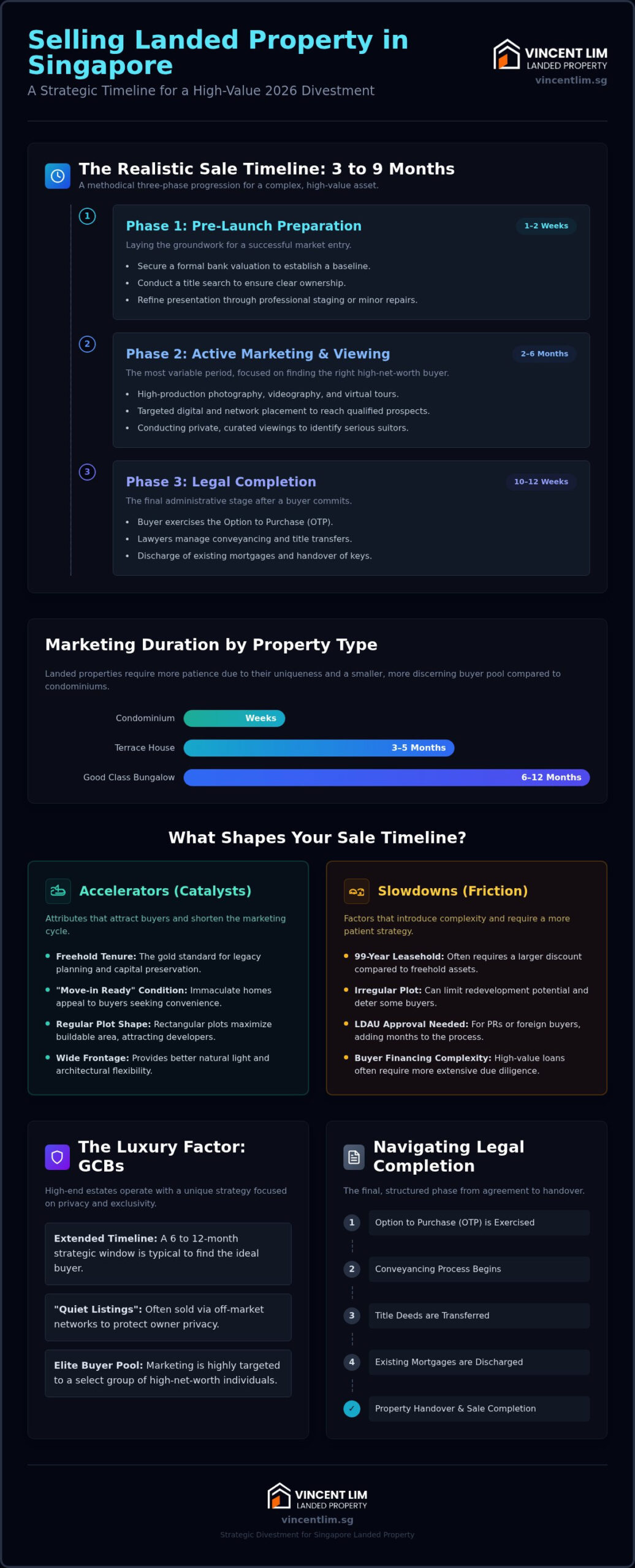
Selling a high-value estate is a marathon, not a sprint. While a condominium might move in weeks, the question of how long to sell landed property singapore typically finds its answer in a three to nine month window. This duration isn’t a sign of market weakness; it’s a reflection of the asset’s complexity and the precision required to match a unique home with a qualified buyer. A successful divestment follows a methodical three-phase progression.
- Phase 1: Pre-launch Preparation (1-2 weeks): This involves securing a formal valuation, conducting a title search, and refining the home’s presentation through staging or minor repairs.
- Phase 2: Active Marketing and Viewing Cycle (2-6 months): This is the most variable period. It encompasses high-production media creation, targeted digital placement, and several rounds of private viewings to identify a serious suitor.
- Phase 3: Legal Completion (10-12 weeks): Once the Option to Purchase (OTP) is exercised, the legal machinery begins. This includes title transfers and the discharge of existing mortgages.
Why Landed Assets Require More Patience
The primary reason for an extended timeline is the inherent uniqueness of the asset. When asking What is Landed Property?, one must recognize that unlike a stack of identical condo units, every landed home has a distinct plot shape, orientation, and redevelopment potential. This uniqueness means buyers conduct far more extensive due diligence before committing.
The buyer pool is also significantly more restricted. Under the Land Dealings Approval Unit (LDAU) regulations, most landed properties are reserved for Singapore Citizens, which naturally narrows the field of prospects. Additionally, the sheer scale of the transaction often leads to financing complexity. Buyers of detached houses or GCBs frequently manage intricate portfolios, and securing the necessary loan quantums can take longer than a standard residential mortgage approval.
The 2026 Market Context
In 2026, the timeline is heavily influenced by URA price trends and the prevailing interest rate environment. Buyers are currently more discerning, often waiting for clear signals of price stability before exercising an OTP. While a terrace house typically concludes its marketing phase within three to five months, a Good Class Bungalow (GCB) often requires a six to twelve month strategic window to identify the right high-net-worth individual. Understanding how long to sell landed property singapore in this climate means preparing for a steady, intentional process rather than expecting an overnight result.
Critical Variables: What Accelerates or Slows Your Sale?
While the market average provides a baseline, specific attributes of your estate can drastically shift the needle on how long to sell landed property singapore. It’s rarely just about the location; it’s about the “liquidity profile” of the land itself. Certain variables act as catalysts, while others introduce friction that requires a more patient, strategic approach to navigate successfully.
Tenure and Land Size Implications
Freehold assets remain the gold standard for liquidity in 2026. These properties typically transact faster than 99-year leasehold counterparts because they offer long-term capital preservation, which is vital for detached house for sale singapore and legacy planning. Land size and shape are equally critical. Regular, rectangular plots attract developers and rebuilders much faster than irregular plots because they maximize buildable efficiency. Wide frontages in terrace and semi-detached homes also command a premium, often shortening the marketing cycle by several weeks as they provide better natural light and architectural flexibility.
The LDAU Factor and Foreigner Restrictions
A significant variable in the timeline is the buyer’s profile. Most landed homes are restricted to Singapore Citizens. If a Permanent Resident or foreigner expresses interest, they must navigate the official sale and purchase process with an added layer: approval from the Land Dealings Approval Unit (LDAU). This vetting process typically adds three to six months to the transaction. For most landed estates, success depends on strategic targeting of local high-net-worth individuals who can move without these regulatory delays.
Determining exactly how long to sell landed property singapore also requires an honest assessment of your home’s current condition versus its potential. “Move-in ready” homes appeal to families wanting immediate occupancy, while those with “redevelopment potential” attract a different class of investor. Properties that fall into the “middle ground,” specifically those that are dated but not yet ready for teardown, often sit the longest as they require the most specific buyer profile. The most common mistake that slows a sale is “testing the market” with an inflated price. In the age of transparent data, a property that sits for too long becomes “stale,” leading buyers to assume there are underlying issues. If you’re looking to optimize your timeline, consulting a specialist in luxury landed transactions can ensure your pricing strategy aligns with current demand from the very first day, preventing your asset from losing its market momentum.
The Luxury Factor: Timelines for GCBs and High-End Estates
The question of how long to sell landed property singapore takes on a different dimension when discussing the pinnacle of the residential market. For those divesting a what is a good class bungalow, the timeline typically extends to a six to twelve month window. This duration isn’t a sign of market stagnation; rather, it reflects the deliberate pace of ultra-high-net-worth (UHNW) transactions where privacy and precision outweigh raw speed. These assets are not commodities; they are trophy holdings that require a bespoke approach to find the right successor.
Off-Market Strategies for Elite Assets
Maintaining the prestige of a high-end estate often requires avoiding the noise of public property portals. “Quiet listings” or off-market deals allow sellers to protect their privacy while ensuring the asset remains exclusive in the eyes of elite buyers. This approach relies heavily on a veteran specialist’s private network to coordinate a match between a unique property and a qualified suitor. By vetting buyers through rigorous financial pre-qualification, we eliminate “window shoppers” and ensure that only serious parties enter the estate. This focused coordination shortens the effective “finding” phase by concentrating efforts on a high-probability buyer pool rather than casting a wide, ineffective net.
GCB Specific Legal and Technical Hurdles
Technical due diligence for a GCB is significantly more intensive than for a standard terrace or semi-detached house. Before listing the property, we must verify boundary setbacks and specific planning constraints mandated by the Urban Redevelopment Authority (URA). If a property has heritage or conservation status, the selling timeline can stretch further as buyers evaluate the limitations on renovation or redevelopment. Because GCB land sizes are substantial, the valuation process is inherently more complex; a single plot can require multiple professional assessments to reach a consensus on its true market value.
Managing the expectations of UHNW buyers requires a high degree of discipline and transparency. These individuals aren’t just purchasing a home; they’re acquiring a legacy asset. They expect a “white-glove” experience that respects their time and intelligence throughout the negotiation. By addressing potential technical hurdles early and utilizing a refined off-market strategy, we ensure the transaction remains a calculated move. Understanding how long to sell landed property singapore at this level means accepting that excellence takes time to orchestrate properly, ensuring the final price reflects the true prestige of the estate.
Strategic Refinement: How to Shorten Your Time-on-Market
While external market conditions set the baseline, your internal strategy determines the ultimate velocity of the transaction. Shortening how long to sell landed property singapore requires moving beyond passive listings into the territory of active asset refinement. A property that is strategically positioned doesn’t just wait for a buyer; it commands attention and triggers competitive interest from the first week of launch.
Strategic pricing is the cornerstone of this refinement. We avoid the common pitfall of “testing the market” with an inflated figure, which often leads to the property becoming a stale listing. Instead, we utilize a “Right Price Analysis” to identify the precise value threshold that attracts serious high-net-worth individuals while maximizing your return. This approach creates a sense of urgency and can lead to multiple offers, significantly reducing the marketing phase.
First Impressions and Presentation
Landed estates are vast, and a vacant shell often fails to communicate the true lifestyle potential of the space. Professional home staging is not optional in the luxury segment; it’s a vital tool to transform an empty floor plan into a cohesive vision of elite living. This presentation is supported by high-production digital storytelling. We move beyond simple wide-angle photos to produce cinematic property tours that capture the estate’s ambiance during both “day and night” cycles. To further reduce friction during viewings, we prepare a comprehensive “Property Fact Sheet.” This document provides immediate answers to technical queries regarding plot depth, URA setbacks, and structural history, ensuring that serious buyers can move toward a decision without delay.
Selecting the Right Landed Specialist
The difference between a generalist and a landed-focused broker is often measured in months of saved time. A specialist doesn’t just list a property; they understand the nuances of land morphology and redevelopment potential that a generalist might overlook. By leveraging a veteran network like OrangeTee & Tie, your property gains exposure to a curated pool of active buyers. Experience since 2004 is a critical asset here. It provides the seasoned authority needed to navigate complex negotiations and market cycles with disciplined precision. If you are ready to begin this process, you can explore our sell my landed property singapore strategic guide for a deeper look at maximizing your estate’s value.
Ultimately, a shortened timeline is the result of meticulous preparation and expert coordination. When every detail from minor repairs to digital placement is managed with a “white-glove” standard, the path to a record price becomes clear and efficient. For a bespoke assessment of your property’s market readiness, you may connect with our team to develop a tailored divestment plan.
Navigating the Legal Completion: From OTP to Handover
Once a buyer is identified, the transaction enters its most structured phase. Understanding how long to sell landed property singapore requires accounting for this administrative tail-end, which typically spans 10 to 12 weeks after the Option to Purchase (OTP) is exercised. The process begins with the buyer paying a 1 percent option fee to secure the OTP. This grants them a standard 14-day window to conduct final due diligence and secure financing before committing the remaining 4 percent exercise fee.
For properties acquired on or after 4 July 2025, the 2026 regulatory landscape requires strict adherence to the four-year Seller’s Stamp Duty (SSD) holding period. Selling within the first year incurs a 16 percent SSD; this rate tapers to 12 percent in the second year, 8 percent in the third, and 4 percent in the fourth year. These liabilities are payable within 14 days of the buyer exercising the OTP, not upon the final completion. Navigating these tax windows is essential to protecting your capital gains, especially for high-value estates where these percentages represent significant sums.
Financial Milestones in the Sales Process
Managing the financial transition is as critical as the sale itself. Most banks in Singapore require a three-month mortgage redemption notice; failing to serve this early can result in interest-in-lieu penalties that erode your net proceeds. Your conveyancing lawyer plays a pivotal role here, coordinating the discharge of your mortgage and the mandatory refund of CPF funds, including accrued interest at 2.5 percent per annum. It’s vital to calculate your net proceeds precisely, accounting for the standard 2 percent agent commission plus 9 percent GST and legal fees, which typically range from S$2,500 to S$3,500 for private property transactions.
The 10-to-12 Week Completion Countdown
The period between the Sale and Purchase Agreement and the final handover is a methodical legal countdown. During these weeks, the buyer’s lawyers conduct exhaustive title searches to ensure the estate is free of encumbrances. We recommend coordinating your move-out date at least two weeks before the legal completion to allow for a thorough professional cleaning. Before the keys change hands, the buyer will perform a final inspection to verify that the property is in the agreed-upon vacant possession state. This “white-glove” transition ensures that your journey in determining how long to sell landed property singapore concludes with the same precision that defined the initial marketing strategy. A seamless handover protects your reputation and ensures the final disbursement of funds occurs without administrative friction.
Orchestrating Your Successful Landed Exit
Achieving a record-breaking result for your estate requires more than just a public listing; it demands a calculated alignment of market timing, presentation, and legal precision. We’ve established that while the question of how long to sell landed property singapore typically finds its answer in a three to nine month window, your specific strategy can significantly compress or extend this timeframe. By addressing technical hurdles early and utilizing elite off-market networks, you protect both your privacy and your property’s prestige throughout the transaction.
As an Executive Associate Director at OrangeTee & Tie with over 20 years of industry experience, I specialize in the complexities of the GCB and luxury landed market. Navigating the 2026 Seller’s Stamp Duty frameworks and identifying qualified buyers in a restricted market is a task for a veteran strategist who values integrity and results. I invite you to Consult Vincent Lim for a Strategic Landed Property Valuation to ensure your divestment is managed with the white-glove care it deserves. Your legacy asset is unique, and its sale should be a seamless, high-value transition that reflects its true worth. Let’s begin the journey toward your next milestone with confidence and clarity.
Frequently Asked Questions
How long is the standard completion period for landed property in Singapore?
The standard legal completion period is typically 10 to 12 weeks from the date the buyer exercises the Option to Purchase (OTP). This timeframe allows conveyancing lawyers to perform necessary title searches and coordinate with the CPF Board for fund disbursements. It’s a structured process that ensures all financial encumbrances are cleared before the final handover. This period remains consistent regardless of the marketing duration.
Can I sell my landed property faster if it is a “tear-down” unit?
A “tear-down” unit often moves faster because it appeals to developers and investors who prioritize land value over structural condition. These buyers generally conduct due diligence on land morphology and URA setbacks rather than aesthetic features. While the marketing phase might be shorter, the question of how long to sell landed property singapore still depends on the plot’s redevelopment potential and your pricing strategy.
Does the 2026 Seller’s Stamp Duty (SSD) apply to me if I bought before 2025?
If you purchased your property between 11 March 2017 and 3 July 2025, the three year SSD holding period applies. The 2026 four year framework is specifically for properties acquired on or after 4 July 2025. It’s essential to verify your exact purchase date to calculate whether your transaction falls under the 12 percent or 16 percent maximum tax brackets based on your specific holding duration.
Why do GCBs take longer to sell than terrace houses?
Good Class Bungalows (GCBs) involve a significantly higher capital outlay and a more restricted pool of qualified Singaporean buyers. The due diligence process is also more intensive, requiring detailed assessments of boundary setbacks and historical land usage. While a terrace house might sell in three months, a GCB often requires six to twelve months to find a buyer who appreciates its unique prestige and heritage value.
How much are the typical property agent fees for selling landed property?
The industry standard commission for selling landed property is 2 percent of the final sale price. Since January 2024, this fee is subject to a 9 percent Goods and Services Tax (GST). For a S$10 million transaction, the commission would be S$200,000 plus S$18,000 in GST. These fees are typically paid upon the legal completion of the sale from the cash proceeds of the transaction.
What happens if the buyer cannot get LDAU approval after paying the option fee?
If a buyer’s application to the Land Dealings Approval Unit (LDAU) is rejected, the Option to Purchase typically becomes null and void. Sellers generally refund the 1 percent option fee unless specific clauses in the OTP state otherwise. To avoid this administrative delay, we vet buyers early to ensure they meet the criteria for owning restricted residential property in Singapore before an option is even granted.
Is home staging necessary for an old landed property?
Staging is highly recommended for older estates to help buyers visualize the property’s lifestyle potential. An empty or cluttered house can distract from the actual land size and architectural bones. By transforming a dated interior into a refined space, we reduce the psychological friction that often extends how long to sell landed property singapore in a competitive market. It positions the home as a premium asset.
How can I find out the true market value of my landed house in 2026?
Determining true market value requires a combination of professional bank valuations and a detailed analysis of recent URA caveats for similar land plots. Online estimators often miss the nuances of land orientation and redevelopment potential. A veteran specialist will provide a “Right Price Analysis” that aligns your expectations with the current 2026 liquidity levels and actual buyer demand for your specific estate type.