With fewer than 2,800 units ever gazetted, Good Class Bungalows represent the most exclusive 0.1% of Singapore’s residential landscape. You understand that acquiring such an asset isn’t just a property purchase; it’s a calculated move to secure a finite piece of the nation’s heritage. However, the distinction between a standard large bungalow and the 39 official Good Class Bungalow areas Singapore maintains can be deceptively technical. Managing URA redevelopment constraints and the nuances of the Residential Property Act requires more than just capital. It requires a strategist’s perspective.
It’s natural to feel overwhelmed by opaque LDAU approval processes or the rigid 1,400 square meter plot requirements that define this asset class. This guide promises to strip away the ambiguity, offering a comprehensive framework for legacy wealth planning in 2026. We’ll analyze the recent market rebound to S$2,341 per square foot and provide a detailed breakdown of the 39 enclaves. By the end of this article, you’ll possess the technical knowledge and market foresight to manage these prestigious transactions with absolute confidence and precision.
Key Takeaways
- Understand the precise URA planning parameters, such as the 1,400 square meter minimum plot size, that distinguish a GCB from standard detached houses.
- Identify the 39 gazetted Good Class Bungalow areas Singapore recognizes to ensure your investment remains within a legally protected and low-density enclave.
- Recognize the “zero-sum” nature of the market where a finite supply of approximately 2,800 units creates a permanent scarcity premium for legacy wealth.
- Navigate the strict eligibility framework, including the Singapore Citizen requirement and the complex LDAU approval process for Permanent Residents.
- Learn why the most prestigious opportunities are often found off-market and how a strategic approach to privacy is essential for successful high-stakes acquisitions.
Defining the Good Class Bungalow: URA Planning Criteria and Standards
The Good Class Bungalow represents the absolute zenith of Singapore’s residential property hierarchy. It sits alone at the top, governed by a set of rigid planning parameters designed to ensure its perpetual rarity. Defining the Good Class Bungalow requires looking past the architectural grandeur to the underlying land title and URA gazetting. While a standard detached house can exist in various districts, true GCBs are found only within the 39 gazetted Good Class Bungalow areas Singapore protects. This legal distinction is vital for investors. It ensures that the low-density character of the neighborhood won’t be eroded by future zoning changes.
Minimum Land Area and Site Coverage Rules
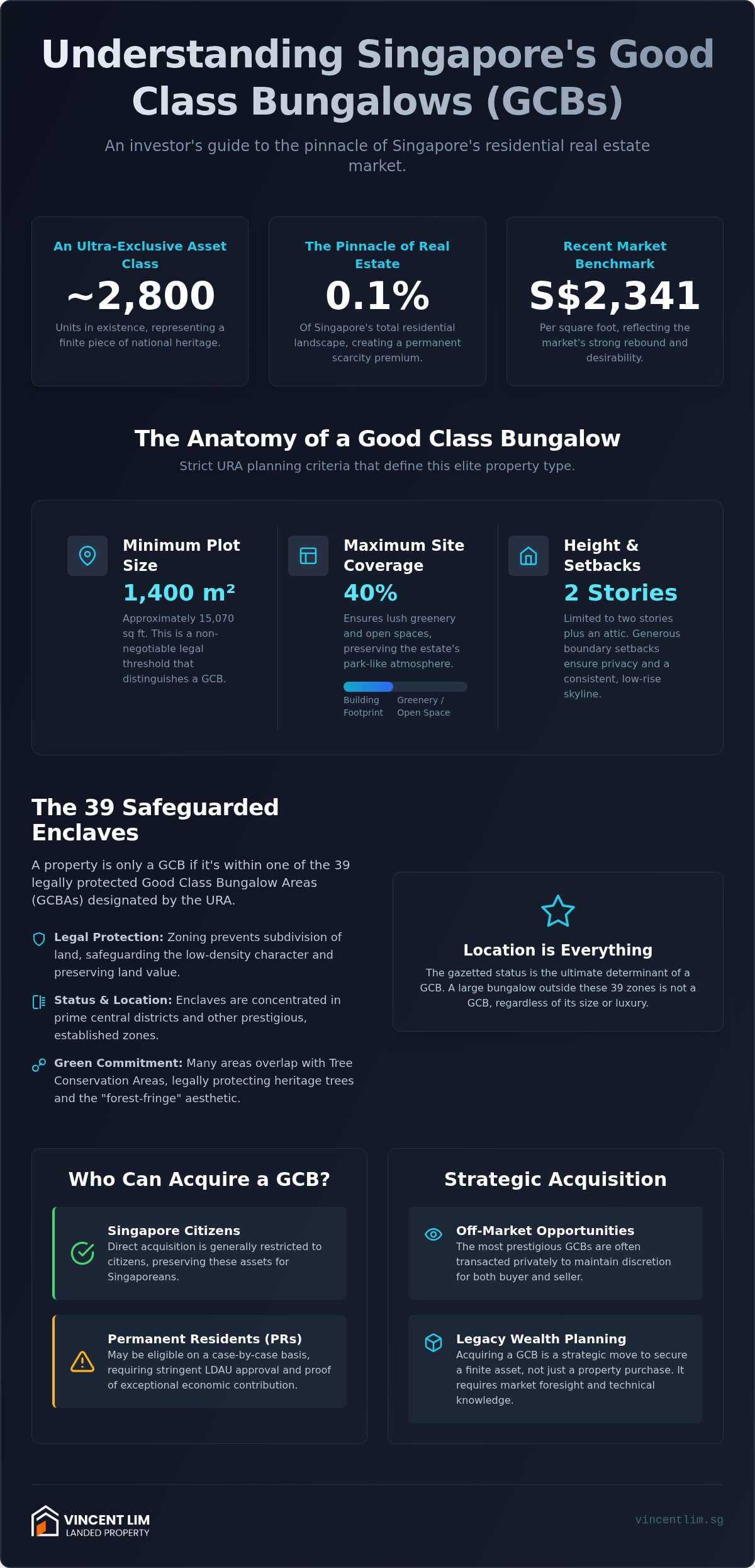
The most defining technical requirement is the minimum plot size. A GCB must occupy at least 1,400 square meters, which is approximately 15,070 square feet. This isn’t a suggestion; it’s a non-negotiable legal threshold. URA enforces a maximum site coverage of 40% to prevent the over-development of these precious plots. This rule ensures that a significant portion of the estate remains dedicated to greenery, swimming pools, and open space. It’s this specific ratio that creates the lush, park-like atmosphere synonymous with these enclaves. By restricting the building footprint, the authorities preserve the prestigious character that sustains the asset’s long-term value. You’ll find that this scarcity of buildable area actually enhances the property’s desirability among the elite.
Height and Setback Requirements
Architectural ambition in these areas is balanced by strict height and setback regulations. Most GCBs are limited to two stories plus an attic. This prevents any single estate from looming over its neighbors, maintaining a consistent skyline across the enclave. Privacy is further safeguarded by generous boundary setbacks. These regulations dictate how far the building must sit from the property line, ensuring a significant buffer between neighboring estates. Recent “Envelope Control” guidelines have introduced more flexibility for modern rebuilds, but they still operate within these fundamental volume constraints. These standards are what distinguish a GCB from a standard detached house through both legal and planning lenses. For the strategic investor, these constraints are the very guardrails that protect their legacy wealth within the Good Class Bungalow areas Singapore maintains.
The 39 Safeguarded Good Class Bungalow Areas (GCBA)
The exclusivity of a property isn’t just about the architecture or the plot size. It’s about the gazetted status. In Singapore, the Urban Redevelopment Authority (URA) has designated exactly 39 Good Class Bungalow areas Singapore recognizes as protected enclaves. These zones are legally safeguarded to preserve the nation’s environmental and historical character. Even if a detached house sits on 20,000 square feet of land, it cannot be classified as a GCB if it falls outside these specific boundaries. Most of these enclaves are concentrated in highly desirable central districts and other established, exclusive zones across the country.
The Logic of Safeguarded Zoning
Zoning serves as a powerful shield for land value. By gazetting these 39 areas, the URA prevents the subdivision of large plots into smaller semi-detached or terrace houses. This maintains the low-density, “forest-fringe” feel that high-net-worth individuals seek. Many of these areas also overlap with Tree Conservation Areas (TCA). This means heritage trees are legally protected, requiring owners to design around existing greenery rather than clearing it. This commitment to the environment ensures that the “greenery and space” aesthetic remains a permanent fixture of your investment, protecting it from the encroachment of urban density.
Key Categories of GCB Enclaves
The 39 GCBAs can be categorized by their unique appeal and geographical positioning. Prime central enclaves offer the highest status and proximity to key urban conveniences and lifestyle hubs. These often command the highest psf rates, with some standard plots in the most coveted central areas ranging from S$40 million to S$80 million in 2026. Conversely, secluded hilltop or forest-fringe GCBAs provide maximum privacy and a quieter lifestyle. Locational prestige within the 39 areas continues to drive a significant pricing gap. While entry-level plots in more outlying GCBAs might start around S$12 million to S$15 million, the most coveted central addresses represent a different tier of wealth entirely.
Understanding the nuances of each enclave is critical for strategic legacy planning. If you’re looking to source off-market GCB opportunities within these specific zones, having an experienced guide, such as Vincent Lim (OrangeTee & Tie), is indispensable to navigate the complexities of each area’s unique character and pricing trends.
The Scarcity Premium: Why GCBs are the Pinnacle of Singapore Real Estate
Ownership of a Good Class Bungalow is the ultimate expression of success in Singapore. With a supply strictly capped at approximately 2,800 units, this market operates on a logic entirely different from the broader residential sector. There are no new land releases for Good Class Bungalow areas Singapore can offer; the boundaries are fixed and the supply is finite. This creates a zero-sum environment where one family’s strategic acquisition is another’s exit. Historically, this asset class has shown remarkable resilience during global economic volatility. Land values grew at a compound annual rate of about 6.9% between 2019 and 2025. By Q2 2026, average land rates rebounded sharply to S$2,341 per square foot, confirming that demand for these rare land parcels remains decoupled from standard market cycles.
GCBs as a Store of Generational Wealth
Strategic investors view these properties as more than just residences; they are stores of generational wealth. While the ultra-luxury condo market saw a 15-quarter high of 23 deals in Q2 2026, GCB transactions remain rare, with only seven deals recorded in the same period. This illiquidity is a deliberate feature of the asset class. It prevents the rapid price fluctuations often seen in high-velocity markets. Understanding the nuances of asset progression to landed property singapore is essential for those transitioning from luxury condominiums to this final tier of ownership. Families often hold these estates for decades, prioritizing legacy preservation over short-term yields. The lack of new supply ensures that capital appreciation remains a steady, long-term trajectory.
The ‘Trophy Asset’ Effect
Owning a GCB signals entry into Singapore’s most elite social circles. Whether the estate is a heritage colonial Black and White or a bespoke modern masterpiece, its architectural significance adds a layer of intangible prestige. This ‘trophy asset’ status creates a permanent floor for resale values that other property types cannot match. Even in the broader detached house for sale singapore market, GCBs command a distinct premium because they are legally irreproducible. The psychological assurance of owning the ‘Gold Standard’ provides a level of peace of mind that few other global investments can provide. You aren’t merely purchasing a home; you’re securing a permanent legacy within the most prestigious Good Class Bungalow areas Singapore maintains.
Eligibility Rules and Regulatory Framework for GCB Acquisitions
The barrier to entry for Singapore’s most prestigious estates is as much legal as it is financial. Under the Residential Property Act, landed homes within the gazetted Good Class Bungalow areas Singapore maintains are restricted primarily to Singapore Citizens. The Land Dealings Approval Unit (LDAU), operating under the Singapore Land Authority (SLA), acts as the primary gatekeeper for these transactions. This regulatory framework ensures that the nation’s limited landed assets remain in local hands, creating a stable, domestic-driven market. For the strategic investor, this protectionism is a benefit; it insulates the asset class from the volatile capital flows often seen in the high-rise luxury segment.
The LDAU Approval Process for PRs
Permanent Residents (PRs) aren’t entirely excluded, but the path to ownership is exceptionally narrow. To secure LDAU approval, a PR must demonstrate an “exceptional economic contribution” to the city-state. This criteria typically involves significant business investment or job creation that aligns with Singapore’s national interests. Even if you meet these high standards, the LDAU enforces a strict owner-occupier restriction. PRs are prohibited from purchasing GCBs for pure investment, rental yield, or capital gains. The property must serve as the owner’s primary residence. Because these approvals are rarely granted, the application requires meticulous preparation and a clear demonstration of long-term commitment to the country.
Ownership Structures and Legal Nuances
Navigating tax liabilities is a critical component of legacy planning in 2026. For a Singapore Citizen, the Additional Buyer’s Stamp Duty (ABSD) for a second residential property is 20%, rising to 30% for the third and subsequent purchases. When acquiring an asset that often exceeds S$30 million, these percentages represent significant capital outlays. Recent regulatory adjustments have also tightened the requirements for purchasing property under a trust. If you’re planning to transfer wealth to the next generation, you’ll need to account for these costs upfront. For example, a GCB purchased at S$28 million carries a Buyer’s Stamp Duty (BSD) of approximately S$2.07 million before any ABSD is even calculated.
Managing these high-stakes acquisitions requires more than just a standard real estate approach. It’s essential to consult a landed property specialist who can coordinate with legal and tax professionals to ensure your ownership structure is both compliant and efficient. If you’re looking to navigate the complex LDAU process or evaluate the tax implications of your next acquisition within the Good Class Bungalow areas Singapore offers, professional guidance is your most valuable asset.
Navigating the GCB Market: Strategic Acquisition and Legacy Planning
The most prestigious estates within the 39 Good Class Bungalow areas Singapore protects rarely appear on public property portals. For the ultra-high-net-worth individual, discretion isn’t just a preference; it’s a prerequisite for any high-stakes transaction. Many of the most significant deals happen in the “off-market” space, where properties are quietly moved through a network of trusted intermediaries. This private channel ensures that sensitive financial details and family legacies remain shielded from public scrutiny. Beyond privacy, navigating this market requires a discerning eye for redevelopment potential. Identifying older GCB plots with the capacity for architectural modernization is a technical skill that separates the elite investor from the casual buyer.
The Value of an Elite Strategist
Securing a prime GCB requires more than just capital; it requires a strategist who understands the invisible layers of the market. Vincent Lim leverages over 20 years of industry experience to source exclusive GCB stock that never hits the open market. His approach goes beyond surface-level aesthetics. A thorough due diligence process is standard, encompassing everything from soil tests and drainage assessments to meticulous checks of URA’s master plans. This “white-glove” brokerage service ensures that every technical hurdle is cleared before a contract is signed. By coordinating these complex tasks, he provides the peace of mind that comes from knowing your legacy is built on a solid foundation. It’s a level of service that values integrity and transparency above all else.
Next Steps for the Sophisticated Buyer
Preparing for a GCB acquisition in 2026 involves developing a structured financial profile that accounts for the high-value stamp duties and regulatory requirements discussed earlier. A long-term asset progression strategy is essential to ensure your portfolio evolves alongside the luxury market’s trajectory. Whether you’re looking to upgrade from a luxury condominium or acquire a second family estate, the timing of your entry is critical to maximizing value. You don’t want to rush a decision that involves such a significant portion of your family’s wealth.
To begin this journey with the precision it deserves, you should consult with Vincent Lim for a bespoke GCB market analysis. This tailored session provides the data-driven insights and off-market access needed to secure your place within the most elite Good Class Bungalow areas Singapore maintains. By positioning your portfolio now, you ensure your family’s wealth is anchored in the nation’s most resilient and prestigious asset class.
Securing Your Legacy in Singapore’s Elite Enclaves
Securing a residence within the 39 gazetted Good Class Bungalow areas Singapore maintains is a definitive statement of legacy. You’ve navigated the technical URA standards and understood the scarcity that drives land rates to a 2026 average of S$2,341 per square foot. This market isn’t just about property; it’s about preserving wealth in a legally protected enclave where supply is permanently capped. The transition to this final tier of ownership requires a disciplined approach to both regulatory compliance and off-market sourcing.
Success in this elite tier depends on the quality of your counsel. As an Independent Executive Associate Director at OrangeTee & Tie with 22 years of luxury real estate expertise, Vincent Lim specializes in identifying these rare off-market opportunities. He simplifies the complex LDAU and ABSD frameworks, providing a white-glove experience that prioritizes your privacy and long-term objectives. Partner with an Elite GCB Strategist: Contact Vincent Lim Today to begin refining your acquisition strategy. Your journey toward securing a cornerstone of Singapore’s heritage starts with a single, calculated step.
Frequently Asked Questions
What is the absolute minimum land size for a Good Class Bungalow?
The absolute minimum land size for a Good Class Bungalow is 1,400 square meters, which is approximately 15,070 square feet. This requirement is strictly enforced by the Urban Redevelopment Authority to maintain the low-density character of these exclusive enclaves. If a plot falls below this threshold, it’s generally classified as a standard detached house rather than a GCB. This large footprint allows for the lush greenery and significant setbacks that define the asset class.
Can a Permanent Resident (PR) buy a GCB in Singapore?
Permanent Residents can purchase a GCB provided they obtain special approval from the Land Dealings Approval Unit. This process requires the applicant to demonstrate an exceptional economic contribution to Singapore. Approval is granted on a case-by-case basis and is quite rare. Additionally, PRs are restricted to purchasing for their own occupation only; they cannot buy these properties for rental or investment purposes, ensuring the land remains in the hands of those committed to the nation.
How many Good Class Bungalow Areas (GCBAs) are there in total?
There are exactly 39 designated Good Class Bungalow areas Singapore recognizes as gazetted enclaves. These areas, such as Nassim Road, Binjai Park, and Chestnut Drive, are legally protected by the Urban Redevelopment Authority to preserve their unique environmental and historical character. This specific zoning prevents the encroachment of higher-density housing. Because these 39 zones are fixed, the supply of GCBs remains finite, contributing to their long-term scarcity and investment value.
Is it possible to subdivide a GCB plot into two smaller houses?
Subdividing a GCB plot is only possible if each resulting parcel meets the minimum 1,400 square meter requirement. Because most GCB plots are between 1,400 and 2,000 square meters, subdivision is practically impossible for the majority of estates. This regulation prevents the fragmentation of these prestigious lands into smaller, higher-density developments. It’s a key mechanism used by the URA to maintain the sprawling, park-like aesthetic that defines these elite residential neighborhoods.
What is the difference between a GCB and a standard detached house?
The primary differences lie in the gazetted location and strict planning parameters. A GCB must be located within one of the 39 designated Good Class Bungalow areas Singapore maintains and sit on at least 1,400 square meters of land. In contrast, a standard detached house requires only 400 square meters and can be located anywhere in Singapore. GCBs also have a more restrictive site coverage of 40%, whereas standard detached houses can cover up to 50% of the land.
Are GCBs always freehold properties?
While the majority of Good Class Bungalows are freehold or 999-year leasehold, some are held under 99-year leases. Leasehold GCBs are often found in areas like Cornwall Gardens or parts of the Bukit Timah region. Freehold status is highly coveted for legacy planning, as it offers permanent ownership and better long-term capital preservation. Investors should always verify the tenure during the due diligence phase to ensure it aligns with their wealth objectives and generational planning.
What is the Land Dealings Approval Unit (LDAU) and why is it important?
The Land Dealings Approval Unit is a department within the Singapore Land Authority that regulates the purchase of restricted residential properties by non-citizens. This includes GCBs and most other landed homes. The unit’s role is to ensure that these limited land assets are owned by individuals who have made significant contributions to the country. For any PR looking to acquire a GCB, navigating the LDAU application is the most critical hurdle in the acquisition process.
Why are GCBs considered the most resilient property investment in Singapore?
GCBs are considered resilient because they are a truly finite resource with zero new supply. Since only about 2,800 units exist, the market operates on a zero-sum basis. Most owners are ultra-high-net-worth individuals who hold these as legacy assets rather than speculative investments, which prevents panic selling during economic downturns. This high concentration of “strong hands” and absolute scarcity creates a permanent floor for valuations, even when other sectors of the real estate market face volatility.