In the world of ultra-luxury real estate, the house itself is often the least significant variable in a multi-million dollar transaction. You likely recognize that a Good Class Bungalow (GCB) is far more than a residence; it’s a strategic land play and a primary vehicle for capital preservation. However, the recurring gap between bank valuations and market asking prices often creates confusion, making it difficult to determine if a specific plot justifies its premium.
Mastering the GCB valuation process singapore is essential to gaining the clarity needed for such high-stakes decisions. This guide offers a deep dive into how URA site coverage regulations, specific plot size tiers, and the prestige of gazetted areas work together to define value. You’ll discover how to identify the “sweet spot” for redevelopment and gain the confidence to select a legacy asset that serves as a permanent anchor for your family’s wealth.
Key Takeaways
- Understand why the 1,400 square metre threshold is the non-negotiable baseline for a property to be classified and valued as a true Good Class Bungalow.
- Learn how the 40% site coverage rule directly influences the GCB valuation process singapore by limiting the maximum architectural footprint of the residence.
- Discover the strategic “magic number” for land size that permits future sub-division, effectively doubling the legacy potential of your investment.
- Identify the “Per Square Foot” anomaly and why larger trophy plots often command higher total prestige regardless of traditional valuation metrics.
- Gain professional insight into navigating technical URA nuances to locate undervalued land parcels within Singapore’s 39 gazetted GCB districts.
The Regulatory Foundation: Defining GCB Land Size and Valuation Criteria
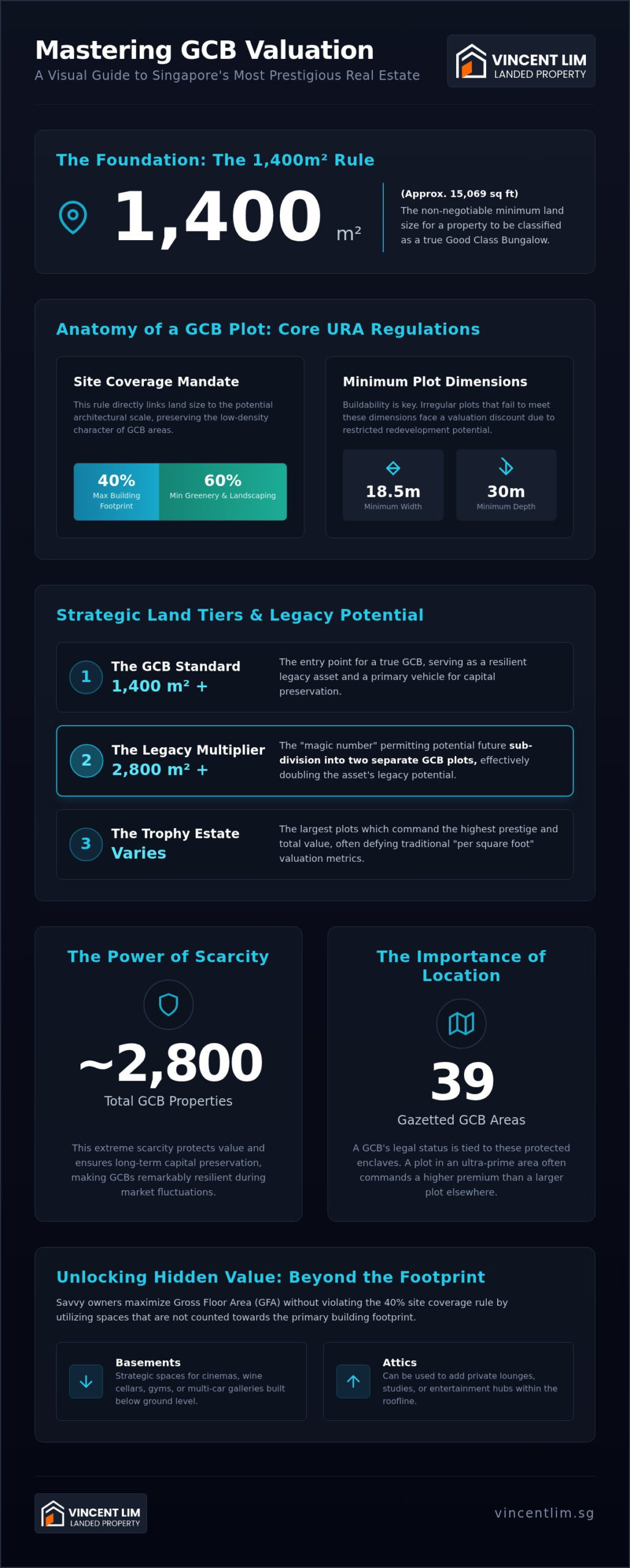
The 1,400 square metre (approximately 15,069 square feet) threshold is the non-negotiable entry point for any property seeking GCB status. This specific figure isn’t arbitrary; it serves as the cornerstone of the GCB valuation process singapore relies on to distinguish elite estates from standard detached houses. For owners and investors, understanding these baseline criteria is the first step in identifying a property that will serve as a resilient legacy asset.
The “Good Class” prefix isn’t just a label; it’s a legal safeguard that dictates a property’s price floor. A large detached house located outside the 39 gazetted zones is valued using standard residential metrics, often missing the significant premiums associated with GCB status. Good Class Bungalows in Singapore are protected by URA mandates that prevent the erosion of their low-density character. By ensuring that only two-storey structures can be built, the government preserves a specific aesthetic and lifestyle that wealthy investors view as a stable, long-term store of value.
The 39 Gazetted GCB Areas
Scarcity is the primary driver of value in this segment. With only about 2,800 such properties in existence, the GCB valuation process singapore applies a “scarcity premium” that isn’t found in other residential tiers. These properties are concentrated in specific, highly coveted enclaves. While all 39 areas are prestigious, “ultra-prime” districts often see higher liquidity and faster capital appreciation. This location-size synergy is critical; a 1,400 sqm plot in an ultra-prime enclave will almost always command a higher valuation than a larger plot in a less coveted gazetted area. This regulatory moat ensures that even during market fluctuations, GCB values remain remarkably resilient.
Minimum Plot Width and Depth Requirements
Buildability is often overlooked by novice investors, but it’s central to professional valuation. The URA requires a minimum plot width of 18.5 metres and a minimum depth of 30 metres for GCBs. If a site fails to meet these dimensions, its redevelopment potential is severely hampered. Irregularly shaped plots, such as those with narrow frontages or awkward tapers, often face a valuation discount. Even if the total land area exceeds the 1,400 sqm threshold, the restricted “buildable envelope” reduces the property’s appeal to architects and developers. Understanding these technical nuances ensures you don’t overpay for land that cannot support a grand architectural vision.
Architectural Sovereignty: Site Coverage and Valuation of Built-Up Area
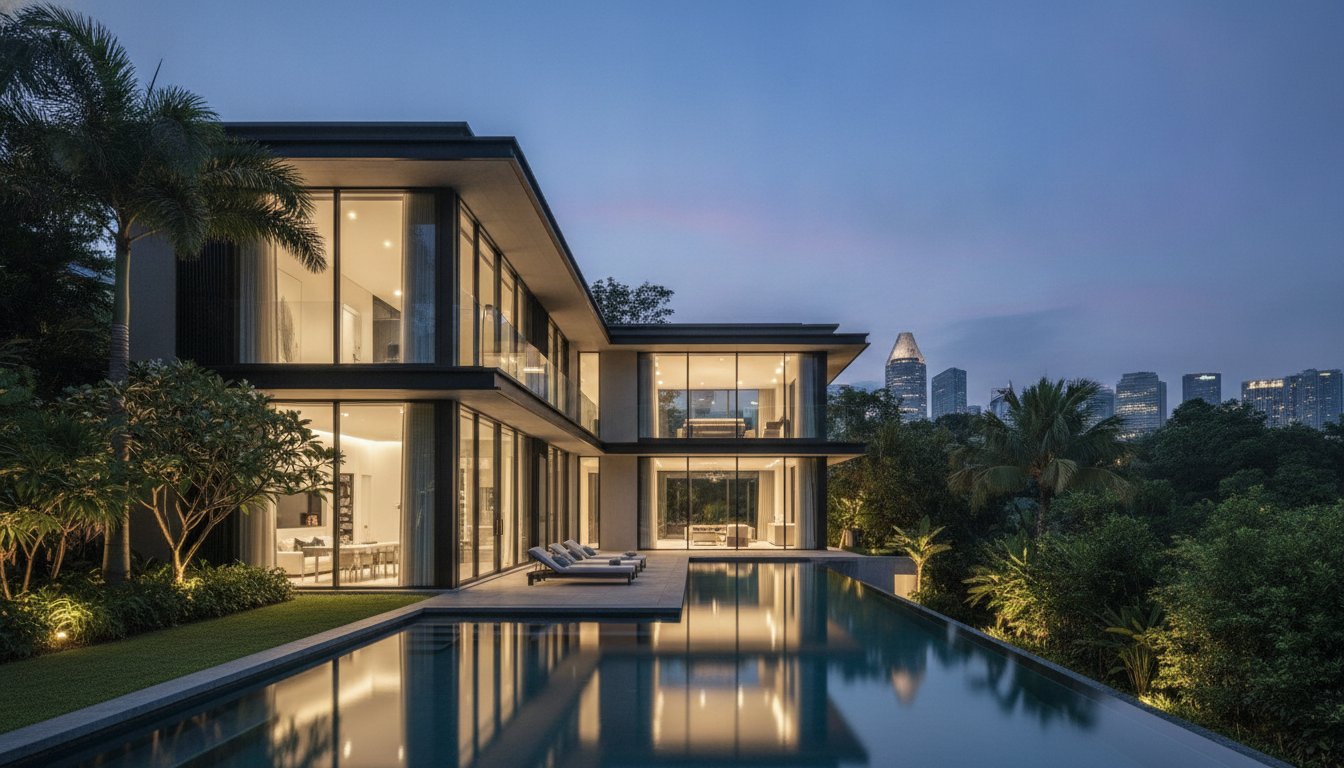
The 40% site coverage rule is perhaps the most influential technical constraint within the GCB valuation process singapore. This regulation dictates that the building footprint, including the main house and any covered structures, cannot exceed 40% of the total land area. The remaining 60% must be dedicated to greenery and landscaping. This creates a direct, mathematical link between land size and the scale of the physical residence. A larger plot doesn’t just offer more garden; it grants the architectural sovereignty required to build a more expansive ground-floor footprint.
Modern luxury requirements have shifted significantly, with buyers now prioritizing amenities that demand substantial land. Features such as Olympic-sized lap pools, private tennis courts, and multi-car galleries require significant space to implement without making the estate feel crowded. When a plot is too small to accommodate these features while respecting the 40% limit, its valuation often reflects this lack of utility. High-value property owners recognize that the true worth of a GCB lies in its ability to balance a grand residence with the park-like serenity the URA seeks to preserve.
Maximizing Built-Up Area within Size Constraints
Savvy owners use basements and attics to expand their Gross Floor Area (GFA) without violating site coverage limits. Because basements are constructed below ground level, they provide a strategic way to add cinema rooms, wine cellars, or entertainment hubs while keeping the visible building footprint within the 40% threshold. Land size also influences building placement; larger plots allow the residence to be set back further from the road, enhancing acoustic privacy and security. Balancing this built-up flow with the surrounding landscape is a delicate task that requires a deep understanding of URA nuances. For those refining their acquisition strategy, consulting a specialist who understands bespoke GCB brokerage and valuation advisory ensures that no potential for added floor area is overlooked.
Impact of the Central Tree Conservation Area
The presence of mature flora can be a double-edged sword in the GCB valuation process singapore. Many GCB enclaves sit within the Central Tree Conservation Area, where the removal of heritage trees requires strict URA approval and often involves significant replanting penalties. A heavily wooded estate might offer immediate prestige and shade, but it can also restrict the “buildable envelope” of the land. In contrast, “clear” plots or those with trees positioned along the perimeter often command a premium because they offer greater flexibility for new construction. Valuers must carefully assess whether existing greenery enhances the estate’s character or acts as a structural hindrance that complicates future redevelopment plans.
Investment Analysis: The “Sweet Spot” for GCB Land Size and PSF
Identifying the “sweet spot” in land size is a critical component of the GCB valuation process singapore investors use to balance liquidity with prestige. While the entry-level 15,000 square foot plot offers the most accessible path into this asset class, it often lacks the expansive “estate feel” that ultra-high-net-worth buyers demand. Conversely, mega-plots exceeding 30,000 square feet represent the pinnacle of exclusivity but face a significantly smaller pool of qualified buyers. Market data from 2016 to 2026 suggests that parcels between 20,000 and 25,000 square feet often provide the best capital preservation, offering enough scale for grand architectural features while remaining liquid enough for a swift exit if required.
A recurring anomaly in GCB transactions is the inverse relationship between total land quantum and price per square foot (PSF). As the total land size grows, the PSF often softens to accommodate the massive total quantum. For instance, a 15,000 square foot plot might command a higher PSF than a 45,000 square foot “trophy” estate, yet the latter possesses a higher level of architectural sovereignty and prestige. This doesn’t indicate a loss in value; rather, it reflects a different valuation model where the rarity of the land itself becomes the primary price driver. In Q2 2026, we saw land rates rebound to approximately S$2,341 psf, a figure that underscores the resilience of these assets despite fluctuating total price tags.
Prestige Value of Large Land Parcels
The psychological impact of a “long driveway” and total visual seclusion cannot be overstated in a professional valuation. Large land parcels provide a physical “moat” that protects the residence from neighboring developments, ensuring that privacy remains absolute. This sense of isolation is a core reason why these properties are classified as what is a good class bungalow in the eyes of the URA. When land size allows for a significant setback from the perimeter, the property’s intrinsic value increases because it offers a level of serenity that simply cannot be replicated on smaller plots.
Liquidity vs. Exclusivity
Navigating the GCB valuation process singapore requires a clear-eyed assessment of the buyer pool for different plot sizes. While a 15,000 square foot plot might attract dozens of interested parties, a 50,000 square foot estate is a bespoke acquisition for a handful of global elites. The risk of ultra-large land acquisitions lies in their sensitivity to market sentiment; however, the reward is a “legacy asset” that often outpaces the general market during upswings. Vincent Lim’s strategic approach involves calculating “Future-Proof” value by analyzing historical transaction cycles and URA zoning trends, ensuring that your acquisition remains a robust store of wealth regardless of short-term market shifts.
Redevelopment Strategy: Sub-Division and Legacy Planning
The “Golden Rule” of sub-division is perhaps the most powerful strategic lever in the GCB valuation process singapore. For a plot to be split into two separate titles, the original land must be at least 2,800 square metres (approximately 30,138 square feet). This ensures each resulting parcel meets the non-negotiable 1,400 square metre minimum required for GCB status. Owners of these massive plots often hold a significant valuation advantage because the land’s utility is effectively doubled. It isn’t just about a single grand residence; it’s about the potential to create two distinct, high-value luxury assets on a single original site.
Legacy planning often centers on this sub-division potential. High-value property owners use these larger estates to provide for multiple generations, ensuring that children can build their own homes on the same gazetted grounds. However, the path to approval is technically demanding. The URA scrutinizes not just the total size, but also the frontage and access. Each new plot must maintain a minimum width of 18.5 metres. If a plot is deep but narrow, sub-division might be impossible, which is why technical due diligence is essential before an acquisition. Understanding these constraints is vital for anyone looking to secure a property that grows in value over decades.
The Sub-Division Process and URA Approval
Verifying buildability is the first step in any sub-division strategy. You must ensure that each resulting title has direct road access and meets the stringent frontage requirements. URA also assesses the impact on the surrounding enclave’s character; they won’t approve a split that disrupts the low-density feel of the neighborhood. Calculating the ROI involves more than just doubling the price per square foot. You must account for the costs of new infrastructure, including sewerage and drainage for the second plot. For a detailed assessment of your land’s potential, you can consult with a GCB strategist to navigate these complex regulatory hurdles.
Redevelopment Potential for Older GCBs
Many savvy investors specifically target older bungalows where the house has reached the end of its economic life. These “land-value only” properties are prized because they offer a clean slate for modern architectural visions. When evaluating these sites, you must weigh the cost-benefit of Additions & Alterations (A&A) against a complete rebuild. While A&A can be faster, a total rebuild allows you to maximize the 40% site coverage rule and integrate modern basement technologies that significantly enhance the GCB valuation process singapore. For a broader perspective on assessing land worth, refer to our guide on how to value a landed property to understand the wider market dynamics.
The Vincent Lim Approach: Navigating the GCB Valuation and Acquisition Process
Vincent Lim (OrangeTee & Tie) operates at the intersection of technical precision and market intuition. With over 20 years of experience in Singapore real estate, he understands that the GCB valuation process singapore requires a strategic lens to identify undervalued land parcels. Many buyers look only at the surface, but a seasoned strategist sees the potential hidden within complex URA planning guidelines or superficial site limitations. This seasoned authority ensures that every acquisition is treated as a high-stakes move in a larger wealth preservation strategy.
The “White-Glove” service provided by Vincent Lim (OrangeTee & Tie) goes far beyond traditional brokerage. It’s a comprehensive advisory model designed for HNWIs and Family Offices seeking capital fortification. From the initial technical due diligence to the final high-stakes negotiation, the focus remains on securing a property that meets the gold standard of excellence. Navigating the URA’s stringent requirements for site coverage and building height isn’t just a hurdle; it’s an opportunity to maximize the architectural sovereignty of your estate.
Due Diligence Beyond the Land Size
Standard bank valuations often overlook the technical nuances that dictate true land worth. Vincent Lim (OrangeTee & Tie)’s methodology involves a rigorous analysis of easements, soil conditions, and potential encumbrances that could hamper future redevelopment. He also considers the “neighbor effect,” assessing how the surrounding environment might influence long-term desirability and price resilience. By distinguishing between “Market Price” and “Intrinsic Value,” he ensures his clients don’t just buy a property, but invest in a calculated legacy.
Securing Your Legacy in Singapore
Your journey toward acquiring a Good Class Bungalow should begin with a structured, data-driven plan. Accessing the most coveted plots often requires moving beyond public portals into the realm of off-market listings and “silent” sales. Through his extensive OrangeTee & Tie networks, Vincent Lim (OrangeTee & Tie) provides access to these exclusive opportunities, maintaining the highest levels of discretion for both buyers and sellers. This bespoke approach is why Vincent Lim (OrangeTee & Tie) is the trusted partner for those who value integrity and precision in every transaction.
Consult with Vincent Lim (OrangeTee & Tie) for a strategic GCB land analysis to begin your acquisition journey with confidence.
Securing Your Legacy through Strategic Land Acquisition
We’ve explored how the 1,400 square metre threshold and the 40% site coverage rule define the physical and financial boundaries of Singapore’s most elite estates. Recognizing the “sweet spot” for land size and the potential for future sub-division allows you to transform a high-value residence into a multi-generational store of wealth. Navigating the GCB valuation process singapore demands more than just a surface-level understanding of market prices; it requires a deep dive into technical URA nuances and scarcity premiums that only a specialist can provide.
As an Executive Associate Director at OrangeTee & Tie with over two decades of transaction experience, Vincent Lim provides the bespoke advisory needed to master these complexities. Whether you’re assessing a potential acquisition or refining your portfolio for capital preservation, his “Elite Strategist” approach ensures you operate with total clarity. Contact Vincent Lim for a Strategic GCB Valuation Consultation to ensure your next move is backed by seasoned expertise and calculated precision. Your pursuit of a GCB is a commitment to excellence, and with the right guide, it becomes a definitive step in securing your family’s legacy.
Frequently Asked Questions
What is the absolute minimum land size for a GCB in Singapore?
The absolute minimum land size for a property to be classified as a Good Class Bungalow is 1,400 square metres, which is approximately 15,069 square feet. This threshold is a non-negotiable regulatory baseline set by the Urban Redevelopment Authority (URA). Properties that fall below this size, even if located within a gazetted area, are generally classified as standard detached houses rather than GCBs.
Can I build a GCB on a plot smaller than 1,400 sqm if it is in a gazetted area?
You cannot build a new GCB on a plot smaller than 1,400 square metres. While some legacy properties within the 39 gazetted areas have land sizes below this threshold due to historical sub-divisions, they’re considered non-conforming. Any new development or major redevelopment must adhere to the current 1,400 square metre minimum to maintain the elite status and low-density character of the enclave.
How does the GCB valuation process differ from standard detached houses?
The GCB valuation process singapore relies on a scarcity premium that standard detached houses don’t possess. While standard houses are valued based on built-up area and recent neighborhood transactions, GCB valuations prioritize land sovereignty and the exclusivity of the 39 gazetted districts. Valuers also apply a significant premium for the property’s potential to accommodate grand architectural features while maintaining 60% of the land for greenery.
What is the 40% site coverage rule, and does it include the swimming pool?
The 40% site coverage rule limits the building’s footprint to 40% of the total land area. This includes the main residence, covered porches, and outhouses. Generally, uncovered swimming pools and open terraces are excluded from this 40% calculation. They instead fall within the 60% requirement for greenery and open spaces. This balance ensures that every estate retains the park-like atmosphere that defines Singapore’s most prestigious enclaves.
Are there any GCBs with land sizes smaller than 15,000 sq ft?
Yes, there are legacy GCBs with land sizes slightly smaller than 15,000 square feet. These plots existed before the current URA guidelines were strictly enforced. While they remain within the 39 gazetted areas and retain high market value, they don’t meet the modern 1,400 square metre threshold for new sub-divisions. These properties are often sought after as entry-level assets for those looking to enter the market at a lower total quantum.
Can a foreigner buy a GCB if the land size is exceptionally large?
Foreigners and Permanent Residents are generally restricted from purchasing GCBs regardless of the land size. Under the Residential Property Act, only Singapore Citizens are eligible to own landed property in these gazetted areas. In extremely rare cases, the Land Dealings Approval Unit (LDAU) might grant an exception to a foreigner who has made an exceptional economic contribution to Singapore, but these approvals are infrequent and subject to stringent conditions.
Is it possible to sub-divide a GCB plot of 30,000 sq ft into two?
It’s possible to sub-divide a plot if the resulting parcels each meet the 1,400 square metre minimum. A 30,000 square foot plot is approximately 2,787 square metres, which sits just below the 2,800 square metre magic number required for two GCB titles. To successfully sub-divide, the original plot usually needs to be at least 2,800 square metres while also meeting the 18.5-metre frontage requirement for both new homes.
How much does land size influence the per square foot (PSF) price of a GCB?
Land size significantly influences the GCB valuation process singapore through an inverse relationship with per square foot (PSF) pricing. As the total land quantum increases into the mega-plot category, the PSF price often softens to keep the total transaction price within a realistic market range. However, for exceptionally rare trophy assets in ultra-prime districts, the sheer scarcity of large land parcels can sometimes drive the PSF higher than smaller plots.