What if a condo’s impressive price and polished lobby are the least reliable signs of its luxury status? For buyers considering a high-value purchase, understanding what makes a condo a luxury property means looking beyond presentation to the qualities that support lasting appeal. A high asking price alone can’t distinguish a genuinely scarce residence from a premium development with elevated marketing.
That caution is justified. Architectural design, construction quality, privacy, and service can vary significantly, even among properties described as luxury. The details that matter most aren’t always obvious during a viewing, yet they can shape daily living and a property’s appeal to future buyers.
This 2026 evaluation framework offers practical ways to assess design, spatial standards, service, and ownership considerations. It can help you separate enduring qualities from sales language and consider how a luxury condo may fit alongside landed property in a broader portfolio. Vincent Lim works in Singapore’s luxury residential market, with a focus on luxury condominiums and landed homes.
Key Takeaways
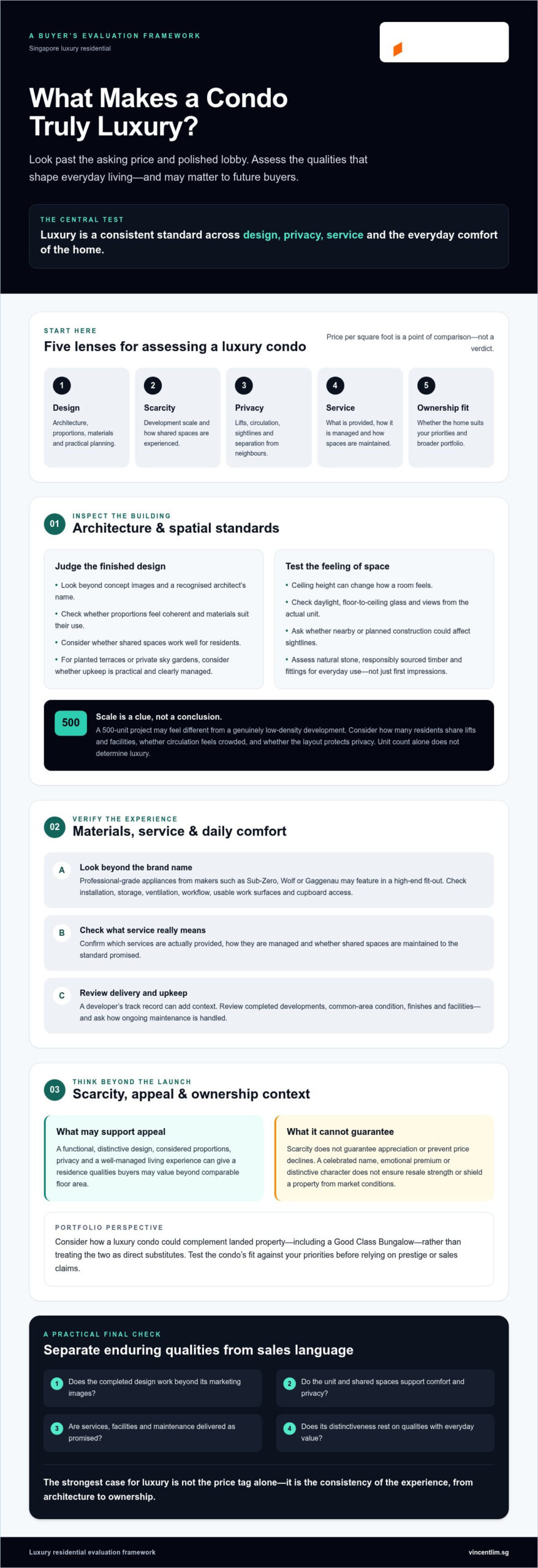
- To assess what makes a condo a luxury property, look beyond price and presentation to its design, scarcity, privacy, and quality of ownership experience.
- Review the development’s scale and spatial standards, including how the layout, natural light, and ceiling height affect everyday comfort.
- Check what services are actually provided, how they are managed, and whether shared spaces are maintained to the standard the development promises.
- Consider how a luxury condo could complement a landed-property portfolio, including a Good Class Bungalow, rather than treating the two as direct substitutes.
- Test a property’s value and fit against your priorities before relying on prestige or sales claims.
What Makes a Condo a Luxury Property: From Premium to Exclusive
A high price can signal demand, but it doesn’t prove that a residence is rare, well built, or meaningfully different from a premium development. Buyers asking what makes a condo a luxury property should assess the complete proposition: design, privacy, service, developer credibility, and the quality of everyday living. Price per square foot is a point of comparison, not a verdict.
The definition has also moved beyond conspicuous finishes such as gold taps. Buyers may place greater value on restrained materials, thoughtful proportions, wellness features, natural light, and systems that work smoothly. A foundational overview of the category’s history and features appears in Defining Luxury, but a property’s label still needs to be tested against its design and delivery.
Developer reputation adds context. A record of delivering considered architecture, sound construction, and well-managed residences may help buyers evaluate a project, but branding alone is not enough. Review completed developments and their upkeep. During a viewing, look at the condition of common areas, finishes, and facilities, and ask how ongoing maintenance is handled.
The Scarcity Principle in Residential Real Estate
Unit count matters because scale can affect privacy, shared-space demand, and the character of daily life. A 500-unit project may offer a different experience from a genuinely low-density development, though the number alone doesn’t settle whether either is luxurious. Consider how many residents share lifts and facilities, whether circulation areas feel crowded, and whether the unit layout protects privacy. Scarcity may support long-term appeal, but it cannot guarantee appreciation or prevent price declines.
Intangible Value: Beyond the Price Per Square Foot
An iconic design or well-regarded development can carry an emotional premium. Buyers may value discretion, reputation, a sense of belonging, or a distinctive living experience that comparable floor area does not offer. That premium is subjective, so check whether it rests on lasting qualities rather than marketing language. Ask what the property provides in daily use, and whether those features are likely to matter to future buyers as well.
Luxury is more than a high price. It is a consistent standard across design, privacy, service, and the everyday comfort of the home. Those details help distinguish an expensive condo from a residence with enduring luxury appeal.
Architectural Pedigree and Spatial Standards
Floor area tells only part of the story. To judge what makes a condo a luxury property, assess how the architecture shapes light, privacy, proportions, and the experience of moving through the home. A distinctive facade can give a building an identity, while a well-planned interior can make everyday life feel considered rather than merely expensive.
The Importance of Signature Architecture
A recognised architect, including a Pritzker Prize winner, may give a residence a design identity that buyers can remember. That can contribute to its appeal, but a celebrated name alone doesn’t guarantee resale strength. Look at the completed building, not just the concept images. Do the proportions feel coherent? Are the materials suited to their use? Do shared spaces work well for residents? Planted terraces or private sky gardens can connect residents with nature, provided their upkeep is practical and clearly managed.
Imagine a market downturn in which comparable developments offer similar layouts and finishes. A building with a functional, distinctive design may give future buyers a clearer reason to consider it. That distinction can support interest, but it won’t shield the property from market conditions or ensure appreciation. The test is whether its character remains desirable beyond launch marketing.
Internal Specifications: The Hardware of Luxury
Look beyond floor area to the sense of space. Ceiling height changes how a room feels, while floor-to-ceiling glass can bring in daylight and frame views. Check sightlines from the actual unit, not just the display suite, and ask whether nearby or planned construction could affect them. Material quality matters too. Natural stone, responsibly sourced timber, and well-made fittings should suit the design and stand up to everyday use, not simply impress at first glance.
Give the kitchen the same careful review. Professional-grade appliances from established makers such as Sub-Zero, Wolf, or Gaggenau may feature in a high-end fit-out, but brand names matter less than installation, storage, ventilation, and workflow. Check whether the work surfaces provide enough usable space and whether cupboards are easy to access. Smart-home systems should simplify lighting, climate, and security controls through reliable integration. A collection of disconnected gadgets is not a substitute for thoughtful design.
For a broader investment perspective, Sotheby’s luxury outlook offers context for considering luxury property as a strategic asset. Architectural distinction should still be weighed alongside construction quality, maintenance, and buyer demand. Buyers considering how design quality fits their acquisition objectives can also explore Vincent Lim’s luxury condominium expertise.
The Service Ecosystem: White-Glove Concierge Culture
A gym and swimming pool can add convenience, but they rarely distinguish a luxury residence on their own. A more revealing test is whether the service ecosystem protects residents’ privacy, handles practical details reliably, and keeps shared spaces in good condition. When assessing what makes a condo a luxury property, consider not only what is offered, but how consistently it is delivered.
The Concierge as a Lifestyle Manager
A concierge may coordinate parcel handling, event arrangements, or travel bookings, extending the role beyond reception and security. Hospitality-trained staff may bring discretion and thoughtful communication to these interactions, but job titles alone don’t establish service quality. Ask what the team actually handles, when support is available, how requests are managed, and what falls outside the service. If a development advertises 24/7 bespoke concierge support, verify the hours and scope directly.
Fees also need context. Higher service charges may reflect more extensive staffing or amenities, but they aren’t proof of exclusivity or quality. Review the services covered, the maintenance plan, and how the management team handles wear, repairs, and resident feedback. The National Association of REALTORS® offers broader context on luxury properties. For a specific condo, the operating details matter more than the label.
Exclusive Amenities for the Modern Collector
Some developments go beyond standard facilities with private dining rooms, sommelier spaces, temperature-controlled wine storage, or cigar humidors. Art galleries or secure storage areas may also appeal to collectors. These features are useful only if access, upkeep, security, and operating arrangements are clear. Ask whether amenities are shared, how reservations work, and who maintains specialised equipment.
Wellness offerings can include dedicated treatment rooms or spa-inspired spaces. Check whether an amenity is available for resident use or whether it requires separate booking or payment. Apply the same care to discreet entrances, private lift lobbies, and biometric access. Inspect how access is controlled and privacy is maintained instead of assuming technology alone ensures security.
Finally, consider whether the property can maintain its condition over time. Consistent cleaning, prompt repairs, and well-managed shared areas support residents’ experience and the building’s presentation. A luxury service ecosystem is not a long list of promises. It is an operating standard residents can see in details such as a well-kept arrival area and reliable handling of everyday requests.
Luxury Condos as a Strategic Investment Asset
A luxury condo can serve as more than a prestigious residence. For some buyers, it offers a managed, lock-up-and-leave alternative or complement to landed property, with the potential to support a broader wealth or legacy strategy. The question of what makes a condo a luxury property therefore includes how its scarcity, tenure, upkeep, and appeal to future buyers may shape its role across market cycles. None of these qualities guarantees capital growth.
Condos vs. Landed: The Wealth Perspective
Good Class Bungalows carry a distinct form of prestige through land ownership, privacy, and rarity. A luxury condo offers a different proposition: shared building management and a residence that may suit owners who travel or prefer fewer property-maintenance responsibilities. Buyers can compare the prestige of Good Class Bungalows with the practical considerations of condominium ownership, then assess how each fits their objectives.
There is no single price comparison that determines which asset is superior. The average price of semi-detached houses can provide one reference point, but a penthouse and a landed home differ in tenure, design, privacy, and ownership structure. A penthouse may command a premium over some detached houses when its views, scale, architectural distinction, and scarcity align with buyer demand. Compare specific properties rather than relying on a broad rule.
Resilience in the 2026 Market
High-end residential property can attract buyers seeking a tangible asset with lifestyle utility. Yet “safe haven” should describe a buyer’s intention, not a promise of stable prices. Luxury assets may respond differently from mass-market homes, but outcomes still depend on purchase discipline, liquidity, upkeep, and the pool of buyers able and willing to acquire the property.
Tenure deserves close attention. Freehold ownership may appeal to buyers prioritising long-term holding, while leasehold properties require careful consideration of remaining tenure and future resale appeal. Neither label settles value on its own. Compare relevant transactions and assess the property’s condition, its specific features, and demand for them.
Cooling measures and wider economic shifts can influence purchasing decisions and affordability across segments. Buyers should assess the rules and costs applicable to their own circumstances rather than assume luxury assets are insulated. Limited supply can constrain competing options, but it cannot prevent price declines.
To assess whether an entry-level luxury home has the qualities to become a classic, look for enduring design, genuine scarcity, sound management, and appeal beyond launch-era marketing. For a considered comparison of luxury condos and landed assets, discuss your acquisition priorities with Vincent Lim.
The Strategic Acquisition: Why a Specialist Matters
A luxury purchase demands more than a shortlist of impressive residences. A specialist can help test whether a property’s design, scarcity, condition, and pricing align with your objectives, then compare it with alternatives across the market. That perspective matters when an asset is being considered as a home and as part of a longer-term portfolio or legacy plan. Vincent Lim is a real estate professional at OrangeTee & Tie who specialises in luxury residences and landed property, including Good Class Bungalows.
The Art of the Private Deal
Some properties may be introduced privately or through invitation-only previews before appearing on public portals. Access depends on the seller, property, and circumstances, so it should never be assumed or promised. A specialist may help identify relevant opportunities and coordinate discreet enquiries while respecting privacy on both sides.
Due diligence should extend beyond the sales brochure. Review the developer’s completed projects and delivery record, and examine available information on the Management Corporation Strata Title (MCST), including maintenance planning, financial management, and the condition of shared areas. For a resale unit, inspect its upkeep and clarify what is included in the sale. Negotiation should address your priorities, from completion arrangements to property condition, rather than focus narrowly on headline price.
A specialist can also help put a condo in context. Is it a practical alternative to a landed home, a complement to an existing portfolio, or a step toward a different residential goal? The answer depends on personal circumstances, not a universal progression path.
Your Next Step in Luxury Living
Build a clear acquisition brief before committing. Define how the home will be used, which qualities are non-negotiable, and how long you expect to hold it. For condominium sites, treat redevelopment potential as a question for careful investigation, not an assumed source of future value. Any assessment should account for the site, ownership considerations, and relevant professional advice.
Legacy planning adds another dimension. Consider how a property fits alongside other assets, who may use or inherit it, and whether its ongoing costs and management suit the family’s plans. A disciplined review helps separate a compelling residence from a purchase that genuinely serves long-term priorities.
For a considered discussion of luxury condominium or landed-property priorities, consult with Vincent Lim.
Make Your Next Luxury Acquisition With Confidence
The strongest luxury purchases are judged by more than price or presentation. Architectural distinction, genuine scarcity, dependable management, and a residence’s fit within your wider plans all deserve careful consideration. Together, these benchmarks clarify what makes a condo a luxury property and help you assess whether its prestige is supported by enduring qualities rather than sales language.
A luxury condominium can complement a landed-property portfolio, but its value depends on the specific asset and your long-term objectives. Compare the evidence, review the ownership considerations, and avoid treating any single feature as a guarantee of future performance.
Vincent Lim specialises in the sale of luxury residences and landed properties, including Good Class Bungalows. If you are considering selling a luxury condominium or landed home, contact Vincent Lim to discuss your property and sales priorities.
With a clear framework and informed guidance, you can approach your next decision with greater confidence and a sharper view of lasting value.
Frequently Asked Questions
Is a high price tag enough to make a condo a luxury property?
No. A high price alone doesn’t establish luxury status. To assess what makes a condo a luxury property, consider its architectural quality, privacy, spatial design, management standards, and the consistency of its services. Compare the residence with relevant alternatives, not just its marketing claims. A premium price should be supported by features buyers can recognise and value beyond an impressive lobby or prestigious-sounding description.
What is the ideal unit density for a luxury development?
There’s no universal unit-count threshold that makes a development luxurious. Assess density in context by considering the site, unit layouts, lift capacity, demand for shared spaces, and how easily residents can enjoy privacy. A smaller project can still be poorly designed, while a larger one may offer thoughtful planning. During a viewing, observe how residents move through the building and ask how facilities are managed. The practical test is whether the scale supports the experience the development promises.
Do luxury condos hold their value better than mass-market projects?
Not automatically. A distinctive luxury condo may attract buyers through its design, scarcity, condition, or service standards, but none of these guarantees stronger value retention. Resale performance also depends on purchase price, tenure, maintenance, buyer demand, and wider economic conditions. Compare completed transactions for genuinely similar properties, and consider how easily the home could appeal to a future buyer. Treat resilience as an investment consideration, not a certainty.
How important is the architect’s brand in luxury real estate?
An architect’s reputation can give a building a recognisable identity and attract buyers who value design. It is one factor, not a substitute for quality. Examine whether the completed building reflects a coherent vision, uses durable materials, and functions well for residents. Also review the developer’s delivery record and the building’s upkeep. A celebrated name may support distinction, but buyers should judge the residence itself rather than assume the architect’s brand ensures resale demand.
Can a leasehold property truly be considered a luxury asset?
Yes. Tenure doesn’t by itself determine whether a property qualifies as luxury. A leasehold residence may offer outstanding architecture, privacy, services, and construction quality. For a purchase, assess the remaining tenure and how it could affect your holding period, future buyer pool, and resale plans. Compare properties on similar terms and seek appropriate professional advice on ownership considerations. A luxury label shouldn’t distract from understanding the asset’s long-term fit.
What specific amenities are non-negotiable in the 2026 luxury market?
There’s no universal list of required amenities for 2026. A pool or gym alone may not distinguish a luxury development. Practical privacy, reliable upkeep, and well-designed shared spaces can matter just as much. Depending on residents’ needs, useful features might include private dining areas, wellness spaces, or secure access arrangements. Verify what’s actually provided, how residents use each amenity, and how its maintenance is managed before assigning it value.
How does the concierge service impact the resale value of a condo?
A well-managed concierge can improve convenience and strengthen a property’s resident experience, which may support buyer interest. It doesn’t guarantee a higher resale price. Confirm the actual service hours and responsibilities, and review how the building funds and manages its operations. Buyers may value practical help with parcels or visitor arrangements, but only if it’s consistently delivered. Consider the service alongside maintenance, privacy, and the property’s wider market appeal.
Should I choose a luxury condo or a landed property for my next investment?
Choose based on your objectives, not a general claim that one property type is superior. A luxury condo may suit buyers seeking managed shared facilities, while landed property offers a different ownership and living experience. Consider how much privacy, maintenance responsibility, tenure, and flexibility matter to you, then assess each property’s condition and resale appeal. Vincent Lim specialises in luxury residences and Good Class Bungalows.