What if the extra side space that draws you to a corner terrace doesn’t make it the right home for your household? A corner position can offer more outdoor space and design flexibility, but every plot, layout and property condition is different. If you’re researching “buying a corner terrace in singapore,” the property’s position is only one part of the decision.
Compare corner and intermediate terraces, then look closely at how each plot and home would work for your needs. Check the boundaries, title details, planning context and transaction documents before you commit.
This guide explains what distinguishes a corner terrace and offers a practical framework for assessing a specific property. You’ll learn what to examine in the plot and layout, which details to clarify, and how to approach the purchase with greater confidence. Vincent Lim has worked in Singapore real estate since 2000, and 70 % of his transactions are in landed property. His Market Analysis and Property Valuation services can help you consider a home in its market context.
Key Takeaways
- When buying a corner terrace in singapore, assess the specific home rather than relying on its position at the end of a row.
- Look beyond the stated land area. Consider the plot’s shape, frontage, access and how outdoor space connects with everyday routines.
- Compare corner and intermediate terraces feature by feature, including boundaries and the upkeep each property may require.
- Use a clear sequence before committing: define your priorities, review property records, inspect the home and clarify constraints, including current planning information from the Urban Redevelopment Authority.
- Market context and property valuation can help bring clarity to a high-stakes landed-home decision.
Buying a Corner Terrace in Singapore: Understand the Property Type First
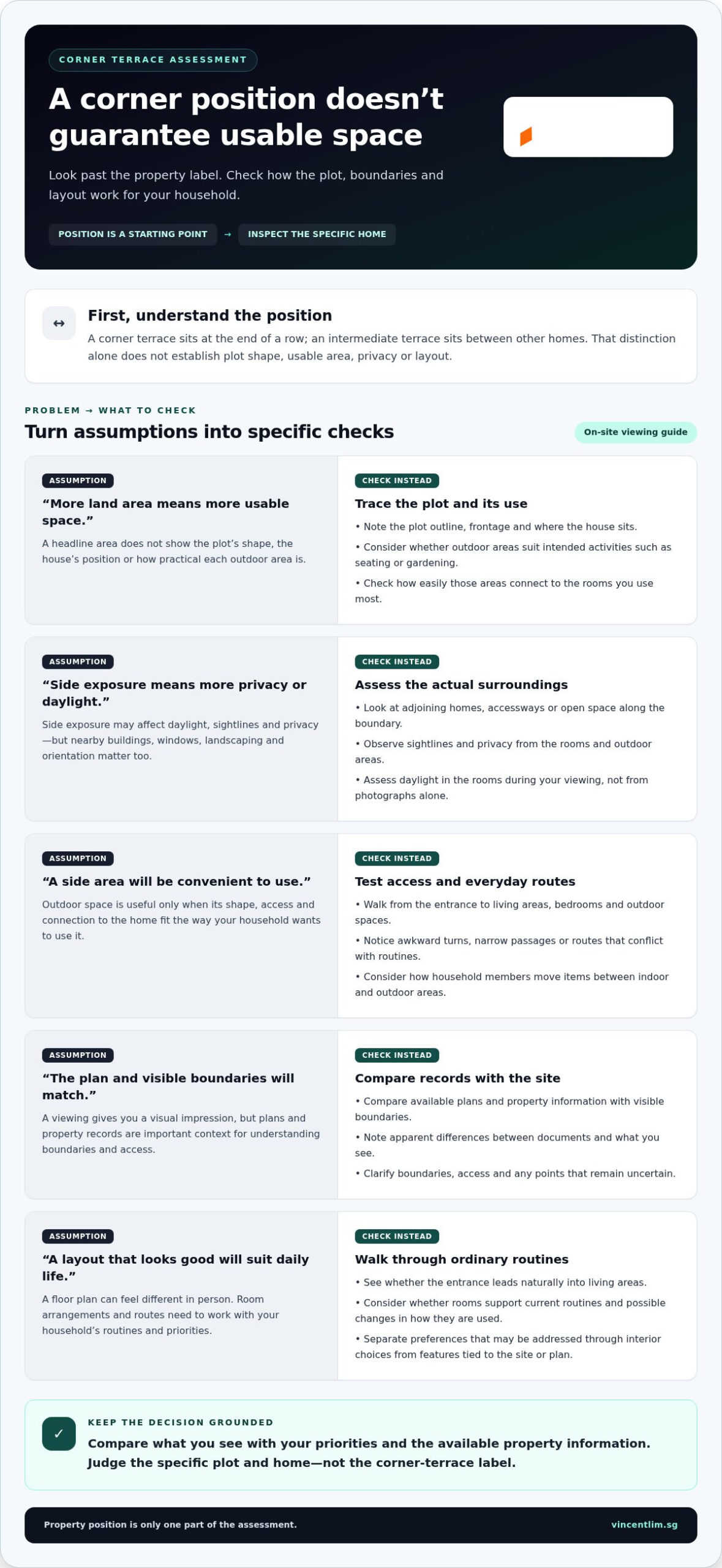
The label “corner terrace” describes a home’s position, but it doesn’t tell you whether the property suits your household. Plot dimensions, boundaries, access and room arrangements vary. When buying a corner terrace in singapore, treat the category as a starting point for inspection, not a promise of extra usable land, privacy or daylight.
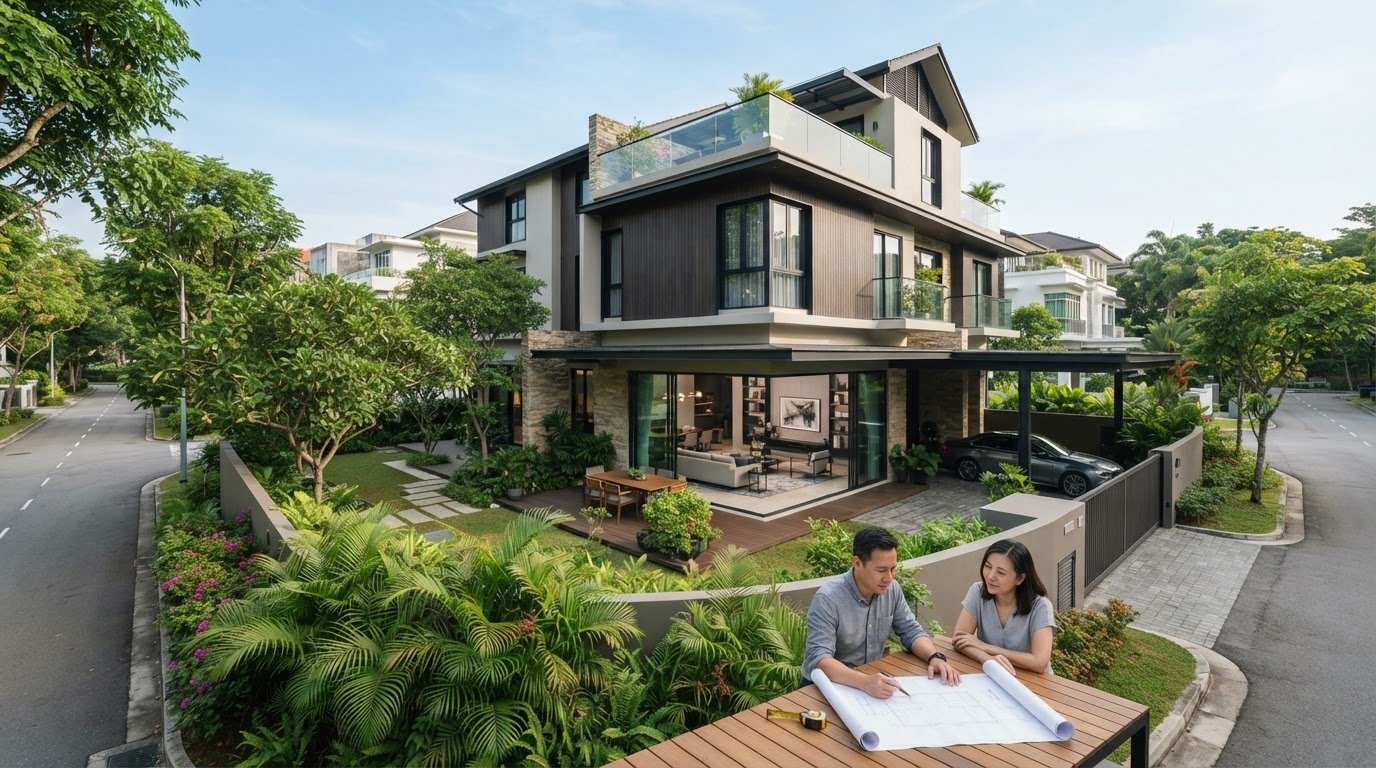
A corner terrace sits at the end of a row of terrace houses. An intermediate terrace is positioned between other homes in the row. For general context on how terrace houses are arranged, see this Terraced House Overview. The practical question is how the position affects the property’s use, and what you need to assess on site.
How a corner terrace differs from an intermediate terrace
An end-of-row position may leave one side of a corner terrace beside a boundary or adjoining space, while an intermediate home is typically flanked by other terrace houses. That broad distinction doesn’t establish the shape or usable area of either plot. A side boundary might adjoin a road, accessway or neighbouring land, and the arrangement of shared walls can vary. Review the specific property rather than assuming every corner home has the same geometry or number of shared walls.
What the corner position may mean for everyday use
Additional side exposure may affect daylight, sightlines and privacy, but nearby buildings, windows, landscaping and the home’s orientation also matter. Outdoor space is useful only if its shape, access and connection to the rooms support the way you intend to use it. Walk through the home and picture ordinary routines, such as bringing items inside and moving between indoor and outdoor areas.
Make the viewing purposeful. Compare what you see with your household’s priorities instead of relying on the property label or an assumed advantage. A side area, for example, may offer space for outdoor use but feel less private than expected. A compact entrance route may also affect how easily household members move through the home. Note the trade-offs and decide whether they matter to your daily life.
- Check the boundaries: Compare the visible plot with the property information. Note where the house meets adjoining homes, accessways or open space.
- Assess usable outdoor areas: Consider their shape, privacy and ease of access, not just their apparent size.
- Walk the daily routes: Follow the paths from the entrance to living areas, bedrooms and outdoor spaces. Look for awkward turns, narrow passages or routes that conflict with household routines.
- Compare your priorities: Decide whether side exposure, shared boundaries and outdoor access are advantages or compromises for your needs.
Keep your observations specific to the home. A corner position can offer possibilities, but it doesn’t establish how much land is usable or how comfortable the layout will feel. A careful viewing helps separate the property’s position from the features that shape everyday life.
Assess the Corner Terrace Plot, Layout and Boundaries
Stated land area is only one part of the assessment. The plot’s shape, the house’s position within it and the routes between different areas all affect how well the property works. When buying a corner terrace in singapore, compare the plans and property records with what you see on site. A corner position does not guarantee a particular plot size or layout.
Read the plot as more than a land-area figure
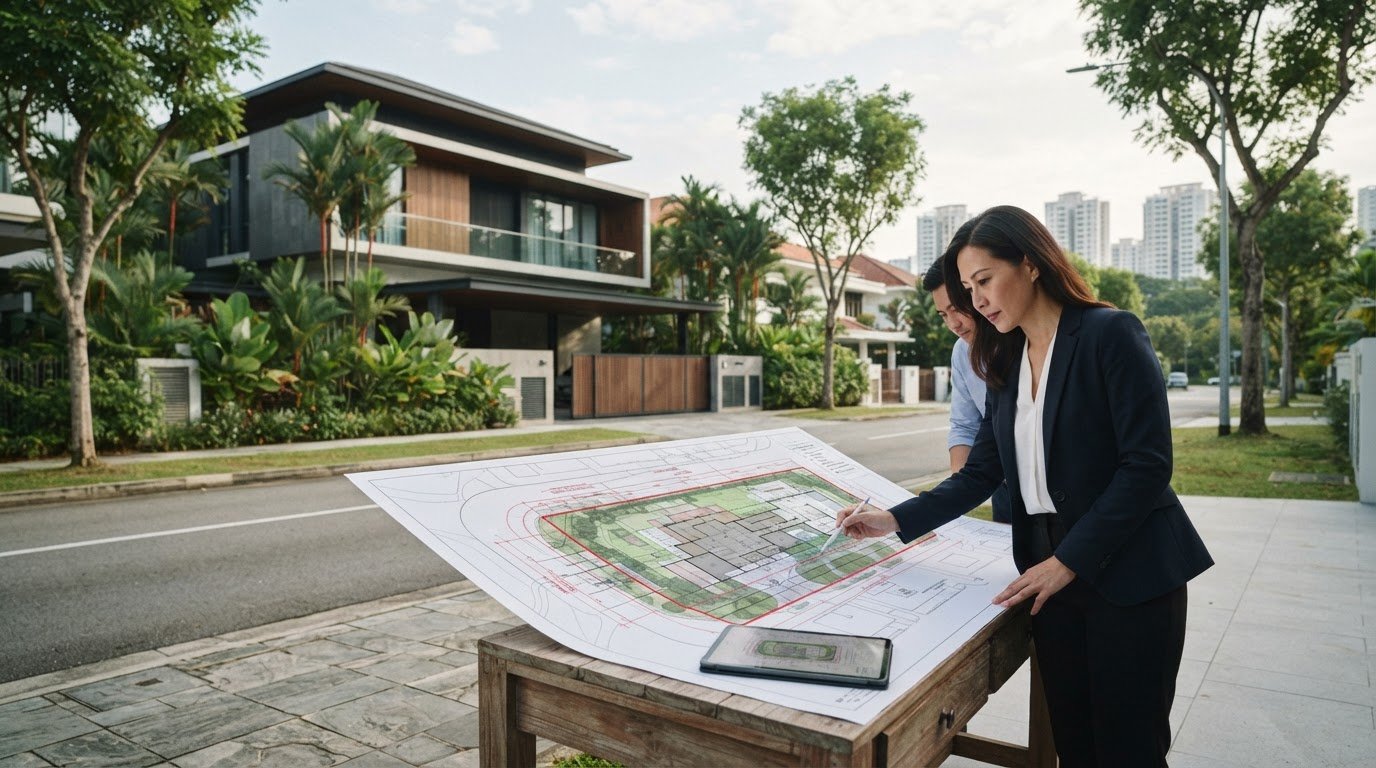
Start with the plot’s outline and frontage. A broad but irregular site may offer a different pattern of usable space from a narrower, more regular plot. Note where the house sits, how people enter and whether the outdoor areas suit your intended use. Listing photographs and headline measurements can provide context, but they don’t establish the dimensions, access or practical usability of each area.
During a viewing, compare the physical boundaries and access points with the available plans. Consider whether an outdoor area is easy to reach from the rooms you use most, and whether its shape suits your plans for seating, gardening or other everyday activities. Check how the frontage relates to the entrance and vehicle access, if applicable. More frontage doesn’t automatically mean greater convenience.
- Trace the plot: Look at its shape and the house’s position, not only its total area.
- Test access: Consider how household members move between the entrance, interior and outdoor areas.
- Assess practical use: Match the dimensions and configuration of outdoor areas to what you would actually do there.
- Compare records and site: Note any apparent differences between plans, property documents and visible boundaries for clarification.
Relate the floor plan to household priorities
Follow the routes you would use each day. Consider whether the entrance leads naturally into the living areas, whether rooms support your household routines, and how easily you can move between indoor and outdoor spaces. Observe where daylight enters, but assess it in the actual rooms and at the time of your viewing. Photographs alone may not reflect the experience.
Think beyond your current needs. A layout that works for one household may feel restrictive if the number of occupants or the use of rooms changes. Distinguish preferences that might be addressed through interior choices from features tied to the site or planning constraints; reviewing work from staging and styling teams like Pair Home Design can illustrate how strategic furniture placement and styling maximize awkward spaces without major construction. Don’t assume that a wall, extension or other structural change is possible simply because it would improve the layout.
Compare the floor plan with the physical home, room by room. If measurements, boundaries or the position of structures appear inconsistent across documents and the site, record the question and resolve it before proceeding. Singapore’s Singapore Land Titles Act provides the statutory framework for land titles. Consider title records alongside the property’s physical characteristics.
For a structured review of a landed home’s property context, Vincent Lim’s landed-property guidance can help you focus on details relevant to your purchase.
Compare Corner Terrace Options Without Assuming One Is Automatically Better
A useful comparison starts with your household, not the assumption that an end position is superior. Before viewing properties, rank the factors that matter most: privacy, outdoor space, room arrangement, ease of access and the level of upkeep you are comfortable managing. When buying a corner terrace in singapore, this order helps you assess each property consistently, even when the homes look quite different.
Match property characteristics to your priorities
Use a simple checklist to record what you see at each viewing. If outdoor use is a priority, for example, assess the area’s size, shape, privacy and route from the main living spaces. If household circulation matters more, focus on the entrance, stairs and routes between frequently used rooms. A feature is an advantage only if it supports your routine.
| Consideration | Corner terrace | Intermediate terrace | What to assess |
|---|---|---|---|
| Plot | May have side exposure, but shape and usable area vary. | Typically sits between neighbouring homes; plot configuration still varies. | Compare boundaries, frontage and practical outdoor space. |
| Layout | Room arrangement depends on the individual house. | Likewise depends on the individual house and site. | Walk the routes you use most and check room relationships. |
| Shared boundaries | Arrangement depends on the adjoining properties and actual site. | May share boundaries with homes on both sides; verify the specific arrangement. | Review the property details and observe the adjoining structures. |
| Access | Side access may be present, but shouldn’t be assumed. | Access is shaped by the site and entrance configuration. | Check how people reach the entrance, outdoor areas and key rooms. |
| Maintenance | More exposed areas, if present, may mean additional upkeep. | Upkeep depends on the home’s condition and features. | Consider the actual exterior and outdoor areas you would maintain. |
A semi-detached home offers another point of comparison because it is a different landed-home arrangement. However, it shouldn’t replace a detailed assessment of the terrace options themselves. Keep the focus on whether each specific plot and layout meets your priorities.
Separate visible appeal from practical trade-offs
Extra side exposure may appeal to you, but it can also mean more visible boundaries or outdoor areas to maintain. A spacious-looking yard isn’t proof of usable space, and a side entrance doesn’t establish a right of access. Treat attractive features as observations to compare with the property’s records and constraints, not as proof of planning approval or access rights.
Keep property fit and price as separate questions. This section helps you decide which property characteristics suit your needs. For broader landed-property guidance, consider the property in its own market context. A disciplined comparison makes it easier to identify the trade-offs you can accept before moving to a separate price assessment.
Complete Singapore-Specific Checks Before You Commit
A disciplined review helps turn a promising viewing into a more informed purchase decision. When buying a corner terrace in singapore, work through the checks in sequence: establish what your household needs, review the available records, inspect the property, then clarify constraints that could affect your plans. Keep your observations and unanswered questions together so you can resolve them before progressing.
Review title, tenure and property information
Start by understanding the ownership interest recorded for the property and its tenure. These details form part of the home’s legal and practical context, but their relevance depends on the specific property and buyer. Don’t assume that one tenure arrangement or eligibility consideration applies universally. Review the records carefully and seek appropriate professional guidance if a document or term is unclear.
Next, compare the available property information and plans with the house as it stands. Look at the stated boundaries, the position of structures and the arrangement of access points. Note any apparent mismatch rather than drawing a conclusion from a viewing alone. The plans and physical site should make sense together. Clarify any differences before relying on them.
Check planning context and property condition
Use current guidance from the Urban Redevelopment Authority (URA) to review the planning context relevant to the property. Don’t treat a feature you would like to add, or an existing alteration you notice, as proof of planning approval. Any assumption about future changes needs a property-specific review of the applicable planning information and records.
During the inspection, record visible concerns such as signs of wear, water staining, damaged finishes or areas that need closer attention. These observations don’t establish the cause, severity or repair requirements. Keep them distinct in your notes so any follow-up can focus on the relevant parts of the home.
Use this checklist in order:
- Confirm priorities: Identify the features your household needs and the compromises it can accept.
- Review records: Examine title and tenure information, boundaries and available plans. List discrepancies for clarification.
- Inspect the property: Compare the documents with the visible home and record areas that need further assessment.
- Clarify constraints: Consult current URA planning information and resolve questions about existing features or possible alterations before relying on them.
A clear record of your priorities, documents, observations and open questions can make the next steps more orderly. For support in assessing a landed-property search and its details, Discuss your landed-property search with Vincent.
Make Your Corner Terrace Purchase More Deliberate with Vincent Lim
Buying a corner terrace in Singapore involves weighing a property’s land, layout, condition and records against the way you intend to live. An experienced landed-property adviser can help bring those details into a clearer decision process. Vincent Lim is an Executive Associate Director at OrangeTee & Tie and has been active in Singapore real estate since 2000. 70 % of Vincent’s transactions are in landed property, giving him substantial experience with the considerations that shape landed-home decisions.
Use a transparent, property-specific decision process
Each home calls for its own assessment. Vincent’s Market Analysis and Property Valuation help buyers understand a property in context, with the focus on the specific home rather than broad assumptions about corner terraces. This perspective supports a considered review of the plot, the layout and the available property information.
As you move through the purchase, Legal and Paperwork Assistance provides guidance through transaction documentation. Vincent’s process is customized and efficient, with transparent communication to keep the steps and questions clear. This helps you distinguish what you have observed from what still needs clarification, so you can make decisions with a more complete view of the property.
- Clarify priorities: Set out the features that matter most to your household before comparing options.
- Organize property information: Bring together the records, plans and viewing observations relevant to the home.
- Address open questions: Identify details that need further explanation before you progress.
This measured approach keeps the purchase grounded in the property’s actual characteristics. It doesn’t promise a particular outcome. It gives you a clearer basis for evaluating the home and deciding how to proceed.
Know who is guiding your landed-property decision
Vincent’s CEA Registration Number is R026632B. He received the EdgeProp Excellence Awards Top 6 Transactor – Landed in 2022 and 2023. The awards were audited by KPMG. These credentials provide context for his experience in landed property, while each purchase still depends on the individual home and your priorities.
For a high-stakes decision, clear advice and careful communication matter at every stage. Vincent’s work focuses on landed residential property, including terrace houses, and his approach is tailored to the property and the buyer’s needs. A discussion about your search can help you organize the questions you want answered and identify factors that deserve closer attention.
Speak with Vincent about your Singapore landed-property search to discuss your priorities and next steps.
Turn Your Shortlist into a Clear Next Step
The next move isn’t necessarily to commit. Decide what evidence would give you confidence in a particular home, then resolve the questions that could affect your plans before proceeding. When buying a corner terrace in singapore, a focused conversation can help turn your priorities into a practical search strategy and help you assess each property on its own merits.
Vincent Lim brings landed-property experience and a transparent, property-specific approach to these decisions. His credentials include the CEA Registration Number R026632B and the EdgeProp Excellence Awards Top 6 Transactor – Landed in 2022 and 2023, audited by KPMG. Use that experience to clarify your search, while still assessing the individual property and its records.
Whether you are refining your requirements or weighing a particular home, a considered discussion can help you identify the next questions to answer. Discuss your Singapore landed-property search with Vincent Lim and take your next step with greater clarity.
Frequently Asked Questions
Is a corner terrace always on a larger plot than an intermediate terrace?
No. A corner position may come with a larger plot, but that isn’t assured. A side area might be narrow or irregular, while an intermediate home may have a plot that better suits your intended use. Compare the property’s plans and records with the site, and consider which sections are genuinely accessible. The label alone can’t tell you how much land will be practical for your household.
Does a corner terrace have to be freehold?
No. You can’t determine a corner terrace’s tenure from its position in the row. Tenure relates to the individual property, so review the relevant records and clarify the stated ownership interest before proceeding. If a listing description and property documents appear to differ, treat that as an open question rather than relying on the listing alone. Base your decision on the documented tenure of the specific home.
How can I check the land area of a corner terrace in Singapore?
Review the available property information and records for the specific home, then compare them with relevant plans and the site. Check whether the stated measurement corresponds to the boundaries shown, and note any areas whose shape or access may affect their practical use. A narrow side strip, for instance, may contribute to the total area without serving your intended purpose. Clarify unclear or inconsistent measurements before relying on them in your assessment.
Can a corner terrace be renovated or extended?
Possibly, but the answer depends on the property, existing approvals and applicable planning controls. A corner position or visible outdoor space doesn’t establish that a particular extension is allowed. Before making plans, review current planning information and the records for the home, including relevant approved plans. Treat a proposed alteration as an idea to investigate, not an assured feature of the purchase. This helps keep renovation expectations grounded in the specific property.
What should I look for during a corner terrace viewing?
Assess the home against your intended routines. Check whether you can move easily from the entrance to the rooms you use most, and whether outdoor areas are accessible in the way you expect. Note visible maintenance concerns, such as damaged finishes, separately from assumptions about their cause. If a feature seems to differ from the plans or listing description, record the question for follow-up rather than treating a viewing impression as a verified fact.
Does the land area alone determine whether a corner terrace is right for me?
No. A larger stated area doesn’t necessarily make a home a better fit. Consider how the plot shape, room arrangement and access work together, then weigh those against the property’s condition, tenure and planning context. A household that values straightforward movement between rooms, for example, may prioritise circulation over additional outdoor space. The right choice depends on how the specific home aligns with your needs, not on one measurement in isolation.