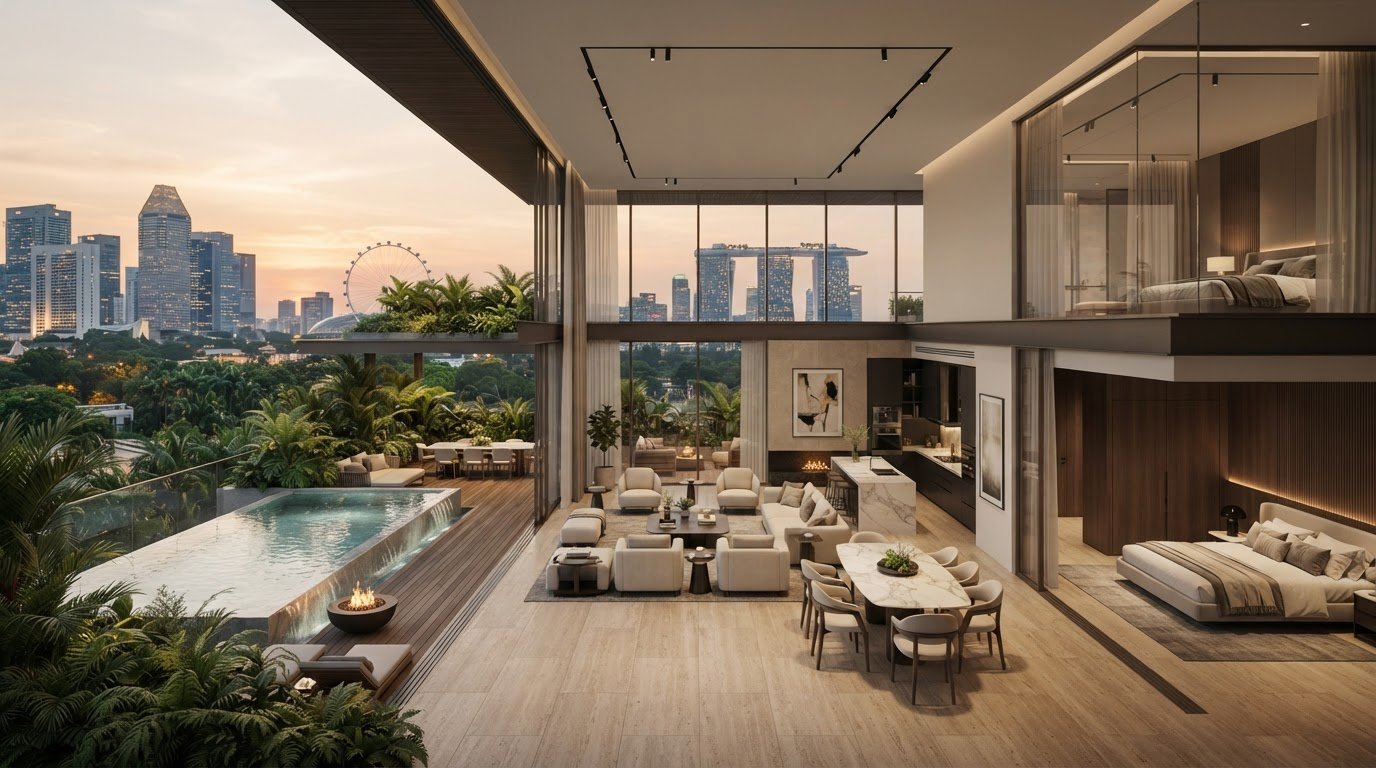
Size is a useful benchmark, but it doesn’t determine a penthouse’s price on its own. The EDITION Penthouse at EDITION Singapore measures 200 square metres. The price of a super penthouse in Singapore depends on how its size, room layout and amenities come together.
A larger home or a more distinctive layout may affect value, but floor area alone cannot show how one property compares with another. Room configuration, indoor and outdoor space, and available amenities all shape the overall picture.
This guide explains how to assess super penthouse prices in Singapore without relying on a single headline figure. Learn how size and room type affect comparisons, which amenities to consider, and what to look for when evaluating a property. It also explains how Vincent Lim’s experience in Singapore’s luxury residential market can support your next steps when you’re considering high-end homes.
Key Takeaways
- Compare usable layout and room configuration, not floor area alone, to judge how well a penthouse suits your needs.
- Assess amenities alongside their ongoing upkeep so their value is considered in the full ownership picture.
- Build a purchase budget around taxes, maintenance and transaction costs, which depend on the property and buyer’s circumstances.
- Understand how buyer status and property classification affect eligibility and stamp duties before proceeding with a purchase.
- If your search extends to landed homes, compare terrace, semi-detached and detached properties against your space and ownership priorities.
Penthouse size
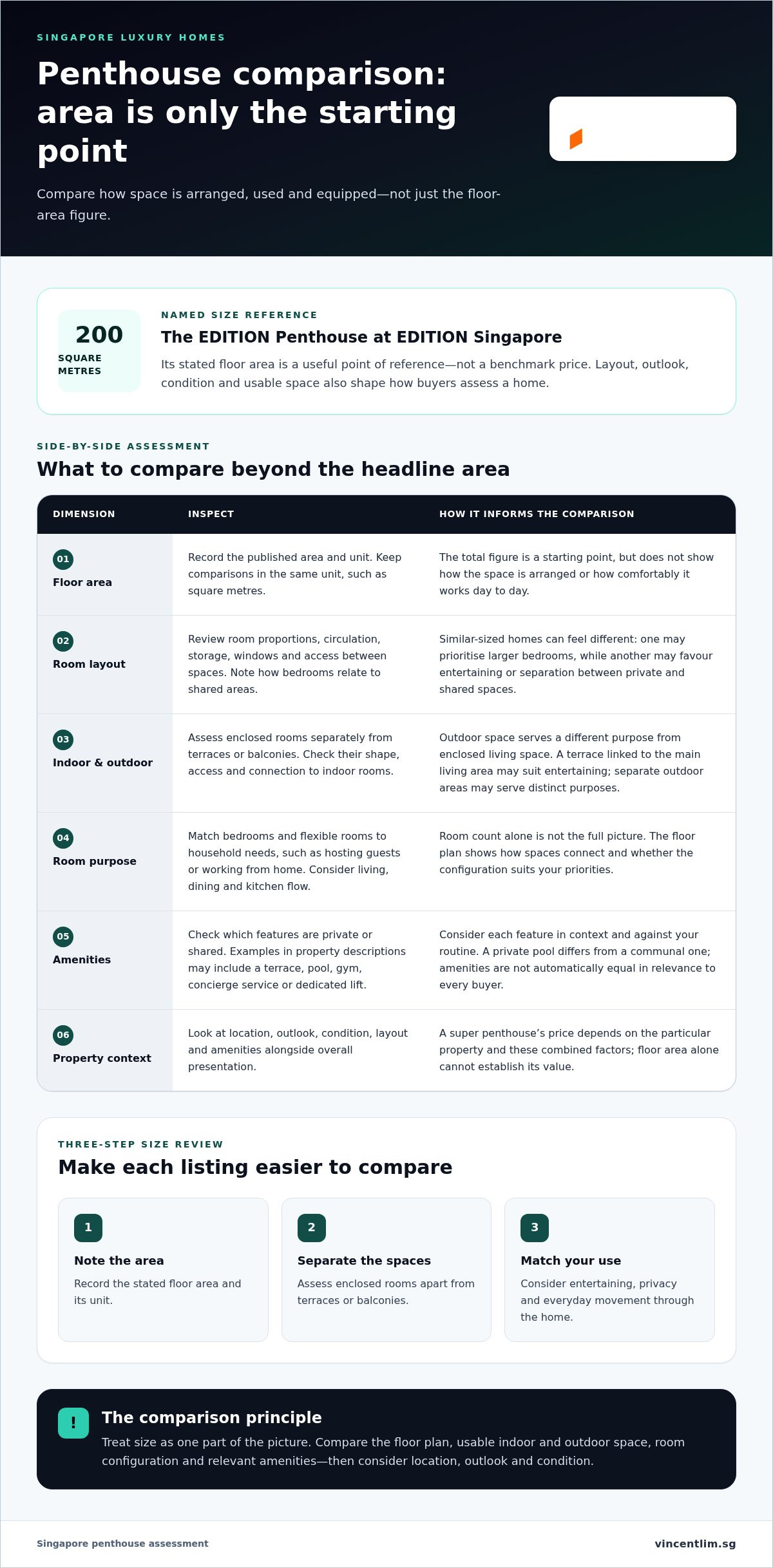
Floor area is a useful starting point for comparing Singapore penthouses, but it cannot explain value on its own. The EDITION Penthouse at EDITION Singapore measures 200 square metres. Use that named example as a size reference, not as a benchmark price. A home’s layout, outlook, condition, and usable space also shape how buyers assess it.
Start with the area figure, then examine how the space is arranged. Two homes with similar floor areas can feel very different. One may have larger bedrooms, while another prioritises entertaining or outdoor space. A large total area does not automatically mean every room feels spacious. The floor plan, circulation, and room proportions all affect how comfortably the home works day to day.
When comparing listings, use the same unit of measurement. The EDITION Penthouse’s stated area is in square metres, so make sure your comparisons use that unit too. Focus on the published floor area and the spaces shown in the layout. Check how the living, dining, bedroom, and outdoor areas relate to one another. This makes comparisons clearer without treating total area as the only measure of suitability.
Assess outdoor space separately when comparing size. A terrace or balcony can extend the home’s usable setting, but it serves a different purpose from enclosed living space. Consider its access, shape, and connection to indoor rooms. For example, a terrace linked to the main living area may suit entertaining, while separate outdoor areas may serve distinct purposes. These differences can affect personal appeal and how buyers compare properties.
Size also shapes choices about location and room configuration. A larger floor plan may create more separation between private and shared areas. A compact plan may use circulation space efficiently and combine functions in fewer rooms. Neither arrangement is inherently better. The key question is whether the space supports your household’s priorities, such as hosting, working from home, or maintaining privacy.
For a structured review, compare each candidate in three steps:
- Record the stated area and its unit, as shown for the EDITION Penthouse.
- Separate enclosed rooms from terraces or balconies when assessing how space is used.
- Match the plan to your intended use, including entertaining, privacy, and everyday movement.
A super penthouse’s price in Singapore depends on more than floor area. Location, outlook, layout, condition, and amenities all influence how a particular property is assessed. Treat size as one part of the comparison, then weigh it against the features that make the home distinctive. The exact purchase figure is specific to the property and set out in its purchase quotation, reflecting these factors.
Buyers also considering landed homes can compare terrace, semi-detached, and detached houses for different ways to use space and achieve privacy. Comparing these property types with a penthouse can clarify whether vertical living or a landed layout better suits your priorities. The useful question is not just how large a home is, but how effectively its area supports the way you intend to live.
Room type and amenities
A penthouse’s room configuration determines how its floor area works in practice. Compare the bedroom arrangement with the living and dining spaces. A separate study, for example, may suit someone working from home. Another buyer may prioritise an open living area for hosting. These preferences affect which properties feel suitable, even when their stated areas are similar.
Start by identifying how you intend to use each room. A bedroom can be a private retreat, while a flexible room may accommodate work or guests. Consider whether the layout separates private areas from shared spaces. For instance, bedrooms set apart from the main living area may offer more separation during gatherings. A floor plan reveals these relationships more clearly than room labels alone.
Room count is only part of the assessment. Check room proportions, storage, windows, and access between spaces. A bedroom described as generous may have limited room for furniture, while a smaller one may be arranged efficiently. Note where doors open and how people move from the entrance to the kitchen or living room. These practical details affect daily comfort and how useful each room is.
Amenities vary between properties, so assess each feature in context. A property description may mention a private terrace, swimming pool, gym, concierge service, or dedicated lift. Treat each as a feature to evaluate, not an automatic measure of value. A terrace, for example, matters more to a buyer who entertains outdoors than to someone prioritising interior rooms. Consider its accessibility and connection to the home.
Distinguish between amenities inside the residence and shared facilities in the development. A private pool serves a different purpose from a communal one. Some residents value shared facilities for recreation; others prioritise privacy or simpler daily routines. Consider how each feature fits your intended use rather than counting amenities as if they all carry equal weight.
For a structured viewing, use this checklist:
- Match bedrooms and flexible rooms to household needs, such as guests or work.
- Assess the living, dining, and kitchen relationship for everyday movement.
- Separate private features from shared development facilities.
- Consider how a terrace, pool, or gym fits your actual routine.
- Compare the floor plan with the property description to understand each feature’s location.
When assessing the super penthouse Singapore price, consider room type and amenities as part of a broader property comparison. Buyers weigh configuration, privacy, condition, and the relevance of each feature alongside location and overall presentation. A high-specification finish may attract attention, but its practical value depends on how it serves the buyer. The same applies to a private lift or expansive entertainment space: consider function, not just prestige.
Before comparing properties, rank the features that matter most to your household. A buyer who hosts regularly may prioritise connected entertaining spaces. Someone seeking quiet may focus on bedroom separation and privacy. Use that shortlist during viewings, then compare each home against the same criteria. For a broader perspective on Singapore luxury property considerations, explore Singapore luxury property guidance.
What are the estimated property taxes, maintenance fees, and transaction costs for buying it?
A purchase budget for a Singapore penthouse includes more than the agreed property price. Separate recurring ownership costs from one-off transaction expenses. Property tax, building maintenance, legal work, and financing can affect the total outlay. The amount for each item depends on the property and the buyer’s circumstances, so account for them separately.
Property tax is an ongoing ownership cost. Its assessment depends on the property’s valuation and use. Distinguish a home occupied by its owner from one held for another purpose, as those circumstances affect the applicable assessment. To estimate the cost, identify the property’s tax basis and intended use, then include the resulting liability in your annual ownership budget. Don’t treat property tax as a one-off completion expense.
Maintenance fees generally cover the development’s upkeep and shared facilities. The charge can reflect the building’s management budget, common areas, and facilities such as lifts, security, landscaping, or a swimming pool. A penthouse’s private features and shared amenities have different cost implications. Review the unit’s stated fee and what it covers, then consider whether the facilities justify that recurring expense for your household.
For example, a development with extensive shared facilities may have different upkeep needs from one with fewer common features. This comparison does not establish a standard charge, but it helps explain why maintenance costs can vary between penthouses. The building’s condition and planned maintenance can also affect the management budget. Include ongoing fees in your affordability calculations rather than focusing only on the payment due at completion.
Transaction costs arise at different stages. Stamp duties depend on the transaction and the buyer’s circumstances. Legal conveyancing work supports the transfer and review of purchase documents. A financed purchase may also involve lender-related charges and valuation work. List these items separately in a written cost plan. Don’t combine recurring charges with completion expenses, as this can obscure the cash needed at each stage.
Use this checklist to structure your estimate:
- Record the agreed consideration and distinguish it from ongoing ownership costs.
- Identify the property’s tax basis and intended use.
- Review the development’s maintenance charge and included facilities.
- List applicable stamp duties and legal costs as transaction items.
- Add financing-related expenses where the purchase uses a loan.
When comparing two penthouses, apply the same cost categories to each. One property, for example, may have higher maintenance fees because of its shared facilities, while another may involve different financing or transaction requirements. A side-by-side budget makes these differences clear and helps prevent a recurring fee from being mistaken for a one-time charge.
The purchase figure and related costs depend on the property, buyer profile, intended use, financing, and building expenses. A cost quotation for a specific case should set out the relevant items based on those details. Before committing, organise the figures by timing: transaction costs, recurring ownership charges, and future upkeep. This gives you a clearer view of initial cash needs and ongoing commitments.
Can foreigners buy the Super Penthouse in Singapore, and what restrictions or stamp duties apply?
For a Singapore penthouse, eligibility depends on the property’s legal classification and the buyer’s status. “Super penthouse” is a marketing description, not enough to establish which rules apply. First identify the property type and ownership structure. Then assess the purchase requirements for that classification and buyer.
A penthouse in a private residential development may be treated differently from landed residential property. This distinction matters because ownership restrictions can depend on property type. Don’t infer eligibility from a listing title, luxury finish, or location alone. Review the tenure and legal description in the sale documents, then determine whether the intended buyer can acquire that specific interest.
Stamp duty is another buyer-specific consideration. The amount depends on the transaction and the purchaser’s circumstances, including relevant property holdings and residential status. Foreign buyers should account for any applicable duties separately from the purchase consideration. Don’t rely on a headline rate from another buyer’s transaction, as different circumstances can result in different liabilities.
Before making an offer, organise the review in a clear sequence:
- Confirm the property’s legal description and whether it is an apartment or landed home.
- Establish each purchaser’s residential status and ownership position.
- Determine which stamp duties apply to that buyer and transaction.
- Include the resulting duties in the acquisition budget and payment schedule.
- Ensure the purchase documents reflect the intended buyer and ownership arrangement.
For example, two purchasers considering the same penthouse may face different stamp duty outcomes because their residential status or existing property interests differ. The property’s legal classification may also affect the applicable acquisition process. Comparing their circumstances without these details can lead to an unreliable budget.
Foreign buyers should distinguish permission to acquire a property from the cost of acquisition. Eligibility concerns whether the buyer can purchase under the property’s classification. Stamp duty concerns the tax payable on the transaction. These are separate questions: resolving one does not automatically answer the other. Include both in your pre-purchase review.
Base this assessment on formal property records and transaction documents. A marketing description may highlight height, views, private facilities, or exclusivity, but these features don’t replace the legal classification. For a penthouse in a mixed-use development, clarify the nature of the ownership interest before treating it like a standard residential apartment.
Keep a written record of the assumptions behind your budget. Note the purchaser’s status, property classification, ownership position, and duties considered. If you’re planning a joint purchase, assess each purchaser’s circumstances rather than treating the household as one buyer. This makes the review more precise and helps identify where separate advice is needed.
In short, a foreign buyer’s eligibility and applicable stamp duties cannot be determined from the phrase “Super Penthouse” alone. Establish the legal property type, identify the buyer’s circumstances, and calculate duties accordingly. Include these checks in the purchase process before committing to the transaction.
Vincent Lim (OrangeTee & Tie): Terrace House Sales
Vincent Lim (OrangeTee & Tie) can help buyers compare terrace houses as an alternative to penthouse living. Consider this option if private outdoor space, a landed-home layout, or a different balance of shared and private areas matters to your decision. Comparing property types can clarify which setting best fits your priorities.
Vincent’s sales offerings also include semi-detached houses, detached houses, and Good Class Bungalows. Each offers a different form of landed residential ownership, so your preferred layout and property type can guide the comparison. If you’re weighing a terrace house against a high-rise residence, Vincent Lim can assist with the terrace house sale process.
To discuss your property requirements, contact Vincent Lim (OrangeTee & Tie) or visit vincentlim.sg.
Make Your Next Property Decision with Clarity
Your assessment of the super penthouse Singapore price is most useful when it reflects how you intend to live, not just what looks impressive on paper. Before moving forward, define your priorities, identify the trade-offs you can accept, and decide whether a penthouse remains the right fit for your plans.
If you decide to focus on landed property, Vincent Lim (OrangeTee & Tie) handles terrace house, semi-detached house, and detached house sales. This can help you consider a different type of home while keeping your space and lifestyle priorities in view.
For a considered discussion of your property plans, contact Vincent Lim (OrangeTee & Tie). A clear next step can make your search more focused and help you move forward with confidence.
Frequently Asked Questions
What is the Super Penthouse Singapore asking price?
The price of a super penthouse in Singapore depends on the specific unit and its sale terms. Compare listings within the same development, considering floor level, outlook, condition, and included fixtures. For example, two units in one building may differ in orientation or interior finish, affecting how buyers assess them. Treat each asking price as specific to that property, rather than assuming one figure represents every super penthouse.
How many bedrooms and square feet is the Super Penthouse?
There is no single bedroom count or floor area for every super penthouse. Use the floor plan and listing details to identify the bedroom configuration and compare the spaces. For square-foot comparisons, keep the measurement unit consistent across properties. The stated area here is in square metres. Room count and floor area describe different aspects of a home.
What amenities and features are included in the Super Penthouse?
A super penthouse’s amenities depend on the individual property and development. Read the listing alongside its floor plan, distinguishing features inside the residence from shared facilities. For example, a private terrace differs from access to a communal pool, while fitted appliances differ from building amenities. This distinction clarifies what comes with the unit and what belongs to the wider development, supporting a more accurate comparison between listings.