
What can you do if you want to sell a co-owned property in Singapore but the other owner refuses? The answer is not always to put the property on the market, or to assume a disagreement leaves you with no options. The right next step depends on how the property is owned and what the relevant documents say.
It is understandable to feel uncertain. Joint tenancy and tenancy-in-common work differently, and an outstanding loan or disagreement over sale proceeds can add complexity. Before deciding how to proceed, clarify the ownership arrangement, each party’s position and any financial obligations tied to the property.
This guide explains how ownership type affects consent, which consensual options may be available, and what a disputed route could involve, including when a court application may be considered. It also outlines the documents and practical details to prepare once the route is clear. With that groundwork, you can make a more informed decision about selling and plan your next step with greater confidence.
Key Takeaways
- Before selling a co-owned property singapore, review the title records and any co-ownership agreement to understand each owner’s registered interest.
- Compare negotiation, a buyout and an agreed sale before considering a court application. The right route depends on the circumstances.
- Organise the relevant documents, list unresolved issues and communicate proposed sale terms and timing in writing.
- Once the sale route is agreed, Market Analysis and Property Valuation can help landed residential owners plan their next steps.
- Clarify ownership and consent before moving into marketing and negotiation.
Selling a Co-Owned Property in Singapore: Why Disagreement Changes the Route
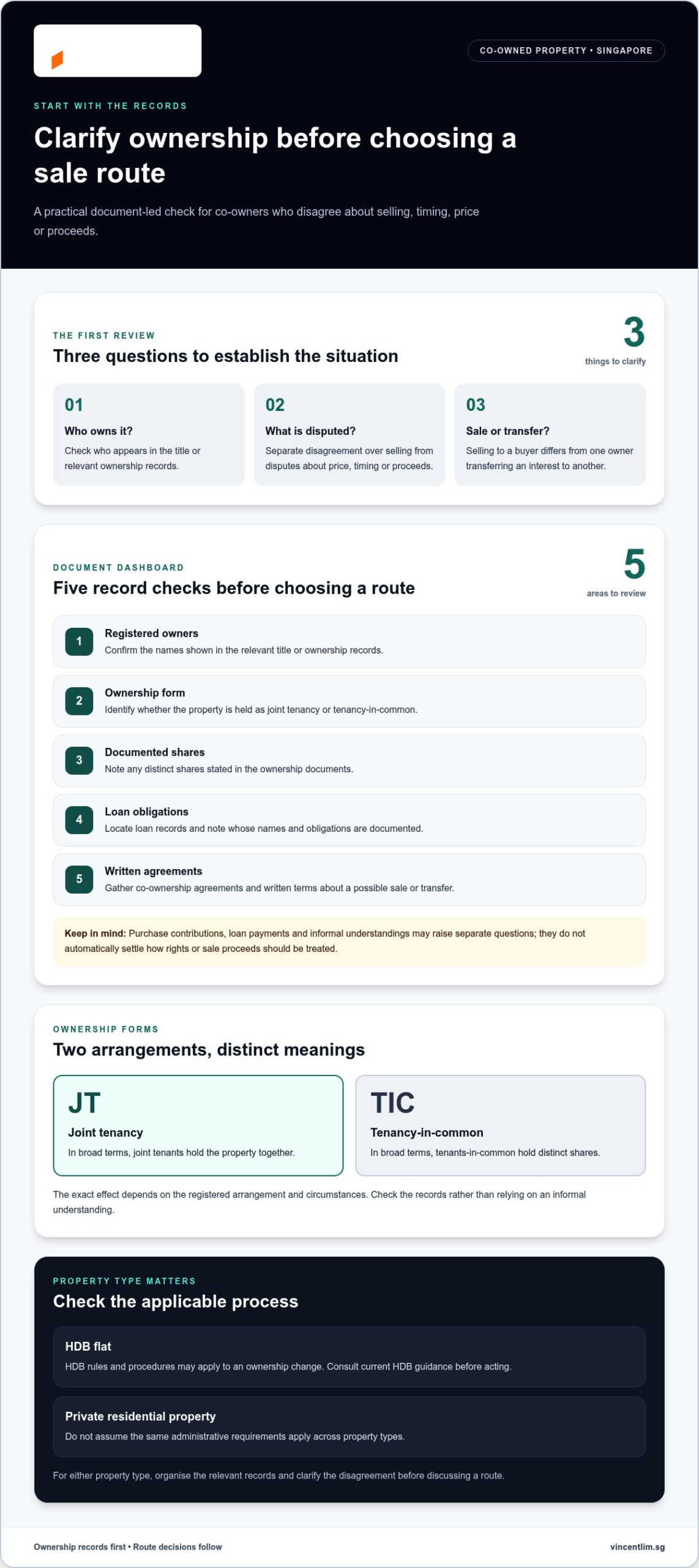
Disagreement over a shared home can make a significant decision harder to manage. Start by separating three questions: who owns the property, what each owner disagrees about, and whether the intended change is a sale or a transfer of ownership. This creates a practical way to assess the next step without assuming a particular legal outcome.
Co-ownership means that two or more people hold registered interests in the same property. Their interests may be held as joint tenants or tenants-in-common, and the distinction can affect how their ownership is treated. A general overview of Co-ownership introduces these forms, but the Singapore title records and relevant documents are the starting point for understanding a specific property.
A disagreement can affect the timing and available routes, but it does not, by itself, determine the legal result. Selling a co-owned property singapore starts with understanding the ownership arrangement and identifying exactly what has stalled. A dispute about whether to sell is different from a dispute about the asking price, when to market the property, or how to account for the proceeds.
What makes a co-owned property sale different?
With multiple registered owners, a decision to sell the whole property involves more than one person’s interests. One co-owner should not assume they can independently complete a sale of the entire property. Before taking steps towards a transaction, clarify who is registered as an owner and whether the owners agree on the proposed sale.
Be specific about the disagreement. All owners might support a sale but differ over timing or price. That calls for a different conversation from a situation where one owner wants to retain the home and another wants to sell. Owners may also disagree about how to distribute the proceeds. Identify that issue separately rather than leaving it until late in the process.
A sale transfers the property to a buyer. A change in ownership, such as one owner transferring their interest to another, is a different route and may involve separate requirements. Distinguishing these objectives early helps focus discussions and avoids treating every ownership change as an open-market sale.
Is this an HDB flat or private residential property?
Property type matters because the applicable processes may differ. The core decision framework remains useful: establish the registered ownership, clarify the point of disagreement and identify whether the goal is a sale or a change in ownership. Do not assume the same administrative requirements apply to every residential property.
For an HDB flat, consult current HDB guidance before acting on an ownership change, as HDB rules and procedures may apply. Verify details against current official guidance rather than inferring them from rules for private residential property. For either property type, organise the relevant records before discussing a route. This gives each owner a clearer basis for considering the next step.
Check the Singapore Ownership Documents Before Choosing a Sale Route
Before deciding how to proceed, establish what the formal records say. Family discussions, past contributions and an understanding that “we own it equally” may not match the registered ownership arrangement. For anyone considering selling a co-owned property singapore, reviewing the documents can help identify what is agreed, what remains uncertain and which questions need professional interpretation.
Start with the title or relevant ownership records, then compare them with purchase documents and any written co-ownership agreement. The records can help identify the registered owners and form of ownership. They may not, by themselves, answer every question about how the parties funded the purchase, paid the loan or intended to divide sale proceeds.
Joint tenancy and tenancy-in-common: what should owners understand?
Joint tenancy and tenancy-in-common are distinct ways of holding co-owned property, not interchangeable labels. In broad terms, joint tenants hold the property together, while tenants-in-common hold distinct shares. The exact effect depends on the registered arrangement and circumstances, so do not assume an informal understanding changes what the records show.
A stated share and a record of financial contributions can raise separate questions. One owner may, for example, have paid more towards the deposit or loan while the registered ownership records show a particular arrangement. That difference does not automatically settle how rights or sale proceeds should be treated. If the owners disagree about its significance, obtain independent Singapore legal advice before relying on an assumption.
Which records can clarify the ownership position?
Gather documents from the purchase and ownership period, not just the latest correspondence. Compare them for names, stated interests, loan responsibilities and any written terms about a future sale or transfer. A note of what each person remembers can help identify issues, but recollections should not replace formal records.
- Owners: Confirm whose names appear in the relevant title or ownership records.
- Ownership form: Identify whether the property is held as joint tenancy or tenancy-in-common.
- Documented shares: Record any distinct shares stated in the ownership documents.
- Loan obligations: Locate loan records and note who is named and what obligations are documented.
- Written agreements: Gather co-ownership agreements and other written terms relating to ownership or a possible sale.
Keep the records together and note inconsistencies rather than trying to resolve them by assumption. The Ministry of Law’s discussion of court powers in co-owned property disputes provides context for why the ownership position matters if agreement breaks down: Ministry of Law Singapore on Co-Owned Property Sales. It is not a substitute for advice on how a particular title or agreement applies to your circumstances.
Once the documents are assembled, independent Singapore legal advice can help interpret disputed rights or unclear wording. For landed residential owners preparing for a sale after clarifying their route, landed property sale planning can bring market considerations into the next stage.
Compare the Main Options When a Co-Owner Will Not Sell
A refusal to sell does not mean the only next step is court. First identify what each owner wants and whether the disagreement concerns the decision to sell, the proposed price, timing or how proceeds should be handled. The best route depends on the ownership form, documents, loan position, each party’s objectives and the property type. When selling a co-owned property singapore, compare practical options before deciding how to proceed.
These routes are not interchangeable, and none should be treated as an outcome another owner must accept. The overview below can help frame a discussion. Disputed rights and formal steps call for independent Singapore legal advice.
| Route | When to explore it | Key dependency | Legal advice |
|---|---|---|---|
| Continued negotiation | Owners may still be able to resolve differences on timing, price or proceeds. | Clear proposals and willingness to discuss the specific disputed points. | Useful if rights, obligations or written terms are unclear. |
| One owner buys the other’s interest | An owner wishes to retain the property and the other is open to transferring their interest. | Agreement on value, ownership position, loan arrangements and transaction terms. | Important to assess the transfer and document the arrangement appropriately. |
| Sale by agreement | Owners agree that the whole property should be sold. | Agreement on sale strategy, timing and treatment of outstanding obligations and proceeds. | Helpful for clarifying transaction documents and distribution issues. |
| Court application | Agreement has not been reached and other routes have been considered. | Applicable law, ownership documents and the facts of the dispute. | Essential before assessing whether an application is appropriate. |
Can owners agree on a buyout or sale without going to court?
Yes, a voluntary buyout or sale can be discussed, but it depends on the owners reaching agreement. Agreeing on a route is only one part of the process. A buyout may require the parties to address value, the registered interests, loan obligations and the documents needed to record a transfer. An agreed sale also requires clarity on marketing decisions and how the owners propose to account for proceeds. Put any agreement in writing and obtain legal advice on the appropriate documentation before relying on it.
When might a court route need legal assessment?
If discussions and possible arrangements have failed, a co-owner can seek advice on whether a court application may be available. Depending on the circumstances and applicable law, court options may include an order for sale or partition. Partition means dividing the property itself, which may not be practical for many residential properties. Neither route guarantees a particular result: the court’s decision depends on the law and evidence before it. A lawyer can assess the documents, ownership form and relevant facts before an owner takes this step.
Before choosing a route, write down the unresolved points and consider how each option affects the owners’ objectives, the loan and the property. This comparison helps keep negotiation focused and makes it easier to identify when independent legal assessment is needed.
A Practical Step-by-Step Plan for Moving a Co-Owned Sale Forward
Once the ownership position is clearer, turn the discussion into a manageable sequence. Selling a co-owned property singapore can involve different interests and unresolved questions, so keep the next steps factual, documented and proportionate to the issue. This plan helps owners distinguish what they know from what still needs agreement or professional advice.
Work through these steps in order:
- Gather the records. Collect the title or ownership records, purchase documents, loan information and any written co-ownership agreement. Keep copies together so the owners can refer to the same documents.
- Confirm the ownership position. Check the registered owners and form of ownership against the documents. If records appear inconsistent or unclear, note the questions rather than resolving them through assumption.
- Identify the disputed points. Ask each owner to state their preferred outcome and concerns. Separate disagreements about whether to sell from questions about price, timing, loan obligations or proceeds.
- Discuss possible routes. Consider whether negotiation, a buyout or a sale by agreement is realistic. Record which options the owners are willing to explore and what information they need before deciding.
- Obtain appropriate advice. Ask an independent Singapore lawyer about disputed rights, legal requirements and documentation. Direct loan questions to the relevant lender or transaction professional, and clarify conveyancing matters with the conveyancing lawyer handling the transaction.
What should co-owners prepare before discussing a sale?
Preparation makes a difficult conversation more structured. Alongside ownership records, gather purchase documents, available loan information and written agreements. Each owner can set out their preferred outcome, concerns and any conditions that matter to them. Then create two short lists: points already agreed and points still unresolved. For example, owners might agree that a sale is worth discussing while remaining divided on timing. Keeping these issues distinct gives the discussion a specific focus.
How can owners reduce avoidable delays and misunderstandings?
After each discussion, summarise proposals, decisions and open questions in a neutral written record. Use precise language, such as “sale timing remains unresolved,” rather than wording that suggests consent where none has been given. Avoid promising a marketing or completion timetable before consent, legal requirements and transaction dependencies are understood. This is particularly useful where loan arrangements or conveyancing steps may affect what can happen next.
For an HDB flat, verify current HDB guidance for any ownership change rather than applying assumptions drawn from private property transactions. Requirements can depend on the specific circumstances, so check official guidance before acting. Clear records and careful communication help owners identify the next question without treating an unresolved matter as settled.
For landed residential owners who have established an agreed sale route, Vincent Lim’s Market Analysis and Property Valuation can inform planning before the transaction moves forward.
Prepare for a Landed Property Sale with Vincent Lim
This section is for co-owners of landed residential property in Singapore who have agreed on a sale route and are ready to plan the transaction. A sales strategy cannot resolve an ownership dispute, but once the owners are aligned, careful preparation can help turn a shared decision into a coordinated sale plan.
Before marketing begins, agree on the objectives that will guide decisions: the intended timing, how the property should be presented, how enquiries will be handled and how owners will communicate about offers. A shared understanding helps reduce mixed messages and supports considered decisions as the sale progresses.
How can a clear sales strategy support co-owners?
Transparent communication gives each owner a clearer view of the sale plan and the decisions that may arise. Market Analysis and Property Valuation can inform discussion of the property’s market position and help co-owners consider a pricing approach. These are planning inputs, not a promise of a particular sale price or outcome.
Once the owners agree on their objectives, Marketing Strategy can shape how the property is presented to prospective buyers, while Expert Negotiation can support discussions around offers. A considered approach also helps co-owners distinguish between a buyer’s proposal and the decisions they must make together. For a broader view of sale preparation, the strategic guide to selling landed property offers further context.
Co-owners can set a shared process for reviewing offers, recording decisions and raising questions before responding. This may not remove every difference of opinion, but it makes responsibilities and communication clearer and helps carry the agreed route forward consistently.
What experience and support can owners expect?
Vincent Lim has been actively engaged as a real-estate agent since 2000. 70 % of Vincent’s transactions are in landed property. His EdgeProp Excellence Awards include Top 6 Transactor – Landed (2022) and Top 6 Transactor – Landed (2023), audited by KPMG. His experience is relevant to landed-property owners seeking structured sale planning and clear communication.
Support can be tailored to the stage of the transaction. Market Analysis and Property Valuation can contribute to sale planning; Marketing Strategy and Expert Negotiation become relevant as co-owners prepare to market and consider offers. Legal and Paperwork Assistance provides transaction guidance, but it is not independent legal representation or legal advice. Owners should seek independent advice where rights, obligations or disputed documents require legal interpretation.
Once the ownership route is settled, a focused plan can help co-owners move from agreement to preparation with shared expectations. Discuss a landed property sale with Vincent.
Turn Agreement into a Considered Sale Plan
Once the co-owners have agreed on a route, turn that decision into a sale plan they can follow together. A shared brief can set out the owners’ objectives, how they will consider offers and how they will keep communication clear as decisions arise. This gives the sale a practical direction without rushing into commitments before the relevant transaction details are settled.
For owners selling a co-owned property singapore, a landed-property specialist can support the market-planning and sale-preparation stages. Vincent Lim has been active in Singapore real estate since 2000. 70 % of Vincent’s transactions are in landed property. His EdgeProp Excellence Awards include Top 6 Transactor – Landed (2022) and Top 6 Transactor – Landed (2023), audited by KPMG.
With the ownership route established, consider the priorities you want your sale strategy to reflect. Discuss a landed property sale with Vincent and take a clear, considered step towards the next stage.
Frequently Asked Questions
Can one co-owner sell a Singapore property without the other owner’s agreement?
One owner generally cannot complete a sale of the entire property without the other registered owners’ agreement. If discussions fail, a co-owner may seek independent legal advice about whether a court application is available. The court may order a sale in appropriate circumstances, but an application does not guarantee that result. For selling a co-owned property singapore, the ownership form and documents are central to understanding the available options.
Does a co-owner automatically receive half of the sale proceeds?
No. A half share should not be assumed. For a tenancy-in-common, the registered shares are relevant to how proceeds may be divided; joint tenancy is a different form of ownership. The final amount available to each owner may also depend on matters such as the outstanding loan and the parties’ documented arrangements. If the ownership records and an owner’s understanding differ, get independent legal advice before agreeing on a distribution.
What happens to an outstanding property loan when co-owners sell?
An outstanding loan needs to be addressed as part of the transaction. The conveyancing lawyer can coordinate the steps required to obtain the lender’s redemption figure and deal with discharging the loan from the sale proceeds, subject to the transaction details. The amount remaining after obligations are settled is not automatically divided equally. Owners should clarify the loan position and any agreed distribution before relying on an estimate of their net proceeds.
Can a co-owner change their mind after agreeing to sell?
It depends on what was agreed and whether binding sale documents have been signed. A preliminary discussion or informal indication may not have the same effect as a signed contract. If an owner wants to withdraw consent, they should promptly have the relevant communications and documents reviewed by a Singapore lawyer. Do not assume a change of mind cancels an obligation once formal sale documents are in place.
Can one co-owner sell only their share of a property?
It may be possible to deal with an individual interest, but the route depends on the ownership form and applicable requirements. A tenant-in-common’s distinct share differs from a joint tenant’s interest. Under the information provided for this guide, a joint tenant seeking to sell an interest independently would first need to address severance of the joint tenancy. Get legal advice before offering or transferring any share.
Does the process differ for an HDB flat and private property?
Yes, requirements can differ by property type. An HDB flat is subject to HDB’s rules, including applicable occupation and eligibility requirements, so do not assume a private-property process applies. HDB owners generally need to meet the five-year Minimum Occupation Period before selling, subject to current rules and circumstances. Check current HDB guidance for the flat and proposed transaction before taking steps.