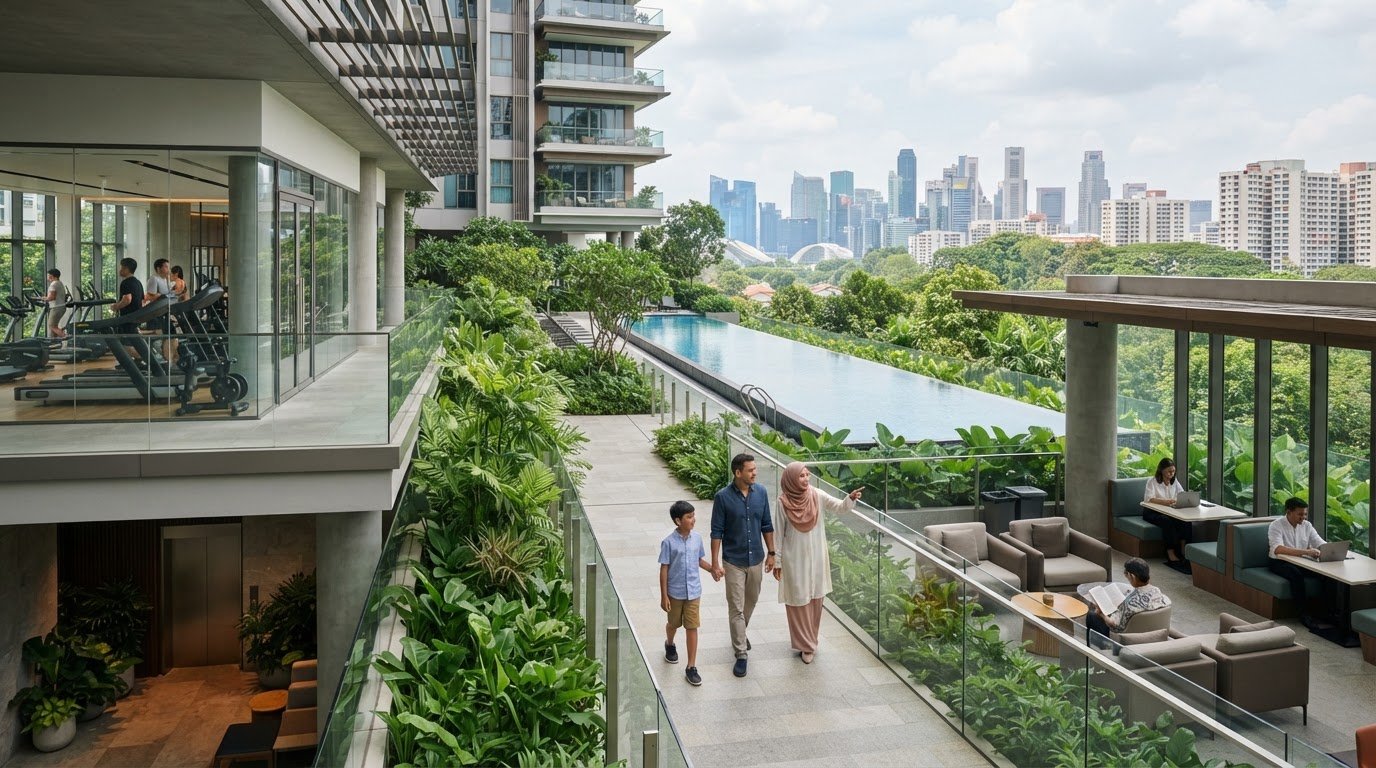
The condo with the longest facilities list may not be the one that best serves your household. A pool, gym or lounge adds value only if you’re likely to use it, can reach it conveniently and find it in good condition. This luxury condo facilities checklist helps you look beyond the brochure and judge what daily life in the development could really be like.
It’s sensible to consider more than the number of facilities. During a viewing, assess their usability and upkeep, and ask how facility-related charges are managed and what responsibilities sit with the condominium’s management. Promotional materials alone may not answer these questions.
This guide offers a practical way to compare developments against your household’s routines and priorities. It covers what to observe on site, which questions to raise during viewings and what to clarify through relevant documents. The aim is to assess usability, maintenance and overall fit, so you can decide whether a property merits closer consideration.
Key Takeaways
- Set household priorities before comparing developments, so useful facilities carry more weight than an impressive amenities list.
- Assess daily essentials, recreation, wellness, work and visitor facilities for cleanliness, visible wear, lighting, ventilation and ease of access.
- Use a side-by-side comparison to record each priority facility’s condition, access arrangements and unanswered questions.
- Apply a luxury condo facilities checklist during viewings: prioritise, inspect, ask, record and verify. When feasible, revisit key spaces at a representative time.
- Sort findings into non-negotiables, meaningful advantages, drawbacks and items to verify before weighing facilities against your broader purchase priorities.
Luxury Condo Facilities Checklist: Start With How You Will Actually Live
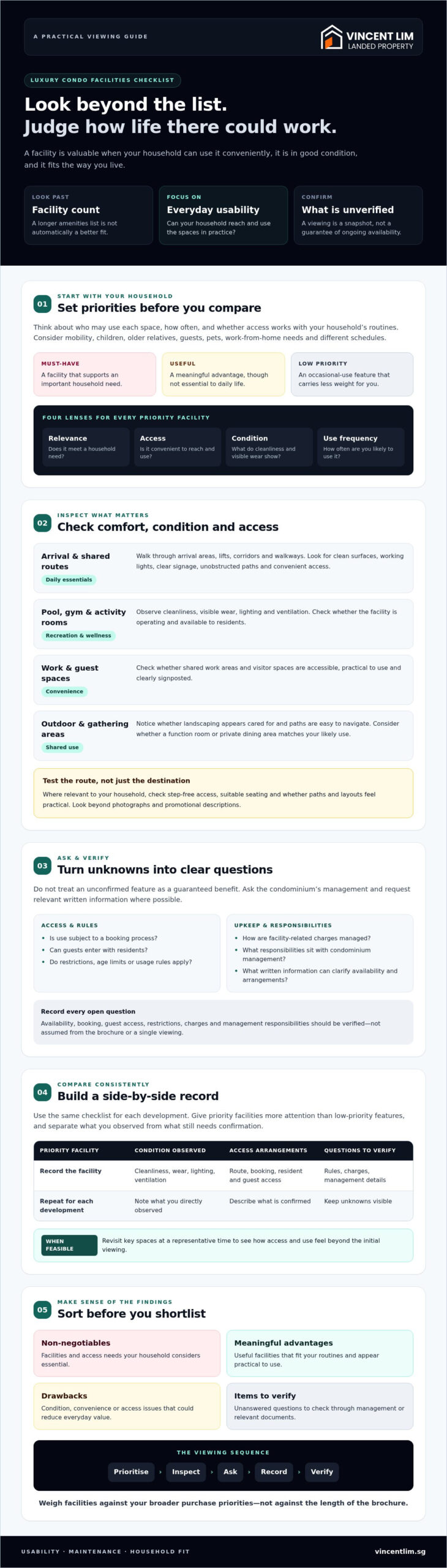
A long amenities list can look impressive, but practical fit matters more than facility count. For condo buyers comparing developments, start with your household’s routine: who will use each space, how often and whether it is convenient for the way you live.
Facility value comes down to usability, condition and fit with your household’s everyday needs. A swimming pool may matter to a family that uses it regularly, while a quiet work area may be more relevant to someone who works from home. Neither should carry the same weight for every buyer.
A condominium generally combines individually owned homes with shared areas and amenities. The Condominium overview explains this distinction. For your assessment, it’s a useful reminder to consider not just what appears in a unit listing, but also how shared spaces work for residents.
Which facilities match your household’s routine?
Before touring a property, list the people who may use its facilities and the needs that shape their access. Consider mobility, children’s routines, older relatives, guests and pets. Note whether household members work from home or follow different schedules.
Separate weekly-use priorities from occasional-use features. A gym, pool or outdoor space may support regular recreation; a function room or private dining area may be useful only for gatherings. This distinction helps you spend viewing time on facilities that could meaningfully affect daily life.
How should you rank must-haves and nice-to-haves?
Use the same categories for every development: must-have, useful and low priority. Then assess each facility against four criteria: relevance to your household, convenience of access, visible condition and likely frequency of use. A consistent rating scale helps compare options without letting a polished presentation dominate your judgement.
Check how access works rather than assuming every advertised amenity is available to every resident in the same way. Ask whether use requires a booking, whether guests can enter with residents, and whether restrictions or charges apply. Record unanswered questions for follow-up instead of treating an unverified feature as a confirmed benefit.
This first pass gives your luxury condo facilities checklist a household-specific basis. It also makes later comparisons more disciplined: you can distinguish facilities that support your routine from those that simply add length to a brochure.
Inspect the Condo Facilities That Affect Everyday Comfort
Once you know which amenities matter to your household, check how they function in practice. An advertised feature may be incomplete, temporarily unavailable or subject to access conditions that aren’t clear from a brochure. During a viewing, observe what you can and note what needs confirmation rather than treating a photograph or listing description as proof.
Facility type tells you what a development offers; condition helps show how usable that offer may be. A pool, gym or shared lounge can look appealing, but cleanliness, visible wear, lighting, ventilation and access arrangements all affect its everyday value.
What should you check in shared indoor and outdoor spaces?
Walk through arrival areas, lifts, corridors and walkways on the route to the facilities. Look for clear signage, clean surfaces, working lights, unobstructed paths and landscaping that appears cared for. In indoor spaces, notice ventilation and whether the layout feels practical. Outdoors, consider whether paths and communal areas are easy to navigate and comfortable for their intended use.
Then assess amenities by purpose:
- Daily essentials: Check the condition and usability of arrival areas, lifts and shared routes.
- Recreation and wellness: Observe pools, gyms and activity rooms for visible wear, cleanliness, lighting and ventilation.
- Work and visitor convenience: Check whether shared work areas or guest spaces are clearly signposted and accessible.
Ask whether facilities are operating and available to residents, and clarify any booking process, guest access, age limits or usage rules. Confirm details with the condominium’s management and, where possible, request the relevant written information. A viewing offers a snapshot, not a guarantee of ongoing availability or future performance.
Do the facilities work for your household’s real needs?
Test the route, not just the destination. Check for step-free access where needed, suitable seating, readable signage and practical connections between common areas. If a family member has mobility needs, consider whether the full journey from the entrance to the facility feels manageable, not merely whether the room itself appears accessible.
Timing can also shape usefulness. A space that suits your household at one hour may feel different at another, so consider visiting at a representative time when feasible. Ask about expected busy periods or access arrangements rather than assuming the viewing conditions reflect typical use.
Finally, record gaps. If a development lacks a facility your household relies on, note whether that would mean arranging a separate membership, travelling elsewhere or adopting a different routine. To compare luxury condominium options, a property professional can help you weigh facility fit alongside other purchase priorities. Building-specific details still need confirmation from management.
Compare Condo Facilities by Maintenance, Access and Ongoing Value
A facility’s presence tells you little about how consistently it is maintained, how residents can use it or what its future operating performance may be. More amenities can offer limited value if they don’t suit your household, are difficult to access or appear poorly maintained. Compare developments using viewing observations and details that can be verified, rather than relying on the length of a brochure list.
Use this side-by-side format for the facilities you’ve prioritised. Record unknowns as questions, not assumptions.
| Priority facility | Visible condition | Access | Questions outstanding |
|---|---|---|---|
| Gym | Note cleanliness, wear, lighting and ventilation | Check entry method and any booking rules | What are the operating hours, and is access included? |
| Pool | Observe the surrounding area and apparent upkeep | Check resident and guest arrangements | Are there usage rules or temporary closures? |
| Shared work area | Assess whether the space appears usable and cared for | Ask whether booking is required | What access conditions apply? |
What management and maintenance questions should buyers ask?
Ask who oversees shared facilities and how residents report faults or maintenance concerns. Request relevant available records, then check their date, scope and limitations. A document may cover only a particular period or issue. Confirm operating hours, temporary closures, booking processes and resident access rules directly with management. These enquiries help clarify what a viewing cannot establish on its own.
How can you compare facilities without guessing at costs?
Review disclosed charges and inclusions only when they’re current and specific to the development. Ask which charges relate to shared facilities and how prospective changes are communicated. Don’t infer operating costs or maintenance quality from a polished space or a worn feature. If details aren’t available, mark them for verification instead of treating marketing claims as confirmed facts.
To strengthen your luxury condo facilities checklist, add a note beside each facility showing what you observed, what management confirmed and what remains unclear. This separates visible condition from documented information and makes comparisons more dependable. A well-presented facility may still have access conditions to clarify, while a modest-looking space may serve your household reliably. Assess both the evidence and the fit before deciding how much weight to give each feature.
Use This Viewing Checklist to Verify Condo Facilities
A structured viewing turns first impressions into information you can compare. Use the same process for each development, and keep what you observed separate from details provided by an agent, sales materials or management. A facility may look accessible during a visit, while its operating hours, rules or availability still need confirmation.
Follow these steps before making a decision:
- Prioritise: Identify the facilities that matter most to your household and the practical needs they must meet.
- Inspect: Visit each priority space and note its visible condition, access route, signage and apparent usability. Mark anything you couldn’t enter or assess.
- Ask: Clarify who can use the facility, whether booking is needed, what rules apply and whether it’s currently operating.
- Record: Use the same scorecard for every property. Rate relevance, condition and access, then list unresolved questions.
- Verify: Check answers against current written information where available, and resolve important unknowns before relying on them.
What should you record during a viewing?
Write down the viewing date and context, such as whether a space was open, in use or temporarily inaccessible. Separate direct observations, like visible wear, from statements you were given about future availability or maintenance. This creates a clear record for follow-up and prevents an unconfirmed claim from becoming an assumed fact.
Photograph facilities only where permitted, and avoid recording other residents without their consent. If you can’t access a space, note that limitation rather than rating its condition based on promotional images.
Which details should you verify after the visit?
Confirm facility availability, operating rules and any disclosed charges against current written information where possible. For strata-management questions, seek clarification from the relevant management body. Legal, management and building-specific matters may require confirmation from appropriate sources; a viewing alone cannot establish them.
Revisit important facilities at a representative time when feasible. A second visit may help you understand how the spaces function under different conditions, but it won’t replace written confirmation of rules or charges. Add every unresolved item to your wider purchase due-diligence list and track who can verify it.
A well-documented luxury condo facilities checklist can also support a broader assessment of property fit and purchase priorities. To discuss how facility findings sit alongside other considerations in a luxury condominium purchase, speak with Vincent Lim about luxury condo options.
Turn Your Luxury Condo Facilities Checklist Into a Confident Shortlist
Use your findings to distinguish genuine household fit from a persuasive facilities presentation. A useful shortlist doesn’t simply favour the development with the most amenities. It reflects which properties meet your essential needs, offer advantages you’ll value and have fewer material questions awaiting confirmation.
How do you decide which condo deserves a closer look?
Summarise each property under four headings. This makes trade-offs visible and helps you compare developments on consistent terms:
- Non-negotiables: The facilities and access arrangements your household needs to function comfortably.
- Meaningful advantages: Features likely to support your routine or add practical convenience.
- Drawbacks: Gaps, restrictions or condition concerns that could affect everyday use.
- Items to verify: Unanswered questions about availability, rules, charges or management information.
Then weigh the facility assessment against the wider purchase. A development may suit your priorities for shared spaces but be less suitable because of its layout, condition, location preferences or alignment with your purchase objectives. State the trade-offs plainly rather than giving extra credit for amenities you’re unlikely to use.
Prioritise properties that meet your household’s essentials and have fewer material facility questions outstanding. Once you’ve received current information, revisit your scorecard. A confirmed access restriction or detail about a charge could change how useful a feature appears. The luxury condo facilities checklist is a comparison tool, not a substitute for building, legal or financial due diligence. Seek confirmation from appropriate sources for matters outside what a viewing can establish.
When can a property professional help with your comparison?
Brokerage guidance can help frame property choices around your stated objectives, including how facilities fit alongside layout, condition and other purchase priorities. Vincent Lim is an OrangeTee & Tie real estate professional who provides luxury condominium sales services. His role is to support your property comparison, not to inspect or certify facilities. Building-specific details should still be verified with the relevant management body or other appropriate sources.
With your shortlist and questions in hand, you can have a more focused discussion about luxury condominium options. Discuss your luxury condo search.
Make Your Next Condo Comparison More Deliberate
A considered purchase looks beyond the amenities list. Use your luxury condo facilities checklist to compare how relevant each facility is to your household, whether it appears usable and well maintained, and which access or management details still need confirmation.
Then weigh those findings alongside the unit’s layout, condition, location preferences and your purchase objectives. A strong facilities match can support a property’s overall fit, but it doesn’t replace building, legal or financial due diligence. Verify important details with the appropriate sources before relying on them.
Vincent Lim provides luxury condominium sales brokerage services through OrangeTee & Tie. Discuss your luxury condo search.
With clear priorities and verified information, you can assess each option with greater confidence and build a shortlist that reflects how you actually want to live.
Frequently Asked Questions
Is a condo with more facilities always a better choice?
No. A longer facilities list doesn’t automatically deliver better day-to-day value. Consider whether each amenity suits your household, is accessible, appears well maintained and has clear usage arrangements. Compare the same factors across each property, then confirm outstanding details with the relevant management or sales contacts. Facility quantity is one consideration, not a substitute for assessing the property as a whole or completing appropriate purchase due diligence.
What facilities should I check when viewing a luxury condo?
Start with spaces your household is likely to use, such as arrival areas, lifts, recreation spaces, fitness areas and landscaped common areas where provided. Check cleanliness, visible condition, access routes and operating information. Ask whether booking or guest rules apply. Facilities vary by development, so rely on your observations and current property-specific information rather than assuming every luxury condo offers the same features or access arrangements.
How can I tell whether condo facilities are well maintained?
Look for cleanliness, visible wear, working access arrangements, adequate lighting and clear maintenance information. One viewing can’t establish long-term performance, so ask who oversees shared facilities, how residents report faults and whether relevant records are available. Use your luxury condo facilities checklist to distinguish what you observed from what you were told, then confirm building-specific details with the appropriate management contact.
Can condo residents use every facility whenever they want?
Not necessarily. Access may depend on operating hours, booking procedures, resident or guest rules, temporary closures or other building-specific arrangements. Don’t assume unrestricted use based on a brochure or viewing. Request current written information for facilities that matter to your household, including reservation procedures and any usage conditions. Confirm important details with the relevant management contact before treating a facility as available whenever you need it.
Do luxury condo facilities affect ongoing charges?
Shared facilities may be part of a development’s management and maintenance responsibilities, but charges and inclusions vary. Don’t estimate costs from the number or appearance of amenities. Request current, property-specific information about disclosed charges and what they cover, then clarify uncertainties with the relevant management or transaction contacts. Consider confirmed ongoing obligations alongside facility usefulness and your wider purchase budget before deciding whether the development is a suitable fit.
What should I ask the condo management about facilities?
Ask who oversees each shared facility, its operating hours, access and booking rules, guest arrangements, and how residents report maintenance concerns. Clarify whether temporary closures or other restrictions apply. Request current written details where available, especially for facilities central to your decision. Keep management’s answers separate from your viewing observations, and verify building-specific or regulatory matters with appropriate sources rather than relying on general assumptions.
Should I choose a condo based on its facilities or its location?
Neither should be considered in isolation. Start with your household’s essential needs, then weigh facility usefulness against location preferences, layout, condition and purchase objectives. A well-equipped development may not suit you if its facilities are unlikely to be used or other priorities aren’t met. Compare trade-offs consistently, and verify important property details before deciding. The right balance depends on your household’s priorities, not the amenities count alone.