
The strongest offer on a luxury condo isn’t always the lowest one. If you’re weighing how to negotiate price for a luxury condo, it can be difficult to judge when the asking price and recent transactions tell different stories. Push too hard without clear evidence, and you may risk losing a suitable home. Offer too much, and you could weaken your position before negotiations begin.
A measured approach starts with understanding what the condo is worth to you and how its features compare with relevant transactions. In Singapore, details such as condition, layout and position within the development can shape that assessment. The aim isn’t to guess what a seller will accept. It’s to prepare a credible offer, explain your reasoning clearly and know whether you’re ready to proceed.
This guide covers how to assess value, distinguish a genuine opportunity from a simple asking-price reduction, and negotiate price and terms while protecting your financing and transaction readiness. You’ll also learn when to hold firm, revise your offer or walk away, so you can make a considered decision without compromising on a home that suits your needs.
Key Takeaways
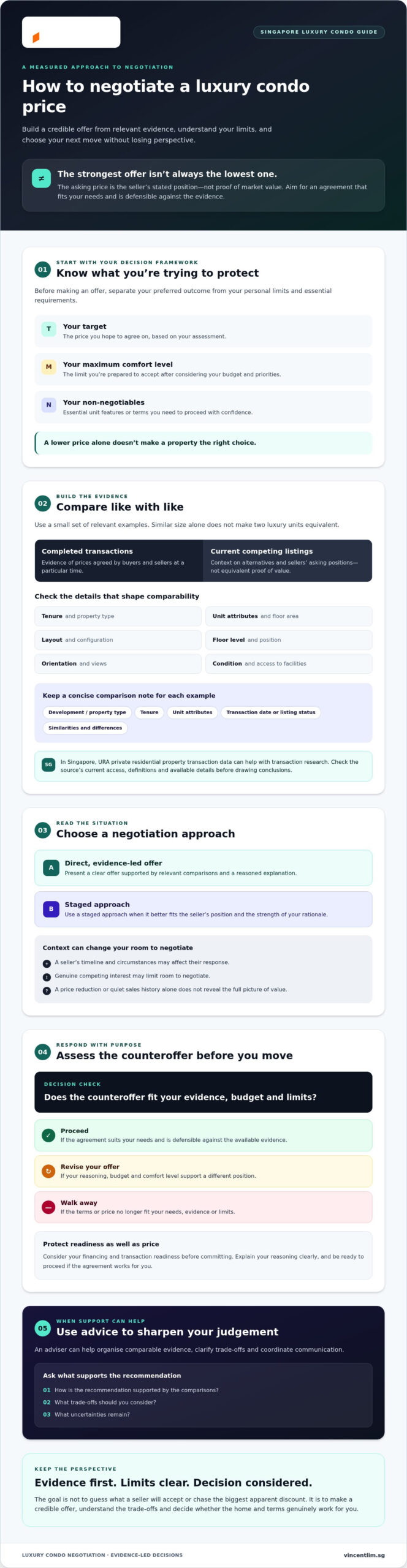
- To understand how to negotiate price for a luxury condo, compare relevant completed transactions and competing listings, prioritising properties with similar tenure and unit attributes.
- Treat the asking price as a starting point. A clear comparison helps distinguish an evidence-based offer from one based on an arbitrary discount.
- Choose between a direct, evidence-led offer and a staged approach based on the seller’s position and the strength of your rationale.
- Assess a counteroffer against your evidence, budget and limits before deciding whether to proceed, revise your offer or walk away.
- An adviser can help organise comparable evidence, clarify trade-offs and coordinate communication. Ask how recommendations are supported and what uncertainties remain.
How to negotiate the price of a luxury condo without losing perspective
Negotiating a luxury condo purchase involves more than seeking the largest possible discount. You want to pay a price supported by evidence without making an unnecessarily aggressive offer that could put a suitable property out of reach. The asking price is the seller’s stated position, not proof of market value. Your task is to assess the available evidence, choose an offer strategy and decide which terms you can accept.
Outcomes depend on the unit, the seller’s circumstances and the level of competing interest. A seller with a firm timeline may respond differently from one who can wait, while genuine competition may limit room to negotiate. These details aren’t always visible in a listing, so don’t treat an asking-price reduction or a quiet sales history as a complete picture of value.
What does a successful luxury-condo negotiation involve?
Success means reaching an informed agreement that suits your needs and is defensible against the evidence, not simply achieving the biggest apparent discount. Before making an offer, separate three things:
- Your target: the price you hope to agree on, based on your assessment.
- Your maximum comfort level: the limit you’re prepared to accept after considering your budget and priorities.
- Your non-negotiables: requirements that matter to your decision, such as essential unit features or terms you need to proceed with confidence.
This distinction helps you respond to a counteroffer without confusing a desirable outcome with a necessary one. A suitable purchase should meet your needs and make sense against the available evidence. If it doesn’t, a lower price alone may not make it the right choice.
Why can luxury-condo asking prices be difficult to interpret?
Luxury units can differ in ways that make headline comparisons unreliable. Layout, floor level, orientation, views, condition and access to facilities can all affect how closely one unit resembles another. Even within the same development, two listings may not be equivalent. A sound valuation process examines these distinctions rather than treating every condo with a similar size as a direct match.
An advertised price shows what a seller is asking. A completed transaction provides evidence of what a buyer and seller agreed to at a particular time. Both can inform your assessment, but neither should be read without context. The broader concept of real estate appraisal helps explain why valuation draws on evidence and relevant property characteristics.
If there are few close comparisons, don’t assume the property is overpriced. Treat the gap as a reason to investigate further: check how the available examples differ, how current they are and whether their features justify a different assessment. This groundwork gives you a clearer basis for deciding how to negotiate price for a luxury condo.
Build a defensible luxury-condo offer from comparable evidence
A well-supported offer starts with a small set of relevant comparisons, not a broad scan of every listing. Bring completed transactions and current competing listings into one working comparison, then assess how closely each matches the condo you’re considering. In Singapore, the Urban Redevelopment Authority’s private residential property transaction data can help buyers review transaction evidence. Check the source’s current access, definitions and available details before drawing conclusions.
Make a concise record for each comparison. Note the development or property type, tenure, unit attributes, transaction date or listing status, and key similarities and differences. Completed transactions show agreed prices. Active listings show alternatives buyers may be considering and the asking positions sellers are testing. Treat active listings as market context, not equivalent proof of value.
Which comparable transactions should buyers examine?
Prioritise evidence that is recent enough to be relevant and similar enough to be informative. A unit in the same development may still differ materially in tenure, floor area, configuration or condition. Broader comparisons can be useful too, but explain why each property belongs in the analysis and where it differs. If a source’s terminology or transaction details are unclear, verify them before using the figure to justify an offer.
A practical comparison note might read: “Similar property type and tenure; transaction completed earlier; different layout and floor level.” That is more useful than presenting a price without context. Realtor.com’s general guide to how to negotiate a real estate deal also discusses offers and counteroffers, though Singapore buyers should base their valuation evidence on relevant local sources.
How should unit-specific features affect the offer?
Review the unit against the evidence. Floor level, orientation, layout, condition and included fittings may distinguish it from a comparable, but don’t assign a premium or discount unless you can support the adjustment. Separate observable differences from personal preferences: a layout you strongly favour matters to your decision, but that preference alone doesn’t establish a higher market value.
Record uncertainty where the evidence can’t reliably show how a feature affects value. This keeps your analysis honest and prevents a subjective impression from being presented as a precise adjustment.
Comparable evidence supports an offer, but it doesn’t dictate one. You still need to weigh the evidence against your priorities, budget and preferred terms. For a transaction-specific perspective on luxury condominium sales, explore luxury condominium guidance.
Choose a negotiation strategy that fits the seller’s position
Once you’ve formed a view of value, decide how to present your offer. A direct, evidence-led offer states your position clearly and explains its basis. A staged offer starts at a considered level while leaving room for a reasoned counteroffer. Neither approach suits every purchase. The choice depends on the strength of your evidence, your willingness to risk rejection and what you can learn about the seller’s priorities.
Negotiating isn’t inherently reckless. A credible offer, supported by a clear rationale and realistic preparation, gives the seller something specific to consider. By contrast, a low opening offer without a persuasive basis can appear arbitrary and prompt the seller to decline rather than engage. Don’t choose a figure simply because you expect to be countered. Decide what you can support and what response you’re prepared to accept.
When is a firmer opening offer appropriate?
A firmer position may make sense when your comparison evidence supports it and you’re comfortable with the possibility that the seller won’t counter. Establish what you know rather than what you suspect. Through appropriate enquiries, clarify whether the seller has indicated a preferred timeline or terms, and whether there is confirmed competing interest. Don’t infer urgency from a listing’s age or assume a seller will accept less. No percentage rule can replace property-specific evidence and a considered assessment of risk.
When should buyers prioritise certainty over a lower offer?
Price is only one part of an offer’s appeal. Consider whether your financing arrangements are sufficiently clear, whether everyone involved in your decision can act promptly, and whether your proposed completion plan is realistic. These are preparation points, not promises. Describe your position accurately and confirm any conditions or timelines before presenting them. A lower offer may not serve you better if it includes terms you can’t confidently meet.
Explore seller priorities respectfully rather than treating them as leverage to exploit. If a seller values a particular timeline, for example, consider whether you can accommodate it without compromising your own requirements. If you’re assessing a wider move from a condominium to landed property, the guide to asset progression to landed property may help frame that broader decision. For a focused purchase, keep your strategy tied to the unit, your evidence and the terms you’re genuinely prepared to accept. That’s a disciplined way to approach how to negotiate price for a luxury condo without relying on assumptions about the seller’s response.
Present the offer, assess counteroffers and protect your decision
A disciplined offer process helps keep the discussion clear, even when the seller responds differently than you hoped. Confirm you’re ready to proceed, submit an offer with a concise rationale, assess the seller’s response against your limits, then accept, counter or withdraw. Keep your evidence and priorities in view rather than making a rushed decision under pressure.
Price, timing and other terms can interact. A seller may value a realistic timeline, while a buyer may need conditions that allow time to confirm important details. Consider the whole proposal, not just its headline figure. Understand all material terms before making a commitment.
What should a buyer clarify before submitting an offer?
Before communicating an offer, make sure the relevant decision-makers agree on the intended price range and purchase conditions. Review your financing position with the appropriate provider, establish a realistic timeline and identify any conditions you need to proceed with confidence. Be precise about what you can confirm and what remains subject to verification.
Separate negotiable preferences from matters that require professional or legal advice. In Singapore, confirm the current Option to Purchase process, terminology and implications with authoritative sources and an appropriate legal professional before acting. Don’t rely on an informal summary to interpret a formal document.
How should buyers respond to a counteroffer?
Pause and compare the seller’s revised position with your comparable evidence, budget and stated limits. A counteroffer can be an invitation to continue, not an instruction to accept quickly. Consider whether the price is defensible, whether the proposed timing is workable and whether any revised terms change the overall commitment.
You can accept, make a reasoned counterproposal or withdraw. If you counter, explain the basis briefly and be clear about which terms you’re changing. Keep a written record of the points discussed and agreed, and seek professional advice before signing or relying on formal documents. This creates a clear record and helps prevent a verbal understanding from being mistaken for a final agreement.
This deliberate process is central to how to negotiate price for a luxury condo without losing sight of your limits. For information about luxury condominium sales and the proposed terms of a purchase, explore luxury condominium guidance.
When expert negotiation support can improve a luxury-condo purchase
An adviser can bring structure to a negotiation by organising comparable evidence, clarifying trade-offs and coordinating communication around your priorities. This can be useful when listings are difficult to compare or a counteroffer changes more than the price. The value lies in making the reasoning visible, so you can judge the recommendation rather than rely on confidence alone.
Vincent Lim advises on luxury condominium sales in Singapore. A property professional can help review relevant evidence, prepare an offer position, assess a counteroffer and coordinate communication. Ask how each recommendation is supported, which assumptions it depends on and what uncertainties remain. A clear explanation should set out practical next steps without implying that a particular price or outcome is assured.
What should buyers expect from a property negotiation adviser?
Expect guidance focused on the property transaction: comparing available market evidence, considering how price and terms interact, and helping you communicate your position clearly. Ask the adviser to distinguish verified information from estimates and to explain the limits of the comparison. Property agency advice isn’t a substitute for legal, tax or financing advice. Consult the appropriate professional for questions in those areas, including the interpretation of formal documents.
How can buyers prepare for a tailored discussion?
A focused conversation is more useful when you arrive with the essentials. Gather the listing details, any comparable evidence you’ve collected and questions about the unit or proposed terms. Then clarify what matters most, your intended timing and the boundaries you’re not prepared to cross. You don’t need to settle on a final offer beforehand. A clear view of your priorities helps make the discussion more productive.
If you’re considering discussing a luxury-condo purchase with Vincent Lim, bring those details and ask how the suggested position follows from the evidence. Understanding the reasoning, trade-offs and remaining uncertainties can help you decide whether to proceed, adjust your approach or pause. That is a measured way to apply what you’ve learned about how to negotiate price for a luxury condo while keeping the decision aligned with your needs.
Make your next offer with clarity
A considered luxury-condo offer rests on relevant transaction evidence, a clear understanding of your priorities and a negotiation strategy that reflects the seller’s position. Asking prices provide context, while completed transactions and unit-specific differences help you assess value. Weigh price alongside timing and other terms, and stay within the limits you set before negotiations begin.
Knowing how to negotiate price for a luxury condo isn’t about pursuing the largest discount at any cost. It’s about making a credible offer, evaluating a counteroffer calmly and being prepared to proceed, revise your position or walk away. The right decision is one you can support with evidence and feel comfortable carrying through.
Vincent Lim is a real estate professional at OrangeTee & Tie who advises on luxury condominium sales in Singapore. He has been active in the Singapore real estate industry since approximately 2004. To discuss your luxury condominium requirements and transaction, contact Vincent Lim.
Frequently Asked Questions
How do you negotiate the price of a luxury condo?
Start by assessing the unit against relevant completed transactions, then decide your target, maximum comfort level and essential terms before making an offer. Explain how your proposed price relates to the evidence, and consider the seller’s response calmly. The best approach to how to negotiate price for a luxury condo depends on the property: a distinctive unit, seller priorities and confirmed competing interest can all affect the discussion.
How much below the asking price should I offer for a luxury condo?
There’s no reliable percentage that suits every luxury condo. The asking price is a reference point, not proof of market value, so base your offer on comparable completed transactions, unit-specific differences and your own limits. A substantial reduction without clear support may be dismissed, while a well-reasoned offer gives the seller a basis to respond. Decide in advance what counteroffer you would consider and when you would walk away.
Can I negotiate the terms as well as the price?
Yes, you can discuss terms as well as price, provided both parties agree. Timing, proposed completion arrangements and other conditions may influence how a seller evaluates an offer. First identify which terms matter to you and which are flexible. Check current Singapore transaction procedures and obtain appropriate professional advice before committing to formal terms, particularly if you’re unsure about a document’s effect or the obligations it sets out.
What evidence should I use when negotiating a condo price?
Use completed transactions for condos with meaningfully similar tenure, property type and unit attributes, and note how recently each transaction occurred. Singapore buyers can consult Urban Redevelopment Authority transaction data where applicable, checking current access and terminology. Compare floor level, layout, condition and other relevant features, and explain material differences. Current competing listings can show asking positions, but they aren’t equivalent to evidence of completed sale prices.
Should I make a low offer on a luxury condo?
Only make a low offer if you can support it with relevant evidence and accept the possibility of rejection. A low figure chosen simply to leave room for bargaining may weaken your credibility, especially if the seller sees no clear rationale. Consider the unit’s comparable transactions, your interest in the property and your maximum comfort level. A measured opening position is more useful than an arbitrary discount.
How should I respond if the seller rejects my offer?
Take a moment to review the rejection against your evidence and limits rather than increasing your offer automatically. If appropriate, ask through the relevant agent whether the seller is open to a revised proposal or has clarified their priorities. You can make a reasoned counteroffer, hold your position or withdraw. Keep a written record of the discussion, and seek appropriate professional advice before signing or relying on formal documents.
Should I use a property agent to negotiate a luxury condo purchase?
A property professional may help organise comparable evidence, clarify price and term trade-offs, assess a counteroffer and coordinate communication. Before proceeding, ask what role the professional will take, how recommendations are supported and what uncertainties remain. Confirm the scope of representation and any relevant arrangements directly. An agent’s property guidance doesn’t replace legal, tax or financing advice, so consult the appropriate professional for those matters.