A deferred payment scheme for a luxury condo can postpone a substantial part of the payment, but it doesn’t necessarily reduce the purchase cost. In Singapore, such schemes are allowed only for completed units issued with a Certificate of Statutory Completion, and condo prices are often about 10% higher when buyers use deferred payment. The decision is therefore a trade-off between payment timing and the total price.
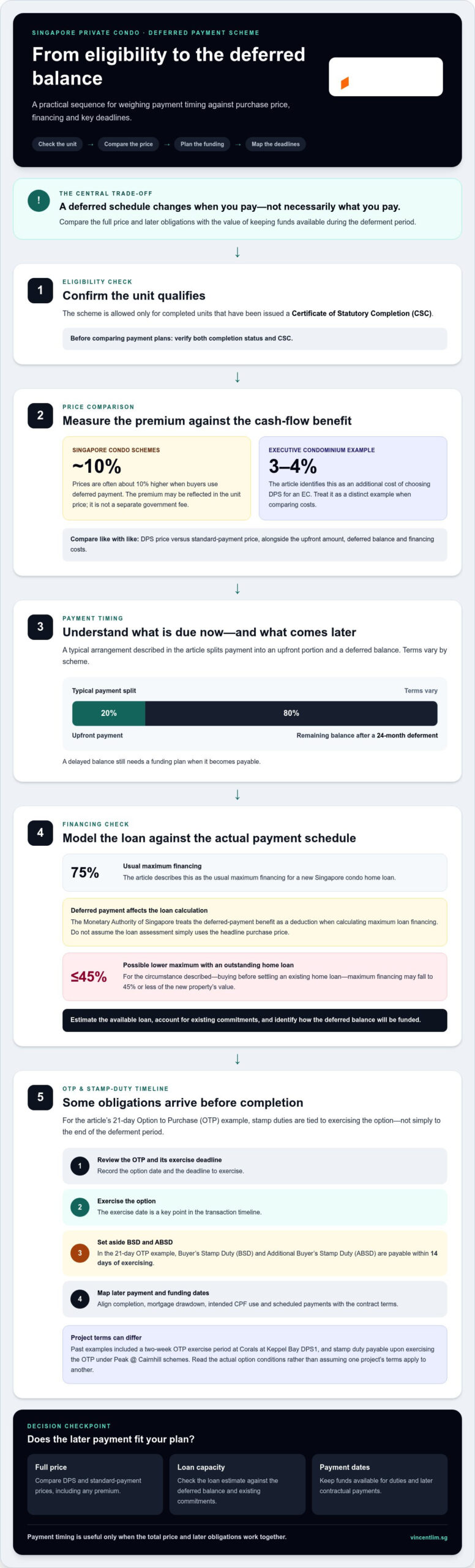
That trade-off can be useful if keeping funds available during the deferment period is important, but the higher price and later financing obligations need to fit your plans. In a typical arrangement, a buyer pays 20% upfront and the remaining 80% after a 24-month deferment, though terms vary by scheme.
This guide explains how payment options and eligibility work, what a price premium can mean in practice, and which Option to Purchase terms affect stamp duty timing. It also covers additional costs to consider, helping you assess the scheme against your budget and financing before deciding whether it suits your condo purchase.
Key Takeaways
- Assess the scheme’s full price against the benefit of delaying payments, rather than focusing on cash flow alone.
- For an OTP with a 21-day exercise date, BSD and ABSD are payable within 14 days of exercising the option.
- For an Executive Condominium, the Deferred Payment Scheme can add 3-4% of the purchase price, so include this in your cost comparison.
- The Monetary Authority of Singapore treats the deferred-payment benefit as a deduction when calculating maximum loan financing, which can affect your borrowing plan.
- Separate general scheme terms from development-specific terms: an EC example has a 5% cash booking payment, while individual OTP and deposit arrangements can differ.
2. DPS price markups and eligibility
What are the rules and restrictions for using DPS to buy a Singapore private condo? The scheme is allowed only for completed units issued with a Certificate of Statutory Completion (CSC). Assess the agreed purchase price and your financing position too: deferred payment changes the timing, not the need to fund the purchase.
Price is a central part of that assessment. Singapore condo prices are often about 10% higher when a buyer uses a deferred payment scheme. This premium is not a separate government fee. It may be reflected in the unit’s purchase price, so compare the DPS price with the price under the standard payment arrangement before weighing the cash-flow benefit.
That difference can outweigh the benefit of postponing payments, particularly if you do not need extra time to arrange funds. Compare the total price, upfront payment, deferred balance and financing costs together. Looking only at the initial amount due can make a higher-priced option seem more affordable than it is.
Financing also affects practical eligibility. The usual maximum financing for a new Singapore condo home loan is 75% of the property price. However, the Monetary Authority of Singapore treats the deferred-payment benefit as a deduction from the purchase price when calculating maximum loan financing. The loan assessment therefore may not simply use the headline purchase price.
An outstanding home loan can further reduce borrowing capacity. Under the circumstances described for a buyer purchasing before settling an existing home loan, maximum financing may fall to 45% or less of the new property’s value. That changes the cash or other funds needed to complete the purchase. Buyers should model the expected loan amount against the full payment schedule, rather than assuming that deferred instalments will be fully covered by borrowing.
Use these checks to compare an eligible unit with a standard-payment alternative:
- Confirm that the unit is completed and has its CSC.
- Compare the total DPS and standard-scheme prices, including any premium.
- Estimate the available loan using the deferred-payment benefit and existing loan commitments.
- Plan how to fund the deferred balance when it becomes payable.
A deferred payment scheme may suit you if delayed payments are valuable and you can meet the later obligations. Your decision depends on the price premium, loan capacity and funds available at each payment stage.
3. Option to Purchase terms and stamp duty timing
For a 21-day Option to Purchase (OTP), stamp duties such as Buyer’s Stamp Duty (BSD) and Additional Buyer’s Stamp Duty (ABSD) must be paid within 14 days of exercising the option. Mortgage funding and CPF use should be planned against the contract’s payment dates; a deferred schedule does not, by itself, set their timing.
The OTP’s exercise date is central to the transaction. It marks when you commit to proceed under the option’s terms. A deferred completion arrangement may extend the period before ownership transfers, but it does not mean every obligation waits until completion. Read the OTP alongside the sale documents and note each deadline before exercising.
For example, a 24-month exercise date is described as a case where the buyer is not yet the owner during the deferment period. That distinction matters when planning the period between securing the property and completing the purchase. Record the option date, exercise deadline, completion date and scheduled payment dates together. This timeline helps clarify which commitments arise at each stage.
Stamp duty timing depends on the OTP terms. In the 21-day exercise-date example, BSD and ABSD fall due within 14 days after exercise. The payment date is therefore tied to exercising the option, not simply to the end of the deferment period. Keep the duty amount available on that schedule, separately from funds reserved for later completion or loan payments.
Past schemes illustrate how terms can differ. Under Corals at Keppel Bay DPS1, buyers had to exercise the OTP within two weeks. Under the Peak @ Cairnhill schemes, stamp duty could be paid upon exercising the OTP. These examples show why a buyer should read the actual option conditions rather than assume one project’s arrangements apply elsewhere.
A historical transitional rule also demonstrates the importance of exact dates. For residential properties with an OTP granted on or before July 5, 2018, the former ABSD rates could be preserved if the buyer exercised before July 26, 2018. Those dates relate to that transitional remission, not to current purchases.
Before exercising, organise the key dates and funding sources:
- Mark the OTP date and the deadline for exercising.
- Identify when BSD and ABSD are due under the applicable terms.
- Map mortgage drawdown and intended CPF use against each contractual payment.
- Separate funds needed at option exercise from funds required later.
This sequence makes the cash-flow commitment clearer, especially when the purchase and completion dates are separated. A careful review of Singapore property purchase planning can help place the OTP, duties and funding milestones in one coherent timeline.
4. Additional cost of deferred payment
What are the risks of deferred payment schemes, including financing and resale risks? For a Singapore Executive Condominium, choosing DPS incurs an additional cost of 3-4% of the purchase price. Financing risk arises if the eventual loan is lower than expected, while resale proceeds may not cover the outstanding amount and transaction costs.
That 3-4% figure applies to Executive Condominiums, not automatically to every private luxury condo. Treat the applicable purchase price and payment terms as the starting point for comparing schemes. The key question is whether the payment delay is worth its additional cost in your own transaction.
This calculation makes it easier to compare the premium with the practical value of retaining funds during the deferment period. Consider it alongside the total purchase price, financing plan and funds needed later, rather than as an isolated percentage.
Financing can create a separate pressure point. The deferred balance remains payable on the agreed schedule, even if your cash position or borrowing capacity changes. A loan shortfall may leave you needing additional funds at completion. Build your funding plan around the amount due later, rather than treating deferment as a reduction in what you owe.
Resale adds another layer of uncertainty. Whether you sell before or after completing the deferred payments, assess the sale proceeds against the remaining loan and other transaction obligations. If the resale price is too low to settle those commitments, your expected equity may be reduced or eliminated. The purchase premium matters too: a later sale may not recover the extra amount paid for the scheme.
Compare the cost and risks in a consistent way:
- Calculate the EC-specific 3-4% additional cost against the purchase price.
- Set aside funds for the deferred amount and related payment obligations.
- Test whether available financing can cover the planned borrowing, including any shortfall.
- Assess a possible resale against outstanding debt and the premium already paid.
A DPS may suit you if delaying payments has meaningful value and you can meet the later obligations. It is less compelling if the extra cost outweighs that benefit or your plan depends on uncertain borrowing or resale proceeds. Compare total cost and payment dates before committing, and align your financing and resale scenarios with the purchase terms.
5. How Singapore condo deferred payment schemes work
Singapore DPS is permitted only for completed units issued with a Certificate of Statutory Completion (CSC). Corals at Keppel Bay and The Peak @ Cairnhill are examples of developments with past DPS arrangements, not a current availability list.
Since 2007, Singapore has allowed DPS only for completed properties. The completion definition includes receiving both the Temporary Occupation Permit (TOP) and CSC. This requirement separates DPS from progressive payments, where buyers pay instalments as construction reaches milestones. A scheme’s name alone doesn’t establish eligibility; the unit’s completion status matters.
For a condo arrangement described in the market, the buyer pays 20% before moving in, then pays the remaining 80% after a 24-month deferment. Some schemes use a 12-month or 36-month deferment instead. Other arrangements may require an initial 20% to 30%, with loan repayments deferred for 2 to 3 years. These are different structures, so compare the payment stages and dates in the specific terms.
Executive Condominiums have a more detailed example. Under an EC DPS, buyers pay 15% in cash or CPF upon signing the Sale and Purchase Agreement, or within 8 weeks from the Option Date. Another 65% is payable when the property obtains TOP, followed by 15% when it obtains CSC. The remaining balance and loan arrangements must be understood alongside those milestones.
Compare that schedule with an EC Progressive Payment Scheme. Buyers pay 5% in cash when booking, then 15% in cash or CPF upon signing the Sale and Purchase Agreement or within 8 weeks from the Option Date. Later payments are tied to construction progress, including foundation work, partition walls and TOP. DPS therefore shifts when major payments fall due; it doesn’t remove the obligation to pay them.
To understand a specific offer, map the documents and milestones in order:
- Confirm that the unit is completed and has its CSC.
- Record the booking, Option Date and Sale and Purchase Agreement payment deadlines.
- List amounts due at TOP, CSC or after the stated deferment period.
- Match each payment date with the intended cash, CPF or loan funds.
The practical takeaway is to compare the full schedule, not simply the initial amount. Corals at Keppel Bay DPS1 deferred the remaining 80% for two years, while The Peak @ Cairnhill schemes used different deferment terms. A deferred payment scheme for a luxury condo should therefore be assessed through its unit eligibility, payment milestones and exact contractual dates.
5. What is the typical booking fee and down payment for a luxury condo under DPS in Singapore?
There isn’t one booking percentage that applies to every Singapore condo DPS. A Singapore Executive Condominium (EC) under DPS requires a 5% cash booking payment, while past private-condo examples used different booking and deposit terms. Treat each figure as scheme-specific, not as a universal luxury-condo rule.
This example helps translate the percentage into an initial cash commitment. It does not represent the booking amount for every private condo or deferred-payment arrangement.
Corals at Keppel Bay shows why the development’s terms matter. Under DPS1, buyers paid a 1% booking fee and had to exercise the Option to Purchase within two weeks. Under DPS2, buyers paid a 9% remaining deposit to exercise the option. These are distinct scheme terms, not amounts to add together as one standard deposit.
The booking fee is only one stage of the purchase. Read the Option to Purchase and sale documents to identify the amount due at booking, the deposit required to exercise the option, and later payment deadlines. A lower initial percentage may still be followed by a substantial deposit or deferred balance. Plan for each stage separately.
For an EC, the subsequent payment terms also specify 15% in cash or CPF upon signing the Sale and Purchase Agreement, or within 8 weeks from the Option Date. That amount is separate from the 5% cash booking payment. Keep the booking amount, later deposit and scheduled payments distinct when calculating funds required at each milestone.
Before committing, organise the figures in a simple payment schedule:
- Record the booking percentage and whether it must be paid in cash.
- Identify the deposit needed to exercise the Option to Purchase.
- Note the deadline linked to the Option Date or Sale and Purchase Agreement.
- Set out the later amounts due under the specific scheme.
This breakdown prevents a booking percentage from being mistaken for the full upfront commitment. Compare the exact documents for the property with your available cash, CPF and planned financing. To discuss the purchase considerations involved in luxury condominium sales, arrange a conversation with Vincent Lim (OrangeTee & Tie).
Vincent Lim (OrangeTee & Tie): Terrace House Sales
Vincent Lim (OrangeTee & Tie) provides Luxury Condominium Sales for buyers considering a Singapore condo purchase. Once you have compared DPS eligibility, payment milestones and total cost, he can help you assess the property against your wider plans.
If your plans also involve selling or considering another type of home, Vincent Lim handles Terrace House Sales, Semi-Detached House Sales, Detached house, and Good Class Bungalow (GCB) Sales. These services are relevant when your property plans extend beyond a condominium to include a landed home.
For a considered discussion about your property plans, contact Vincent Lim (OrangeTee & Tie) or visit vincentlim.sg.
Make your next property decision with a clear plan
A property purchase is part of a wider financial and lifestyle decision. Before committing to a deferred payment scheme for a luxury condo, consider how it fits your longer-term plans, including whether you may sell or change property types later. Clarity on those priorities can help you identify which questions to resolve before signing.
Vincent Lim (OrangeTee & Tie) provides Luxury Condominium Sales, alongside Terrace House Sales, Semi-Detached House Sales and Detached house sales. This broader property perspective may help if your plans involve comparing a condominium with a landed home or coordinating a future sale.
For a considered discussion of your property plans, contact Vincent Lim (OrangeTee & Tie). Take the next step with a clear understanding of the options in front of you.
Frequently Asked Questions
Should You Take Up A Deferred Payment Scheme When Buying A Condo?
Consider DPS if the timing of payments has real value to you and you can fund the later balance. Compare the purchase price, expected borrowing and payment dates against a standard schedule. DPS may come with a higher purchase price, so weigh any price premium against the value of delaying payments for your circumstances. It may be less suitable if your plan depends on borrowing more than you can secure.
So, what’s DPS?
DPS means Deferred Payment Scheme. It changes when a buyer pays parts of a property’s purchase price, rather than removing those obligations. For example, one Singapore condo arrangement lets a buyer pay 20% before moving in and the remaining 80% after a deferment period. The contract sets the actual milestones and deadlines, so the name alone doesn’t tell you the full payment schedule.
What is a deferred payment scheme (DPS) for a luxury condo in Singapore?
It is a payment arrangement for an eligible completed property that postpones part of the purchase payment. Singapore allows DPS only for completed units issued with a Certificate of Statutory Completion. For buyers considering a deferred payment scheme for a luxury condo, the key distinction is between delayed payment and reduced cost: you still need a plan for the full contractual amount and financing.
How does the Singapore condo deferred payment scheme work, and when are payments due?
The buyer pays an initial portion, then pays the balance according to the development’s terms. One common example uses 20% upfront and defers the remaining 80% for 24 months. Other arrangements may use a 12-month or 36-month deferment. The contract identifies the dates and milestones that trigger payment, so map those against your cash, CPF and expected loan funds before committing.
How much does a deferred payment scheme cost compared with the normal progressive payment scheme?
There’s no single cost comparison for every Singapore condo. For an Executive Condominium, DPS incurs an additional cost of 3-4% of the purchase price. Condo prices are also often about 10% higher with DPS, but that broader figure shouldn’t be treated as the EC-specific additional cost. Compare the actual purchase prices and payment schedules for the property, rather than adding these percentages together.
Who is eligible for a deferred payment scheme for a Singapore condo?
The property must meet the completion condition: Singapore DPS is allowed only for completed units issued with a Certificate of Statutory Completion. Your financing capacity matters too, because deferred payments remain payable under the purchase terms. For example, an existing home loan can reduce the maximum financing available for a new property in the circumstances described. Assess the unit’s eligibility and your funding plan separately.
What are the pros and cons of DPS for luxury condo buyers and investors?
DPS can postpone large payments, which may help you manage the timing of funds. The trade-offs include a possible price premium and a substantial balance due later. Investors should also distinguish rental income from profit. That example illustrates gross rent, not a guaranteed return or net income.
What steps are involved in buying a luxury condo in Singapore using a deferred payment scheme?
First, confirm the unit is completed and has its Certificate of Statutory Completion. Next, compare the DPS purchase price with the standard-payment option and review the Option to Purchase deadlines. Then map stamp duty, booking payments, CPF use and loan funding to their due dates. Finally, record every deferred payment milestone and make sure your plan covers the balance when it becomes payable.