The branded-residence sector has grown 180% over the last decade. These homes combine private ownership with a hotel or lifestyle brand’s identity and, in some developments, hospitality services. For Singapore investors, the investment potential of branded residences depends not only on that appeal, but also on the purchase premium, ongoing fees and the terms of any rental programme.
Developers are drawn to branded residences because a recognised name can distinguish a project and attract buyers seeking a particular standard of service. But a strong brand alone does not establish value. The premium should make sense against comparable homes, while recurring costs can affect ownership expenses and net rental income.
This article explains why developers pursue branded residences and how to assess their investment potential in Singapore. It covers premiums, management fees, rental arrangements and key risks, helping you weigh a branded home’s appeal against the obligations that come with it.
Key Takeaways
- Branded residences are expanding globally, but headline growth alone doesn’t establish whether a particular property is soundly priced.
- Review the brand-management agreement’s duration, responsibilities and exit provisions to understand the obligations that may continue after purchase.
- Assess rental programmes by looking beyond projected income: management deductions and operating terms shape what owners may actually receive.
- Compare hotel-branded and non-hotel residences based on the services, management structure and ownership experience each provides.
- Use comparable non-branded homes to judge whether a branded-property premium is supported by its location, service offer and resale prospects.
What are Branded Residences, and Why are They Becoming Popular Among Developers?
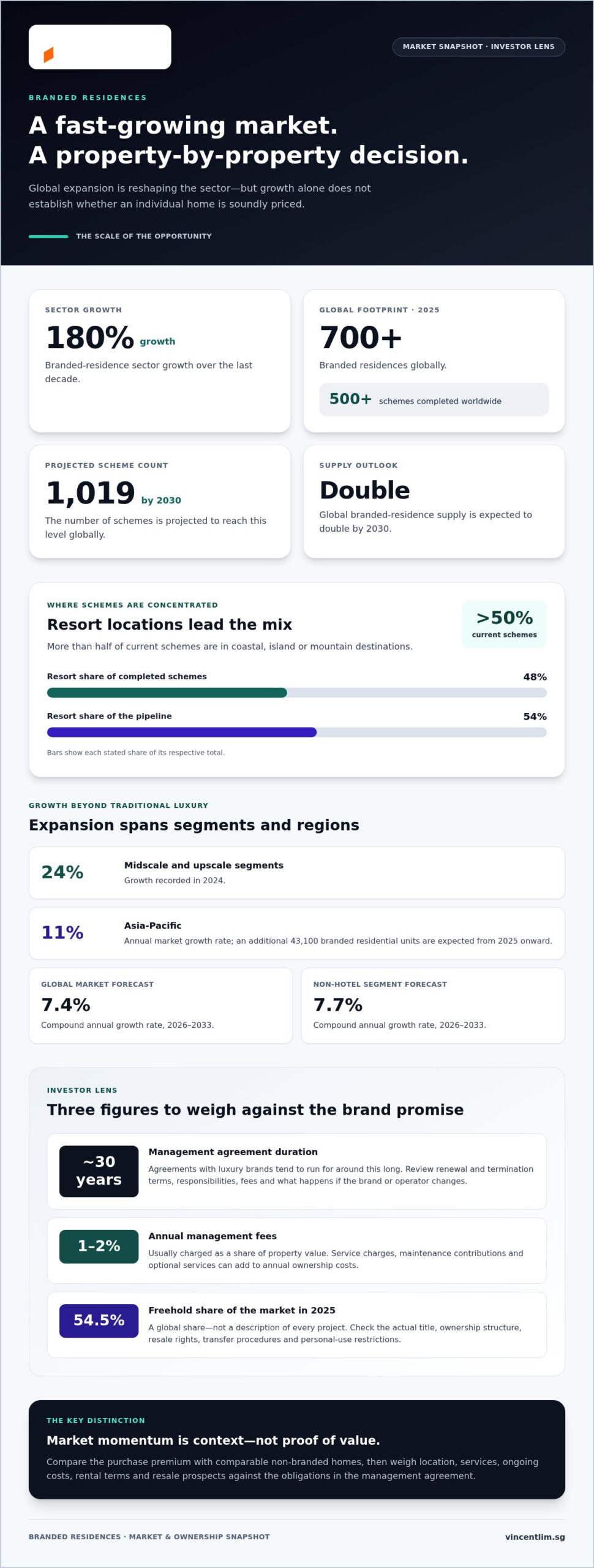
A branded residence pairs private home ownership with an established hotel or lifestyle brand. Depending on the project, that identity can shape design, management and resident services. The sector grew 180% over the last decade, turning a specialised property format into a global development strategy. For developers, the model offers a way to distinguish a project and attract buyers who value a recognised service standard. For investors, the investment potential of branded residences depends on whether those advantages justify the price and ongoing obligations.
The global market’s scale is visible in its project pipeline. There were over 700 branded residences globally in 2025, while more than 500 schemes had been completed worldwide. The number of schemes is projected to reach 1,019 by 2030. These figures point to continuing development, but a rising supply also gives buyers more choice. A growing market alone does not show whether a particular home is competitively priced or suited to its location.
Forecasts indicate further expansion, though their measures differ. Global branded-residence supply is expected to double by 2030. Separately, the market is forecast to grow at a 7.4% compound annual growth rate from 2026 to 2033. For developers, these projections support planning around continued demand. For buyers, they make project-level scrutiny more important: future supply can affect competition, while a brand’s appeal must remain relevant throughout ownership.
Resort and coastal locations form a substantial part of that development story. More than half of current branded-residence schemes are in coastal, island or mountain destinations. Resort projects account for 48% of completed schemes and 54% of the pipeline. This concentration reflects how a residence can combine private ownership with hospitality, wellness and services suited to stays across seasons. It also means that location-specific demand and the project’s operating model matter alongside the brand.
Growth is extending beyond traditional luxury and hotel-led formats. Midscale and upscale branded-residence segments grew by 24% in 2024. In Asia-Pacific, the market recorded an annual growth rate of 11%, with an additional 43,100 branded residential units expected from 2025 onward. This regional expansion matters to Singapore buyers assessing a wider range of projects, but regional momentum is not a substitute for evaluating an individual property.
Non-hotel concepts are also gaining ground. The non-hotel branded-residences segment is projected to grow at a 7.7% compound annual growth rate from 2026 to 2033. Lifestyle brands can appeal through design, wellness or service identity rather than hotel operations. Developers can use this broader model to reach buyers with different priorities. Investors should distinguish the brand promise from what the residence’s actual management and services deliver.
How can I manage the risks and stay ahead of trends as a new investor in this sector?
Start with the ownership and management documents, not the brand’s marketing. Management agreements with luxury brands tend to run for around 30 years. That duration can outlast an owner’s plans, a brand’s market appeal or a property’s first resale. Read the agreement for renewal and termination terms, service standards, owner obligations and fees. Also establish what happens if the brand or operator changes. These details shape long-term control and the property’s continued association with the brand.
Budget for recurring costs as well as the purchase price. Branded residences usually have annual management fees of roughly 1-2% of the property’s value. Service charges, maintenance contributions and optional services can add to the yearly ownership burden. Identify which charges are fixed, which can change, and how owners approve budgets. Then compare the total cost with the services and management actually provided. A prestigious offering creates value only if its costs suit your intended use and holding period.
In Singapore, foreign-buyer eligibility, taxes and financing limits depend on the purchaser’s status and the property type. These factors affect whether a purchase is permitted, its transaction costs and the borrowing available. Assess them alongside the title and ownership structure before comparing developments.
Ownership models also differ across markets. Freehold branded residences accounted for 54.5% of the market in 2025, but that global share does not describe every project or jurisdiction. Establish whether the title grants freehold ownership, a leasehold interest or another arrangement. Then examine resale rights, transfer procedures and restrictions on personal use. Contract terms determine the practical level of exclusivity and control, not the brand name alone.
Bali illustrates why location-specific ownership structures matter. Depending on the project, foreign buyers may hold branded residences through leasehold, PT PMA, Hak Pakai or fractional ownership arrangements. These structures do not provide identical rights. Review the holding structure, duration, transfer conditions and permitted use before treating a Bali property as a straightforward freehold purchase. Legal and commercial terms influence both exit options and how owners can use the residence.
Rental rules deserve equal attention, even if income is not your main goal. Some developments require owners to join a designated rental programme or limit occupancy and personal stays. Others leave day-to-day decisions to the operator. Read the rental agreement alongside the purchase documents, focusing on owner-use periods, participation terms, deductions, maintenance responsibilities and withdrawal conditions. These provisions show how much control you retain.
Before committing, compare the title, management agreement, annual costs, rental conditions and resale provisions. This consistent review helps distinguish an appealing brand identity from durable ownership rights, especially when comparing properties across countries and legal systems.
Brand-management fees and rental programmes
In Singapore, branded residences have no single purchase price or rental yield. Value depends on location, tenure, unit features and the brand agreement. Rental returns depend on achieved rents, occupancy, operating expenses and management deductions. Assess projected income against the full cost structure instead of treating a brand name as a yield indicator.
A rental programme can simplify hospitality operations by placing marketing, bookings and guest services under professional management. In return, the operator’s deductions reduce the income owners retain. Rental-pool management fees may take 25-50% of a branded residence’s rental revenue. Compare the fee base with the services included, then clarify how costs, booking revenue and vacant periods are allocated among participating owners.
Brand and operator charges can sit alongside rental-pool deductions. Brands may receive management fees of 2-3% of property value and rental income when a property has a rental programme. Luxury hotel brands charge license fees of 3.5% to 6%. These structures may overlap or apply differently, so map every charge to its recipient and calculation basis. The real estate’s hospitality appeal must be weighed against the resulting net income.
Rental programme participation is not universal. More than one third of Marriott residential projects offer a programme, illustrating that arrangements vary even within one major hotel group. A programme’s presence does not establish likely occupancy or earnings. Review how owners join or leave, when they can use their homes, how bookings are allocated and whether operating costs are deducted before distributions.
Tourism demand can support rental prospects, but income depends on more than visitor numbers. Seasonality, local competition, property condition, service quality and the economic environment influence achieved rates and occupancy. Global hotel stays in 2022 were 14% below their 2019 total, while global hotel demand was forecast to be 31% above its 2019 level by 2027. Those global figures show how travel conditions can shift; they are not Singapore yield forecasts.
For a practical comparison, calculate gross rental income, subtract programme deductions and recurring operating expenses, then compare the net amount with total ownership costs. Consider both high-occupancy periods and quieter seasons. Confirm whether the programme allows personal stays and whether those stays reduce earning days. This helps show whether rental income supports the property’s appeal or relies on assumptions that weaken its investment case.
There is no single purchase price or rental yield for branded residences in Singapore. Prices vary by location, tenure and unit features, while rental returns depend on achieved rents, occupancy, operating expenses and management deductions. Assess projected net income against total ownership costs.
Pros and Cons of Buying a Branded Residence: Is It Worth the Premium?
Compared with other Singapore luxury properties, a branded residence adds a brand identity and may include hospitality services. A non-branded luxury home may offer more independence from brand management. The trade-off involves service and lifestyle benefits, ongoing obligations and the capital required for the property.
Singapore examples include W Residences Singapore – Sentosa Cove and The St. Regis Residences Singapore, which link residential offerings with international hotel brands. Compare the specific services and ownership terms attached to each development rather than assuming every brand provides the same experience.
Hotel brands remain central to the sector. Hotel brands are a prominent part of the branded-residence sector, although their market presence and revenue share can vary. Their appeal often rests on an established hospitality identity and services such as concierge support. Branded residences typically offer five-star hospitality alongside private ownership, but the precise amenities and service arrangements differ by project.
That distinction matters in Singapore’s luxury market. A buyer who values staffed services may prefer hotel-linked management, while someone prioritising private use may favour a conventional luxury condominium. Hotel-style amenities can add convenience and appeal, but they also bring management arrangements and recurring obligations. Assess whether the services suit your lifestyle, not just the brand’s reputation.
Hotel affiliation is not the only route. About 25% of Marriott’s upcoming branded-residence developments are standalone, showing that a residence need not share a hotel building. Standalone projects can still draw on a hotel brand’s standards, while their day-to-day setting may differ from a hotel environment. Buyers should examine which facilities are on site and what services the operator actually provides.
Competition is also widening beyond hospitality. Non-hospitality lifestyle brands are expected to reach a 21% share of the global branded-residence sector soon. This expansion gives developers more ways to differentiate projects and offers buyers alternatives built around design or lifestyle identity. A strong name, however, is valuable only if the development translates it into a coherent residential experience.
For investors, the key comparison is not simply branded versus unbranded. Assess the home’s location, layout, management arrangements, included amenities and total ownership costs. Then consider how much you would use the services and whether the brand supports your holding strategy. This review helps determine whether the additional capital buys practical value or mainly a prestigious association.
Price premiums over non-branded luxury homes
A branded residence may cost 25-35% more than a comparable non-branded luxury property. The global average premium is 33%, but location changes the comparison: emerging cities average 47%, resort destinations 34%, and global cities 27%. These differences show why a global benchmark cannot determine whether a Singapore home is fairly priced. Compare properties with similar locations, size, tenure, condition and facilities before attributing the gap to branding.
Singapore buyers should distinguish a brand premium from other features that affect value. A prime address, construction quality, views, layouts and included amenities can all influence pricing. Compare a branded home with nearby luxury condominiums that have similar fundamentals, then identify what the brand adds in measurable services or management. This makes the premium easier to assess than relying on reputation or launch materials alone.
Premiums can be higher in some markets. Select branded residences in Dubai have recorded premiums of up to 90%, while global branded homes have reportedly achieved resale values 25-40% higher than comparable properties. These figures describe reported outcomes, not a guaranteed resale result for a Singapore property. The purchase premium also raises the amount an owner must recover before a sale produces a comparable return.
Resale prospects depend on whether future buyers value the brand, location and services together. Brand recognition can support buyer interest, but management quality, property upkeep and the remaining term of the brand agreement also shape the offer. For a long-term holding plan, check whether the brand association continues through resale and whether obligations transfer to the next owner. The contract and the property’s condition can matter as much as branding trends.
Downturn performance offers another perspective, though it should not be confused with protection from market risk. Savills research reports that branded residences remain 15% more resilient during market downturns. During the COVID-19 pandemic, branded homes reportedly lost approximately 5% of their value, compared with approximately 10% for non-branded luxury properties. Those observations offer historical context; they do not establish how a particular Singapore property will perform in a future cycle.
Before committing, compare the purchase premium, ongoing management costs, resale evidence and the home’s features beyond its brand. Ask whether the services improve your ownership experience enough to justify the extra capital, and whether a future buyer of a luxury home would value them. This structured review helps distinguish durable value from a premium driven mainly by a name.
For a property-specific comparison, explore Singapore luxury condominium sales when assessing branded and non-branded homes.
Vincent Lim (OrangeTee & Tie): Terrace House Sales
Vincent Lim (OrangeTee & Tie) provides Terrace House Sales for buyers and owners considering a landed-home purchase or sale in Singapore. If your comparison of branded residences has led you to consider another property type, he also handles Semi-Detached House Sales, Detached house and Good Class Bungalow (GCB) Sales.
This is a practical next step when comparing ownership priorities, assessing a landed property or preparing to sell. A focused discussion can help you consider how a home’s type and characteristics align with your plans, alongside the service and management trade-offs covered in this guide.
To discuss a Singapore landed-property sale or purchase, contact Vincent Lim (OrangeTee & Tie) or visit vincentlim.sg.
Make Your Next Property Decision Deliberately
Turn your investment criteria into a clear property brief. Define whether you prioritise personal use, rental income, future resale or a balance of these aims. Then compare each opportunity with that purpose in mind, including the ownership structure and obligations that shape your experience over time. This disciplined approach helps you judge the investment potential of branded residences against other routes into Singapore property.
If your plans extend beyond condominiums, Vincent Lim (OrangeTee & Tie) offers Terrace House Sales, Semi-Detached House Sales and Detached house sales. These options let you consider different forms of landed-property ownership alongside your branded-residence assessment.
For a measured discussion of your next property move, contact Vincent Lim (OrangeTee & Tie). A considered decision starts with the priorities that matter most to you, and you can take that next step with confidence.
Frequently Asked Questions
Are these higher returns and prices really sustainable, or am I paying for hype?
A branded residence’s value is sustainable only when buyers continue to value its location, services and brand relationship. Treat the premium as a cost to justify, not proof of future gains. For example, compare a branded unit with nearby homes offering similar layouts and facilities, then identify which benefits explain the price difference. If the premium rests mainly on a name rather than features buyers can experience, the investment case is more exposed to changing tastes.
With so much rapid growth, is now a good time to invest, or has the market peaked?
Market-wide growth cannot show whether a particular purchase is well timed. Assess the project’s launch pricing, competing supply, completion stage and likely resale audience. A buyer entering a completed development can inspect the finished home and operating arrangements; an off-plan buyer relies more on contractual commitments and delivery plans. Compare these risks with your holding period and financial capacity instead of treating sector growth as a signal to buy immediately.
What are branded residences and how do they differ from conventional luxury homes?
Branded residences link a private home to a hotel or lifestyle brand through a formal branding and management arrangement. Unlike a conventional luxury home, a residence may have brand standards, an appointed operator or shared hospitality services. The arrangement varies by development. Before comparing options, establish whether the brand manages the building, licenses its name, provides services or performs several roles. This shows what the owner receives and which obligations come with ownership.
What is the global market size and growth outlook for branded residences?
The sector grew 180% over the last decade, and its market is forecast to expand at a 7.4% compound annual growth rate from 2026 to 2033. Supply is also expected to double by 2030. These figures describe global activity, not Singapore performance or a particular development’s prospects. For a practical outlook, consider whether new projects target the same buyers, locations and lifestyle preferences as the property you are assessing.
Do branded residences command a price premium over comparable non-branded properties?
Yes, a branded residence may cost 25-35% more than a comparable non-branded luxury property, although the gap varies by location and project. To test a specific Singapore asking price, compare homes with similar tenure, size, condition and access to amenities. Then separate the value of the physical property from the brand-related services. This helps show whether the premium buys benefits you would use or simply increases your entry cost.
How have branded residences performed in resale value, rental yields, and occupancy?
Reported outcomes vary across markets, brands and property types, so global results should not be treated as a Singapore forecast. Rental income depends on achieved rates, occupied nights, owner-use periods and programme deductions. For resale, compare completed transactions for similar homes and consider whether the brand agreement remains active. A useful assessment tests income after expenses and examines the likely buyer pool, not just headline yield or projected appreciation.
What fees, service charges, and ongoing costs apply to branded residences?
Owners may face management charges, building service fees, maintenance contributions and separate deductions if they join a rental programme. The contract sets how each charge is calculated, what services it covers and whether it can change. Request a complete annual cost schedule and identify who is responsible for each charge. Also check whether major repairs, shared facilities and optional services are billed separately, as these affect the cost of holding the home.
What are the main risks of investing in branded residences, including brand withdrawal and resale liquidity?
Key risks include long management commitments, changing brand appeal, restricted owner use, rising costs and a smaller resale audience. If a brand exits or its agreement ends, review the contract for termination rights, transition procedures, remaining service obligations and use of the brand identity. To assess liquidity, consider who might buy the home and whether they must accept the same management terms. A carefully reviewed exit plan clarifies your options before purchase.