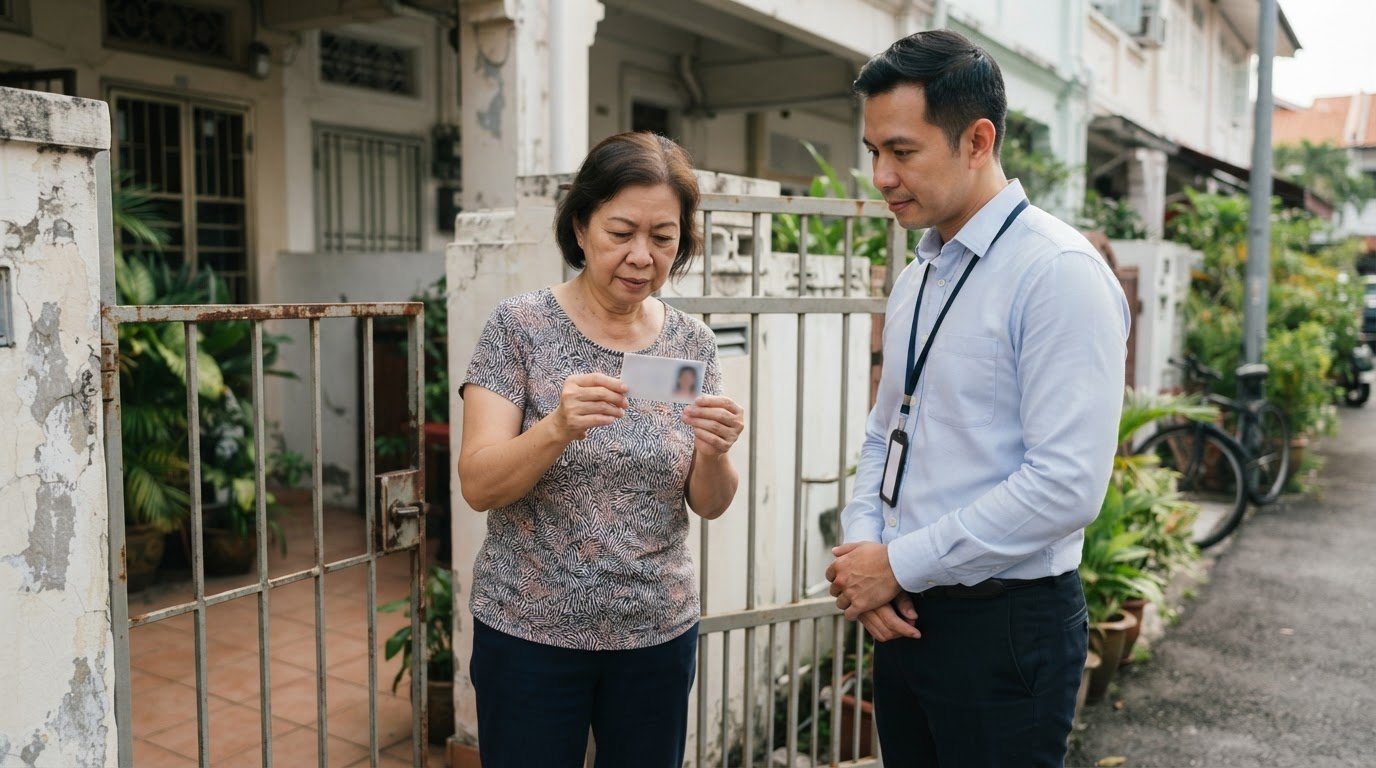
A property agent’s name or claimed qualification alone doesn’t establish their authority to act. To learn how to verify a property agent’s credentials in Singapore, search the Council for Estate Agencies (CEA) Public Register using the phone number you’re dealing with or the number in the advertisement. The register shows whether the agent is currently registered, and includes details such as awards and disciplinary records.
Look beyond certificates and professional titles. These can relate to different skills or roles, but CEA registration is the key check for an agent’s authority to conduct estate agency work in Singapore.
This guide explains how to check an agent’s registration, identify who issued other credentials and understand what the agent is authorised to do. It also covers the information property advertisements must display and how the CEA register can help you review an agent’s record and spot potential warning signs, so you can proceed with greater clarity.
Key Takeaways
- Assess an agent’s current authority separately from additional professional designations.
- Use the details in a property advertisement to identify inconsistencies that may signal a risk.
- Check who issued a credential and what its stated standards or recognition actually cover.
- Understand the limits of an agent’s authority before relying on them to represent you in a property transaction.
Checking whether a real estate licence is active
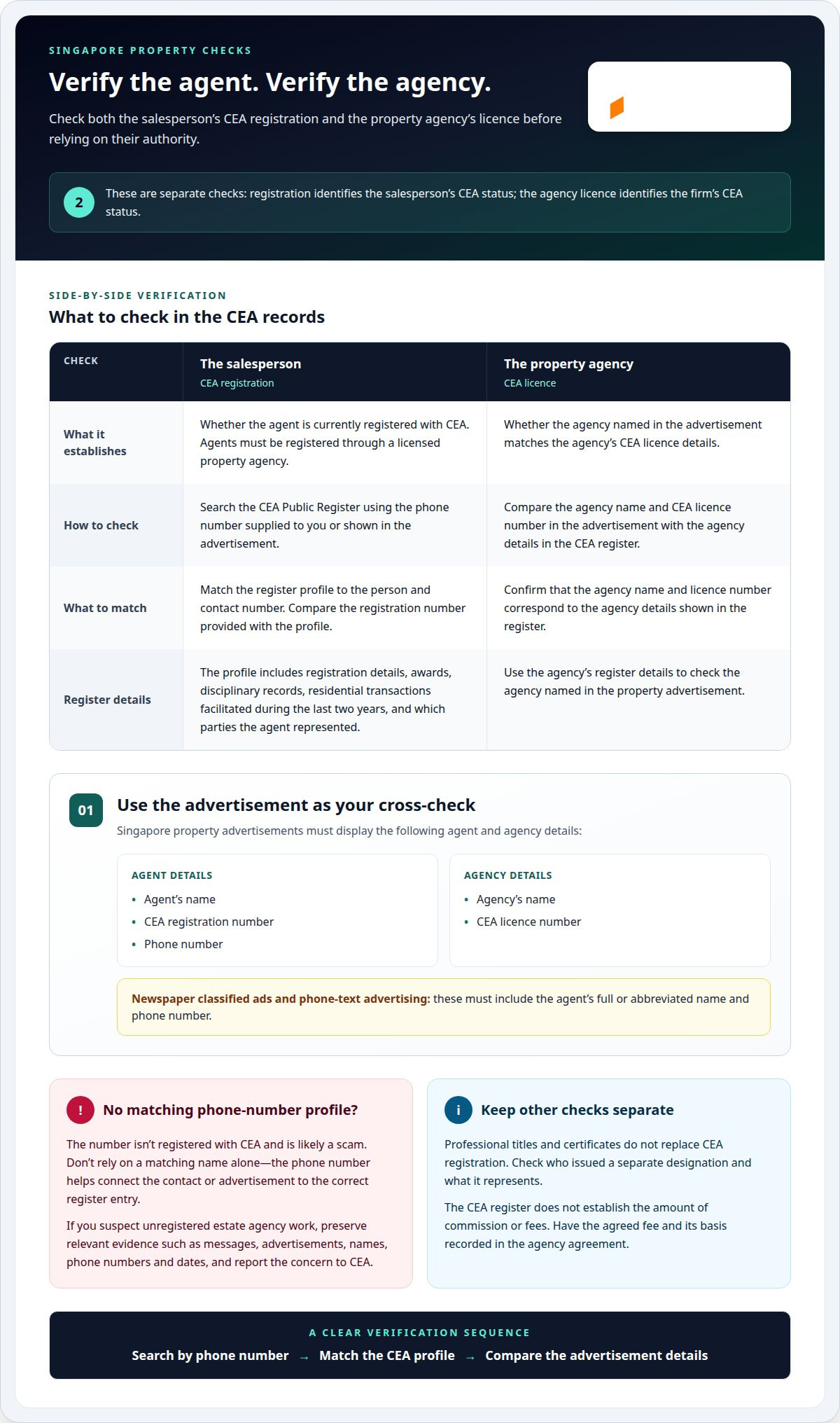
In Singapore, check both the salesperson’s CEA registration and the property agency’s licence before relying on their authority. The CEA Public Register lets you verify registration details and review relevant records directly.
Checking Agent Registration
Agent registration is the CEA’s record that a property salesperson is registered through a licensed property agency. Every property agent must be registered with the Council for Estate Agencies (CEA) through a licensed property agency, and carrying out estate agency work without valid registration is an offence.
Search the CEA Public Register using the phone number of the person you’re dealing with or the number shown in the advertisement. Check that the profile matches the person and contact number, rather than relying on a name or credential alone. The register also shows awards, disciplinary records, residential transactions facilitated during the last two years and which parties the agent represented.
Checking Licence Status
Registration status indicates whether the agent’s CEA registration is valid, an important check before they act in an estate agency transaction. Search the Public Register using the advertised or supplied phone number, then review the registration information on the matching profile.
For the agency, compare its name and CEA licence number in the property advertisement with the agency details in the CEA register. Singapore property advertisements must list the agent’s name, CEA registration number and phone number, as well as the agency’s name and CEA licence number. Newspaper classified advertisements and phone text advertising must include the agent’s full or abbreviated name and phone number.
If a phone-number search returns no agent profile, the number isn’t registered with CEA and is likely a scam. Don’t rely on a matching name alone. The phone number helps connect the advertisement or contact to the correct register entry.
Commission and fee arrangements are separate from a CEA registration check: the register doesn’t establish the amount. Before proceeding, have the agreed fee and its basis recorded in the agency agreement.
Consumer protection and fraud prevention
Use the CEA Public Register and the information in an agent’s advertisement to look for potential warning signs. If details don’t match, resolve the discrepancy before relying on the person’s claims or proceeding with a transaction.
Checking Disciplinary Records and Complaints
The CEA Public Register lets you review an agent’s disciplinary records and assess whether their professional history raises concerns. Search using the phone number you have, then read the profile instead of relying on a credential or advertisement alone.
A disciplinary record is different from an untested complaint. Treat the register as a source of recorded information, not as proof that every allegation has been resolved or that no concerns exist. Note what the record says and consider how it relates to the agent’s proposed role.
Reporting Unregistered Agents or Misconduct
Report suspected unregistered estate agency work or misconduct to the Council for Estate Agencies (CEA). Set out what happened clearly and preserve relevant evidence, such as messages, advertisements, names, phone numbers and dates.
For example, if a phone-number search returns no agent profile, record the number and the advertisement where it appeared. A number without a matching profile isn’t registered with CEA and is likely a scam. Report the concern to CEA rather than treating an unverified claim as established fact.
Responding to Unverifiable Credentials
An unverifiable credential is a claimed qualification or registration that you can’t match to reliable information. Pause before relying on it, and distinguish an unverified claim from a confirmed disciplinary finding.
Compare the person’s details with the CEA profile and identify which credential or detail doesn’t match. Keep copies of relevant communications and advertisements. If the issue concerns a separate professional designation, record its exact title and claimed issuer so you can describe the concern accurately when reporting it.
For a property transaction, careful due diligence includes both the agent’s recorded status and the authority behind any claimed credential. Singapore property transaction guidance can help you consider your next steps with greater clarity.
Credential issuer verification
Knowing how to verify a property agent’s credentials starts with distinguishing CEA registration from additional professional designations. In Singapore, titles such as Certified Residential Specialist (CRS), Certified Luxury Home Marketing Specialist (CLHMS) and Accredited Buyer’s Representative (ABR) refer to different credentials, not substitutes for agent registration.
To verify a Singapore property agent’s CEA registration number, search the CEA Public Register using the agent’s phone number or the number in the advertisement. Match the profile to the person and compare the registration number with the one provided. This helps confirm whether the number corresponds to the agent you’re dealing with.
When learning how to verify a property agent’s credentials beyond registration, identify the exact title printed on the certificate or profile. Check which organisation issued it, then review the issuer’s information to understand what the designation represents. A professional-looking certificate, initials after a name or copied logo doesn’t establish who issued the credential.
Consider whether the designation is relevant to the work the agent describes. For example, ABR relates to representing buyers, while CLHMS indicates specialised skills for high-end property transactions. A title’s stated focus can help you judge its relevance, but it doesn’t independently establish the agent’s authority for a particular transaction.
Keep these checks distinct: CEA registration concerns an agent’s registration in Singapore, while a professional designation describes an additional qualification or specialisation. If the issuer or wording is unclear, note the exact title and issuer name, then review the issuer’s information. Don’t treat an unexplained designation as proof of broader authority.
If you suspect that a real estate agent has provided false information, document the suspected false information and gather evidence related to the issue. These steps help preserve the concern and the material behind it before you make a report. Report the issue to an appropriate regulatory body. The recommended response is to document what you suspect, gather evidence, and direct the concern to the appropriate commission or regulatory body. Keep the report focused on the suspected false information and the evidence you have gathered.
Credential scope and privilege
A credential can establish registration or a specialist designation, but it doesn’t grant unlimited authority. In Singapore, the agent’s role and the transaction determine which authority matters.
Credentials an Agent Should Provide
An agent should provide details that let you identify their CEA registration and understand any additional designation they rely on. This distinction matters because a professional title doesn’t replace registration.
For a claimed specialisation, note the exact designation and its issuer. For example, an Accredited Buyer’s Representative (ABR) designation relates to representing buyers, while the Certified Luxury Home Marketing Specialist (CLHMS) designation indicates specialised skills for high-end property transactions. These credentials describe a focus; they don’t independently establish authority to act for every party.
Agent Identification
Useful identifying details include the agent’s name, phone number and CEA registration number. Together, they help connect the person to their register profile and the specific property transaction.
Compare the identity presented in discussions with the name and number associated with the agent’s registration. An abbreviated name may appear in newspaper classified advertisements or phone text advertising, but the phone number remains a practical way to find the corresponding profile. A credential alone doesn’t establish that the person using the contact details is the registered agent.
The Estate Agents Act defines estate agency work to include negotiating a property transaction on behalf of a client. It also includes introducing a prospective property buyer to someone wishing to dispose of the property, or that person’s salesperson. The relevant authority therefore depends on what the agent is doing, not simply the title they use.
Before relying on an agent, clarify whom they represent and what role they will perform. The CEA Public Register also shows which parties an agent represented in residential transactions facilitated during the last two years. This information provides context, but doesn’t determine whom the agent represents in your transaction.
For a landed-property transaction, discuss your property transaction with a professional whose role and representation are clear.
A hypothetical procurement agent’s verifiable credential could state authority to commit up to 10,000 EUR per transaction, illustrating how a credential may define a bounded scope.
Vincent Lim (OrangeTee & Tie)
Vincent Lim (OrangeTee & Tie) can help if you’re considering a landed-property sale and want to understand an agent’s role before proceeding. The checks above help distinguish CEA registration, additional credentials and the authority relevant to your transaction.
Vincent Lim handles sales of terrace houses, semi-detached houses, detached houses and Good Class Bungalows (GCBs) in Singapore. If you’re preparing to sell one of these properties, clear communication about representation and responsibilities can support informed decisions throughout the process. Verify registration independently using the CEA Public Register, then discuss your property sale with Vincent Lim.
Contact Vincent Lim (OrangeTee & Tie) to discuss selling your property.
Make your next property decision with clarity
Knowing how to verify a property agent’s credentials gives you a stronger basis for deciding whom to trust with an important transaction. Carry that care into your next step: be clear about your priorities, the role you expect an agent to perform and the decisions you need support with. A considered conversation can help you understand how those responsibilities fit your property plans.
If you’re preparing for a property sale in Singapore, Vincent Lim (OrangeTee & Tie) can discuss the process and your next steps. Use the conversation to clarify your objectives and understand how professional representation may fit your plans.
Start a conversation with Vincent Lim about your property plans and move forward with greater confidence.
Frequently Asked Questions
How do I use the CEA Public Register to check an agent’s details and status?
Search the register using the phone number connected to your conversation, then compare the profile with the person and agency involved. Check that the agent’s name and registration details correspond, and note any disciplinary information or transaction history relevant to your decision. If the person contacts you from a different number, don’t assume the profile establishes who is using that number.
How can I spot fake property agents and impersonation scams in Singapore?
Be cautious if a caller’s name, phone number, agency or registration details don’t match the CEA profile. Impersonators may use a real agent’s name, so a name match alone doesn’t establish identity. Pause the discussion, retain the message or advertisement showing the inconsistent details, and report suspected impersonation to CEA with the information you have.