An inherited property can pass to you without nominal stamp duty, yet still affect the costs of what comes next. A transfer to a beneficiary by inheritance has attracted no nominal stamp duty since 19 February 2011; the inherited property itself isn’t subject to Additional Buyer’s Stamp Duty (ABSD), but it may count toward the property total used to calculate ABSD on a later home purchase. Knowing what to do with an inherited property in Singapore starts with understanding that distinction.
It’s understandable to focus first on whether duty is payable. But the transfer is only one part of the picture: how the property is held, who is entitled to a share, and whether it is an HDB flat, private home or landed property all affect what to do next.
This article explains how stamp duty may apply to later transactions, how a deceased owner’s interest may be distributed, and what inheritance, legal and property expenses to consider. It also outlines why estate duty and ongoing costs are separate questions, so you can assess the practical implications before deciding whether to keep, transfer or sell the property.
Key Takeaways
- Inheritance itself generally attracts no nominal stamp duty, but receiving a property can affect the ABSD payable on a later purchase.
- Whether a flat interest passes automatically or forms part of the estate depends on how the property was jointly owned.
- Without a Will, the Intestate Succession Act sets out how a non-Muslim’s estate is distributed among eligible family members.
- Plan for more than inheritance tax: ongoing property expenses, legal costs and mortgage arrangements can also shape what happens next.
Is Stamp Duty Payable When Inheriting Property in Singapore?
Receiving a residential property through inheritance generally does not attract stamp duty. The position may change if ownership shares are transferred, a beneficiary buys out a relative, or the inherited property affects a later purchase.
Stamp Duty on Inherited Residential Property
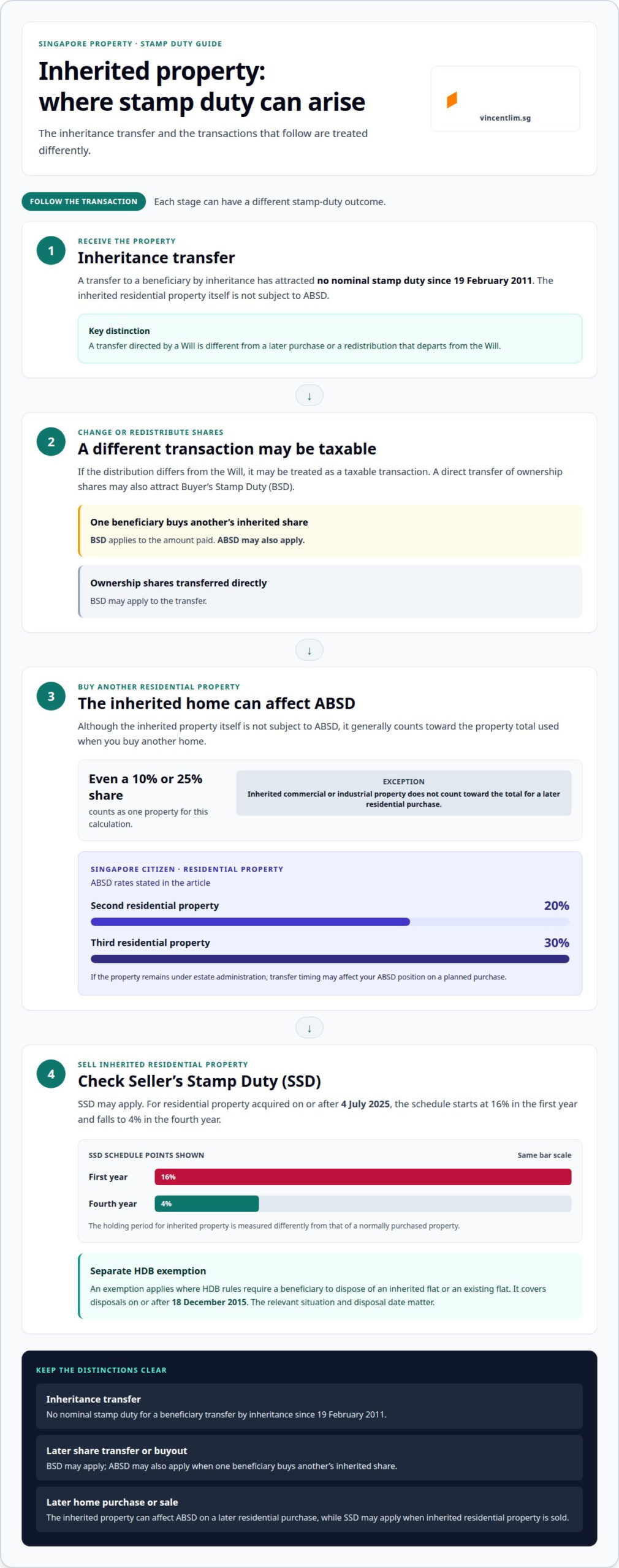
Stamp duty is a tax on certain property transactions, but a transfer to a beneficiary by inheritance has attracted no nominal stamp duty since 19 February 2011. This distinction matters because a transfer directed by a Will is different from a later purchase or a redistribution that departs from the Will.
A distribution that differs from the Will may be treated as a taxable transaction. A direct transfer of ownership shares may also attract Buyer’s Stamp Duty (BSD). If one beneficiary buys another’s inherited share, BSD applies to the amount paid, and Additional Buyer’s Stamp Duty (ABSD) may also apply.
Additional Buyer’s Stamp Duty and Inherited Property
An inherited residential property isn’t itself subject to ABSD, but it generally counts toward the property total when you buy another home. Even an inherited 10% or 25% share counts as one property for this calculation. Inherited commercial or industrial property doesn’t count toward the total for a later residential purchase.
For a Singapore Citizen, ABSD is 20% on a second residential property, according to the Inland Revenue Authority of Singapore. The rate is 30% on a third residential property. If the property remains under estate administration, its transfer timing may affect your ABSD position on a planned purchase.
Seller’s Stamp Duty and Inherited Property
Seller’s Stamp Duty (SSD) may apply when inherited residential property is sold, but its holding period is measured differently from a normally purchased property. For residential property acquired on or after 4 July 2025, the SSD schedule starts at 16% in the first year and falls to 4% in the fourth year, according to the Inland Revenue Authority of Singapore.
A separate exemption applies where HDB rules require a beneficiary to dispose of an inherited flat or an existing flat. It covers disposals on or after 18 December 2015. The relevant situation and disposal date therefore matter before a sale proceeds.
Keep, Rent, Sell, or Manage the Mortgage?
Whether to keep, rent out or sell depends on ownership, applicable HDB eligibility rules, ongoing expenses and your plans for another purchase. Weigh how you intend to use the property and its carrying costs, as well as any effect on ABSD, before deciding.
An outstanding private-property mortgage remains within the deceased owner’s estate and is managed by the executor or administrator, unless you co-signed or guaranteed it. Taking over the mortgage typically requires lender approval and eligibility checks. For an HDB flat, the deceased owner’s loan and any applicable Home Protection Scheme coverage affect how the outstanding loan is handled.
Distribution of a deceased sole owner’s or tenant-in-common’s flat interest
For an HDB flat, inheritance depends first on how the deceased held ownership. A surviving joint owner receives the property automatically through the right of survivorship, so it does not enter the deceased’s estate. A sole owner’s share, or a tenant-in-common’s share, instead passes under a Will or, if there is no Will, the applicable succession rules.
What rules apply to inheriting an HDB flat in Singapore? The beneficiary must meet HDB’s eligibility requirements to retain it. A recipient must be at least 21, while a single person generally must be 35; a qualifying family nucleus may also be required. HDB rules also prevent a person from owning two HDB flats at the same time. Private-property ownership can affect eligibility, and the flat’s purchase date may matter.
The executor or administrator needs a Grant of Probate or Letters of Administration before transferring a solely owned property. For an inherited HDB flat, the executor or administrator must apply to HDB for transmission within 6 months of obtaining the grant. After transmission, the executor or administrator should arrange to transfer the flat to eligible beneficiaries or sell it. Open-market sale requires the flat to have met its Minimum Occupation Period as at the date of death; the general MOP for new HDB flats is 5 years.
Can inherited property in Singapore be sold, and what approvals are needed? Yes, but the estate’s executor or administrator must obtain the court grant for a solely owned property before sale. HDB eligibility and MOP rules apply to flats. A non-citizen inheriting landed property needs Singapore Land Authority approval to retain it. A foreign heir who doesn’t obtain approval for restricted landed residential property must sell their share within 5 years from the date of death, unless an extension is allowed.
When a tenant-in-common dies, only that owner’s share is distributed; the other owner does not automatically receive it. The Will or intestacy rules determine who inherits the interest, while the grant authorises the estate’s administration and transfer.
Non-Muslim inheritance under the Intestate Succession Act
For a non-Muslim who dies without a Will, Singapore’s Intestate Succession Act 1967 determines how the estate is distributed. Intestate succession applies to the deceased’s estate, including their property interest; it does not replace separate eligibility rules for a beneficiary who hopes to retain an HDB flat. The Act does not apply to Muslims.
The family circumstances decide the shares. If a non-Muslim dies leaving a spouse and children, 50% of the estate goes to the spouse, and the remaining 50% is shared equally among the children. For example, two children divide that children’s portion equally. If the deceased leaves a spouse but no children or parents, the spouse receives 100% of the estate. These rules determine entitlement, not whether a beneficiary should keep, sell, or purchase another property.
A Will records how the deceased wants their estate distributed and names an executor to administer it. In Singapore, the Will must be signed or acknowledged in the simultaneous presence of at least two witnesses to meet the stated witnessing requirement. The executor carries out its directions rather than deciding afresh who should inherit. The named beneficiaries and their shares guide the property transfer.
The estate’s administration cannot begin until the court issues a Grant of Probate when there is a Will, or Letters of Administration when there is no Will. The executor or administrator then acts for the estate and carries out the distribution. This step is necessary before a solely owned property can be transferred or sold; a beneficiary’s expected share does not complete the legal transfer.
Muslim estates follow a different framework. Distribution is governed by Muslim inheritance law, known as faraid, through the Syariah Court. Under the general Faraid principle, a male heir receives twice the share of a female heir at the same relational degree. A Muslim Will, or Wasiat, is limited to one-third. The deceased’s religion therefore affects which inheritance rules apply.
Estate duty, legal costs and property expenses
Singapore’s inheritance tax was repealed on all assets, including property, on 15 February 2008, according to the Inland Revenue Authority of Singapore. For what to do with an inherited property in Singapore, distinguish inheritance tax from the costs of administering, owning and disposing of it. The Intestate Succession Act determines entitlement when there is no Will, but it doesn’t remove the expenses of managing the property.
Legal expenses may arise during probate or administration, a property transfer, a sale or mortgage refinancing. Refinancing may involve administrative fees or legal charges. If beneficiaries need a valuation to decide whether to retain or sell, a licensed valuer’s assessment is another possible expense. Costs depend on the work required for the estate and property; there is no single inheritance charge.
After the transfer, recurring property costs continue. Singapore property tax is payable annually on residential and commercial properties. Rates are based on the property’s annual value, which reflects its assessed market rental value. Owner-occupied properties have a lower rate than non-owner-occupied properties.
Mortgage and CPF arrangements also affect the estate’s net value. If a beneficiary proposes taking over an outstanding loan, lender approval may be needed, and refinancing can add legal or administrative charges. CPF refunds may be made to the deceased’s estate before distribution. Separately, CPF savings used to buy a property do not have to be refunded to the deceased’s CPF account when the property is inherited or later sold.
A sound decision about what to do with an inherited property in Singapore starts by mapping legal costs alongside annual tax, maintenance, mortgage obligations and any valuation expense. For a landed home, plan an inherited-property sale with a clear view of its ownership and carrying costs.
Vincent Lim (OrangeTee & Tie)
If you decide to sell an inherited landed home, Vincent Lim (OrangeTee & Tie) can support the property sale. Once ownership and transfer arrangements are clear, his role is to help you move from inheritance decisions to the sale with a defined plan.
His services include Terrace House Sales, Semi-Detached House Sales, Detached House Sales and Good Class Bungalow (GCB) Sales. These are relevant options if the inherited property falls into one of these categories and the beneficiaries are considering a sale. Align the sale with the estate’s distribution and your intended outcome for the property.
If you’re considering selling an inherited landed property, contact Vincent Lim (OrangeTee & Tie) to discuss the sale.
Make Your Next Property Decision Deliberately
Deciding what to do with an inherited property in Singapore becomes clearer when you define the outcome you want. Consider whether the property supports your longer-term plans, whether keeping it fits your financial commitments, and whether selling would better serve the estate’s beneficiaries. A considered decision can align the property’s next step with your priorities.
If you are weighing a sale, consider how the property should be positioned and how the transaction fits your circumstances. Vincent Lim (OrangeTee & Tie) supports sales of landed properties, including terrace houses, semi-detached houses and detached houses. His service is relevant once you have decided to sell and want professional support with the property transaction.
Discuss a property sale with Vincent Lim (OrangeTee & Tie) and take your next step with a clear plan.
Frequently Asked Questions
Can I Keep the Inherited Property in the First Place?
Often, but the answer depends on the property type, your eligibility and any ownership restrictions. An inherited private home may be retained subject to applicable rules; restricted landed residential property may require Singapore Land Authority approval for a foreign beneficiary. HDB eligibility conditions apply separately from inheritance entitlement. Being named in a Will identifies a beneficiary, but does not automatically mean that person can keep every type of property.
Can you keep an inherited HDB flat if you already own a home?
Possibly, depending on your existing home, the inherited flat’s circumstances and HDB eligibility rules. If you already own private property, the previous owner’s flat purchase date may affect whether you can retain the HDB flat. Options may include giving up your inheritance rights, selling your existing property or transferring the inherited flat to another eligible family member. The estate may also sell the flat and distribute the proceeds.
Need Help With Inherited Property or Estate Matters?
The executor or administrator handles the estate’s legal administration, probate and distribution. Vincent Lim (OrangeTee & Tie) supports owners selling landed homes, including terrace, semi-detached and detached houses, as well as Good Class Bungalows. His role is relevant once the estate is ready to sell and a beneficiary needs real estate transaction support. It does not replace estate administration.
What happens when several siblings inherit the same property together?
Each sibling’s entitlement follows the Will or applicable intestacy rules, and the property may be held in separate ownership shares. Siblings can consider keeping it together, arranging for one beneficiary to acquire another’s share, or selling and distributing the proceeds according to their entitlements. A buyout is a separate property transaction, so plan its agreed terms and resulting ownership transfer alongside the estate distribution.
What is the actual process, from death to transfer?
Start by establishing whether a Will exists and identifying the executor named in it. The executor applies for a Grant of Probate; if there is no Will, an eligible person applies for Letters of Administration. Once appointed, the estate representative administers the assets and carries out the distribution. A jointly owned property may pass to the surviving owner through survivorship instead of entering the estate.
How is inherited property in Singapore transferred to beneficiaries?
The transfer process depends on the property and estate. For a property held solely by the deceased, the executor or administrator obtains the relevant court grant and arranges the transfer according to the Will or intestacy entitlement. For an HDB flat, transmission is handled through HDB. If the beneficiary cannot retain the flat, the estate can arrange its sale and distribute the proceeds to those entitled.