The choice is less about who lives in a property than what happens to each owner’s interest when one dies. In Singapore, choosing between joint tenancy and tenancy-in-common means deciding whether ownership passes automatically to the surviving co-owner or whether each person holds a defined share. Under joint tenancy, the survivor takes the deceased co-owner’s interest; under tenancy-in-common, a co-owner’s share forms part of their estate.
Both structures can suit co-owners, but they address different priorities. Joint tenancy may suit people who want the survivor to receive the deceased owner’s interest, while tenancy-in-common can offer more flexibility to blended families or co-investors who want defined shares. This guide explains how each arrangement works, compares their implications, and helps you identify which structure aligns with your ownership and inheritance plans.
Key Takeaways
- Identify whether automatic transfer to the surviving co-owner matches your plans for the property and your estate.
- Consider whether co-owners need defined, potentially unequal shares, particularly when contributions or family circumstances differ.
- Weigh how each ownership structure affects inheritance and the ability to deal with an individual share.
- Use the comparison to align the ownership arrangement with your priorities as a family or co-investor before completing a purchase.
What is Joint Tenancy?
In Singapore, co-owners can hold residential property as joint tenants or tenants-in-common. The key difference is whether they own a shared interest with a right of survivorship or separate, defined shares.
Shares and Financial Contributions
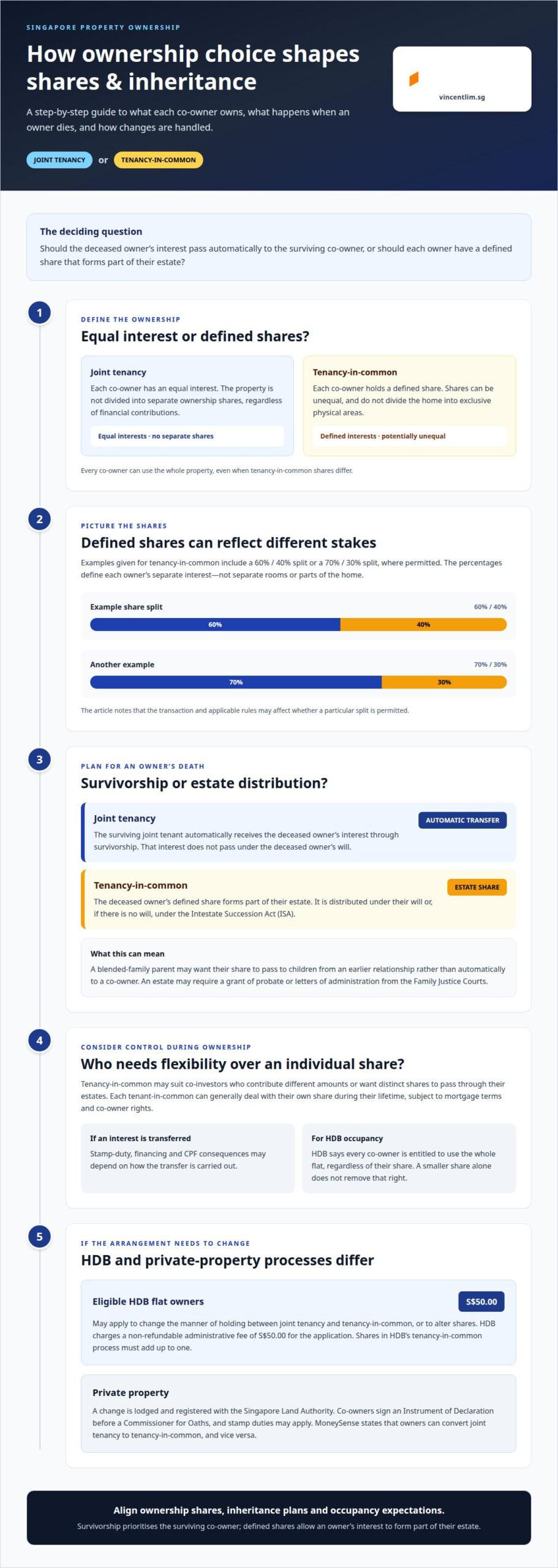
Joint tenancy gives each co-owner an equal interest, regardless of their financial contributions to the purchase. Joint tenancy does not divide the property into separate ownership shares. HDB describes joint tenancy as giving all flat owners equal shares. This arrangement differs from tenancy-in-common, where owners hold defined shares that can be unequal.
For example, tenants-in-common might hold 60% and 40% of an investment property, or 70% and 30% where permitted. Those percentages define each owner’s separate interest; they don’t divide the home into physically separate areas. Each co-owner can use the whole property, even when their ownership shares differ.
Transfer of a Deceased Joint Tenant’s Share
When a joint tenant dies, the surviving joint tenant automatically receives the deceased owner’s property interest through survivorship. That interest does not pass under the deceased’s will. By contrast, a tenant-in-common’s defined share forms part of their estate.
A tenant-in-common’s share is distributed under their will or, if there is no will, the Intestate Succession Act (ISA). The estate may require a grant of probate or letters of administration from the Family Justice Courts. The intended recipient of each separate share is therefore a central consideration for co-owners.
| Ownership structure | Shares during ownership | When an owner dies |
|---|---|---|
| Joint tenancy | Equal interests; no separate shares | Interest passes automatically to surviving joint tenant |
| Tenancy-in-common | Defined shares, which may be unequal | Share enters the deceased owner’s estate |
Choose the structure based on whether survivorship or defined shares better reflect your ownership and inheritance intentions.
Joint tenancy and right of survivorship
In Singapore, survivorship determines who receives a deceased co-owner’s interest in a jointly held property. This distinction matters when owners plan for a spouse, children or other beneficiaries.
Right of Survivorship
With joint tenancy, the surviving owner automatically receives the deceased joint tenant’s property interest. The ownership arrangement can affect whether the survivor shares the property with beneficiaries under the deceased owner’s will. For example, if two spouses own a home as joint tenants and one dies, the surviving spouse receives the deceased spouse’s interest through survivorship.
This outcome follows the ownership structure, not a separate choice in the will. It differs from tenancy-in-common, where each owner’s defined share can pass through their estate. This matters when co-owners intend the survivor, rather than another beneficiary, to retain the property.
Survivorship and Estate Distribution
Joint tenancy can affect how a deceased co-owner’s interest is handled, so estate plans are worth considering when choosing an ownership structure. The will cannot redirect that interest to someone else. The ownership arrangement can therefore be decisive when family members have different expectations.
By contrast, a tenant-in-common’s separate share forms part of their estate. It is distributed under their will or, if there is no will, under the Intestate Succession Act (ISA). This distinction can matter in blended families: a parent may want their share to pass to children from an earlier relationship rather than automatically to a co-owner.
Before buying a residential property, co-owners should consider whether the survivor should receive the jointly held interest. If they intend to leave a defined share to another beneficiary, tenancy-in-common may better reflect that plan. The ownership structure should align with their estate intentions.
For a landed-home purchase, consider how ownership decisions fit the property itself. Explore Singapore property ownership considerations as part of that planning.
Choosing a structure for blended families or investment co-ownership
For a blended family or investment partnership, the intended recipient of each owner’s interest can guide the choice. Defined shares make it possible to specify each owner’s stake, while joint tenancy prioritises survivorship.
A tenancy-in-common arrangement can record unequal shares, such as 60% and 40%, where the transaction and applicable rules allow. The percentages set each owner’s separate interest; they don’t divide the home into exclusive physical areas.
This distinction may matter to co-investors who contribute different amounts or want their estates to receive distinct shares. Each tenant-in-common can generally deal with their own share during their lifetime, subject to mortgage terms and co-owner rights. Transferring an interest can also have stamp-duty, financing and CPF consequences, depending on how it is carried out.
Eligible HDB flat owners may apply to change their manner of holding between joint tenancy and tenancy-in-common, or alter their shares. HDB charges a non-refundable administrative fee of S$50.00 for an application to change the manner of holding or proportion of shares. Tenancy-in-common shares in HDB’s process must add up to one.
For private property, a change is lodged and registered with the Singapore Land Authority. Co-owners sign an Instrument of Declaration before a Commissioner for Oaths, and stamp duties may apply. MoneySense states that owners can convert joint tenancy to tenancy-in-common, and vice versa.
Ownership percentages do not determine who may occupy an HDB flat. HDB says every co-owner is entitled to use the whole flat, regardless of their share. This matters in a family disagreement: a smaller ownership share alone does not remove a co-owner’s right to use the home. Align the intended ownership, transfer plans and occupancy expectations before purchase.
Joint tenancy compared with tenancy in common
The central difference is how ownership is recorded and what happens when an owner dies. Compare the structures against your inheritance plans, contribution arrangements and shared financial responsibilities.
| Criterion | Joint tenancy | Tenancy-in-common |
|---|---|---|
| Ownership | Equal interests, without separate shares | Defined shares, which may be unequal |
| Death of an owner | Interest passes automatically to the survivor | Share enters the deceased owner’s estate |
| Inheritance | Survivorship takes priority over the will for that interest | Share is distributed under the will or intestacy law |
| Contribution planning | Contributions do not create separate ownership shares | Shares can reflect agreed ownership proportions |
For couples who want the survivor to retain the property, joint tenancy aligns ownership with that outcome. In the joint-tenancy arrangement described, participants share 50% of profits if the home is sold or rented to someone else. They also share financial responsibility for the mortgage, property taxes, and maintenance.
Tenancy-in-common offers a different framework for investment co-owners. For example, owners may record 75% and 25% interests, where permitted. Each defined share becomes part of its owner’s inheritance when they die, according to Majlis Ugama Islam Singapura. This can suit owners who want their shares distributed according to individual estate plans.
The manner of holding should reflect the intended outcome, not simply who pays more toward the purchase. Unequal financial contributions do not automatically establish unequal legal ownership. Conveyancing documents should record the intended ownership structure, while mortgage obligations and co-owner arrangements also matter.
Use this decision guide:
- Choose joint tenancy if automatic transfer to the surviving owner is the priority.
- Consider tenancy-in-common if defined shares or inheritance for other beneficiaries matter more.
- Before purchase, align the ownership record with contributions, estate intentions, and mortgage responsibilities.
For help assessing a landed-property purchase, discuss your property plans in light of the ownership structure you intend to use.
Vincent Lim (OrangeTee & Tie)
Vincent Lim (OrangeTee & Tie) helps buyers assess Singapore property opportunities in light of their ownership priorities. After considering survivorship, inheritance and each co-owner’s intended share, evaluate the property itself and how it fits your plans.
For buyers considering landed homes or luxury residences, Vincent Lim facilitates sales of terrace houses, semi-detached houses, detached houses and Good Class Bungalows. His Market Analysis, Property Valuation and Marketing Strategy services support the property decision when you are buying with a spouse, family member or investment co-owner. The ownership structure remains a separate legal decision that should align with your estate intentions and purchase arrangements.
Contact Vincent Lim (OrangeTee & Tie) to discuss your Singapore property plans.
Set Your Ownership Intentions Before the Next Move
A sound approach to choosing between joint tenancy and tenancy-in-common starts with an open discussion among co-owners. Agree on what you want the arrangement to achieve, how the property fits your family or investment plans, and whether everyone shares the same expectations. Clarifying these priorities before deciding on a property can help keep the next steps aligned.
Ownership structure is one part of a broader property decision. Consider the home, the people involved and each owner’s longer-term plans. Clarify your priorities before moving forward, especially if a purchase could affect a blended family or shared investment.
For guidance on your Singapore property plans, contact Vincent Lim (OrangeTee & Tie). A clear next step can help you move forward with greater confidence.
Frequently Asked Questions
What is Tenancy-in-Common?
Tenancy-in-common is a form of co-ownership where each owner holds a distinct share in the same property. The shares can be unequal, such as 60% and 40%, where the transaction and applicable rules allow. Each share is an interest in the whole property, not ownership of a particular room. This can help co-investors record different agreed ownership proportions.
Which structure is better?
Neither structure is right for every co-owner; the choice depends on the intended ownership and inheritance outcome. When choosing between joint tenancy and tenancy-in-common, consider whether survivorship or defined shares better match your plans. Joint tenancy may suit a couple who wants the surviving owner to receive the interest. Tenancy-in-common may suit investment partners or blended families with separate estate plans.
What is the difference between joint tenancy and tenancy-in-common in Singapore?
In Singapore, joint tenancy gives co-owners equal interests without separately defined shares, while tenancy-in-common records a distinct share for each owner. For example, two owners could hold tenancy-in-common shares of 70% and 30%, where permitted. The structures also differ at death: joint tenancy applies survivorship, while a tenant-in-common’s interest forms part of their estate.
How does the right of survivorship work for joint tenants in Singapore?
When a joint tenant dies, the surviving joint tenant automatically receives the deceased owner’s interest in the property. That interest does not pass to a beneficiary under the deceased’s will. For example, if spouses own a home jointly and one dies, survivorship transfers the deceased spouse’s interest to the survivor. The will can still address other assets in the estate.
How are ownership shares determined under tenancy-in-common in Singapore?
The intended permitted proportions should be reflected in the conveyancing documents and ownership record. For example, co-owners might record 70% and 30% shares, which together make up the whole interest. Unequal payments toward the purchase price don’t automatically establish unequal legal shares. For HDB’s process to change shares, the proportions must add up to one.
How do co-owners choose or change the form of co-ownership in Singapore?
When choosing between joint tenancy and tenancy-in-common, co-owners should first agree on their intended shares and what should happen to an owner’s interest. Eligible HDB owners may apply to change the manner of holding or ownership proportions; HDB charges a non-refundable S$50.00 administrative fee. For private property, a change is registered with the Singapore Land Authority, and co-owners sign an Instrument of Declaration before a Commissioner for Oaths. Stamp-duty, financing, and CPF consequences may also arise.