The access that makes a property usable may legally cross someone else’s land. A right-of-way easement gives someone a defined right to pass over another person’s property. In Singapore, an easement by prescription may be established after at least twenty years of continuous use with the consent or acquiescence of the former registered owner, although courts rarely grant easements on this basis.
Understanding right of way and easements on property matters when buying because an easement can affect how a home and its surrounding land may be used. The route, permitted purpose and legal terms matter as much as the presence of a path or driveway.
This guide explains what a right-of-way easement means, when prescription may apply, what to consider when buying property affected by access rights, and how to respond if a neighbour appears to exceed those rights. Understanding these distinctions helps buyers and owners assess an easement’s practical impact and consider their options if a dispute arises.
Key Takeaways
- Distinguish a public right of way from a private easement, and understand how the easement’s purpose and terms shape access.
- Learn why long-term use alone may not establish a prescriptive easement in Singapore.
- Assess how an existing access right can affect a property’s use when ownership changes.
- Recognise when conduct may exceed an easement’s scope and what legal options may help address the dispute.
How do you stop a neighbour abusing right of way?
Start by distinguishing private rights from public access. In Singapore, the Land Titles Act and the easement’s terms help define the permitted use.
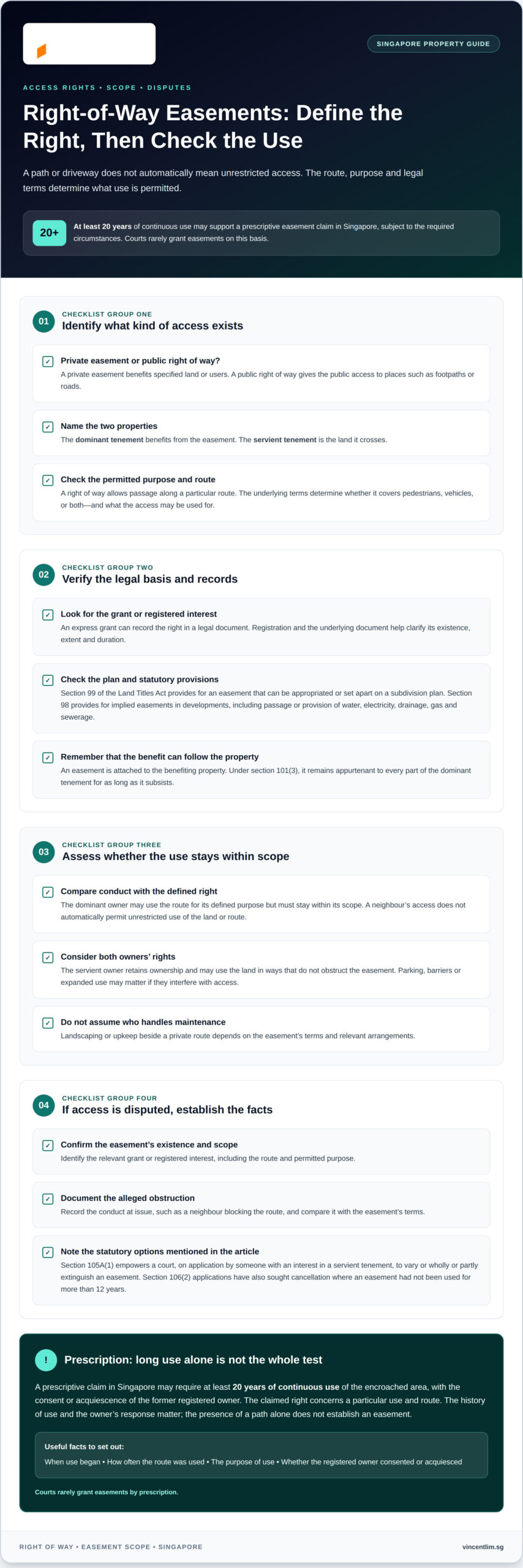
An easement is a defined right to use another person’s land. A right of way is one type of easement, allowing passage along a particular route. By contrast, a public right of way gives the public access to places such as footpaths or roads. A neighbour’s access does not automatically grant unrestricted use of the land or route.
For adjoining units in a development, section 98 of Singapore’s Land Titles Act provides for implied easements for the passage or provision of water, electricity, drainage, gas and sewerage, according to the Attorney-General’s Chambers of Singapore.
Landowner Rights and Obligations
The dominant landowner benefits from an easement, while the servient landowner owns the land it crosses. The dominant owner may use the route for its defined purpose but must stay within its scope. The servient owner retains ownership and may use the land in ways that do not obstruct the right. These limits matter if a neighbour’s parking, barriers or expanded use interferes with access.
Public access and private easements serve different purposes: a public route serves the public, while an easement benefits specified land or users. Utility access may also be governed by specific rights. Landscaping or upkeep beside a private route depends on the easement’s terms and relevant arrangements, so don’t assume either neighbour is responsible for every maintenance task.
Resolving Access Disputes
Resolving an access dispute means establishing the easement’s existence and scope, then addressing conduct outside those terms. The Land Titles Act governs easements in Singapore, and disputes are determined by the Singapore Courts through proceedings. A practical first step is to identify the relevant grant or registered interest and document the alleged obstruction, such as a neighbour blocking the route.
According to Singapore Courts, applicants under section 106(2) of Singapore’s Land Titles Act sought cancellation of an easement because it had not been used for more than 12 years. Separately, section 105A(1) empowers a court, on application by someone with an interest in a servient tenement, to vary or wholly or partly extinguish an easement, according to the Attorney-General’s Chambers of Singapore.
Meaning of a right-of-way easement
Understanding right of way and easements on property starts with distinguishing a right to use land from ownership of it. An easement gives one landowner a defined right to use another owner’s land. A right of way is an easement for passage, such as walking or driving across a neighbour’s driveway. It benefits one property and burdens another.
The land that benefits is called the dominant tenement; the land carrying the burden is the servient tenement. For example, a house without direct road access may benefit from a documented path across adjoining land. The document creating the right sets out its route, purpose and terms. These details determine whether it permits pedestrians, vehicles or both.
In Singapore, an express grant can create an easement through a legal document. Section 99 of the Land Titles Act also provides for an easement where it can be appropriated or set apart on a subdivision plan. Section 98 provides for implied easements in developments; the Attorney-General’s Chambers of Singapore identifies this statutory basis.
Registration and the underlying document matter because they clarify an easement’s existence, extent and duration. For buyers, the practical effect of right of way and easements on property depends on the documented route, purpose and limits. A plan may identify land set apart in a development, while an express grant records rights agreed between owners.
An easement is attached to the benefiting property and typically passes with the land when ownership changes. Under section 101(3) of the Land Titles Act, an easement remains appurtenant to every part of the dominant tenement for as long as it subsists, according to the Attorney-General’s Chambers of Singapore. A sale generally transfers the benefit with the land, not as a personal privilege belonging only to the former owner.
Easements acquired by prescription
An easement by prescription is a right claimed through long, continuous use of someone else’s land. In Singapore, it may be established after at least twenty years of continuous use of the encroached area, with the consent or acquiescence of the former registered owner. The claimed right must relate to a particular use, such as regularly crossing a defined path to reach a home.
That threshold makes the history of use central. For example, a landowner relying on a neighbour’s driveway would need to establish the route, purpose and continuity of use over the required period. Occasional access or a changing route may not demonstrate the same established pattern. Relevant evidence concerns actual use and the former registered owner’s response.
Prescription differs from an express grant, which records an agreed right in a document, and from an implied easement, which arises from legal circumstances rather than a long-use claim. It also differs from mere tolerance: the legal question is whether the use and owner’s conduct meet the applicable requirements. In Singapore, courts rarely grant easements by prescription, so the existence of a path alone does not establish a right.
To assess a claim, set out a clear chronology: identify when use began, how often and for what purpose the route was used, and whether the registered owner consented or acquiesced. A driveway used openly for access over the required period presents a different factual picture from occasional entry for deliveries. Each fact helps define the right claimed, including its route and scope.
If an easement is established, its benefit may pass with the dominant property while the easement subsists. That does not automatically expand the right beyond the particular use established. A claimed footpath, for instance, should not be treated as permission for vehicle access without a basis for that broader purpose. In Singapore, a claim based on long use therefore requires careful assessment of both duration and the actual terms of use.
Buying property with a right-of-way easement
An existing access right can shape how a Singapore property is used after purchase. Easements are attached to the property and typically pass with the land to a new owner. A buyer considering right of way and easements on property should assess whether the route supports the home’s residential use and whether its terms meet the household’s access needs.
Examine the easement document and any plan showing its route. Identify which land benefits, which land carries the burden, and whether the right permits walking, driving or another defined use. For example, a narrow pedestrian path may not support regular vehicle access. Its purpose and location can affect privacy, circulation and the use of adjoining areas. Considering right of way and easements on property in this practical context helps clarify how the arrangement may affect daily life.
Singapore’s Land Titles Act also matters for older property interests. A subsisting easement created before land came under the Act can bind registered title as an overriding interest under section 46(1)(ii). A buyer therefore shouldn’t assume that an easement is irrelevant simply because it doesn’t appear as an ordinary registered entry.
Consider necessity separately from convenience. A right of way of necessity may arise only when there is no other access to the land except across adjoining property. A longer or less convenient alternative route does not, by itself, establish necessity. The courts focus on whether another access route exists, not whether a buyer prefers the easement route.
If the property needs a new access right, the arrangement may involve legal costs to agree and draft a deed, register it, and any payment requested by the landowner granting access. Those are distinct from the terms of an existing easement. For a considered view of how access rights shape a residential purchase, review your Singapore property options.
Vincent Lim (OrangeTee & Tie)
Vincent Lim (OrangeTee & Tie) helps buyers and sellers make informed decisions about Singapore property transactions. If an access easement affects a home you are considering, its route and permitted use can be important factors in assessing the property’s practical fit. Vincent Lim handles sales of terrace houses, semi-detached houses, detached houses, and landed properties.
For buyers, understanding how an access right relates to the property helps frame questions about its use and suitability. For sellers, understanding the property’s features supports a considered sale discussion. Easement terms remain a distinct legal matter, so assess how they may affect the property’s use.
Contact Vincent Lim (OrangeTee & Tie) to discuss a Singapore property purchase or sale.
Make your next property decision with clarity
Before moving forward, consider how an access arrangement fits the way you intend to use the property. A route may affect privacy, arrival, outdoor space and future plans, so weigh its practical impact alongside the home’s other qualities. A careful assessment of right of way and easements on property keeps these considerations in view without letting one feature define the entire decision.
For a purchase or sale involving a landed home, raise access considerations early in the broader property discussion. Think about your priorities, such as daily convenience, privacy or flexibility, and use them to guide your decision. The legal scope of an easement is distinct from a property’s overall appeal, but its practical effect deserves consideration. A measured approach can help you move forward with a clearer understanding of what matters to you.
Discuss your property plans with Vincent Lim (OrangeTee & Tie) and take the next step with a clearer sense of what suits your goals.
Frequently Asked Questions
What is a Right of Way Easement?
A right-of-way easement is a legal right to pass over land owned by someone else. For example, it might let residents reach a public road by crossing a private driveway. The right benefits a particular property rather than granting general access to everyone. Its defined route and permitted use distinguish it from informal permission to cross a neighbour’s land.
Do I have a right of way over my neighbour’s property?
Only if there is a legal basis for your access: seeing a path across your neighbour’s land is not enough. Look for an express grant, an applicable statutory basis or facts supporting a claim by long use. A right of way of necessity requires that no other access route exists, not merely that an alternative is less convenient. The permitted route and purpose also determine what use is allowed.
Do easements affect property value?
An easement can influence how a buyer assesses a property, but its effect depends on the specific right and the land affected. A defined route serving a neighbouring home could affect privacy or outdoor use; an access right benefiting the property could improve practical access. The location, permitted activity and impact on intended use all matter. There is no single value adjustment that applies to every easement.
Does a right-of-way easement affect selling my home later?
An easement can shape a future buyer’s view of a home, particularly if the route crosses a garden, driveway or other area used by the household. Clear records help explain the arrangement and its practical boundaries during a sale. For instance, a pedestrian-only route creates a different pattern of use from vehicle access. Consider the easement’s effect on privacy, access and the buyer’s intended use.
How do I know if my property is burdened by an easement?
Review the property’s title information alongside documents and plans connected with its transfer or subdivision. A title entry may identify a registered interest, while a conveyance document or plan can clarify the route and purpose. Also distinguish a visible track from a legal right. Some subsisting easements predating the Land Titles Act can bind registered title as overriding interests.
What does the ouster principle mean in relation to easements?
The ouster principle limits an easement that would effectively exclude the landowner from possession or meaningful use of the affected land. A right to cross a defined strip differs from a right to occupy it exclusively. For example, permanent control that prevents the owner from using the area may raise an ouster concern. The right’s wording and practical effect are central.