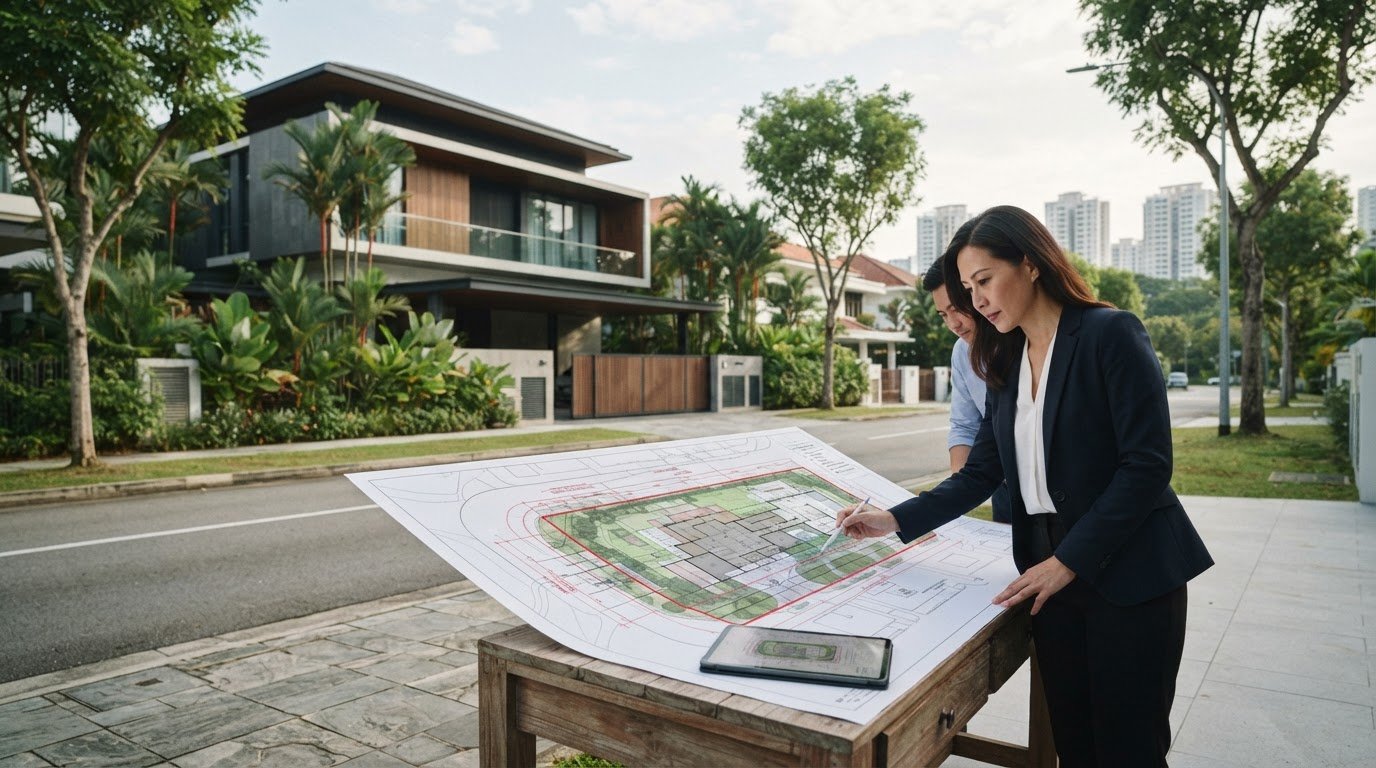
Could a red line on a plan change what you can do with a property, or is it a prompt to investigate further? The road line plan and its impact on property can be easy to misread. A road reserve may affect future use, renovation or redevelopment, but its appearance on a plan does not mean an immediate change is happening to the lot.
Take road reserve information seriously when assessing a landed property, but distinguish what the plan shows from what it cannot determine on its own. This article explains the Line of Road Reserve and “Land Required as Road Reserve”, and why the mapped area, applicable setbacks and proposed works need property-specific assessment. You’ll also find a practical sequence for checking the lot, understanding the notation and identifying what still needs verification before making a decision.
Key Takeaways
- Distinguish the Line of Road Reserve and land marked for road reserve from building setback requirements.
- Understand why a Road Line Plan alone does not confirm immediate land loss or determine a property’s value.
- Follow a property-specific due-diligence sequence, from identifying the lot to reviewing current official records and plan notations.
- Assess the road line plan and its impact on property alongside the intended use, renovation or redevelopment of the landed home.
- Use Market Analysis and Property Valuation as part of a considered property decision.
What Is a Road Line Plan, and Why Does It Matter to Property Buyers?
A road-related notation on a landed property plan can raise immediate questions: could part of the site be needed for a future road, and might that affect renovation or redevelopment? A Road Line Plan (RLP) shows road safeguarding information in relation to a property, but it is not a complete verdict on the site. Understanding what it shows, and what needs separate verification, helps buyers assess the issue without assuming that a proposed reserve means immediate land loss.
In Singapore, the Land Transport Authority (LTA) manages public streets and safeguards land for future road works. An RLP presents road safeguarding information against cadastral data from the Singapore Land Authority (SLA). It can show the Line of Road Reserve, which marks the extent of a future safeguarded road, and land identified as required for road reserve. These notations should be considered alongside the circumstances of the particular lot.
What information does a Road Line Plan show?
The plan shows the location of safeguarded road land in relation to property boundaries. A marked area may indicate that some land falls within a road reserve. The notation alone does not establish when works will happen or what outcome will apply to the property. For a broader overview of the planning context, see Urban Planning in Singapore.
An RLP is not a boundary survey, title record or valuation. On its own, it does not establish the precise on-site dimensions of an affected area, the property’s legal interests or its market value. Those questions require the relevant records and, where needed, professional interpretation—just as property buyers in the UK turn to specialists such as Winfields Surveyors London for independent property valuation advice. Keeping these documents distinct prevents a map notation from being mistaken for an answer to every property question.
Why should landed-property buyers check it?
For buyers, checking the RLP is part of understanding a site’s planning context before committing to a purchase or forming expectations about future use. A road reserve may matter more to one property’s layout or redevelopment plans than another’s. The position and extent of the marked land, the existing building and the buyer’s intended works all affect the assessment.
The same notation can have different practical implications across two lots. A marked portion near a boundary may interact differently with a house, access or proposed design than a larger area that affects the site’s usable layout. These are reasons to investigate, not grounds to assume that every property shown will be acquired or physically changed.
Assess the road line plan and its impact on property as one part of property-specific due diligence. As residential land sales and management specialists such as Citacle Realtors emphasize, verifying plot boundaries and development constraints early is essential for any land acquisition. Identify the lot accurately, obtain current plan information and consider how the notation relates to the intended use. If renovation or redevelopment is central to the decision, review the relevant planning requirements and site details as well. This gives buyers a clearer basis for weighing uncertainty and identifying what needs further verification.
Road Reserve, Land Required, and Setback: How to Read the Key Terms
A line on a Road Line Plan can look like a clear boundary, but its meaning depends on what the line represents and how it relates to the lot. Separate three concepts: land safeguarded for road works, the part of a property identified within that reserve, and the space a building must keep from a road or boundary. They are connected, but they are not interchangeable.
In Singapore, the Land Transport Authority (LTA) safeguards land for future road construction or improvements. The Urban Redevelopment Authority (URA) sets building setback guidelines. Read a plan notation alongside the relevant planning requirements and the property’s actual layout. It is not permission to build up to a line or proof that road works will take place by a particular date.
What is a Line of Road Reserve?
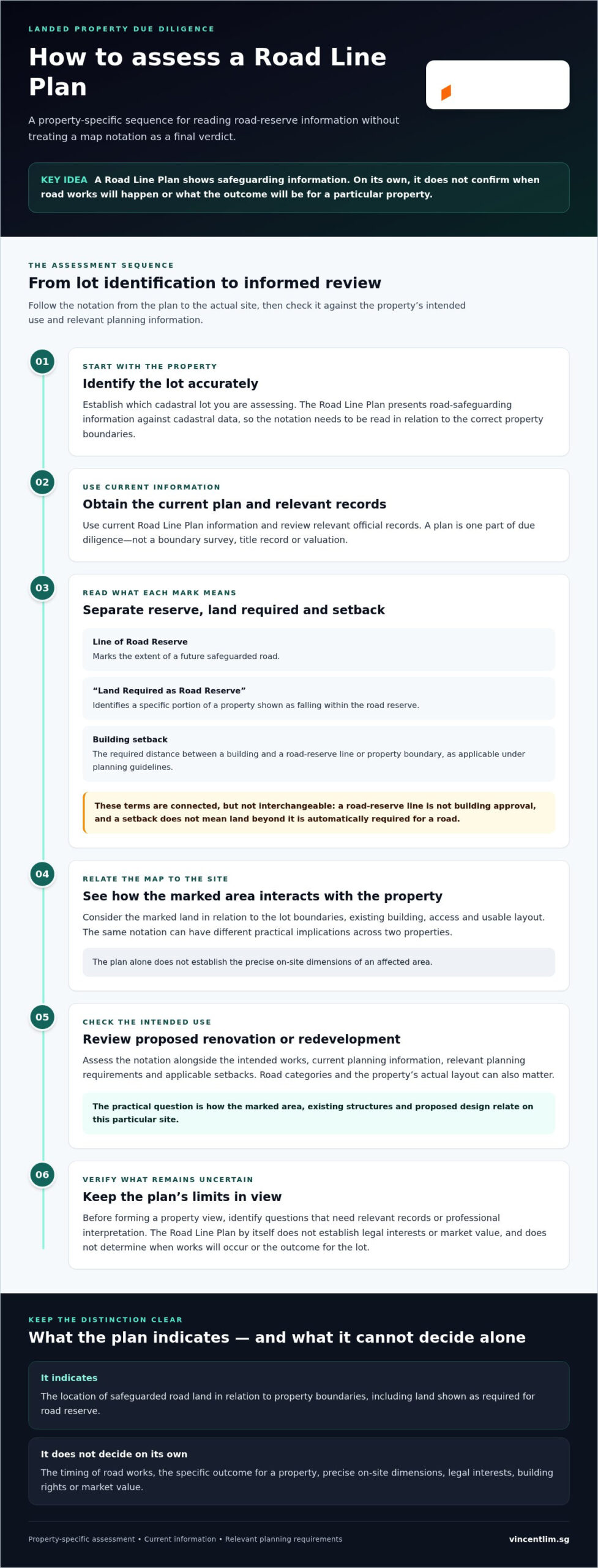
The Line of Road Reserve marks the extent of a future safeguarded road. On the Road Line Plan, locate the line in relation to the cadastral lot boundaries, then check whether the plan separately marks any part of the lot as “Land Required as Road Reserve.” The line shows a planning boundary; on its own, it does not state when road works will occur or establish the outcome for a particular property.
- Road reserve: Land safeguarded for constructing new roads or improving existing roads.
- Land Required as Road Reserve: The specific portion of a property shown as falling within the road reserve.
- Building setback: The required distance between a building and a road reserve line or property boundary, as applicable under planning guidelines.
How is road reserve different from a building setback?
A road reserve concerns land safeguarded for road purposes. A setback concerns where a building may be positioned in relation to specified lines or boundaries. One identifies a road-planning area; the other guides building placement. A setback does not mean that the land beyond it is automatically required for a road, and a road-reserve line is not itself a building approval.
Road categories also matter because the road’s function informs the applicable planning context. Do not use a line on a plan alone to infer the required setback, buildable area or construction rights. Those questions depend on current planning information and the specific site. Two properties with a road-reserve notation may have different building layouts and proposed works, so the practical implications can differ even if the map symbols look similar.
A plan indicates safeguarded road land; it does not, on its own, confirm when land will be taken or what a specific owner may build. This distinction is central to understanding the road line plan and its impact on property. For a landed-property decision, assess the marked area against the lot, existing structures and intended use, then verify the planning requirements relevant to the proposed works.
Vincent Lim’s Market Analysis and Property Valuation can help put property-specific considerations in the context of a landed-property decision, without treating a plan notation as a standalone measure of value.
Does a Road Line Plan Mean Immediate Land Loss or Lower Property Value?
No. A Road Line Plan alone does not establish that land will be taken immediately, that a particular property will be acquired or that its value must fall. It identifies road safeguarding information, but the practical outcome depends on the specific lot, current official decisions and the circumstances of any proposed works or redevelopment.
Separate a planning indication from an action affecting the property. An indicated reserve is not, by itself, confirmation that a road project has been approved or scheduled. Nor does it settle what may happen if the owner proposes building works. Assess the current plan alongside official information relevant to the property and intended use, rather than relying on the notation as a prediction.
What can and cannot be inferred from the plan?
The plan can show where safeguarded road land lies in relation to a lot and identify land marked as required for road reserve. On its own, it cannot confirm a project’s timing, whether acquisition will occur or how a future application affecting the site will be assessed. Those questions depend on current official decisions and property-specific facts, so they require verification rather than assumption.
The circumstances also matter. Under the guidance summarised for this article, a redevelopment may involve surrender of land identified as required for road reserve, while land acquisition associated with a government-initiated road project is a different process. These are not the same event. Before relying on either scenario, verify the current requirements and decisions that apply to the property through relevant official information.
How might the information matter to value or future use?
A road-reserve notation may raise questions about usable site area, building placement, access or redevelopment plans. The answers depend on where the marked land sits, the property’s existing layout and the owner’s objectives. A notation affecting a strip at the edge of one lot may have a different practical bearing from one intersecting an area central to a proposed design. The plan alone does not resolve either case.
Value also requires context. Buyers may consider uncertainty and potential planning implications, but an RLP does not set a discount or premium. Its relevance to a particular property depends on factors such as the extent and position of any affected land, current planning information, the property’s characteristics and market evidence. A broad percentage reduction would overlook these differences.
A Road Line Plan is one due-diligence input, not a valuation conclusion. The notation deserves careful review, but it is not proof of immediate loss or an automatic change in market value. For a purchase or sale decision, interpret it alongside verified property records, intended use and a property-specific Market Analysis or Property Valuation.
How to Assess a Road Line Plan Before Making a Property Decision
A reliable review starts with the correct property and proceeds from the plan to the practical question: what might the information mean for your intended use? In Singapore, a Road Line Plan can be obtained through the Singapore Land Authority’s Integrated Land Information Service (INLIS). Treat it as one record in a wider due-diligence exercise, not as a substitute for checking the lot, relevant property records and current planning information.
- Identify the lot. Match the property address and lot details to the plan. Confirm that it relates to the exact parcel under consideration, especially where a property has more than one lot or the site boundaries are not straightforward.
- Obtain current records. Access the Road Line Plan through SLA’s INLIS portal and gather relevant property information for comparison. Keep the plan’s issue details with your notes so you can distinguish the record reviewed from any later version.
- Record and interpret the notation. Note the Line of Road Reserve and any area marked “Land Required as Road Reserve.” Compare these with the lot boundaries and existing site layout. Do not estimate affected dimensions from a visual impression alone; precise site measurements may require professional interpretation.
- Assess the implications. Relate the marked area to your intended use, such as retaining the existing home, renovating or considering redevelopment. Verify material planning questions against current information from the relevant authorities before treating an implication as a confirmed constraint.
What should buyers verify against the specific property?
Check that the plan corresponds to the correct lot, then record the exact notation and its source. Compare the mapped information with property records and site details, bearing in mind that a plan, a title record and a physical survey serve different purposes. If the interpretation could affect a purchase or proposed works, seek clarification through relevant official information and appropriate professional assessment rather than relying on a map image alone.
How should findings inform a purchase or ownership decision?
Connect verified findings to the decision at hand. A buyer considering a particular redevelopment should focus on how the notation may relate to that proposal; an owner with different plans may weigh the issue differently. Keep documented facts separate from possibilities, and flag unresolved questions before relying on an assumption in negotiations or planning.
A short decision note can make the review more disciplined:
- Confirmed facts: the lot identified, the plan source and date, and the notations shown.
- Open questions: dimensions, current planning interpretation or implications for intended works that still require verification.
- Assumptions: any expected timing, acquisition, land impact or effect on value that is not established by the records reviewed.
This process turns the road line plan and its impact on property into a property-specific assessment rather than a broad assumption. For a landed-property decision, discuss your property decision with Vincent Lim, with Market Analysis and Property Valuation considered alongside the due-diligence findings.
How Vincent Lim Helps Landed-Property Clients Interpret the Implications
Once the Road Line Plan and related property information have been reviewed, the next task is to understand how the findings fit the decision ahead. Vincent Lim is an Executive Associate Director at OrangeTee & Tie, focused on landed residential property sales in Singapore. 70 % of Vincent’s transactions are in landed property, reflecting the focus of his work.
His role is to help buyers and sellers assess a property in its market context. A road-reserve notation may raise questions about a site’s future use, but it is not a complete measure of value or a legal or planning determination. Keeping those distinctions clear helps clients consider the information carefully without drawing conclusions beyond what the records support.
Property-specific analysis for landed homes
Market Analysis formulates a pricing strategy based on current market transactions and asking prices. In a decision involving a Road Line Plan, this market perspective can be considered alongside the property’s individual characteristics and the buyer’s or seller’s priorities. It helps frame the discussion; it does not convert a planning notation into a confirmed constraint or predict a future sale price.
Property Valuation provides the latest valuation to help optimise the selling price. For sellers, this offers a property-specific reference point when considering market positioning. A valuation is not a legal conclusion about road-reserve rights, nor does it replace current official planning information. It informs the property decision without promising a particular outcome.
A transparent process for buyers and sellers
Clear communication matters when a plan notation, property records and market considerations need to be weighed together. Vincent’s approach centres on transparent communication and an efficient, customised process. This helps clients understand what is established, what remains an open question and how those considerations relate to their objectives. For a seller, that may mean discussing how the property is positioned in the market; for a buyer, it may mean weighing available information against intended use and priorities.
Vincent has been actively engaged as a real-estate agent since 2000. He received the EdgeProp Excellence Awards title “Top 6 Transactor – Landed” in 2022 and 2023. Each property decision remains specific to its facts and the client’s plans.
Understanding the road line plan and its impact on property requires careful due diligence and a realistic view of the market. Vincent can bring those perspectives into the same discussion without presenting a plan notation as a guaranteed valuation or outcome. Discuss your landed-property plans with Vincent Lim to consider the relevant property information and transparent next steps for your decision.
Make Your Next Property Decision With Clarity
A road-related planning notation deserves attention, but it need not define your decision before its relevance to the specific property is understood. Treat the road line plan and its impact on property as one factor to assess alongside your plans for the landed home, current market context and verified property information. A measured review can help separate what is documented from what still needs clarification.
Vincent Lim focuses on landed residential property sales in Singapore, and 70 % of Vincent’s transactions are in landed property. He received the EdgeProp Excellence Awards title “Top 6 Transactor – Landed” in 2022 and 2023. His CEA Registration Number is R026632B. His approach combines transparent communication with Market Analysis and Property Valuation, without treating a planning notation as a guaranteed outcome.
If you’re weighing a purchase or considering a sale, take the next step with a clear understanding of the questions that matter to your plans. Discuss your landed-property plans with Vincent Lim or call 9007 5980 to consider a transparent path forward.
Frequently Asked Questions
How can I obtain the current Road Line Plan for a property?
Obtain the Road Line Plan through the Singapore Land Authority’s Integrated Land Information Service (INLIS), the official access route identified for purchasing the plan. Check the current INLIS instructions before submitting a request, as portal steps may change. Use the property’s exact lot details to avoid retrieving a plan for a neighbouring parcel. Keep a copy of the plan and its date with your purchase or ownership records for reference.
Does a Road Line Plan show when road works will take place?
No. The plan presents road safeguarding information, but it is not a works schedule. A line or marked area is not confirmation that a project has been approved, funded or assigned a construction date. If timing could affect your plans, look for current announcements or decisions from the relevant authorities and distinguish those from the plan itself. A buyer’s intended renovation timeline, for example, cannot be inferred from a reserve notation alone.
Can an existing landed house be affected even if I do not plan to rebuild?
Possibly, but the answer depends on the property and any official action relating to it. A road reserve indication does not by itself mean an existing house must immediately change or that land will promptly be taken. Review the current plan and relevant official information for the specific lot. If a government-initiated road project or future works are raised, verify the details and their implications against current official decisions.
Does a Road Line Plan automatically reduce a property’s market value?
No. A plan notation does not establish a standard discount or determine what a buyer will pay. Its relevance depends on details such as the marked land’s position, the site layout, intended use and verified planning circumstances. The implications may differ for a buyer planning to retain a house and one assessing redevelopment. A property-specific valuation should consider appropriate market evidence and verified facts, rather than applying an automatic reduction because a notation appears.
Is a road reserve the same as a building setback?
No. A road reserve is land safeguarded by the Land Transport Authority for constructing or improving roads. A building setback is the required distance a building must keep from the road reserve line or relevant property boundaries under applicable Urban Redevelopment Authority guidelines. The reserve describes land designated for road purposes; the setback concerns building placement. Check the current plan and planning guidance together, since one term does not establish the requirements represented by the other.
Should I check the Road Line Plan before making an offer on a landed property?
Yes, include it in due diligence before finalising your decision. Use the plan to identify road-related notations for the correct lot, then compare them with property records, the site and your intended use. If a notation could affect a renovation or redevelopment plan, identify what requires official clarification before relying on an assumption. The plan is one input among several, so weigh it alongside the property’s condition, market context and other purchase considerations.
Can a Road Line Plan confirm whether land will be acquired?
No. The plan can identify land shown as required for road reserve, but that notation alone does not confirm whether or when acquisition will occur for a particular property. The circumstances may differ between land affected by redevelopment and land involved in a government-initiated road project. Check current official information and decisions for the specific lot before making assumptions about acquisition, compensation or timing. Treat each as a separate question requiring property-specific verification.