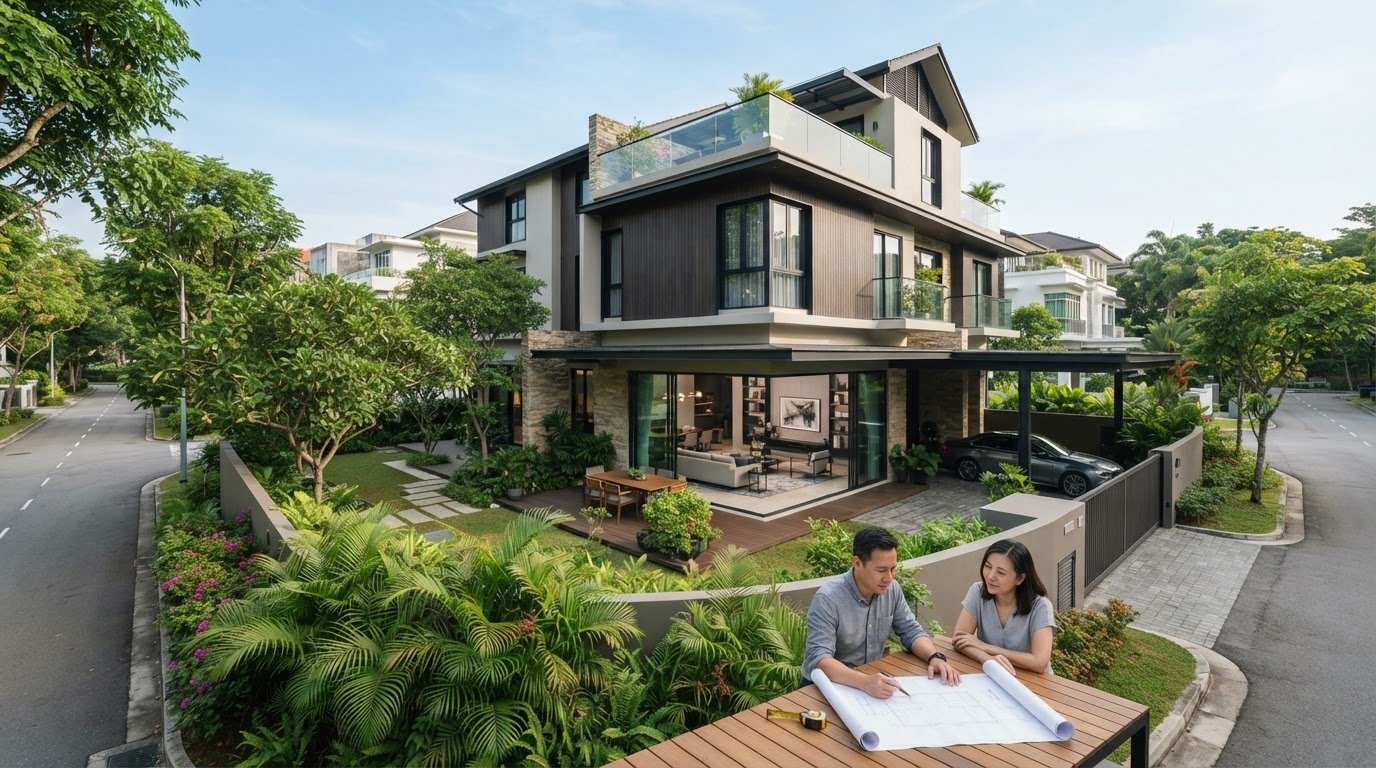
The bank’s maximum loan is not the same as your true landed-property budget. If you’re researching financing a landed property purchase singapore, plan for the full commitment, including cash and CPF funds, possible valuation gaps and the ongoing cost of borrowing.
It’s understandable if the numbers feel difficult to bring together. A first housing loan may be subject to a 75% loan-to-value limit, with at least 5% of the purchase price payable in cash. TDSR rules and the bank’s assessment also shape how much you can borrow. If the bank values the property below your agreed price, you may need to fund the difference yourself.
This 2026 guide explains the main financing checks and upfront commitments so you can build a realistic funding plan before making an offer. It also shows how to align borrowing capacity with your property choice and transaction milestones, so you assess the whole commitment rather than relying on the headline loan figure alone.
Key Takeaways
- Map the full purchase commitment, separating the property price from duties, legal expenses, immediate costs and post-completion reserves.
- Understand how LTV, TDSR, loan tenure and your borrower profile shape a bank’s assessment. Maximum borrowing is not guaranteed approval.
- Compare bank financing, eligible CPF use and construction financing by eligibility, timing, effect on liquidity and fit for the property or project.
- Review cash flow, obtain a lender assessment and plan your offer before exercising an option.
- Make financing a landed property purchase singapore part of a broader decision that considers property type, condition, intended works and holding plans.
Financing a Landed Property Purchase in Singapore: What the Commitment Includes
A landed-home purchase is funded through loan proceeds and the buyer’s eligible funds, coordinated around payment deadlines. The approved loan quantum is the amount a lender is prepared to lend, but it is only one part of the total commitment. Your plan must also account for cash and CPF contributions, duties, transaction expenses and money set aside for costs after completion.
Start by separating the property price from the full cash-flow commitment. Some payments are due before the loan is disbursed, and the bank’s valuation may be lower than the agreed price. Plan separately for any resulting shortfall and for costs the loan does not cover.
Which landed property types affect the financing plan?
Terrace, semi-detached, detached and Good Class Bungalow purchases can differ in price, land attributes, condition and intended works. A home that needs substantial repairs or alterations may require more accessible funds after completion than one ready for occupation. The property category alone does not determine the loan outcome. The valuation, borrower’s circumstances and lender assessment also matter. For context on land administration in Singapore, the Singapore Land Authority (SLA) oversees land registration and manages state land.
What belongs in the full purchase budget?
Break the budget into separate costs rather than treating the downpayment as the only upfront commitment. For a first housing loan, the maximum LTV limit is 75%, subject to applicable rules and assessment. The remaining purchase funding is not necessarily all cash: eligible CPF savings may be used for permitted costs, while minimum cash requirements and payment timing affect how much liquidity you need. Check current CPF and IRAS guidance for your circumstances.
- Purchase funding: Cash and eligible CPF contributions toward the downpayment, plus the loan-funded portion.
- Buyer’s Stamp Duty (BSD) and, where applicable, Additional Buyer’s Stamp Duty (ABSD): Amounts depend on the property and your circumstances. Confirm the applicable treatment with current IRAS guidance.
- Transaction expenses: Allow for legal expenses, valuation costs and other relevant purchase costs.
- Post-completion reserves: Retain funds for moving, immediate repairs, planned works and ongoing ownership expenses.
These costs have different payment schedules and funding rules. List each amount alongside its due date to see which payments need cash, which may use CPF and when loan proceeds are expected. This helps protect a reserve for the home’s first months of ownership. Your plan should reflect your finances and the property, rather than rely on a standard figure for every landed purchase.
How Banks Assess a Singapore Landed-Property Mortgage
A lender assesses both the property and the borrower before deciding how much to lend. For landed homes, the indicative loan amount depends on the applicable Loan-to-Value (LTV) limit, the bank’s valuation, your income, existing debt and the proposed loan tenure. Understanding these checks makes financing a landed property purchase singapore a considered decision, rather than an assumption based on the asking price.
How do LTV and TDSR shape borrowing capacity?
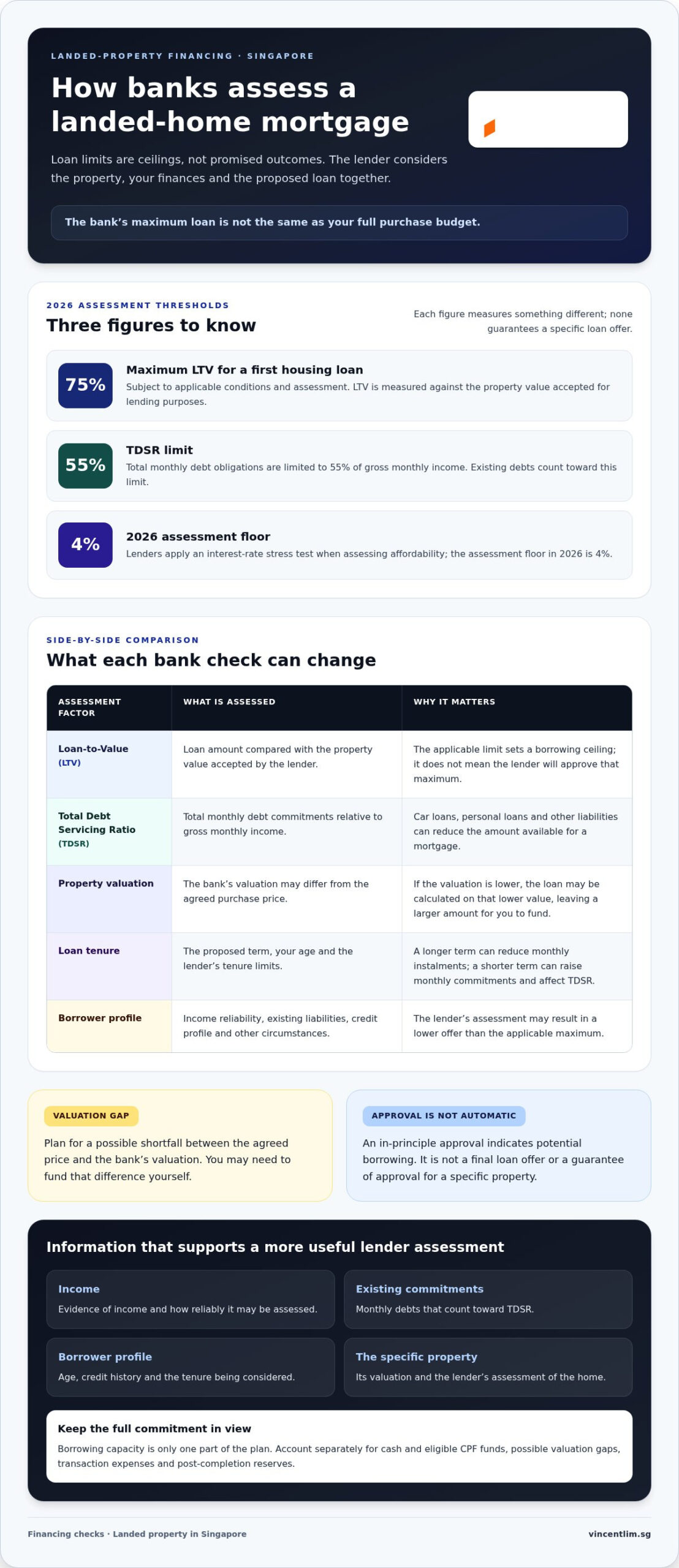
LTV measures the loan against the property value accepted for lending purposes. Under the 2026 framework, the maximum LTV for a borrower’s first housing loan is 75%, subject to applicable conditions. TDSR limits total monthly debt obligations to 55% of gross monthly income. It includes existing debt commitments, so car loans, personal loans and other liabilities can reduce the amount available for a mortgage. See the MAS property financing rules for the regulatory framework.
These thresholds are ceilings, not promised outcomes. A bank may offer less after considering income stability, credit profile, liabilities and its assessment of the property. Lenders also apply an interest-rate stress test when assessing affordability. The assessment floor in 2026 is 4%. The actual loan offer and repayment terms depend on the lender’s assessment and your circumstances.
Why can valuation and tenure change the loan plan?
The agreed purchase price and the bank’s valuation may differ. If the lender values the property below the negotiated price, the loan calculation may be based on the lower assessed value, leaving you to fund a larger portion of the price. This can matter particularly for distinctive homes where comparable transactions may be limited. Include a possible valuation gap in your plan rather than assuming the loan will cover a fixed share of the agreed price.
Loan tenure affects monthly repayments and total borrowing capacity. A longer term can reduce monthly instalments, but your age and the lender’s tenure limits may constrain the term available. A shorter term can increase monthly commitments and affect TDSR calculations. Neither tenure nor loan size can be determined from the property category alone.
Prepare for a more useful lender assessment
Before making an offer, organise the information that shapes the lender’s assessment. An in-principle approval can indicate potential borrowing, but it is not a final loan offer or a guarantee of approval for a specific property.
- Income: Assemble evidence of income and consider how the lender will assess its reliability.
- Existing commitments: List monthly debts that count toward TDSR.
- Borrower profile: Review your age, credit history and the tenure you are considering.
- Property details: Compare the likely valuation with the agreed price.
- Offer readiness: Keep funds available for a valuation shortfall and payments due during the transaction.
With lending capacity clearer, property-market perspective can help align your price range and home type with your plans. Explore landed-property purchase considerations as you refine your shortlist.
Compare Financing Routes Before Committing to a Landed Home
Different funding routes can work together, but they serve different purposes. A bank mortgage provides loan proceeds subject to lender approval. Eligible CPF savings may fund permitted parts of a purchase. Construction financing may be relevant when buying land and building, rather than acquiring a completed home. Cash and CPF are funding sources, not substitutes for mortgage approval. Compare each route by fit, timing and effect on available liquidity as you plan financing a landed property purchase singapore.
| Route | Eligibility and fit | Timing | Liquidity impact |
|---|---|---|---|
| Standard bank mortgage | Commonly considered for a completed or resale home. Approval depends on the borrower, property valuation and lender terms. | Coordinate the lender’s assessment, valuation, approval and loan disbursement with the purchase milestones. | Reduces the amount funded directly by the buyer, but still requires buyer funds for the balance and costs not covered by the loan. |
| Eligible CPF use | May be used for permitted purchase costs, subject to CPF rules and the buyer’s eligibility. | CPF use must be arranged in line with the transaction’s payment schedule and applicable procedures. | Can reduce cash outlay, while using savings that would otherwise remain in CPF accounts. It does not increase the lender-approved loan. |
| Construction financing | May be relevant when purchasing land for a build or financing construction, rather than buying a completed home. Project and borrower eligibility depend on lender requirements. | Some arrangements may release funds progressively as construction reaches specified stages. The structure and requirements depend on the lender and project. | Funding may be drawn over time, but buyers need to plan for land, construction and other payments not covered by financing. |
When may a standard bank mortgage suit the purchase?
For a completed landed home, a standard mortgage is generally the main loan route to assess. Treat approval, valuation and disbursement as separate milestones: an early indication of borrowing capacity does not replace a property-specific assessment or final loan offer. Set your purchase timeline around the lender’s process, and allow for a valuation that differs from the negotiated price. Rates and terms vary, so build your plan around confirmed terms rather than an assumed rate.
When might construction financing be relevant?
Buying a completed house is different from buying land and commissioning a build. Construction financing can have project-specific criteria and may involve staged disbursement, so do not assume a completed-home mortgage will apply in the same way. Understand the project’s financing structure and requirements before committing to the land or works. Eligibility to buy landed residential property is also a separate consideration. The Residential Property Act sets out relevant ownership restrictions.
The suitable mix depends on your circumstances, the property and the project. Compare how much cash remains accessible after each funding choice, then align the route with the purchase and construction schedule.
Build a Purchase-Ready Financing Plan Before Exercising an Option
A sound plan turns an indicative loan figure into a funding schedule you can act on. Before making an offer, map the money available to you, the payments due at each stage and the expenses that continue after completion. This makes financing a landed property purchase singapore a more deliberate process, without relying on every available dollar to complete the transaction.
What should buyers calculate before making an offer?
Use this step-by-step review to test both affordability and timing:
- Review cash flow. Identify available cash, regular income, existing debt payments and upcoming financial commitments.
- Separate funding sources. Estimate eligible CPF funds, potential loan proceeds and cash required for the purchase. Treat loan assumptions as provisional until the lender completes its assessment.
- List transaction expenses. Include applicable duties, legal expenses, valuation and other purchase costs, as well as moving expenses and immediate repairs.
- Model ongoing ownership. Add expected mortgage instalments to maintenance, insurance, utilities and planned works. Test whether the budget remains manageable if income changes or other liabilities rise.
- Protect a reserve. Set aside a contingency for unexpected repairs and post-completion costs instead of committing all available funds to the transaction.
For example, a property that appears affordable based on its expected loan may still pressure your cash flow if it needs immediate work. Assess the home’s condition and planned improvements alongside the monthly repayment, not as an afterthought. Integrating these commitments into a broader financial strategy with advisory firms like Zenith Wealth can help preserve long-term liquidity while undertaking such large-scale capital commitments.
Which checks should happen before an Option to Purchase commitment?
Before committing to an Option to Purchase, bring your financing assumptions and the transaction schedule together. Review indicative borrowing capacity, understand how the lender will value the property and allow for the possibility that its valuation differs from the agreed price. An indication of borrowing is not final approval, so keep funds needed for early payments separate from funds expected later through CPF use or loan disbursement.
Coordinate anticipated payment dates and required funds with the relevant transaction professionals. The aim is to understand the sequence and prepare, not to replace professional legal guidance or make decisions based on an assumed timeline. If the property needs repairs or planned works, include their timing in your reserve.
A disciplined financing plan also helps refine which landed homes are realistic to consider, based on price, condition and intended use. For property-market perspective as you shape your shortlist, explore landed-property purchase considerations with Vincent Lim.
Connect Financing Readiness to the Right Landed-Property Purchase
Financing capacity should help define a sensible search range, not dictate which home you must buy. Bring your funding plan together with the property’s condition, land attributes, intended works and expected holding period. This wider view helps you compare what each purchase may require beyond the initial price.
How should financing capacity inform property selection?
Terrace, semi-detached, detached and Good Class Bungalow homes represent different property choices, but category alone does not determine affordability or suitability. Compare each shortlisted property against your expected loan, available buyer funds and the cash you want to retain. Then consider how condition, layout, land characteristics and intended improvements may affect the funds needed after completion.
For instance, a home that fits the purchase budget may still require a larger reserve if you plan substantial works. Holding plans matter too: a buyer intending to stay long term may weigh future alterations differently from someone prioritising flexibility. Consider these factors together rather than ranking homes by headline price alone. For a more detailed property-type comparison, refer to the relevant landed-property acquisition guide alongside your funding assessment.
Property-market perspective can add useful context. Vincent Lim works with landed-property sales, from terrace houses to Good Class Bungalows, and can help frame questions about the acquisition and how a home fits your priorities. Financing decisions remain part of your assessment with the relevant financial professionals. Property selection is a separate, closely connected decision.
What is a practical next step for prospective buyers?
Prepare a short purchase brief before progressing your search. Include:
- Financing assumptions: Indicative borrowing, available cash and eligible CPF funds, with a reserve you intend to preserve.
- Property priorities: Preferred home type, condition, land attributes and any works you may consider.
- Purchase timing: Your intended timeframe and transaction milestones that matter to your plans.
- Holding intentions: How you expect to use the home and your anticipated ownership horizon.
This brief gives property discussions a clear foundation. It can help narrow your search to homes that align with your priorities and financial readiness, without treating a preliminary budget as a final decision. A considered landed-property acquisition is built through clear requirements, careful comparison and coordinated planning.
Discuss your landed-property plans with Vincent Lim to explore your requirements and potential next steps.
Move Forward With a Clearer Purchase Plan
A confident landed-home purchase begins with a complete funding picture. Look beyond the potential loan to account for upfront payments, duties, transaction expenses and a reserve for work after completion. Then consider how lender assessment, valuation and repayment commitments fit your cash flow. This is the foundation of financing a landed property purchase singapore buyers can plan around with greater clarity.
Financing readiness can also sharpen your property search. Terrace, semi-detached, detached and Good Class Bungalow homes each call for careful consideration of price, condition, land and intended use. Your budget should guide the shortlist, while your priorities determine which property is the right fit.
Vincent Lim, an OrangeTee & Tie Executive Associate Director active in Singapore real estate since approximately 2004, works with buyers across these landed-property categories. His market perspective can help you assess property choices and plan the acquisition process, while mortgage decisions remain with the relevant financial professionals.
Discuss your landed-property plans with Vincent Lim and take the next step with a considered brief, clear priorities and a financing plan that supports your goals.
Frequently Asked Questions
Can I get a mortgage for a landed property in Singapore?
Yes, a bank mortgage may be used to finance a landed property purchase in Singapore, subject to the lender’s assessment. The lender considers factors such as your income, existing debts, credit profile, age, loan tenure and its valuation of the property. The maximum loan permitted under applicable limits is not guaranteed approval. Obtain an indicative assessment early, then account for the specific property and the lender’s final terms before committing.
How much downpayment do I need for a landed property in Singapore?
For a first housing loan with a 75% LTV limit, the downpayment is at least 25% of the relevant property value, subject to applicable rules and lender assessment. At least 5% of the purchase price must be paid in cash, while the remaining 20% may be funded with cash and/or eligible CPF savings. Other loan situations may have different limits, so calculate your funding needs based on your circumstances.
What happens if the bank valuation is lower than the purchase price?
If the lender’s valuation is below the agreed purchase price, the loan may be calculated using the lower assessed value rather than the price you negotiated. You may therefore need more buyer funds to cover the gap, in addition to the usual downpayment and transaction costs. If you agree to pay above the valuation, do not assume the lender will finance that difference. Build a valuation-gap allowance into your purchase plan.
Can CPF savings be used to finance a landed property purchase?
Eligible CPF savings may be used for permitted parts of a private residential property purchase, subject to CPF rules and your eligibility. Depending on your circumstances, CPF may contribute toward the purchase or mortgage payments. It does not replace lender approval, and CPF use does not remove any minimum cash requirement. Before relying on CPF funds, check current CPF guidance and coordinate the expected usage with the transaction payment schedule.
How does TDSR affect a landed-property mortgage application?
TDSR limits a borrower’s total monthly debt obligations to 55% of gross monthly income under the current framework described in this guide. The calculation includes the proposed mortgage and other relevant debts, such as existing loan repayments. As a result, a buyer with substantial monthly liabilities may qualify for less than the property’s LTV limit allows. For anyone researching financing a landed property purchase singapore, TDSR is a key affordability check, not a loan guarantee.
Can a foreigner buy landed property in Singapore and obtain financing?
Foreigners generally need special approval from the Singapore Land Authority to buy landed property in Singapore, and approval is rare. Applicants typically need to be Permanent Residents for at least five years and have made significant economic contributions. Any financing remains a separate matter, assessed by the lender against the buyer and property.
Is construction financing different from a mortgage for a completed landed home?
Yes. A mortgage for a completed landed home finances an existing property, while construction financing may apply when buying land and building a home or funding construction works. Some arrangements release funds progressively as the project reaches specified stages, subject to lender terms and project eligibility. Do not assume the same criteria or disbursement schedule apply to both routes. Include land, construction payments and buyer-funded costs in the project’s overall cash-flow plan.