
What if a planning change makes an area more attractive but leaves a property’s own development potential unchanged? That distinction sits at the heart of the impact of URA master plan on property value. Singapore’s URA Master Plan 2025 is now the statutory land-use plan, but a planning signal isn’t a promise of future construction, stronger demand or a higher sale price.
It’s understandable to see a new transport link, a change in land use or a proposed community hub as a potential advantage. The challenge is determining whether it affects a specific property, when any benefit might materialise, and what could still change. Location, site characteristics, market conditions and buyer demand all matter alongside planning information.
This article explains the main ways the Master Plan can influence value, from land-use designations and development potential to connectivity and neighbourhood amenity. It also sets out how to check the relevant planning details, distinguish confirmed plans from uncertain outcomes, and weigh them against other property factors. With a disciplined, property-specific assessment, you can make a more informed decision about buying, holding or selling without treating a proposal as a guaranteed gain.
Key Takeaways
- The impact of URA master plan on property value depends on how planning provisions relate to the specific site, not just the wider area.
- Land use, plot ratio, building controls and permitted activities can shape a property’s potential, but site-specific rules need to be checked.
- Transport and public-realm improvements may influence accessibility and buyer expectations, while also carrying uncertainty around delivery and impact.
- Learn how to distinguish confirmed planning provisions from proposals and market commentary before weighing their possible effect.
- Use a structured assessment of planning information, property characteristics and market context to inform a buying, holding or selling decision.
What the URA Master Plan Means for Singapore Property Value
The Urban Redevelopment Authority (URA) Master Plan is Singapore’s statutory land-use plan. It sets out how land may be used and developed, including planning parameters that guide what can be built. As of September 2026, the gazetted Master Plan 2025 replaces the 2019 plan and guides development over the next 10 to 15 years.
In brief: the Master Plan sets the planning framework for land use and development; it does not set a property’s market price or guarantee that its value will rise. Its provisions can affect a property’s permitted use or potential, but an actual transaction price depends on what buyers are willing to pay and other property-specific and market factors.
How the Master Plan differs from long-term planning and project approval
Singapore’s plans work at different levels. Long-term strategic planning establishes the broad direction for the country’s physical development; URA’s Long-Term Plan Review is the current framework for considering needs over a longer horizon. The Master Plan translates that direction into more detailed land-use planning. For background on Singapore’s urban planning framework, readers can also consult this overview.
A land-use designation is not confirmation that a particular building, transport link or public facility will be constructed. A specific development still requires the relevant project planning and approvals. Before relying on a planning change, check its status, applicable amendments and any project-specific information through URA’s official sources. Treat a confirmed plan provision, a proposal and informal market commentary as different levels of evidence.
Why planning information is only one property-value factor
Planning can influence how a site may be used, the development parameters that apply, or how buyers perceive its utility and future options. These effects may inform demand, but they don’t assure appreciation. A designation that appears favourable on a map may have limited practical relevance to an individual property, while restrictions or nearby uses may also matter.
Value is shaped by several factors together. Location attributes, the property’s condition, tenure and prevailing market conditions can all affect buyer interest and transaction outcomes. For example, a planning provision that allows a broader use does not by itself establish that redevelopment is feasible, approved or financially worthwhile.
For a sound assessment, start with the exact site and the current official planning information, then consider how the provisions relate to the property’s existing characteristics. The impact of URA master plan on property value is therefore a property-specific question, not a uniform result that can be inferred from a broad area announcement. Verify the documents and seek qualified advice where interpretation or development potential is uncertain.
How URA Planning Can Influence Property Value Through Land Use and Development Potential
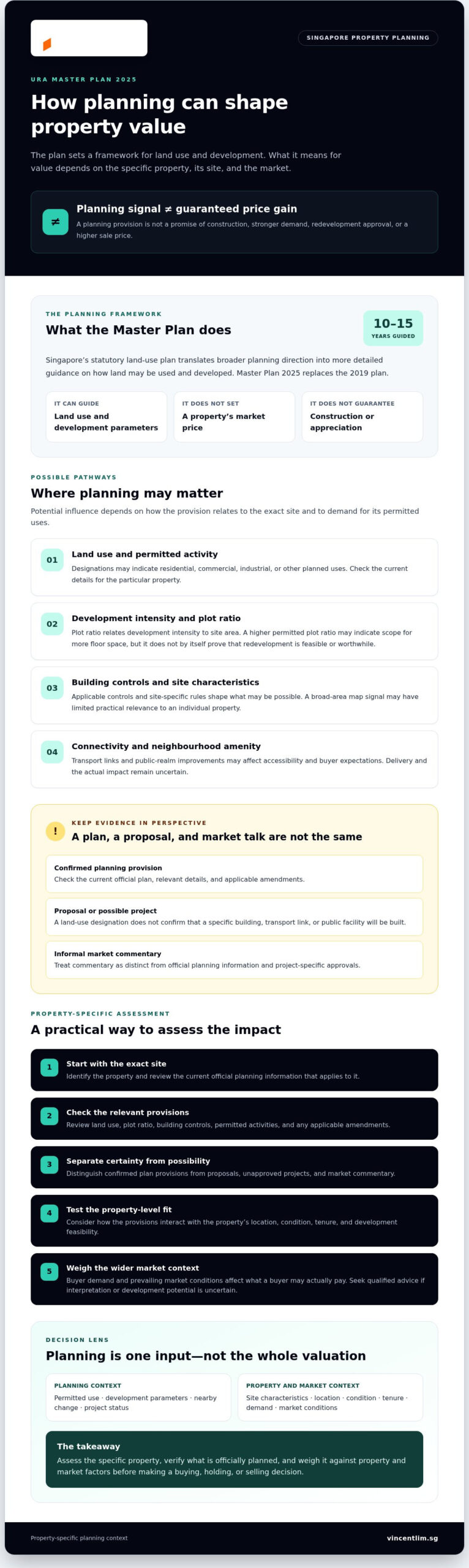
The impact of URA master plan on property value depends on how planning provisions interact with a particular site and the demand for its permitted uses. The main pathways are land use, development intensity, building controls and changes to the surrounding environment. These provisions may affect a property’s utility or future options, but they don’t translate automatically into a higher transaction price.
Planning can influence value through permitted use, development options and buyer demand, not through automatic price increases. That distinction helps separate what the plan allows from what a buyer may actually pay.
Land use, zoning, and plot ratio
URA’s land-use designations indicate the broad uses planned for different sites. Depending on the designation and applicable controls, a site may be intended for residential, commercial, industrial or other uses. The permitted activity and detailed requirements must be checked against the current planning information for the exact property. The Official URA Master Plan is the appropriate starting point for reviewing the plan and its details.
Plot ratio is a planning parameter that expresses development intensity in relation to a site’s area. A higher permitted plot ratio may indicate scope for more floor space, but it does not confirm that a larger development is approved, technically feasible or financially worthwhile. Building controls and other site conditions also matter. For an existing home, theoretical redevelopment capacity should never be treated as an established sale premium without further assessment.
Transport, amenities, and changes to the surrounding environment
Improved access to transport, services or public spaces may make daily travel and local living more convenient. If buyers value those attributes, expectations and demand could change over time. The effect is not uniform: it depends on the improvement’s confirmed status, its practical relevance to the property and how prospective buyers respond.
There can be trade-offs. Construction may bring noise, access changes or temporary disruption. New development may also add housing or commercial space, changing the surrounding environment and the choices available to buyers. Whether those changes help or weigh on a particular property depends on their scale, timing and proximity, so check project information rather than relying on broad claims.
For any transport proposal, distinguish an official commitment from a concept, study or market rumour. Where a relevant project is mentioned, verify its current status with the responsible agency, including the Land Transport Authority for transport matters. The impact of URA master plan on property value is best assessed by weighing confirmed planning information against the property’s characteristics and market context. Owners of landed homes or luxury residences may find property-specific perspective useful when considering how planning provisions relate to an individual asset.
Do URA Master Plan Changes Increase or Reduce Property Value?
Not by themselves. A favourable planning signal may support buyer interest if it improves a property’s practical use, access or surroundings. But a land-use change or proposed project cannot establish what a future buyer will pay. The impact of URA master plan on property value depends on the provision’s status, its relevance to the specific property, and wider market conditions.
Keep three kinds of information distinct: provisions in the current gazetted plan, proposed changes that may still evolve, and unverified market commentary. News coverage, such as this account of Latest Master Plan updates, can help explain proposals, but it should not replace checking current official planning documents or project status.
| Planning change | Plausible positive channel | Potential downside | Evidence to check |
|---|---|---|---|
| Improved transport access | Greater convenience may broaden buyer interest. | Construction can cause disruption; benefits depend on delivery and actual access. | Current agency information on project status, route, works and timing. |
| Changed land use or development parameters | Broader permitted uses or options may improve a site’s utility. | New development can add competing supply or change the surroundings. | Applicable URA provisions for the exact site, plus relevant approvals. |
| Conservation or other controls | Preserving a building’s character may appeal to buyers who value it. | Controls may limit alterations or redevelopment choices. | Property-specific conservation status and current requirements. |
Potential upside: accessibility, permitted uses, and buyer demand
Where an adopted provision or confirmed improvement makes a property more useful or convenient, it may strengthen its appeal to some buyers. The effect is not automatic: a transport project must be assessed for its actual proximity and accessibility, while any expanded use must apply to the property itself. Anticipated demand is not the same as observed demand, and a price movement should not be attributed to one planning event without supporting market evidence.
Potential trade-offs: added supply, restrictions, and disruption
Development can bring services and amenities, yet additional homes or commercial space may also give buyers more alternatives. Conservation controls may protect a building’s character while narrowing alteration or redevelopment options. Construction impacts and timelines vary by project, so verify them with relevant official sources rather than relying on general claims.
A favourable planning signal alone cannot establish future resale value. Assess the exact property, the current rules, the status of any related project and comparable market evidence before drawing a conclusion. This balanced approach helps distinguish a credible opportunity from an assumption.
How to Assess the URA Master Plan for a Specific Singapore Property
Start with the property itself, not a headline about an area. The impact of URA master plan on property value depends on the exact site, the planning provisions that apply to it and how those provisions relate to the asset. Use this checklist to move from general claims to verifiable information.
- 1. Identify the exact site. Confirm the property parcel and address, then consult the current URA planning resources. Avoid relying only on a broad map view or a description of the surrounding area.
- 2. Record the applicable planning details. Check the designated land use and relevant development parameters, such as plot ratio and building controls. Where applicable, verify conservation status and other site-specific restrictions.
- 3. Compare planning provisions with existing use. Consider whether the property’s current use aligns with the plan and whether any apparent development option is actually available. Planning capacity alone doesn’t establish approval, feasibility or financial viability.
- 4. Establish the status of nearby changes. Separate adopted plan provisions from proposals, works in progress and unverified commentary. Check the responsible agency’s latest information, any stated timeline and evidence of implementation before factoring a project into your assessment.
- 5. Test the implications for this asset. Consider property type, condition, tenure and feasible use. A change may matter differently to an owner-occupier seeking convenience, an investor assessing buyer demand, or a redevelopment buyer evaluating site constraints.
- 6. Confirm your interpretation. Where planning parameters or development potential are unclear, seek confirmation from suitably qualified professionals. Keep the documents and assumptions behind your assessment on record.
Then connect the planning evidence to the factors buyers actually assess. A transport improvement could affect convenience, for example, but its relevance depends on confirmed status, access from the property and buyer priorities. For a landed home, the plan’s parameters must be considered alongside the site and the existing building, rather than treated as proof that redevelopment will be possible. Readers reviewing landed options may also find the considerations in The Ultimate Guide to Buying a Terrace House relevant.
Planning is only one part of a valuation. Compare it with property characteristics and relevant market evidence, as explained in How Landed Property Valuation is Calculated. This helps prevent an appealing planning signal from overshadowing condition, tenure or the preferences of likely buyers.
For a property-specific discussion of planning context alongside landed homes or luxury residences, discuss your property assessment.
Make a More Informed Property Decision with URA Planning Context
A planning signal is most useful when placed in context. Before acting, confirm the current plan, establish whether its provisions apply directly to the property or only to its surroundings, and assess the likely effect alongside market evidence. The impact of URA master plan on property value is not a forecast by itself. It is one input to a decision that must also account for uncertainty.
Questions to resolve before buying, holding, or selling
- Buying: Which land-use provisions and controls apply to this exact property? Is the claimed benefit based on an adopted plan, an approved project, or a proposal that may change?
- Holding: Is there evidence that a planning change affects the property’s utility or likely buyer demand? Consider the asset’s condition, tenure and current market context rather than relying on an anticipated future benefit.
- Selling: Can any planning-related claim be supported by current official documents and relevant transaction evidence? Present confirmed facts clearly, and avoid pricing the property on an unverified development assumption.
For each decision, identify the source behind any claimed benefit, restriction or timeline. Compare the planning view with an independent valuation and current transaction evidence. If a project is mentioned, verify its status and the responsible agency’s latest information. This helps distinguish a factor that can be established today from an expectation that may not materialise.
Owners preparing a landed-property sale may also find Strategic Guide to Selling Your Landed Property in Singapore relevant. Any planning information used in sale materials should be accurate, current and clearly distinguished from projections.
When a property specialist can add useful context
An experienced property adviser can help connect planning research with the asset’s characteristics and the priorities of potential buyers. That perspective is particularly relevant for landed homes and luxury residences, where site conditions, permitted use and buyer expectations need to be considered together. Vincent Lim specialises in terrace, semi-detached and detached homes, Good Class Bungalows, and luxury condominiums; that experience can inform the discussion, but it cannot guarantee a valuation or sale outcome.
Use a measured framework: verify the plan, assess the property-specific effect, compare market evidence, then account for what remains uncertain. If you’re weighing a purchase, considering whether to hold, or preparing to sell, consider discussing the property and its verified planning context with an adviser familiar with the relevant asset type.
Turn Planning Insight into a Confident Property Decision
The URA Master Plan is a valuable source of planning information, but its relevance depends on what applies to the exact property and how it relates to current buyer demand. The impact of URA master plan on property value is best assessed by checking official provisions, distinguishing confirmed plans from proposals, and weighing possible benefits against restrictions and market conditions.
For a buying decision, clarify the property’s applicable controls and any assumptions behind future improvements. If you’re holding, review whether verified changes meaningfully affect the asset’s use or appeal. Before selling, support planning-related statements with current evidence and consider them alongside the property’s condition, tenure and comparable market information.
Vincent Lim (OrangeTee & Tie) specialises in landed homes, Good Class Bungalows and luxury residences, with Singapore real estate experience dating to approximately 2004. His specialist perspective can help place planning context alongside a property’s characteristics, without treating any change as a guaranteed valuation or outcome.
For a measured discussion about your property plans and verified planning context, discuss your property plans with Vincent Lim. A careful review can help you move forward with greater clarity and confidence.
Frequently Asked Questions
Does the URA Master Plan affect property value?
Yes, it can influence value by shaping a property’s permitted use, development options and surrounding environment. The impact of URA master plan on property value depends on the provisions that apply to the exact site and how buyers respond to them. Planning information is only one factor, alongside location attributes, condition, tenure and market conditions. It can inform an assessment, but it doesn’t determine a transaction price.
Can the URA Master Plan increase property prices?
It may contribute to buyer interest if a confirmed planning provision or improvement makes a property more useful or convenient. That doesn’t mean prices will automatically rise. A proposal may change or take time to implement, and any market movement can have several causes. Assess the property’s specific planning position alongside current transaction evidence rather than treating a planning announcement as a price forecast.
What is the difference between the URA Master Plan and the Concept Plan?
The Master Plan is the statutory land-use plan that sets out detailed planning intentions and parameters for land in Singapore. The Concept Plan was the term used for a longer-term strategic plan; URA’s current long-range planning work is described through the Long-Term Plan Review. In practical terms, broad long-term planning guides the direction of development, while the Master Plan translates that direction into more detailed land-use planning.
How do I check the URA Master Plan for a property?
Start with the exact property parcel and consult URA’s current Master Plan information. Check its land-use designation and applicable development parameters, including plot ratio and relevant controls. Review any amendments and distinguish current provisions from proposals or commentary. If you’re assessing nearby projects, confirm their status with the responsible agency. For questions about interpretation or development potential, seek advice from suitably qualified professionals.
Can a proposed development change nearby property values?
It may influence buyer expectations, but a proposal alone doesn’t establish that property values will change. Its status, scale, location, timing and effect on access or surroundings all matter. A project could bring amenities, while construction or additional supply may create trade-offs. Verify the proposal and any implementation details through official sources, then assess current transaction evidence before attributing a market change to it.
Does a higher plot ratio mean a property is worth more?
No. A higher plot ratio may indicate greater permitted development intensity, but it doesn’t confirm that additional floor space can be approved, built or used profitably. Site conditions, building controls and other applicable requirements can affect what is feasible. Treat plot ratio as one planning parameter, not a standalone valuation measure. Any development assumption should be checked against current site-specific information and professional advice.
Can conservation controls affect a property’s value?
Yes. Conservation controls can preserve a property’s architectural character, which may appeal to buyers who value its heritage qualities. They can also limit alteration or redevelopment options, potentially affecting the property’s appeal to buyers seeking flexibility. The effect depends on the property and the rules that apply. Check its conservation status and current requirements through official information before drawing conclusions about value or potential works.