
A new launch isn’t automatically the more suitable luxury purchase. In the resale luxury condo vs new launch decision, the central trade-off is often certainty now versus waiting for a future home. You can inspect a completed condo before purchase and, once the sale is completed, it may be ready for you to occupy or rent. A new project may require a wait of three or more years before handover.
It’s understandable to weigh modern facilities against the reassurance of seeing the actual unit and its surroundings. Payment timing differs too: new launches generally follow a progressive payment schedule tied to construction milestones, while resale purchases involve a larger payment at completion. Assess financing, taxes and ownership eligibility against your circumstances, and verify current requirements before proceeding.
This comparison will help you assess both options using consistent financial and practical criteria. We’ll look at ownership timing, cash-flow commitments, property condition and long-term flexibility, then outline due diligence to complete before proceeding. The aim is to help you identify which route better fits your priorities and investment horizon, rather than assume one is right for every buyer.
Key Takeaways
- Understand how completed resale units differ from new-launch homes, and what you can assess before committing to either.
- Compare payment timing and cash-flow demands, then verify financing eligibility and current purchase requirements for your circumstances.
- Assess the risks of each option, from resale condition and maintenance to a new project’s completion timeline.
- Use a five-step decision framework to weigh timing, budget, certainty, unit details and documents against your priorities.
- Approach the resale luxury condo vs new launch choice with a written comparison and a clear due-diligence plan before making an offer.
Resale Luxury Condo vs New Launch: What Does Each Option Actually Offer?
A resale luxury condo is an existing, completed unit offered for sale by its current owner. A new launch is a unit in a development being sold before or during its initial marketing period, usually before buyers can inspect the finished home. These options sit within Singapore’s broader housing landscape, where private condominiums exist alongside public housing in Singapore.
What changes when you buy a completed resale condo?
You can view the actual unit and assess its layout, finishes, natural light, maintenance and surrounding activity. This helps you judge how the home may suit your needs, but a viewing cannot replace checks of the unit’s condition or any repairs and renovation it may need. Resale homes vary: some may be ready for use, while others may require work.
A completed home may allow you to move in sooner, but don’t assume you can occupy it immediately. Confirm the sale’s completion arrangements, whether vacant possession is included, and the relevant dates and terms. The specific agreement matters.
What should buyers understand about a new launch?
Before completion, buyers generally assess plans, specifications, show units and project information disclosed during the sale. These materials help you understand the proposed home, but they aren’t the same as inspecting the finished unit. A show unit may use staging or finishes that don’t reflect the delivered home, so check the stated specifications and confirm what is included.
Construction and handover timing is project-specific. Review the information available for the particular development and plan for the possibility that occupation will be later than your purchase. The resale luxury condo vs new launch choice therefore involves weighing what you can verify in person against what you can assess from plans and disclosures.
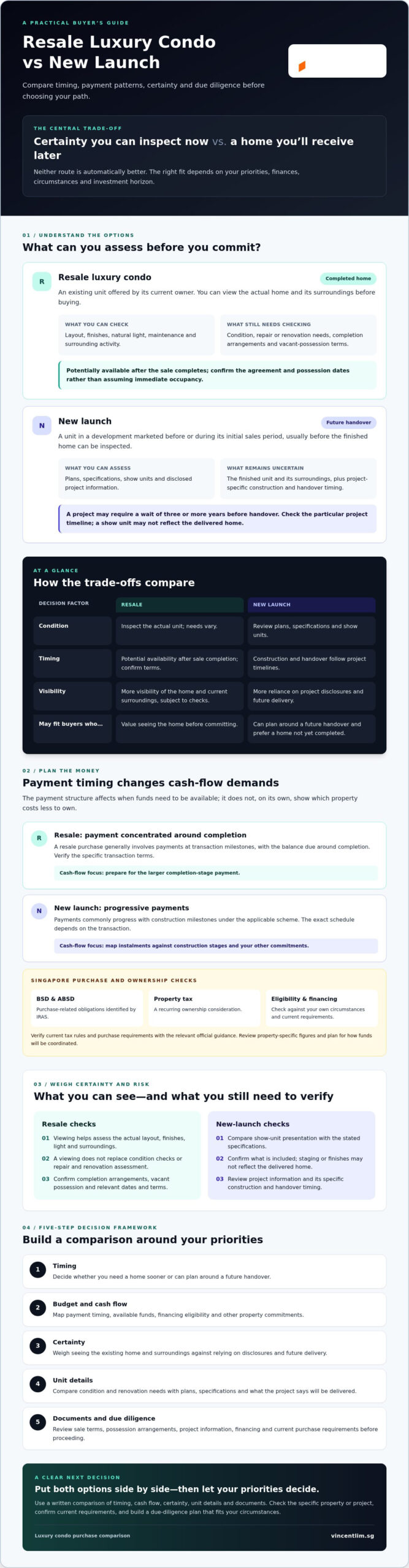
| Factor | Resale luxury condo | New launch |
|---|---|---|
| Condition | View the actual unit; condition and renovation needs vary. | Assess plans, specifications and show units before the home is completed. |
| Timing | Potentially available after completion of the sale; confirm possession terms. | Construction and handover follow project-specific timelines. |
| Certainty | Greater visibility of the unit and current surroundings, subject to checks. | More reliance on disclosed project information and future delivery. |
| Payment stages | Payment is generally concentrated around completion; verify the transaction terms. | Payments typically progress with construction milestones under the applicable scheme. |
| May suit buyers who | Value seeing the home before committing. | Can plan around a future handover and prefer a home not yet completed. |
Use the table as a starting point, not a verdict. Compare specific units and project documents, since condition, possession arrangements and delivery details can materially affect the decision.
Compare Cash Flow, Financing, and Singapore Purchase Rules Before You Choose
The payment structure affects when funds need to be available, but it doesn’t by itself tell you which property costs less to own. In Singapore, IRAS treats Buyer’s Stamp Duty (BSD) and Additional Buyer’s Stamp Duty (ABSD) as purchase-related obligations, while property tax is a recurring ownership consideration. Check current rules and your circumstances directly with IRAS. For context on market conditions, consult the latest URA property market data alongside the figures for each shortlisted property.
How do payment milestones differ between resale and launch purchases?
A resale purchase generally involves payments at transaction milestones, with the balance due around completion. A new launch commonly follows a progressive payment scheme, with instalments linked to construction stages. The precise schedule and obligations depend on the transaction, so review the sale documents and verify the process against current official guidance before committing.
This distinction matters for liquidity. Map when funds may be needed, how you’ll coordinate any existing property commitments, and whether your available cash and other resources align with the payment schedule. Staged payments don’t reduce the purchase’s overall financial commitment by themselves. They change the timing of outflows, not necessarily the total cost of ownership.
Which Singapore rules and costs should buyers verify?
Financing eligibility and loan assessment depend on the buyer and applicable requirements. Lenders assess each application according to their criteria and current rules. Discuss borrowing capacity and loan terms with relevant financial institutions, and confirm whether and how CPF funds may be used with the CPF Board or a qualified adviser. Don’t assume that a previous approval or another buyer’s experience applies to you.
Before comparing a resale luxury condo vs new launch, prepare a cost checklist that separates one-off purchase obligations from recurring expenses:
- Transaction obligations: Check the applicable BSD and ABSD treatment with the Inland Revenue Authority of Singapore (IRAS), based on your profile and purchase circumstances.
- Financing and CPF: Confirm loan assessment, available funds, payment dates and CPF use with the relevant institutions.
- Ongoing ownership: Account for recurring items such as property tax and other property-specific expenses. Verify applicable amounts and requirements before purchase.
Use the same categories to compare both options, while allowing for their different payment schedules and the details of each property. For a structured review of luxury condominium options, you can discuss your purchase priorities with Vincent Lim, an OrangeTee & Tie real estate professional. This can help organise the property comparison. Confirm financial, tax and legal questions with the appropriate qualified advisers.
Which Option Offers More Certainty, and What Risks Should You Assess?
Certainty depends on what you can verify before committing. With a resale luxury condo, you can inspect the actual unit and observe its current condition. With a new launch, you assess a proposed home through project documents and disclosures before the finished unit is available. Neither route removes risk; each leaves different questions to resolve.
What can a buyer verify more directly in a resale unit?
A viewing lets you examine finishes, fixtures, signs of wear and the layout in person. Ask for available information on maintenance and management, and arrange appropriate property-specific checks. Renovation needs and future upkeep vary by unit, so don’t assume an older home automatically requires extensive work or that a well-presented one has no issues.
Review the title, tenure, transaction documents and other relevant records with qualified professionals. An inspection provides useful evidence, but it can’t establish every legal, structural or future maintenance matter on its own. Confirm what is documented and what requires specialist review.
What remains uncertain before a new launch is completed?
Study the project’s approvals, plans, specifications, developer disclosures and contractual documents. Confirm the stated completion and handover framework in authoritative project documents, and note what each document does and doesn’t establish. If borrowing is part of your plan, review applicable MAS financing regulations and confirm your circumstances with a lender or qualified adviser.
Plans and published specifications describe the proposed development; they don’t guarantee how the completed home will feel to live in. A show unit may not represent every detail of the delivered unit. Completion experience, future rental demand and capital appreciation are not assured outcomes, so treat projections as uncertain rather than established facts.
In brief: A resale viewing can reveal observable details such as the unit’s present layout, finishes and visible condition, while records and professional checks can help assess other property-specific matters. At launch stage, buyers rely more heavily on plans, specifications and disclosures. The finished unit and handover experience are still to come, while future market outcomes remain uncertain.
For the resale luxury condo vs new launch decision, separate what you have directly observed from what documents state and what remains an assumption. This creates a clearer due-diligence list and helps you compare options without mistaking published features or an attractive viewing for a guarantee.
How to Decide Between a Resale Luxury Condo and a New Launch
Neither route is universally superior. The right choice depends on when you need the home, how you prefer to assess a property and what payment schedule you can accommodate. A resale luxury condo vs new launch comparison is most useful when you apply the same priorities to both options, rather than relying on general market claims.
Which choice fits your timeline and tolerance for uncertainty?
Start with your circumstances. If you need a home you can view and assess before purchase, suitable resale options may be worth prioritising, subject to unit-level checks and confirmed transaction terms. If you can plan around a project timeline and are comfortable making decisions from plans and disclosures, a new launch may merit consideration. Let your intended move-in date and comfort with uncertainty guide the shortlist.
Use this five-step framework to make the decision methodical:
- Define move-in timing: Identify when you need to occupy the property and how much flexibility you have.
- Set cash-flow limits: Map expected payment timing against available funds and other commitments. Confirm assumptions with relevant financial institutions or qualified advisers.
- Assess certainty: Decide whether you prefer to inspect a completed home or evaluate project documents before handover.
- Compare units: Use consistent criteria for usable layout, condition, tenure, facilities and management. For a launch, include the disclosed project information and specifications.
- Verify documents: Review the relevant property or project records and transaction terms with appropriate professionals before proceeding.
How should buyers make a like-for-like shortlist?
For every option, record what you know, what needs checking and what remains uncertain. A resale unit’s visible condition doesn’t replace a review of relevant records; a launch’s published features aren’t proof of the future lived experience. Assess total financial commitments using current, buyer-specific assumptions and professional guidance.
| Your priority | Option to investigate | Key consideration |
|---|---|---|
| Seeing the actual home before committing | Resale | Inspect the unit and verify its condition, documents and possession terms. |
| Planning around a future handover | New launch | Review project documents and confirm the stated completion framework. |
| Balancing several priorities | Compare both | Apply the same written criteria and verify outstanding details. |
For a wider perspective on property decisions, see Asset Progression to Landed Property: The Elite Strategist’s Guide to Singapore Real Estate in 2026. To compare luxury condominium options against your own timeline and priorities, discuss your condo shortlist with Vincent Lim.
Plan Your Next Steps With a Structured Luxury Condo Purchase Review
Before making an offer or committing to a launch purchase, organise the information that will let you compare each option on its own merits. A written review helps keep the resale luxury condo vs new launch decision grounded in your needs, verified documents and realistic financial assumptions, rather than impressions alone.
What should you prepare before viewing or reserving a property?
Start with your own criteria. Record your intended move-in timing, whether the home is for your own use or another purpose, your preferred ownership structure, financing assumptions and non-negotiable requirements. These details give you a consistent basis for assessing both completed units and proposed developments.
Then assemble a property-specific file. Request relevant unit or project information, note what you have received, and mark details that need independent confirmation. Your checklist can include:
- For a resale unit: Available unit and transaction information, details relevant to condition and maintenance, and documents requiring review.
- For a new launch: Project plans, specifications, developer disclosures and contractual documents, with completion and handover details to verify.
- For either option: Financing assumptions, ownership eligibility questions, anticipated transaction obligations and the advice needed before proceeding.
Confirm legal, tax, financing and eligibility questions with the appropriate qualified professionals or institutions. An agent can help organise property information and comparisons, but that support doesn’t replace specialist advice on those matters.
How can a property adviser help you compare options?
A property professional can help you review suitable resale listings alongside available launch information, then test both against your stated criteria. The value is in making trade-offs visible: what you can inspect, what documents describe, what remains uncertain and which questions still require verification. This is a measured process, not a promise of returns or a guaranteed outcome.
Before deciding, place shortlisted options side by side using the same written criteria, such as timing, layout, condition, tenure, facilities, management, disclosed project details and financial commitments. Keep a separate record of assumptions and outstanding checks. This makes it easier to see whether a property genuinely fits your priorities or only appears attractive on one dimension.
For a considered discussion of your requirements and possible next steps, Discuss your luxury condo purchase priorities with Vincent Lim. The conversation can help organise a comparison of luxury condominium options while leaving legal, tax and financial advice to the relevant qualified professionals.
Make Your Condo Decision With Greater Clarity
The resale luxury condo vs new launch decision comes down to fit, not a universal winner. A completed unit gives you the opportunity to assess the actual home, while a launch requires you to weigh project documents and a future handover. In either case, compare timing, cash-flow commitments, condition and outstanding checks against the same written criteria.
Before committing, verify unit or project information and transaction terms, and seek current professional advice on financing, tax, legal and ownership eligibility questions. Separate what you can observe from what remains an assumption, especially when assessing future value or rental prospects.
Vincent Lim is an OrangeTee & Tie Executive Associate Director who specialises in Singapore residential property, including luxury condominium sales. He has been active in the Singapore real estate industry since approximately 2004. He can help organise comparisons between resale options and launch information, while legal and financial questions should be referred to qualified advisers.
For a considered discussion of your priorities and suitable next steps, discuss your luxury condo purchase priorities with Vincent Lim. With a clear framework and careful due diligence, you can move forward with greater confidence.
Frequently Asked Questions
Is a resale luxury condo better than a new launch?
Neither is automatically better; the right choice depends on your timeline, finances and preference for certainty. A resale condo lets you inspect the actual unit and assess its present condition, while a new launch requires you to evaluate plans and project information before completion. Compare shortlisted properties using the same criteria, including layout, tenure, payment timing and documents. Verify property-specific details and seek current professional advice before committing.
What is the main difference between a resale condo and a new launch?
A resale condo is an existing, completed unit offered by its current owner. A new launch is sold during a development’s initial marketing period, often before the home is completed. This changes what you can assess: resale buyers can view the actual unit, while launch buyers rely on plans, specifications, show units and disclosures. Payment schedules and possession timing also differ, so verify the terms for each specific purchase.
Can I move into a resale condo immediately after buying it?
Not necessarily. A completed unit may be available for occupation after the transaction is completed, but your move-in date depends on the agreed completion arrangements and whether vacant possession is provided. Confirm these details in the transaction documents before making plans. Also allow time for any necessary repairs, renovation or setup. A viewing can reveal current condition, but it can’t confirm possession terms or replace appropriate property checks.
How much should I budget for a luxury condo purchase in Singapore?
There’s no single budget that applies to every buyer or property. Calculate the purchase price alongside financing costs, applicable Buyer’s Stamp Duty and Additional Buyer’s Stamp Duty, legal and transaction expenses, and ongoing ownership costs. A resale unit may also require a condition-specific allowance for repairs or renovation. Check current stamp-duty information with IRAS, and obtain buyer-specific estimates from relevant financial institutions and qualified advisers before setting your limit.
What happens if a new-launch condo is delayed?
The consequences depend on the sale and purchase agreement, the project’s documented timeline and the circumstances of the delay. Review the contractual completion and handover provisions, and seek advice from a qualified lawyer about your rights and available steps. Don’t assume a particular remedy, compensation or revised date applies in every case. Keep project communications and documents on record, and rely on verified updates rather than informal estimates.
Are new-launch condos always more expensive than resale luxury condos?
No. Prices vary by development, unit attributes, tenure, condition and transaction timing, so a new launch isn’t invariably more expensive than every resale alternative. Compare genuinely comparable properties and account for the complete financial commitment, not just the advertised price. For resale, factor in any unit-specific work identified during checks. For a launch, assess the disclosed specifications and payment schedule. Avoid treating general market claims as a substitute for property-level comparison.
What should I check before buying a resale luxury condo?
Inspect the unit and review its layout, finishes, visible condition and potential maintenance or renovation needs. Request available information about management and upkeep, and have relevant title, tenure and transaction documents reviewed by qualified professionals. Confirm the agreed completion arrangements and whether vacant possession is included. Separately verify financing, ownership eligibility and applicable stamp duties for your circumstances. A careful review helps identify questions that a viewing alone may not answer.