With the price premium for freehold landed properties widening to 43% in early 2026, the case for perpetual land ownership has never been more compelling. For the discerning investor, a freehold detached house singapore represents much more than a prestigious residence; it’s a finite, appreciating asset in a city where land remains the ultimate currency. You likely understand that while the initial capital outlay is substantial, the inherent scarcity of these plots creates a unique hedge against market volatility and long-term inflation.
This guide will demonstrate why these properties serve as the definitive vehicle for multi-generational wealth preservation and total autonomy over your family’s legacy. We’ll examine current valuation trends where average prices have recently crossed the S$2,000 per square foot mark, the impact of URA planning restrictions, and the strategic advantages of securing a detached home in the current financing environment. By the end of this analysis, you’ll see how to navigate complex regulatory requirements to transform a high-stakes acquisition into the cornerstone of your private estate.
Key Takeaways
- Identify the technical characteristics that define a true detached house and why its standalone nature offers unmatched privacy and autonomy.
- Evaluate the strategic benefits of perpetual tenure to ensure your freehold detached house singapore remains a secure legacy for future generations.
- Navigate the intricate URA setback and site coverage regulations that dictate the true buildable potential of your private estate.
- Analyze the asset progression journey to understand why high-value landed properties represent the definitive endpoint for wealth preservation.
- Learn how to access exclusive off-market opportunities through specialized guidance tailored for the elite detached house segment.
Defining the Freehold Detached House in the Singapore Market
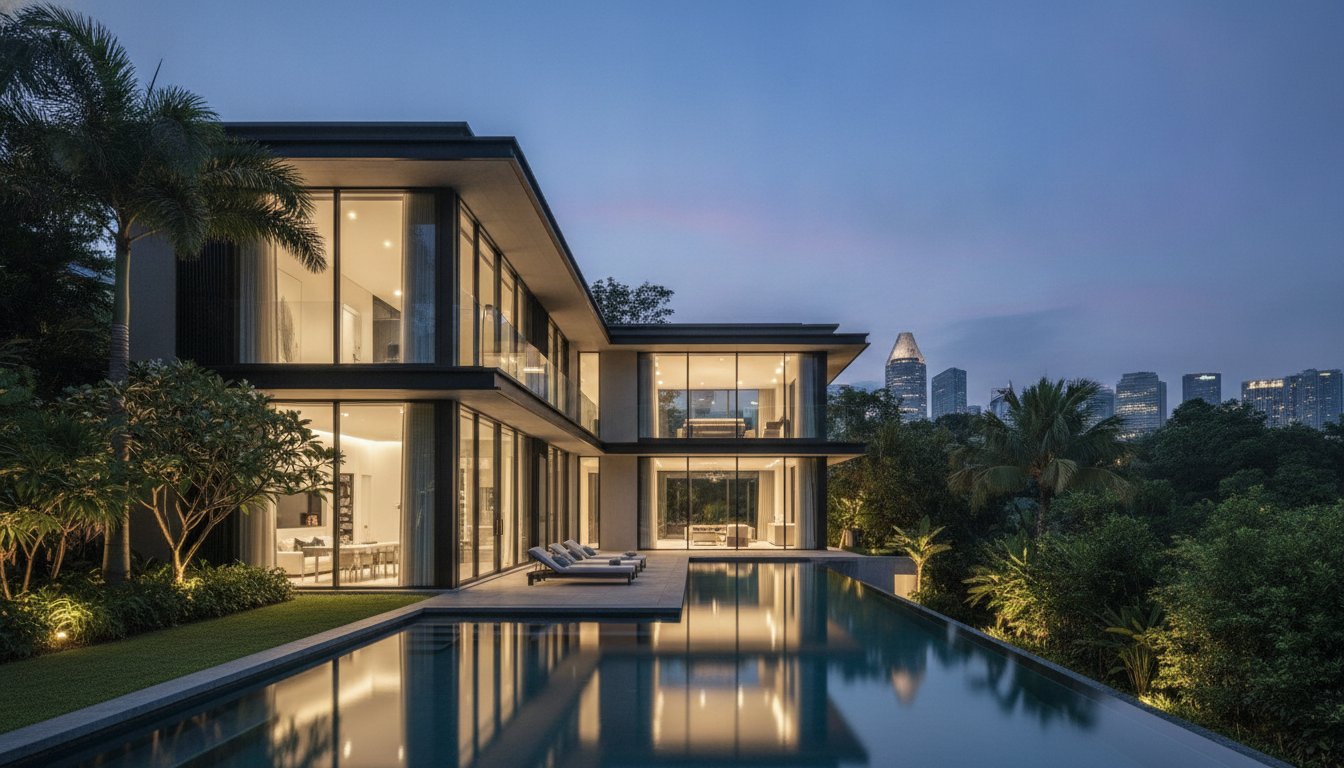
In the structured hierarchy of Singapore’s residential real estate, the detached house represents the ultimate tier of land ownership. While the market offers various landed options, the detached house, commonly referred to as a bungalow, is defined by its total physical independence. It doesn’t share structural walls or foundations with any neighboring property. This standalone status provides a level of privacy and architectural freedom that terrace houses and semi-detached homes simply cannot match. For the investor, a freehold detached house singapore is more than a residence; it’s a strategic land-bank asset that commands a significant premium due to its inherent rarity.
The Legal and Physical Anatomy of a Detached House
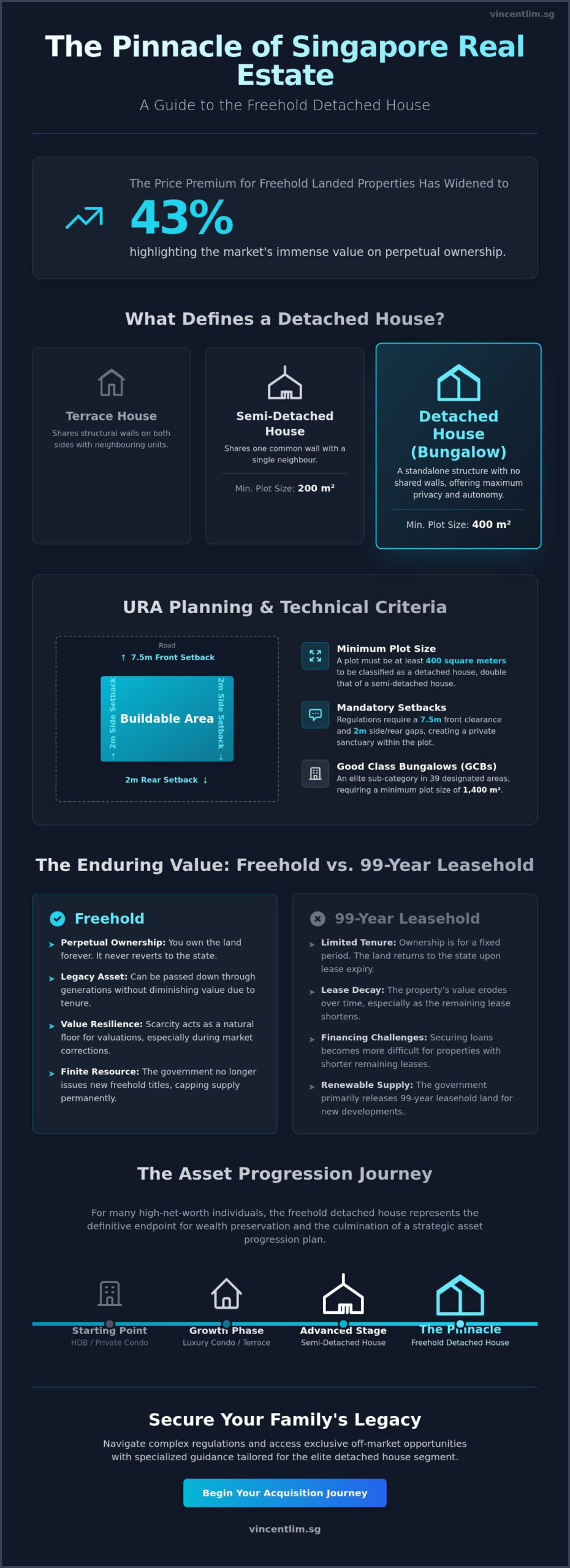
To qualify as a detached house under Urban Redevelopment Authority (URA) guidelines, a property must sit on a plot with a minimum land area of 400 square meters. This is double the requirement for a semi-detached house, which only requires 200 square meters. This 400 sqm threshold is a critical legal boundary. It ensures that every detached home maintains a specific distance from its neighbors, known as setbacks. These setbacks typically require a 7.5-meter clearance from the front road and 2-meter gaps from the sides and rear, creating a private sanctuary within the plot boundary.
It’s also vital to distinguish between a standard detached house and a Good Class Bungalow (GCB). While both are standalone structures, GCBs are confined to 39 designated conservation areas and must possess a minimum plot size of 1,400 square meters. For many high-net-worth individuals, the standard detached house offers the ideal balance of prestige and manageable scale, providing the full benefits of land ownership without the extreme maintenance requirements of a GCB estate. Understanding the precise distinctions in a semi detached vs detached house comparison is essential before committing capital to either asset class.
The Scarcity Factor: Why Freehold Land is Finite
The strategic value of these assets is deeply rooted in Singapore’s unique land constraints. Most residents live within Singapore’s public housing system, where properties are held on 99-year leases. The government has shifted almost entirely toward 99-year leasehold titles for new land sales to ensure long-term flexibility in urban planning. This policy makes existing freehold land a non-renewable resource. It’s a finite slice of the country that you can own in perpetuity.
Historical freehold titles are primarily concentrated in prime residential districts. Because the state no longer issues new freehold titles for residential land, the supply of a freehold detached house singapore is effectively capped. This permanent supply ceiling, paired with a growing population of affluent families, ensures that freehold land remains the gold standard for wealth preservation. Ownership here isn’t just about the current market cycle; it’s about securing a piece of the island that will never revert to the state.
The Enduring Value of Freehold Tenure: Why Land Ownership Matters
In Q1 2026, the price gap between freehold/999-year and 99-year leasehold landed properties widened to 43%. This data highlights a fundamental truth: the market values perpetuity. A freehold detached house singapore isn’t just a home; it’s a permanent claim on a finite resource. While leasehold assets begin to lose their luster as the clock ticks down, freehold land maintains its value because it lacks an expiration date. This creates a level of price resilience that is particularly evident during market corrections, where the scarcity of freehold land acts as a natural floor for valuations.
The legal certainty of your investment is underpinned by official government definitions that categorize these high-value landed assets. This transparency allows investors to plan with confidence, knowing their title is secure for generations. Beyond the legalities, the “Legacy Advantage” remains a primary driver for family offices and private wealth holders. Passing down a freehold asset means your descendants inherit the full value of the land without the burden of top-up costs or the eventual return of the property to the state. It’s a clean transfer of wealth that remains intact regardless of shifting land-use policies for new developments.
Freehold vs. Leasehold: The Long-Term Appreciation Gap
Capital gains for freehold properties have shown remarkable consistency over 20-year cycles. In early 2026, freehold landed homes averaged S$2,223 psf, outperforming leasehold counterparts that face the “vanishing asset” dilemma. When a 99-year bungalow crosses the 40-year mark, the pool of potential buyers often shrinks. This is due to stricter financing restrictions and the looming concern over lease extensions. Freehold owners bypass these hurdles entirely, enjoying a psychological and financial premium from buyers who prioritize “forever” ownership.
Redevelopment Potential and En Bloc Possibilities
The true value of a detached house is heavily weighted toward the land itself. Freehold status offers the ultimate flexibility for future redevelopment, allowing owners to update the structure to modern standards without the fear of a shortening lease. This potential for renewal attracts institutional interest and high-net-worth buyers who view land as a strategic bank. Banks also recognize this stability, generally offering more favorable loan-to-value (LTV) ratios and longer loan tenures for freehold titles. If you are ready to explore these permanent assets, you can view a curated selection of detached house options that align with your long-term wealth preservation goals.
Navigating the Technical Criteria: Plot Size, Setbacks, and the Planning Act
Acquiring a freehold detached house singapore requires a sophisticated understanding of the regulatory framework that governs land use. While the title deed provides perpetual ownership under Singapore’s Land Titles Act 1993, the actual buildable potential of that land is strictly managed by the Urban Redevelopment Authority (URA). These technical parameters dictate everything from the footprint of the home to its final height, directly impacting both your lifestyle and the property’s long-term valuation. Precision in assessing these constraints is what separates a standard purchase from a strategic acquisition.
URA Planning Guidelines for Detached Houses
The URA enforces rigorous setback requirements to maintain the low-density character of landed estates. For a standard detached house, you must typically observe a front setback of 7.5 meters from the road. The side and rear boundaries require a 2-meter clearance. These buffers ensure adequate ventilation and privacy between neighboring plots. In areas designated for two-storey housing, the maximum building height is capped at 12 meters; however, in three-storey zones, this increases to 15.5 meters. These limits are non-negotiable and must be factored into any renovation or redevelopment budget.
Another critical factor is the site coverage limit. For bungalows located outside of Good Class Bungalow areas, the building footprint cannot exceed 50% of the total land area. This means on a minimum plot of 400 square meters, your ground floor structure is restricted to 200 square meters. Identifying these zones on the URA Master Plan is a prerequisite for any serious investor. It reveals the true development capacity of the land before you commit any capital. It’s not just about the land you see; it’s about the volume you’re legally allowed to build.
Maximizing the Built-Up Area
While site coverage limits the footprint, you can maximize your Gross Floor Area (GFA) through the strategic use of basements and attics. URA guidelines allow for these additional levels, provided they meet specific ventilation and structural standards. This approach effectively increases the usable square footage without violating height or coverage restrictions. It’s a common strategy for modern multi-generational homes where space and privacy are paramount. You can create expansive living areas by building vertically and utilizing subterranean space. Investors who have previously optimized a semi detached house layout to maximize GFA under URA envelope controls will find these same principles apply — and scale even more powerfully — on the larger footprint of a detached plot.
Understanding these nuances is essential before you make an offer. Our comprehensive detached house for sale singapore guide provides deeper insights into identifying properties with high redevelopment potential. Mastering the Planning Act ensures you aren’t just buying land; you’re securing a canvas that can be refined to meet your family’s evolving needs. We focus on properties that offer the greatest architectural flexibility, ensuring your investment remains a premier asset in a competitive market.
Asset Progression Strategies: From Luxury Condos to Detached Homes
The journey through Singapore’s real estate market often follows a deliberate trajectory. It typically begins with public housing and moves toward executive or luxury condominiums. For the sophisticated investor, a freehold detached house singapore represents the final destination in this progression. It’s the ultimate asset class where capital growth is driven by land scarcity rather than just building quality. Transitioning into this segment requires more than just capital; it demands a strategic exit from high-performing luxury condos at the peak of their cycle to capture the next wave of landed appreciation.
Benchmarking your entry is vital. Many clients monitor the average price of semi detached house in singapore as a primary indicator before moving into the detached segment. While semi-detached homes offer a gateway to landed living, the detached house provides the absolute autonomy of a standalone plot. For those weighing their options at this critical juncture, a thorough analysis of the semi detached vs detached house investment case can clarify whether the premium for full independence is justified within your specific wealth strategy. Timing this jump involves analyzing the price gap between your current strata-titled asset and the target landed property to ensure the landed premium remains within a healthy investment margin.
Financial Planning for Landed Acquisitions
Entering the detached market in 2026 involves navigating a complex fiscal environment. You’ll need to account for a 5% cash downpayment and a 20% component that can be settled via CPF or cash. Beyond the purchase price, Buyer’s Stamp Duty (BSD) rates now reach 6% for the portion of the property value exceeding S$3 million. If you’re a Singapore Citizen acquiring your second residential property, the 20% Additional Buyer’s Stamp Duty (ABSD) is a significant consideration. We often coordinate bridging loans for our clients to facilitate a seamless transition, allowing them to secure their new home before finalizing the sale of their previous asset. This methodical approach ensures you don’t miss out on rare opportunities while managing liquidity.
The “Landed Premium”: Is it Worth the Jump?
Many investors question if the higher cost of land is justified compared to luxury condominiums. The answer lies in the floor price. While a condo’s value is heavily tied to its building age and facilities, a freehold detached house singapore derives most of its value from the land itself. Land doesn’t depreciate. You also gain complete autonomy over your estate, escaping the restrictions and recurring costs of MCST fees. This shift from shared facilities to private grounds offers a level of lifestyle control that no luxury penthouse can replicate. If you’re ready to evaluate your current portfolio’s readiness for this transition, you can contact us for a strategic portfolio review to develop a bespoke progression roadmap.
Securing Your Legacy: Professional Guidance for High-Value Acquisitions
Acquiring a freehold detached house singapore involves far more than a simple title transfer. In this elite segment, the complexity of the transaction scales with the property’s value. You aren’t just buying a structure; you’re securing a specific legal interest in land that requires meticulous verification. A generalist agent might oversee a standard condo sale with ease, but the detached market demands a strategist who understands the intersection of urban planning, legal encumbrances, and private wealth goals. Precision at this level is the only way to ensure your capital is protected.
The Value of a Landed Specialist
Negotiations in the multi-million dollar landed space are often layered with emotional history and financial pragmatism. A specialist provides the vital buffer needed to keep discussions focused on objective value. We leverage exclusive data on recent enclave-specific transactions to ensure your offer is grounded in market reality. This expertise extends far beyond the contract itself. We frequently coordinate with a network of trusted architects and contractors to provide preliminary redevelopment assessments. This proactive approach ensures you know the exact buildable potential of a plot before you sign the Option to Purchase.
Technical due diligence is the bedrock of a secure acquisition. We investigate potential drainage reserves and road line markings that could restrict future expansion or affect the property’s future valuation. Structural integrity checks are equally vital, especially for older properties where hidden defects can lead to significant post-purchase costs. These checks protect your capital and ensure the property’s longevity as a primary family asset. We don’t leave these details to chance; we verify them through rigorous site inspections and official records.
Bespoke Acquisition and Wealth Planning
Your property search must align with your broader wealth preservation strategy. Whether you’re purchasing through a family office or planning for a multi-generational transfer, the acquisition should be structured with long-term goals in mind. As an Executive Associate Director at OrangeTee & Tie, I provide the seasoned guidance necessary to navigate these high-stakes decisions with absolute confidence. We focus on identifying off-market “pocket listings” that never reach public portals, giving you a distinct advantage in a supply-constrained market.
The ultimate goal is peace of mind. Our process is designed to alleviate the stress of high-value transactions through calculated competence and total transparency. If you’re ready to secure your legacy with a freehold detached house singapore, the next step is a confidential consultation. We’ll define your specific requirements, analyze current market opportunities, and begin a targeted search for an asset that meets your exacting standards. This is the start of a partnership dedicated to your long-term success in Singapore’s most exclusive real estate segment.
Securing Your Multi-Generational Land Bank
The 2026 market landscape has solidified the position of the freehold detached house singapore as the premier asset for capital preservation. Perpetuity of tenure effectively eliminates the risks associated with lease decay, while a firm grasp of URA technical criteria ensures you maximize the redevelopment potential of your plot. These properties aren’t merely residences; they’re strategic land-bank assets that serve as the permanent foundation for enduring family wealth and privacy.
Navigating these high-stakes acquisitions requires a partner who combines decades of market data with a disciplined, strategic approach. As an Executive Associate Director at OrangeTee & Tie with over 20 years of real estate expertise, I specialize in the complexities of Good Class Bungalows and luxury landed sales. You can secure your legacy with a bespoke consultation from Vincent Lim to gain access to exclusive off-market opportunities and refined wealth planning strategies. Your journey toward a definitive landed estate is a significant milestone that deserves the highest standard of professional care.
Frequently Asked Questions
Can permanent residents (PRs) buy a freehold detached house in Singapore?
Permanent Residents must obtain prior approval from the Land Dealings Approval Unit (LDAU) before they can legally purchase a freehold detached house singapore. This approval is granted on a case-by-case basis and usually requires the applicant to demonstrate significant economic contributions to Singapore. Generally, the land area of the property should not exceed 1,300.6 square meters, and it cannot be located within a designated Good Class Bungalow enclave.
What is the minimum land size for a detached house according to URA?
The Urban Redevelopment Authority (URA) mandates a minimum plot size of 400 square meters for any property to be classified as a detached house. This translates to approximately 4,306 square feet. This specific land threshold is essential to maintain the low-density character of bungalow estates and ensures that the plot can comfortably accommodate the required building setbacks and site coverage limits.
Why are freehold detached houses more expensive than leasehold ones?
Freehold properties command a higher price because they offer perpetual ownership, which removes the financial risk of lease decay. In Q1 2026, the price gap between freehold and 99-year leasehold landed properties widened to 43%, reflecting a strong market preference for assets that don’t revert to the state. This premium is a direct result of land scarcity and the long-term stability that a permanent title provides for wealth preservation.
Do I need to pay ABSD when buying a freehold detached house?
Yes, Additional Buyer’s Stamp Duty (ABSD) is applicable based on your residency status and the number of residential properties you currently own. For Singapore Citizens, the rate is 20% for a second property and 30% for the third and subsequent homes as of May 2026. Permanent Residents pay 5% on their first residential purchase and 30% on their second, making it a critical factor in calculating your total capital outlay.
What is the difference between a detached house and a Good Class Bungalow (GCB)?
The primary differences lie in the land size and the specific location of the property. While a standard freehold detached house singapore requires a minimum of 400 square meters of land, a Good Class Bungalow must have at least 1,400 square meters. Furthermore, GCBs are strictly confined to 39 gazetted enclaves, whereas standard detached houses can be found in various landed housing zones across the island.
Can I subdivide a large freehold detached house plot into two semi-detached units?
Subdivision is possible only if the resulting plots meet the minimum land area and width requirements for semi-detached housing. Each new semi-detached plot must be at least 200 square meters and have a minimum width of 8 meters. You’ll also need to ensure that both new units can comply with all prevailing setback and site coverage guidelines before the URA will grant subdivision approval.
What are the setback requirements for a bungalow in Singapore?
Standard setback requirements for a bungalow typically include a 7.5-meter clearance from the front road and 2-meter gaps from the side and rear boundaries. These distances ensure adequate privacy, fire safety, and ventilation between neighboring properties. It’s important to verify the specific road category fronting your plot, as some locations may require a larger front setback depending on the road’s classification.
How does the Planning Act affect the renovation of a detached house?
The Planning Act regulates the intensity of your land use by capping the building footprint at 50% site coverage. It also imposes height restrictions, limiting structures to 12 meters in two-storey zones and 15.5 meters in three-storey zones. Any major renovation that increases the Gross Floor Area (GFA) or changes the building’s external envelope requires formal submission to the URA to ensure the project stays within these legal boundaries.