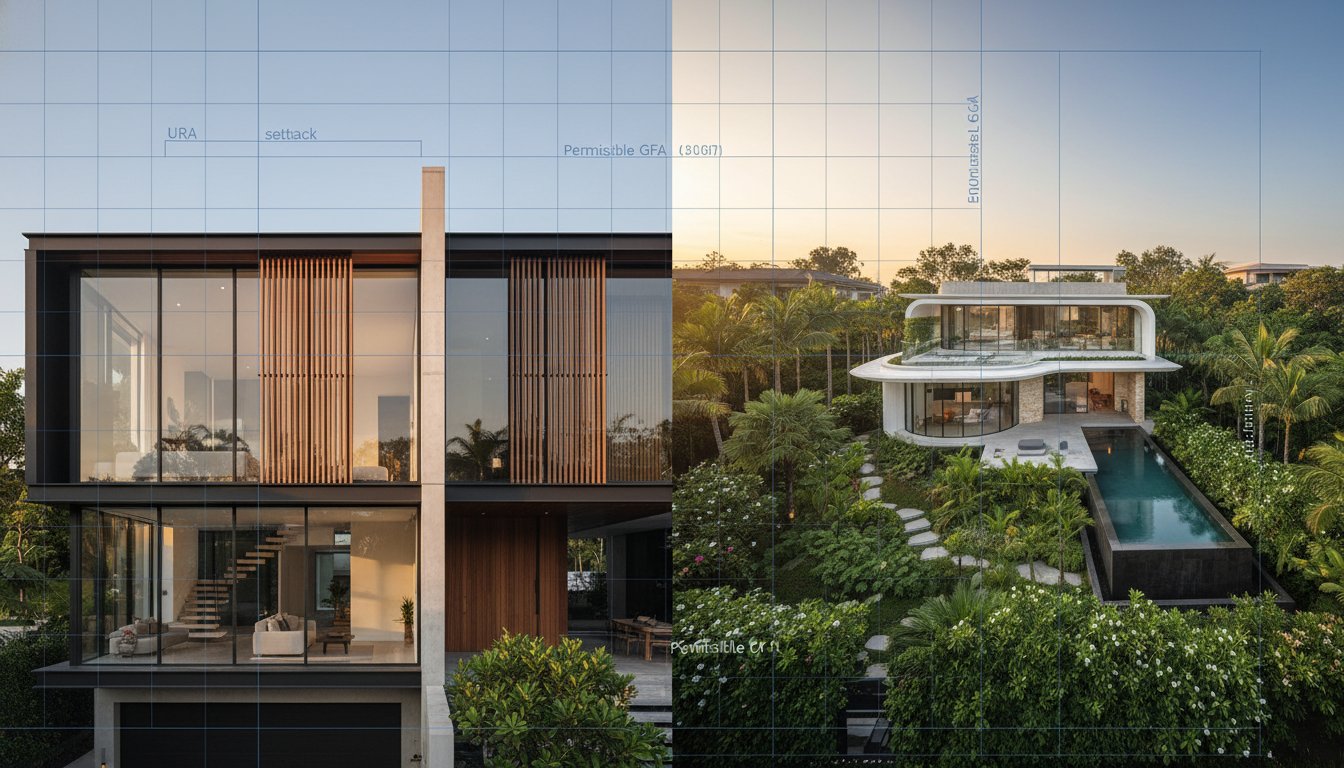
The decision to upgrade to a detached house is rarely just about the prestige of a standalone structure; it’s a calculated play for ultimate control over your living environment and land potential. You’ve likely felt the tension of balancing the desire for absolute privacy with the practicalities of Singapore’s strict land-use zones. Understanding the nuances of a semi detached vs detached house requires more than a casual glance at a floor plan. It demands a deep dive into the technicalities of URA setback requirements and the financial implications of plot sizes, which start at 200 square meters for semi-detached units and 400 square meters for bungalows.
This strategic guide provides the clarity you need to navigate these high-stakes investments with confidence. You’ll master the technical, lifestyle, and wealth-building differences that separate these two asset classes in the 2026 market. We will examine why landed property has seen an 18 to 22 percent capital appreciation over the last five years and how specific regulatory shifts impact your long-term returns. By the end of this analysis, you’ll have a clear framework to decide which property type aligns with your vision for both lifestyle excellence and disciplined financial growth.
Key Takeaways
- Master URA classifications and the “party wall” concept to accurately assess a property’s long-term redevelopment potential.
- Compare the acoustic privacy and ventilation benefits of 360-degree layouts to ensure your residence aligns with your lifestyle requirements.
- Evaluate the strategic trade-offs between a semi detached vs detached house by examining market liquidity and price quantum trends for 2026.
- Discover how to time your transition into the detached segment to maximize equity growth and secure a legacy asset for future generations.
- Understand why off-market access is essential for securing high-value landed properties in Singapore’s most competitive residential zones.
Defining the Tiers: URA Classifications and Plot Requirements
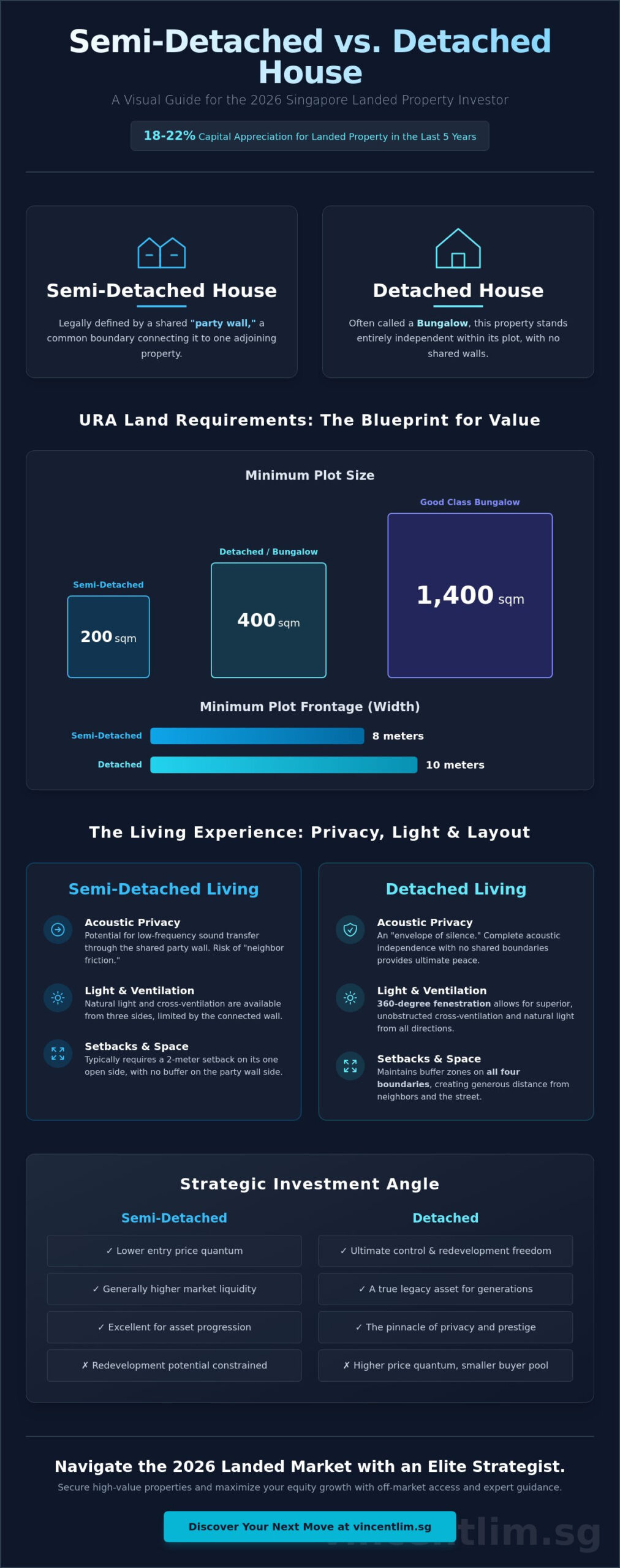
URA classifications provide the definitive structure for Singapore’s landed housing market. These regulations ensure a disciplined approach to urban density while preserving the character of residential enclaves. A semi-detached house is legally defined by its shared “party wall,” which is a common boundary wall separating two adjoining properties. In contrast, a detached house, often referred to as a bungalow, stands entirely independent within its plot. While some regional definitions suggest bungalows must be single-story, Singapore’s 2026 standards allow these structures to reach heights of 12 to 15.5 meters, depending on whether they’re designated as two-storey or three-storey zones. The technical choice between a semi detached vs detached house often hinges on these structural constraints and the resulting redevelopment potential.
Minimum Plot Sizes and Frontages
Success in landed property investment requires a meticulous understanding of minimum land requirements. For a semi-detached property, the URA mandates a minimum plot size of 200 square meters. This must be paired with a plot width, or frontage, of at least 8 meters. Detached houses require a more significant footprint, with a minimum land area of 400 square meters and a 10-meter frontage. These dimensions aren’t merely arbitrary numbers. They dictate the building’s footprint after accounting for mandatory setbacks, such as the typical 2-meter side setback for semi-detached units. For those targeting the pinnacle of the market, the Good Class Bungalow (GCB) category carries a much higher threshold of 1,400 square meters, ensuring an elite level of privacy and exclusivity.
The Back-to-Back Semi-Detached Variation
Investors should distinguish between traditional side-to-side semi-detached homes and the back-to-back variation. Unlike the standard configuration where houses share a side wall, back-to-back units are joined at the rear. This orientation significantly alters the living experience, as it often limits garden space to the front and sides of the property. URA regulations for back-to-back units require a minimum plot size of 200 square meters and a wider 10-meter frontage to ensure adequate access. Deciding between a semi detached vs detached house in this specific configuration requires a careful look at how the land is utilized. This setup can impact driveway placement and the overall flow of natural light, making it a critical consideration during the due diligence phase. Choosing the right layout is essential for maintaining market liquidity and ensuring the property remains attractive to future buyers.
Privacy, Light, and Layout: The Living Experience Compared
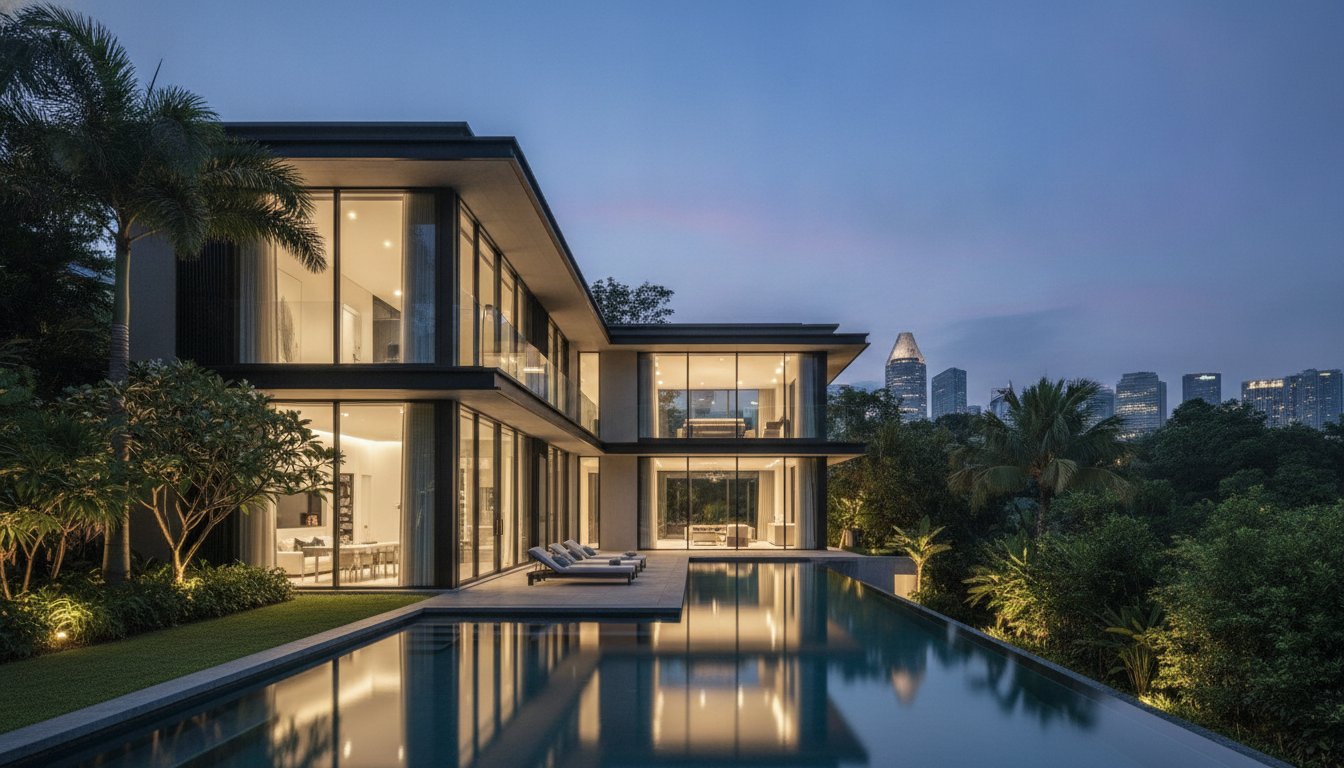
The transition from a semi-detached home to a detached residence is often driven by a desire for total control over one’s environment. When evaluating a semi detached vs detached house, the most immediate difference is the “envelope of silence” that a standalone structure provides. Semi-detached homes are physically tethered to a neighbor via a shared party wall. Even with modern construction standards, this connection can permit low-frequency acoustic transfer. Detached houses eliminate this shared boundary entirely, replacing it with 360-degree fenestration. This architectural independence allows for superior cross-ventilation and natural light penetration from every direction, creating a living space that feels significantly more expansive and airy.
The “setback” advantage further distinguishes the detached experience. While a semi-detached property typically adheres to a 2-meter side setback on its open side, a detached house maintains these buffer zones on all four boundaries. This creates a generous physical distance from the street and neighboring plots. Despite the growing appeal of smaller landed homes for some investors, the psychological peace of mind offered by a standalone sanctuary remains the definitive choice for those prioritizing privacy. These larger buffer zones don’t just provide distance; they serve as a canvas for sophisticated security perimeters and private green belts.
The Psychology of Standalone Living
Standalone living effectively removes “neighbor friction” from your daily life. You aren’t just buying land; you’re buying the freedom to manage your property without negotiating shared maintenance or boundary concerns. Visual privacy is easily achieved through strategic landscaping that isn’t constrained by a neighbor’s existing structures. This autonomy contributes to the high prestige factor of detached homes, which continue to be viewed as the ultimate status symbol in Singapore’s residential landscape.
Architectural Flexibility and Extensions
Design freedom is where the detached house truly excels. Owners of semi-detached properties often find that Additions & Alterations (A&A) are limited by the shared roofline or the structural requirements of the party wall. In contrast, detached plots allow for highly ambitious modern detached house layouts. You can more easily integrate large-scale features like perimeter lap pools or expansive basement levels that span the entire footprint of the home. These structural upgrades are often technically impossible or prohibitively expensive on the narrower plots typical of semi-detached units. Before committing to a rebuild or major A&A, reviewing a comprehensive semi detached house layout guide can help you identify how to maximize usable space within URA envelope control regulations. If your goal is to build a bespoke family estate, exploring available detached house listings will reveal the true potential of these larger land parcels.
Financial Performance: Price Quantum and Capital Appreciation Trends
Financial performance in the landed segment is defined by a clear divergence in liquidity and scarcity value. When analyzing a semi detached vs detached house, investors must weigh the broader buyer pool of the former against the uncompromising capital preservation of the latter. As of 2026, the average price for landed property stands at S$5.9 million, with a per-square-foot average of S$1,815.79. Semi-detached houses typically transact between S$3 million and S$15 million, offering a level of market liquidity that detached homes, which can exceed S$100 million in prime areas, simply cannot match. This higher transaction volume for semi-detached units ensures a more efficient exit strategy, while detached houses serve as a premier vehicle for wealth preservation.
Landed assets aren’t just homes; they’re land banks. Between 2021 and 2026, landed property in Singapore achieved capital appreciation of approximately 18 to 22 percent on a per-square-foot basis. While gross rental yields remain modest at 1.9 to 2.0 percent, the primary objective for most owners is the long-term growth of the underlying land value. In a high-inflation environment, these properties act as a hedge, providing a level of security that volatile financial markets often lack. The limited supply of freehold detached land ensures that these assets remain highly coveted by the nation’s most disciplined investors.
Entry Costs and Stamp Duties
Understanding the entry requirements is vital for a seamless acquisition. You should evaluate the average price of semi detached house in singapore to benchmark your investment against current 2026 market standards. Buyers must account for Buyer’s Stamp Duty (BSD), which reaches 6 percent for the portion of the purchase price exceeding S$3,000,000. Additionally, Singapore citizens purchasing their second property face an Additional Buyer’s Stamp Duty (ABSD) of 20 percent. These costs, combined with a 45 percent Loan-to-Value (LTV) limit for second property loans, necessitate substantial capital reserves for high-value detached acquisitions.
Resale Value and Demand Drivers
The resale market for landed homes is driven by the intrinsic value of the land. Freehold status is a critical factor in maintaining the strategic value for detached homes, as it removes the concerns of lease decay that affect 99-year leasehold properties. While detached houses command the highest premiums, corner terraces are frequently compared to semi-detached units because they often share similar plot sizes and side-setback advantages. However, the true semi detached vs detached house comparison always favors the detached unit for long-term ROI due to its absolute scarcity and the prestige of owning a standalone plot in a land-scarce city-state.
Asset Progression: When to Upgrade from Semi-Detached to Detached
Upgrading from a semi-detached home to a detached house represents a significant shift in a portfolio’s strategic depth. For many owners, the “sweet spot” for this transition occurs when the accumulated equity from a semi-detached asset can be deployed to cover the substantial down payment required for a detached residence. Between 2021 and 2026, landed property in Singapore achieved a capital appreciation of 18 to 22 percent. This growth has provided many semi-detached owners with the financial leverage needed to move up the asset ladder. With the URA Private Residential Property Price Index for landed homes showing a modest 0.4 percent decline in Q1 2026, this period of market stabilization offers a calculated entry point for those ready to commit to a larger land footprint.
The choice between a semi detached vs detached house at this stage is often a decision between maintaining a liquid asset and securing a legacy. Detached houses serve as the ultimate vehicle for legacy planning, offering the land area required for multi-generational living. While a semi-detached property is a resilient asset, the 400 square meter minimum plot size of a detached house provides a superior foundation for long-term wealth preservation. If you are ready to evaluate your current equity position, browse our exclusive listings of detached house opportunities to find your next legacy investment.
The 5-Step Transition Framework
- Step 1: Conduct a comprehensive valuation of your current semi-detached asset to determine your exact net proceeds.
- Step 2: Define your long-term spatial needs, weighing the requirements of multi-generational living against pure investment goals.
- Step 3: Analyze the land-to-built ratio of prospective detached plots to ensure the land is being utilized efficiently.
- Step 4: Secure specialized landed property financing, noting that 2-year fixed rates are approximately 1.45 percent as of May 2026.
- Step 5: Identify under-utilized plots that offer significant redevelopment potential to maximize future capital gains.
Redevelopment as a Value Multiplier
The “buy-to-rebuild” strategy is a hallmark of the elite strategist. You can often find older detached homes on large plots where the existing structure does not reflect the land’s true value. By identifying these under-utilized plots, you can maximize the “gross floor area” allowed under URA envelope control guidelines. This approach transforms a simple residential purchase into a high-yield development project. Navigating these restrictions requires precision, as setbacks and height limits of 12 to 15.5 meters will dictate your final buildable area. Mastering the nuances of a semi detached vs detached house redevelopment allows you to create a bespoke residence that far exceeds the value of a standard developer-built home.
Navigating the 2026 Landed Market with an Elite Strategist
Navigating the complexities of the 2026 landed market requires more than just access to digital portals. It demands a sophisticated understanding of URA regulations and a keen eye for undervalued assets. When deciding between a semi detached vs detached house, the margin for error is thin. Generalist agents often lack the technical depth to interpret nuanced zoning restrictions or evaluate the true redevelopment potential of a plot. Vincent Lim leverages over 20 years of industry experience to provide a white-glove service that prioritizes your long-term wealth and lifestyle goals.
Off-market access is a critical component of this elite strategy. Many of Singapore’s most prestigious detached homes and GCBs are transacted privately to maintain the seller’s discretion. Working with a specialist ensures you’re positioned to capture these opportunities before they reach the public eye. This proactive management of your acquisition journey alleviates the stress of high-stakes transactions. It provides the peace of mind that comes from expert advocacy and meticulous planning. We don’t just find houses; we identify strategic land opportunities that align with your financial objectives.
Bespoke Brokerage for Discerning Clients
For those with specific lifestyle requirements, we offer tailored sourcing for semi-detached houses with pools. Our strategic representation also extends to sellers looking to exit at peak market valuations. We manage the intricate complexities of asset progression, guiding clients through the transition from luxury condominiums to the landed segment with calculated precision. Every transaction is treated as a bespoke partnership. This ensures that your property portfolio reflects your own standards of excellence and long-term vision.
Securing Your Legacy in Singapore Landed Property
Singaporean soil remains one of the world’s most resilient asset classes. As the market stabilizes in 2026, the opportunity to secure a standalone legacy has never been more compelling. Whether you’re refining your search for a semi detached vs detached house or preparing for a high-value exit, professional guidance is the key to a successful outcome. The right partner helps you navigate URA restrictions and financial requirements with ease. We invite you to consult with Vincent Lim for a strategic landed property analysis today and take the first step toward your next elite acquisition.
Securing Your Legacy in Singapore’s Premier Landed Enclaves
The strategic selection between a semi detached vs detached house serves as the cornerstone of a sophisticated property portfolio. We’ve explored how URA plot regulations dictate buildable area, while market dynamics in 2026 highlight the distinct advantages of liquidity versus absolute land scarcity. Land remains the ultimate asset in Singapore. Securing these properties requires a disciplined approach to identifying undervalued plots and navigating complex zoning laws with precision.
As an Executive Associate Director at OrangeTee & Tie with over 20 years of experience, Vincent Lim specializes in GCB and high-value landed assets. His white-glove approach ensures that every transaction is handled with the seasoned authority your investment deserves. Partner with Vincent Lim for your next elite landed acquisition to gain a competitive edge in Singapore’s most exclusive residential zones. Your pursuit of excellence in landed living is a journey best taken with a trusted advocate by your side.
Frequently Asked Questions
Can a semi-detached house be converted into a detached house?
Conversion is possible provided the resulting plot meets the minimum requirements for a detached house. The land area must be at least 400 square meters with a minimum width of 10 meters. This process involves the demolition of the existing structure and the physical separation of the shared wall from the neighbor, which requires both URA approval and professional structural coordination to ensure the integrity of the adjoining unit.
What is the minimum land size for a detached house in Singapore?
The URA mandates a minimum plot size of 400 square meters for a standard detached house. This requirement ensures that the property can accommodate the necessary setbacks and maintain the character of a standalone bungalow. For properties located within designated Good Class Bungalow Areas, this threshold increases significantly to 1,400 square meters to preserve the low-density, high-prestige environment characteristic of these elite enclaves.
Are semi-detached houses harder to sell than detached houses?
Semi-detached houses generally benefit from higher market liquidity due to their more accessible price quantum. While detached homes are the pinnacle of the market, their high entry costs limit the pool of potential buyers. The choice between a semi detached vs detached house often involves balancing this ease of exit against the superior scarcity value of a standalone plot in a land-scarce city-state.
How does the URA define a “party wall” in semi-detached housing?
A party wall is a common boundary wall that physically joins two residential units. This structural element defines a semi-detached property and distinguishes it from a detached house. The URA requires that the two units share this wall along a common boundary, which has significant implications for acoustic privacy and any future reconstruction or Addition & Alteration works that an owner might consider.
Is a corner terrace considered a semi-detached house?
A corner terrace is technically classified as a terrace house, though it shares many physical characteristics with a semi-detached property. Both types feature a side setback on one side of the house. However, a terrace house can be converted into a semi-detached unit only if the plot meets the minimum requirement of 200 square meters with a width of 8 meters, as specified in the 2026 URA guidelines.
What are the setback requirements for a detached house in 2026?
Detached houses are subject to a front setback of 7.5 meters, though this can vary based on the road category. Side and rear setbacks are typically 2 meters for houses up to three storeys high. These buffer zones are essential for maintaining 360-degree ventilation and ensuring that the structure remains physically independent from neighboring boundaries, a key factor in the semi detached vs detached house lifestyle comparison.
Do detached houses always appreciate faster than semi-detached ones?
Detached houses don’t necessarily appreciate faster on a percentage basis, but they offer superior wealth preservation due to land scarcity. While both segments saw capital appreciation of 18 to 22 percent between 2021 and 2026, detached land often commands a higher premium over time. The absolute limited supply of freehold detached plots makes them a more resilient asset during periods of high inflation or market volatility.
Can foreigners buy semi-detached or detached houses in Singapore?
Foreigners and Singapore Permanent Residents are generally restricted from purchasing landed property. They must obtain special approval from the Land Dealings Approval Unit (LDAU), which is typically granted only to individuals who have made significant economic contributions to the country. Singapore citizens remain the primary buyer demographic for these high-value assets, ensuring a stable and regulated market environment for long-term investors.