The total land area of your property is often a secondary metric; the real value lies in how you command the internal volume and vertical flexibility allowed under current building guidelines. Many homeowners worry that a standard 200 square meter plot will feel restrictive once the mandatory two meter side setbacks are applied. It’s a valid concern, as a poorly executed semi detached house layout can make a multi-million dollar investment feel surprisingly cramped. You’ve likely seen homes where the square footage is high, yet the flow feels disjointed and the natural light is non-existent.
This guide provides a professional framework to help you evaluate and optimize your floor plan for both luxury living and long-term investment resilience. We’ll explore how to navigate URA envelope control regulations to maximize usable space and why certain configurations drive the 32% appreciation seen in high-performing areas like District 28. You’ll gain the clarity needed to transform a standard plot into a high-yield asset that accommodates multi-generational needs while securing your capital in Singapore’s competitive 2026 landed market.
Key Takeaways
- Understand the mandatory URA plot requirements, including the 200sqm minimum land area, to establish a precise baseline for your architectural footprint.
- Learn how to optimize a semi detached house layout by balancing open-plan ground floors with strategic transitions that elevate the property’s luxury perception.
- Discover how to leverage URA’s Envelope Control guidelines to introduce mezzanines and attics, effectively increasing usable square footage without expanding the footprint.
- Evaluate the integration of home lifts and flexible ‘dual-key’ configurations to meet the 2026 market demand for sophisticated multi-generational living solutions.
- Identify the specific layout characteristics, such as wide frontage and minimal wasted volume, that drive superior capital appreciation and long-term resale performance.
Defining the Modern Semi-Detached House Layout and URA Standards
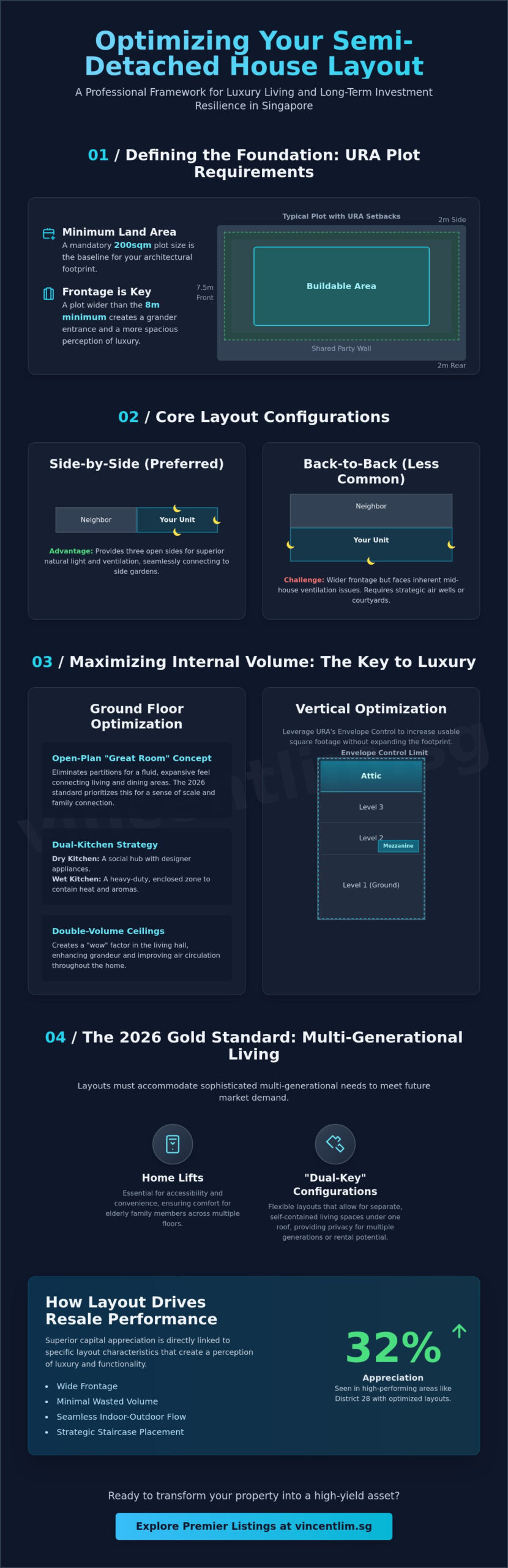
In Singapore’s sophisticated real estate market, a Semi-detached house represents a unique middle ground between the density of terrace housing and the total independence of detached bungalows. By definition, these properties share a single common party wall with one neighbor. This structural bond creates a symmetrical architectural profile that requires careful planning to ensure individual privacy. While the shared wall is a constraint, it also allows for a more substantial building footprint compared to terrace houses. The Urban Redevelopment Authority (URA) regulates these dwellings through precise plot requirements. You must have a minimum land area of 200 square meters to qualify. However, seasoned investors know that the land’s dimensions are often more important than the total square footage.
Minimum Dimensions and Setback Requirements
The physical boundaries of your semi detached house layout are strictly defined by mandatory setbacks. URA requires the main building to sit at least 2 meters away from the side and rear common boundaries. This space isn’t just for fire safety; it’s a critical corridor for natural light and air. The front setback is usually 7.5 meters from the road buffer. This area dictates the functionality of your car porch and driveway. If your plot is wider than the 8-meter minimum, you gain significant flexibility. Wider plots allow for a grander entrance and a more spacious ground floor that avoids the narrow, corridor-like feel often found in older reconstructions. It’s the width, not just the area, that creates the perception of luxury.
Side-by-Side vs. Back-to-Back Layouts
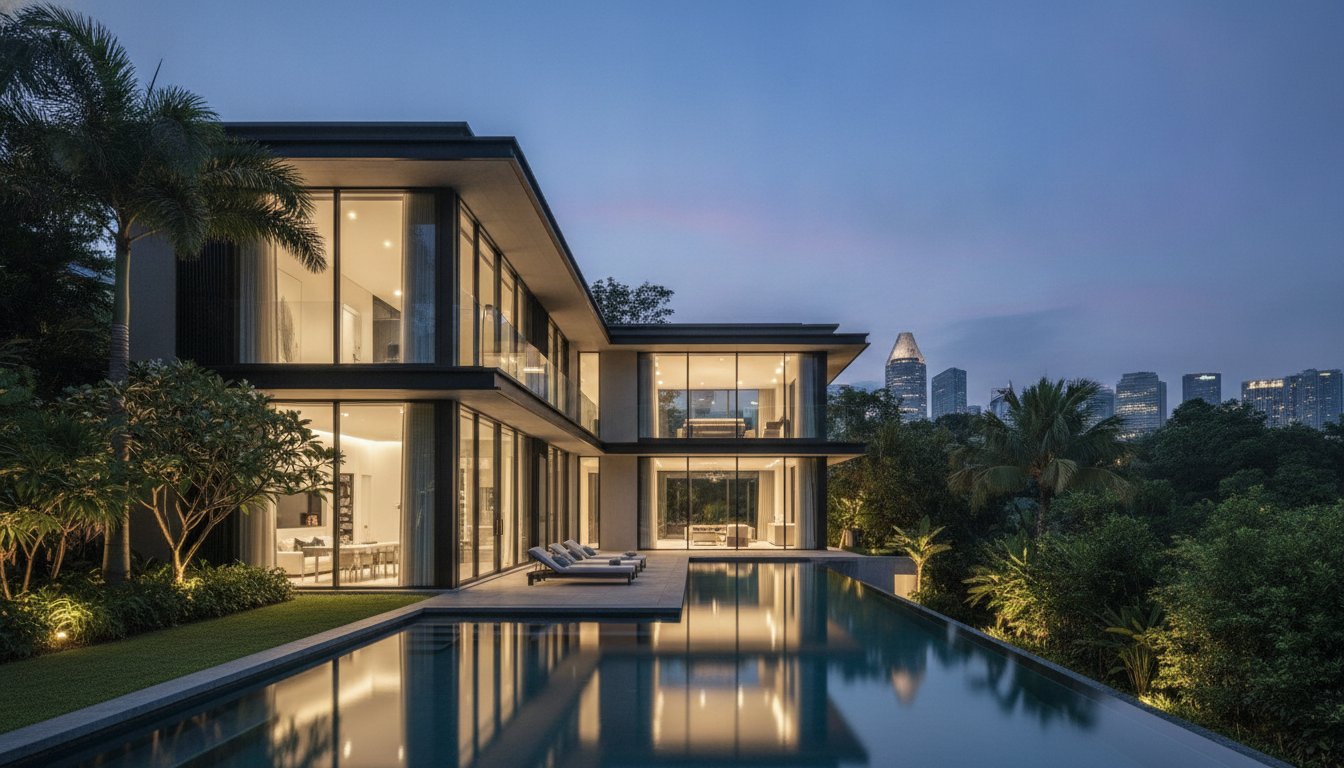
Most semi-detached properties in Singapore are configured side-by-side. This arrangement is preferred because it provides three open sides for windows and ventilation. It creates a seamless connection between the indoor living areas and the side garden. Back-to-back configurations are less common and occur when units share a rear wall. While these units often boast a wider frontage, they face inherent challenges with mid-house ventilation. When you evaluate these options, look for designs that strategically place air wells or courtyards to mitigate the loss of a rear window. Choosing a layout that maximizes the open side of the property is essential for maintaining the elite standard of luxury that discerning buyers expect. A well-ventilated home isn’t just more comfortable; it’s a more resilient asset.
Core Layout Configurations: Maximizing the Ground Floor
The arrival experience at a luxury residence begins well before the front door. In a sophisticated semi detached house layout, the transition from the car porch to the formal living area must feel intentional and expansive. Modern homeowners increasingly favor an open-plan configuration that eliminates unnecessary partitions, allowing the eye to travel across the entire depth of the ground floor. This approach doesn’t just improve the sense of scale; it facilitates a lifestyle where the family remains connected regardless of whether they’re in the living hall or the dining area. While older properties often relied on compartmentalized rooms, the 2026 standard prioritizes a fluid “Great Room” concept that maximizes every square inch of the building footprint.
A hallmark of high-end landed living is the separation of culinary functions. The dry kitchen now serves as a social extension of the dining room, featuring premium cabinetry and designer appliances meant for display. Conversely, the wet kitchen is a dedicated, heavy-duty zone designed to contain heat and aromas. This dual-kitchen strategy is essential for maintaining a pristine entertaining environment. For those seeking to refine their property’s functionality, exploring bespoke semi-detached house sales can provide insights into which configurations currently command the highest market premiums.
The Social Hub: Living and Dining Integration
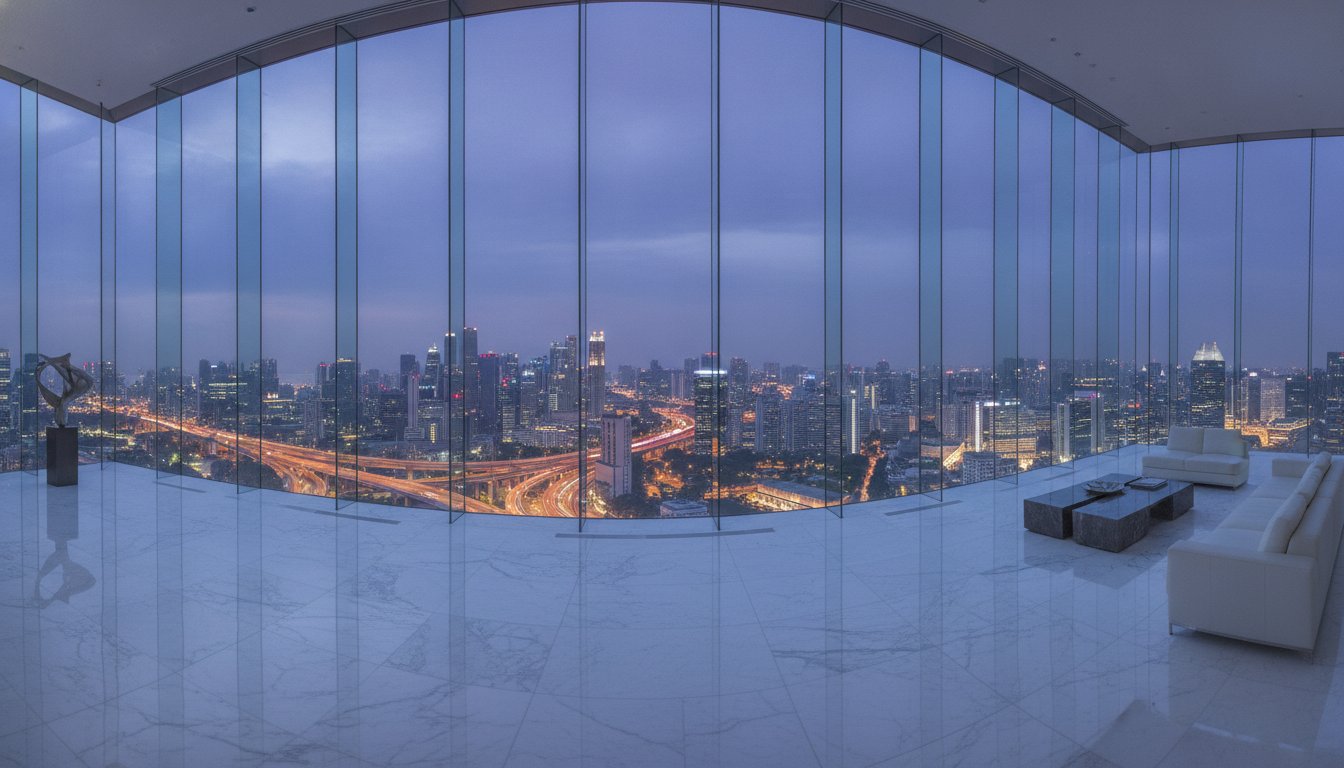
To create a genuine sense of grandeur, many owners opt for double-volume ceilings in the main living hall. This vertical void creates an immediate “wow” factor and improves air circulation throughout the home. Strategic staircase placement is equally vital. By tucking the stairs along the shared party wall or at the rear, you avoid bifurcating the social space. Integrating floor-to-ceiling glass panels along the side garden further blurs the boundary between the interior and the outdoor patio. This seamless connection is a core requirement under modern URA guidelines, which encourage designs that harmonize with the surrounding greenery.
Functional Service Zones
Precision in a semi detached house layout extends to the service areas, which must remain discreet yet highly efficient. The helper’s quarters and utility rooms should be positioned with independent access to the side of the house to ensure family privacy. A well-ventilated laundry yard is no longer an afterthought; it’s a necessity for managing a large household. Additionally, the ground-floor powder room should be placed away from direct sightlines of the dining table, providing guests with a private, conveniently located retreat that doesn’t disrupt the formal flow of the home.
Vertical Optimization: Attics, Mezzanines, and Basements
Modern luxury is no longer defined solely by horizontal square footage; it’s defined by volume. Under URA’s Envelope Control guidelines, the rigid “two-storey plus attic” rule has been replaced by a more flexible framework that prioritizes the overall building mass. This shift allows homeowners to manipulate floor-to-floor heights with greater freedom, creating a semi detached house layout that feels significantly more expansive than its land size suggests. By prioritizing verticality, you can introduce dramatic voids and staggered floor plates that improve both natural ventilation and the internal sense of scale.
Basements have also emerged as a hallmark of high-tier landed properties. While they require careful waterproofing and drainage planning, they offer a secluded environment for private wine cellars, sound-insulated cinema rooms, or even additional parking for a growing car collection. A well-designed basement adds a layer of utility that doesn’t count towards the building’s visual bulk, preserving the sleek architectural profile of the home while providing essential lifestyle spaces.
The Power of the Mezzanine
A mezzanine level serves as a strategic architectural bridge between the public and private zones. In a semi detached house layout, this intermediate floor is often utilized as a sophisticated home office or a curated library. To stay within regulatory limits, the mezzanine must be designed as an internal floor within the allowable building envelope, ensuring it doesn’t compromise head clearance. Beyond its utility, a mezzanine creates a visual connection between levels, allowing light from high-level windows to penetrate deeper into the ground floor. It functions as an ideal ‘buffer’ zone in multi-generational homes, providing a quiet retreat that remains connected to the household’s social pulse.
Attic Sanctuaries and Roof Terraces
The attic has evolved from a storage area into the ultimate master sanctuary. Positioned at the highest point of the home, it offers the most privacy and the best views. High-performance thermal insulation and strategic cross-ventilation are critical here to manage Singapore’s tropical heat. Many owners are now opting for a junior master suite on this level, complete with a walk-in wardrobe and an ensuite bath that rivals five-star resorts.
Integrating a roof terrace further extends the living space outdoors, providing an elite venue for evening gatherings under the stars. This vertical expansion is a primary driver of property value; as internal volume increases, so does the market appeal. Understanding how this vertical space influences the average price of semi detached house in singapore is essential for any investor looking to maximize their capital appreciation in the 2026 market. A home that utilizes every vertical inch effectively will always command a premium over those that rely on conventional, flat configurations.
Layouts for Multi-Generational Living: The 2026 Gold Standard
The cultural shift towards multi-generational living in Singapore has fundamentally transformed the architectural requirements of the landed market. A high-performing semi detached house layout in 2026 isn’t just about the total room count; it’s about the strategic distribution of privacy and communal zones across multiple levels. Designing “Dual-Key” style configurations within a single title allows families to reside together while maintaining distinct boundaries. This often involves dedicating the ground floor to the eldest generation with a comprehensive “granny suite,” while the upper floors serve the needs of the younger family units. To maintain the elite standard of these homes, every bedroom must feature a private en-suite bathroom, ensuring that personal space is never compromised even in a shared household.
Creating multiple communal pockets is equally vital. Beyond the main living hall, smaller family lounges or study alcoves on upper landings allow different family members to host guests or work without disrupting the entire house. This thoughtful layering of space ensures the home remains functional as family dynamics evolve over the decades. If you’re looking to acquire a property that perfectly balances these complex family dynamics, you can browse my current portfolio of semi-detached house sales to find your ideal match.
Home Lift Integration and Accessibility
Home lifts have transitioned from an optional luxury to an essential feature for future-proofing. A private lift ensures that the entire semi detached house layout remains accessible for aging family members, effectively removing the physical barriers of multi-storey living. Strategic placement of the lift core is critical; by positioning it near the staircase or along the shared party wall, you minimize the impact on Gross Floor Area (GFA) and maintain efficient room configurations. Beyond immediate utility, a home lift significantly bolsters resale value. Future buyers in the 2026 market increasingly view vertical accessibility as a non-negotiable requirement, making it a sound financial investment as well as a lifestyle one.
Privacy Within Proximity
Maintaining peace in a shared environment requires more than just a good floor plan; it requires technical precision. Soundproofing strategies for shared party walls, such as the use of high-density acoustic insulation or double-brick constructions, are essential to ensure that activities in one unit don’t disturb the neighbor. Inside the home, secondary family lounges on the second or third floors act as social buffers, providing the younger generation with a private retreat. This focus on internal privacy and autonomous zones often bridges the gap in the semi detached vs detached house debate, proving that a well-designed semi-detached property can offer a level of seclusion that rivals its detached counterparts.
Strategic Value: How Layout Influences Resale Performance
In the high-stakes Singapore landed market, the internal logic of a home often dictates its capital appreciation more than the raw land area. A superior semi detached house layout ensures that every square foot serves a specific purpose, eliminating the “dead zones” that plague older, less considered designs. While land size provides the canvas, the layout provides the actual value that savvy investors prioritize during the valuation process. Modern buyers in 2026 are looking for homes that maximize usable volume while maintaining a sense of effortless flow and architectural integrity. A property that masters this balance isn’t just a dwelling; it’s a high-performing financial asset that commands a premium in a competitive secondary market.
Layout Efficiency and PSF Value
Investors frequently overlook the fact that a property on a 200 square meter plot with a superior layout can often command a higher price per square foot (PSF) than a larger plot with poor flow. With the average PSF for landed properties reaching S$1,815.79 in recent cycles, every wasted meter represents a significant loss of potential capital. Efficient designs avoid excessively long corridors and awkward “dead corners” that serve no functional purpose but still count toward the total built-up area. By refining these “wasted” spaces, you increase the perceived value and the actual utility of the home. This strategic approach to floor-plan efficiency is a cornerstone of value in the landed segment, much like the factors that drive the elite pricing of a freehold detached house singapore.
There’s also a distinct premium associated with wide-frontage semi-detached houses. A wider plot allows for a more expansive semi detached house layout, facilitating better natural light penetration and superior cross-ventilation. Premium buyers are increasingly discerning about environmental comfort. A home that feels bright and airy without constant reliance on mechanical cooling will always hold a stronger valuation and sell faster than a narrow, dimly lit counterpart that feels restrictive despite its land size. It’s about the math of livability.
Future-Proofing Your Investment
Future-proofing requires an eye for architectural flexibility. A high-value layout is one where rooms can adapt as family needs change over a decade. A “clean” structural grid, where load-bearing columns are strategically placed at the perimeter, allows for these future modifications without requiring costly structural overhauls. This “rebuild-ready” appeal is highly attractive to premium buyers who seek a bespoke living experience without the headache of major structural remediation.
The complexity of land regulations and shifting market trends means that the difference between a standard layout and a strategic one can be worth millions in resale value. Consulting a dedicated landed specialist like Vincent Lim (OrangeTee & Tie) ensures your property isn’t just built for today, but is meticulously positioned for the market demands of tomorrow. A market-ready asset is the result of disciplined planning and a deep understanding of what elite buyers truly value in a home.
Securing Your Legacy through Strategic Design
Optimizing a semi detached house layout is a complex exercise in balancing architectural ambition with regulatory precision. As we’ve explored, the strategic integration of URA’s Envelope Control guidelines unlocks significant vertical potential, while multi-generational features like home lifts ensure long-term market resilience. The properties that command the highest premiums in 2026 are those that prioritize internal volume and functional flow over simple land dimensions. Every design choice you make today serves as a foundation for your property’s future capital appreciation and lifestyle quality.
Executing these high-stakes decisions requires a partner who understands the nuances of luxury residential transactions. Vincent Lim (OrangeTee & Tie) has specialized in high-end landed property sales since 2004, offering the deep expertise in GCB and luxury residential transactions necessary to safeguard your investment. Refine your landed property strategy with Vincent Lim (OrangeTee & Tie) to ensure your next acquisition is both a sanctuary and a high-yield asset. Your vision for a sophisticated home is within reach when guided by seasoned industry authority and a commitment to excellence.
Frequently Asked Questions
What is the minimum land size for a semi-detached house in Singapore?
The minimum land size for a semi-detached house is 200 square meters. Beyond the total area, you must also adhere to specific plot width requirements. A side-to-side configuration requires a minimum width of 8 meters, while a back-to-back unit requires at least 10 meters. These dimensions ensure that the property maintains the necessary setbacks for fire safety and proper ventilation.
Can I build a swimming pool in my semi-detached house layout?
Yes, you can integrate a swimming pool, provided it remains within the allowable building setbacks. Typically, the pool must be at least 2 meters away from the side and rear common boundaries. It’s a popular feature in a modern semi detached house layout, though you must ensure the filtration system and pump room are positioned to minimize noise disturbances for your immediate neighbor.
How many stories can a semi-detached house have under current URA rules?
Most semi-detached houses are built up to 3 stories plus an attic level. The actual height is governed by URA’s Envelope Control guidelines, which manage the building’s overall massing rather than just the floor count. This allows for creative internal configurations, such as varying floor-to-floor heights or the addition of a mezzanine, provided the structure stays within the designated building envelope.
Is it possible to convert a semi-detached house into a detached house?
Conversion is only possible if your land plot meets the minimum requirements for a detached house. This requires a land area of at least 400 square meters and a minimum plot width of 10 meters. If your property was originally two semi-detached units that have been amalgamated, you may apply to URA for a change in housing type to a detached bungalow.
What is the difference between a corner terrace and a semi-detached house?
A corner terrace is the end unit of a row of at least three terrace houses, while a semi-detached house is one of a pair sharing a single party wall. While both require a minimum land size of 200 square meters, their zoning and development potential can differ. Semi-detached houses are often perceived to have a higher status and greater architectural symmetry than corner terraces.
Do I need a home lift for a 3-story semi-detached house?
While not legally mandatory, a home lift is highly recommended for any multi-storey semi detached house layout in the 2026 market. It’s a critical feature for future-proofing your home, especially for multi-generational families with elderly members. From an investment perspective, houses equipped with a lift core typically see faster transaction times and higher demand in the secondary market.
How does the shared wall affect my renovation options?
The shared party wall is a structural boundary that you cannot move or demolish. Any renovations that involve hacking or structural alterations near this wall require a professional engineer’s endorsement to ensure the neighbor’s property remains stable. You’ll also need to manage noise and vibration during construction to maintain neighborly harmony, as the shared wall transmits sound more readily than external walls.
What is the ‘Envelope Control’ guideline and how does it affect my layout?
Envelope Control is a URA framework that defines the maximum three-dimensional space your building can occupy. Instead of rigid storey heights, it allows you to distribute the internal volume more flexibly. This means you can design a semi detached house layout with double-volume ceilings or staggered mezzanine levels, creating a sense of luxury and space that wasn’t possible under older, more restrictive building codes.