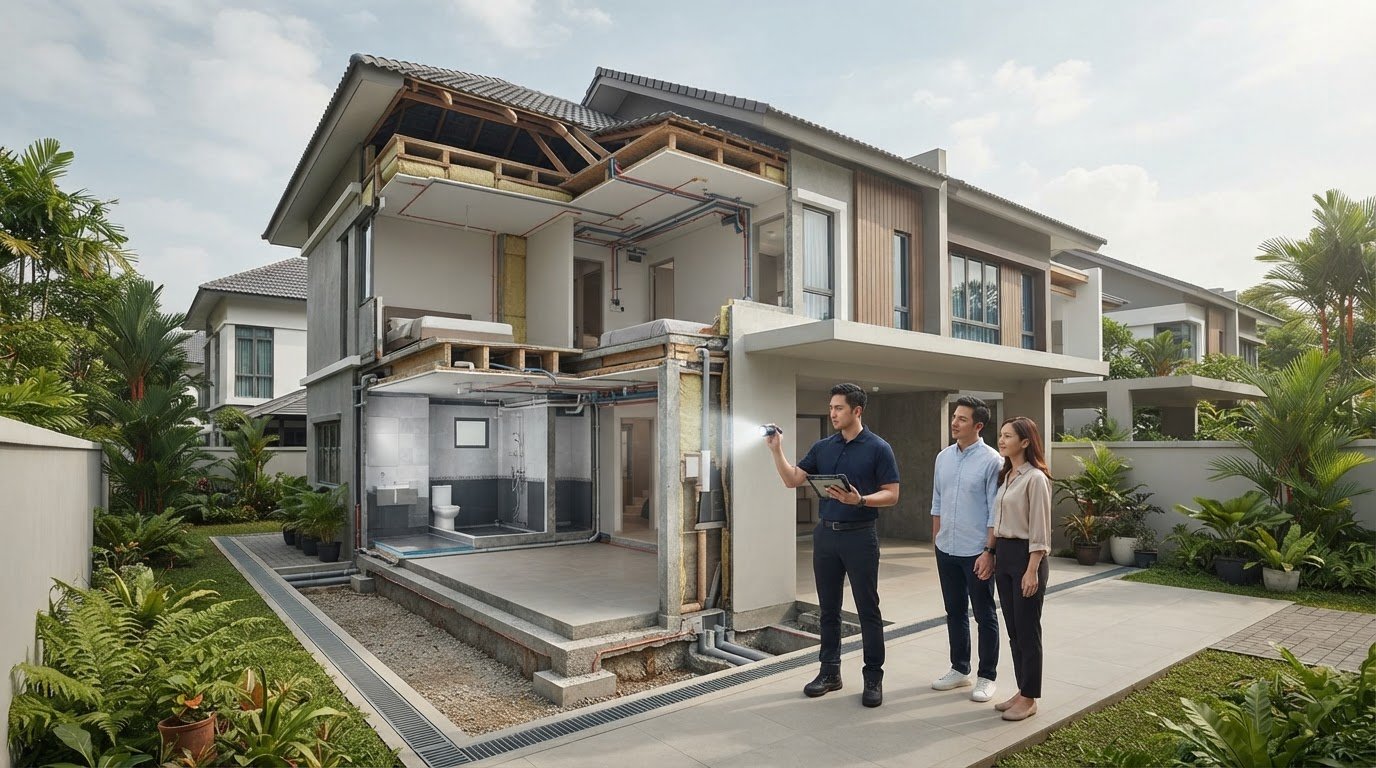
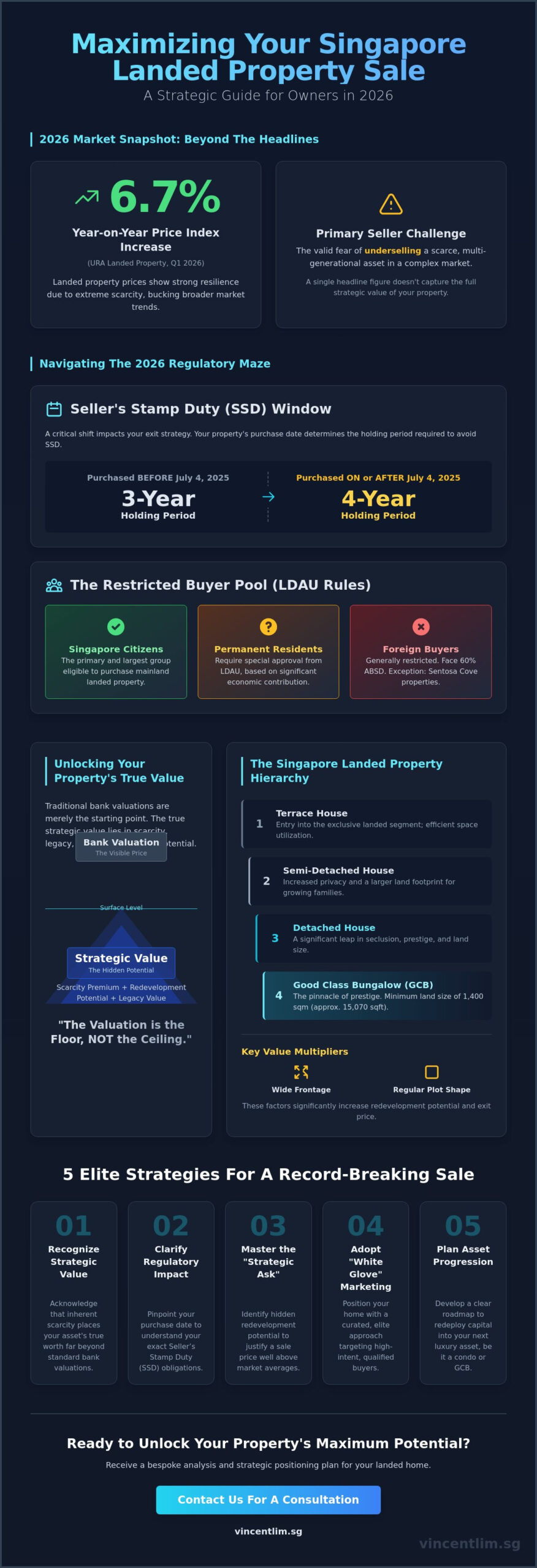
While the URA Landed Property Price Index showed a 6.7% year-on-year increase in early 2026, the reality of the current market is far more nuanced than a single headline suggests. You’ve spent years stewarding a multi-generational asset. The decision to sell my landed property singapore now involves navigating a landscape of 60% ABSD for foreign buyers and the updated four-year Seller’s Stamp Duty window. It’s natural to feel a sense of hesitation when the stakes involve such a significant portion of your net worth; the fear of underselling a scarce resource is a valid concern for any discerning owner.
This guide promises to move beyond basic listings to provide you with the elite positioning strategies required for a record-breaking sale in 2026. You’ll learn how to manage the limited buyer pool created by LDAU restrictions and how to leverage redevelopment potential to attract high-intent investors. We’ll walk through a methodical framework for valuing your terrace, semi-detached, or detached home, ensuring your transition is as seamless as it is profitable.
Key Takeaways
- Recognize why the inherent scarcity of Singapore’s landed homes means traditional bank valuations often fail to capture the true strategic value of your asset.
- Clarify the impact of the 2026 regulatory environment, specifically how your original purchase date dictates your Seller’s Stamp Duty obligations.
- Master the “Strategic Ask” by identifying hidden redevelopment potential that can drive your sale price well beyond standard market averages.
- Position your home for a record-breaking result by adopting a curated, white-glove marketing approach when you choose to sell my landed property singapore.
- Develop a clear asset progression roadmap to successfully redeploy your capital into luxury condominiums or a Good Class Bungalow.
The Scarcity Factor: Why Selling Landed Property Requires a Strategic Lens
Singapore’s landed property market operates on a fundamental principle of extreme rarity. Unlike the high-rise landscape that defines much of the city-state, landed homes represent a non-reproducible asset class that cannot be expanded through reclamation or vertical density. When you decide to sell my landed property singapore, you’re not just listing a residence; you’re offering a piece of limited island soil. This inherent scarcity ensures that “Market Value” is merely a starting point. While bank valuations provide a baseline for financing, they rarely account for the emotional premium or the multi-generational security these homes provide. A strategic seller views the valuation as the floor, not the ceiling.
Achieving a record price requires moving away from a mass-market mindset. Elite positioning involves identifying the specific profile of a buyer who values privacy and legacy over mere square footage. High-net-worth individuals aren’t looking for a bargain; they’re looking for an acquisition that reflects their status and long-term wealth preservation goals. Understanding this psychology allows a seller to command a price that exceeds local comparables. It’s about refining the narrative of the home to match the aspirations of the most qualified buyers in the market.
The Landed Hierarchy: From Terrace to GCB
The strategic approach begins with identifying where your property sits within the landed hierarchy. Terrace houses offer an entry into this exclusive segment, providing land ownership with efficient space utilization. Semi-detached houses offer increased privacy and a larger land footprint, often appealing to growing families who require more outdoor space. Detached houses provide a significant leap in seclusion and prestige. For those interested in the History of Bungalows, these structures have long been symbols of architectural prestige in Singapore’s colonial and modern history. At the pinnacle sits the Good Class Bungalow (GCB), which requires a minimum land size of 1,400 square meters. Factors such as a wide frontage and a regular plot shape significantly elevate the exit price, as they offer greater flexibility for future redevelopment and grander architectural expressions. Engaging a qualified GCB specialist Singapore is essential when navigating transactions at this pinnacle of the market, where a single oversight can result in significant capital exposure.
Asset Scarcity and the 2026 Market Sentiment
The supply of freehold landed plots remains strictly capped, creating a natural floor for prices even during periods of economic cooling. Even as the broader market saw some easing in 2026, landed property prices remained resilient, posting a 6.7% year-on-year increase in the first quarter according to Prop.sg. This resilience stems from the fact that owners of these assets are typically well-capitalized and under no pressure to liquidate. In 2026, the scarcity premium is the additional value a buyer is willing to pay to secure a finite land legacy within a highly regulated and land-scarce environment. Every successful transaction in this sector relies on a seller’s ability to demonstrate that their specific plot is a once-in-a-decade opportunity rather than just another listing on a portal.
Navigating the 2026 Regulatory Landscape: SSD and LDAU
Success in a high-stakes transaction depends on your ability to navigate the complex tax framework established by the Singapore government. If you intend to sell my landed property singapore in 2026, your first priority is identifying which regulatory regime applies to your home. A significant shift occurred for properties purchased on or after 4 July 2025; these assets are now subject to a four-year Seller’s Stamp Duty (SSD) window. This extended timeline requires a more patient exit strategy compared to the previous three-year cycle. Understanding the specific Seller’s Stamp Duty (SSD) regulations is not merely a compliance step; it’s a fundamental component of your financial planning.
The buyer pool for landed property is uniquely constrained by the Land Dealings Approval Unit (LDAU). Unlike the condominium market, where foreign capital flows more freely, mainland landed properties are generally restricted to Singapore Citizens. Permanent Residents must seek specific LDAU approval, which is granted based on economic contribution and residency duration. The only notable exception remains Sentosa Cove, where foreigners may purchase landed homes with a typically expedited approval process. This restriction means your marketing efforts must be surgically focused on local high-net-worth individuals and new citizens who possess the legal capacity to acquire such assets.
Strategic Timing: Avoiding the SSD Trap
The date on your Option to Purchase (OTP) is the legally binding marker for SSD liability. If you sell even one day before your holding period expires, you may face a tax bill that erodes your capital gains. For those who purchased after the July 2025 policy change, the tax burden in the first year is a substantial 16%. Calculating your break-even point involves more than just subtracting the tax; you must account for legal fees and the opportunity cost of not waiting for the next tax bracket drop.
| Holding Period | Purchased before 4 July 2025 | Purchased on/after 4 July 2025 |
|---|---|---|
| Up to 1 year | 12% | 16% |
| >1 to 2 years | 8% | 12% |
| >2 to 3 years | 4% | 8% |
| >3 to 4 years | 0% | 4% |
Identifying the Eligible Buyer Pool
The typical 2026 landed buyer is a Singapore Citizen, often an owner of a luxury condominium or an HDB flat looking to upgrade their lifestyle. With foreign buyers facing a 60% ABSD on residential property, the “mass market” approach to listing is ineffective for landed homes. Marketing must be discreet and highly targeted. You’re looking for individuals who view the purchase as a legacy move rather than a speculative play. Partnering with a specialist like Vincent Lim (OrangeTee & Tie) can help you access these exclusive circles through a curated, white-glove approach that prioritizes qualified leads over high-volume inquiries.
Beyond the Valuation: Determining the Strategic Ask Price
Standard bank valuations often provide a conservative estimate that fails to account for the unique characteristics of landed assets. When you prepare to sell my landed property singapore, relying solely on an automated valuation model can result in leaving significant capital on the table. Banks prioritize risk mitigation; this leads them to focus on historical data rather than future potential. To establish a truly competitive ask price, you must look beyond these baseline figures and analyze the strategic value of your land. Utilizing a specialized property valuation for landed house guide allows you to set a realistic floor while identifying the upside potential that attracts serious investors. In some cases, smaller landed clusters may even possess collective sale potential, where the “en bloc” value significantly exceeds individual plot prices.
The Three Pillars of Landed Valuation
A precise valuation rests on three distinct pillars. First, we distinguish between land value and built-up value. In Singapore, the land typically carries the highest weight; a high price per square foot (psf) on the land area is often more indicative of value than the psf on the floor area. Second, qualitative factors play a decisive role. A wide frontage, regular plot shape, and favorable terrain elevation can command a premium. For instance, a terrace house with a frontage exceeding the URA minimum of 6 meters offers better parking and aesthetic options. Finally, we analyze recent comparable transactions within your specific street rather than the broader district, as landed values can vary significantly even between adjacent neighborhoods.
Redevelopment and Legacy Value
Savvy buyers in 2026 are often looking for redevelopment potential rather than move-in ready conditions. If your property is in its original state, it should be positioned as a blank canvas for a legacy mansion. We analyze the URA Master Plan to highlight the allowable plot ratio and any potential for subdivision. For example, a large semi-detached plot might meet the 400 square meter threshold required for conversion into a detached house, instantly unlocking equity. Positioning a freehold terrace house as a long-term wealth hedge is particularly effective; it appeals to buyers who recognize that freehold land is a finite resource in Singapore. By emphasizing what the property can become, you shift the conversation from a simple transaction to a strategic acquisition of future value.
The White-Glove Sales Process: Positioning for a Premium
Securing a premium price requires a departure from the high-volume, low-touch methods used in the mass market. When you prepare to sell my landed property singapore, the execution of the sale must mirror the prestige of the asset itself. This begins with understanding the landed property transaction process from a position of strength, ensuring every touchpoint with a potential buyer is meticulously managed. Curated marketing replaces mass listings; we focus on quality over quantity to protect the property’s perceived value and exclusivity. For high-profile owners, discretion is often the most valuable currency. Off-market listings allow for a controlled environment where only pre-qualified, ultra-high-net-worth individuals are granted access, preventing listing fatigue and maintaining a sense of urgency.
Psychological positioning is essential in the luxury segment. The home must feel like an unattainable prize that has finally become available to the right steward. This involves more than just a beautiful listing; it requires a narrative that emphasizes the lifestyle and legacy the property offers. By controlling the flow of information and viewings, we ensure that the seller maintains leverage throughout the entire engagement. Every detail, from the initial inquiry to the final handshake, is designed to reinforce the home’s premium status.
Strategic Presentation and Staging
Investing in luxury home staging services is a strategic decision to maximize your return on investment. Staging isn’t merely about interior design; it’s about defining the lifestyle the property facilitates. Professional videography and 3D tours serve as a critical filter, allowing us to pre-qualify buyers before they ever step foot on the grounds. This ensures that physical viewings are reserved for those with the genuine intent and financial capacity to close the deal. A well-staged home creates an immediate emotional connection, allowing buyers to visualize their own legacy within the walls.
The Art of the High-Stakes Negotiation
Negotiation in the landed segment is a delicate balance of leverage and etiquette. Handling multiple offers requires a steady hand to avoid alienating potential buyers while still driving the price toward your target. Your agent acts as a vital buffer, managing the emotional intensity of the transaction to keep the focus on your financial objectives. A smooth transition from the Option to Purchase (OTP) to final completion depends on this meticulous planning and clear communication between all parties. Experience a higher standard of service and secure a premium result for your landed home sale today.
Asset Progression: Planning Your Next Move Post-Sale
The successful completion of a transaction marks the beginning of a new financial chapter rather than the end of a journey. Once you decide to sell my landed property singapore, the focus shifts immediately to capital preservation and strategic redeployment. For many owners, this transition involves a move from a large landed estate into the luxury condominium market. This shift often prioritizes lifestyle efficiency, where high-end amenities and professional management replace the maintenance demands of a private house. Others view the liquidation of a terrace or semi-detached home as the necessary liquidity event to step into the most exclusive tier of the market: the Good Class Bungalow.
Redeploying your proceeds requires a sophisticated understanding of the 2026 tax environment. With ABSD rates for Singapore Citizens standing at 20% for a second residential property and 30% for subsequent ones, the method of acquisition is just as important as the asset itself. My role as your partner extends beyond the initial sale; Vincent Lim (OrangeTee & Tie) acts as a strategist to ensure your capital is positioned for either maximum rental yield or long-term appreciation. We analyze your portfolio through the lens of wealth progression, ensuring that every move aligns with your broader financial objectives and family legacy.
Redeploying Capital into Luxury Assets
In the 2026 market, luxury condominiums in prime districts offer an attractive balance of immediate rental income and capital stability. Diversifying your post-sale capital into multiple high-end apartments can provide a steadier cash flow compared to a single landed asset. This strategy allows for greater flexibility in future liquidations and estate planning. For those with significant wealth growth, the logical progression is to investigate what is a good class bungalow and how to secure one of these 2,800 rare plots. Working with a trusted GCB specialist Singapore ensures that your acquisition of one of these ultra-prime assets is managed with the rigorous vetting and strategic precision that a $150 million legacy demands. This upgrade path remains the ultimate goal for collectors of Singapore real estate who seek the pinnacle of privacy and prestige.
Wealth Preservation and Legacy Planning
Structuring your next purchase requires meticulous attention to regulatory requirements and tax efficiency. Decoupling remains a popular strategy for couples looking to acquire a second property without triggering the full ABSD burden, though it must be executed with professional legal guidance. We also explore how to structure ownership to benefit the next generation, ensuring that the wealth built through your landed property is protected and passed down seamlessly. For condominium owners considering a strategic upgrade, understanding the full roadmap for asset progression to landed property in Singapore is an essential step before committing capital. Transforming equity into a multi-generational legacy is the ultimate goal of any successful asset progression plan. By viewing the decision to sell my landed property singapore as a strategic pivot, you ensure that your real estate portfolio remains a dynamic engine for wealth creation.
Securing Your Legacy in Singapore’s Landed Market
Selling a landed home in the 2026 landscape is a multi-faceted endeavor that extends far beyond a simple transaction. As we’ve explored, success hinges on recognizing the scarcity premium of your plot and navigating the tightened four-year SSD window with precision. By adopting a white-glove approach to marketing and valuation, you ensure your home is positioned as a finite legacy asset rather than a commodity. Your decision to sell my landed property singapore is the first step in a broader wealth strategy, allowing you to redeploy capital into high-yielding luxury condos or the elite realm of Good Class Bungalows.
Navigating these high-stakes decisions requires the guidance of a veteran who understands the nuances of the Singapore mainland and Sentosa Cove markets. With over 20 years of expertise in the elite landed segment and a specialization in GCB divestments, Vincent Lim (OrangeTee & Tie) provides the seasoned authority needed to secure a record-breaking result. As an Executive Associate Director at OrangeTee & Tie, I am committed to acting as your dedicated advocate throughout this transition. Consult with Vincent Lim (OrangeTee & Tie) for a strategic valuation of your landed asset and transform your property equity into a lasting family legacy. Success in this segment is reserved for those who plan with intent.
Frequently Asked Questions
How much commission do I pay to sell my landed property in Singapore in 2026?
Commission rates for landed properties in 2026 typically range between 2% and 4% of the final sale price. When you engage a professional to sell my landed property singapore, this fee covers bespoke marketing, buyer qualification, and high-stakes negotiation. While there is no regulated fixed rate, the complexity of managing a multi-generational asset often justifies a higher tier of service to ensure optimal positioning and a record-breaking result.
What is the Seller’s Stamp Duty (SSD) if I sell my landed house within 3 years?
Your Seller’s Stamp Duty liability depends on your original purchase date. For homes bought before 4 July 2025, the rate is 12% in the first year, 8% in the second, and 4% in the third. If you purchased on or after that date, the rates are higher, starting at 16% for the first year and tapering down to 8% by the third year. Tax is not payable if you sell after the third or fourth year respectively.
How long does it typically take to sell a landed property compared to a condo?
Landed properties generally require a longer marketing period than condominiums, often spanning three to six months. This is due to the higher price quantum and the smaller pool of eligible Singaporean buyers. A strategic approach to sell my landed property singapore focuses on finding the right buyer rather than just any buyer, which requires a more methodical and patient execution to protect your asset’s valuation.
Do I need to renovate my landed house before putting it on the market?
Major structural renovations are rarely recommended because many buyers intend to rebuild or customize the space to their specific needs. Instead, focus on white-glove staging and minor cosmetic refinements that enhance the property’s curb appeal. These targeted improvements help buyers visualize the home’s potential without imposing a design that might not suit their personal taste, ensuring you don’t spend capital on features a developer might eventually demolish.
Can a foreigner buy my landed property if it is not in Sentosa Cove?
Foreigners are generally restricted from purchasing landed property on the Singapore mainland unless they obtain special approval from the Land Dealings Approval Unit (LDAU). This approval is usually reserved for individuals who have made significant economic contributions to the country. For properties outside Sentosa Cove, your buyer pool is almost exclusively limited to Singapore Citizens and certain Permanent Residents who have met stringent residency and contribution criteria.
What happens if the buyer cannot get LDAU approval after paying the option fee?
If a buyer fails to secure LDAU approval after the Option to Purchase has been granted, the transaction typically cannot proceed. Most Option agreements for foreign or PR buyers include a clause making the sale conditional upon this approval. If the application is rejected, the option fee is generally refunded to the buyer, and the property is returned to the market for a more suitable candidate with the legal capacity to close.
How do I determine if my landed property has redevelopment potential?
You can determine your home’s redevelopment potential by analyzing the URA Master Plan and your specific plot dimensions. URA guidelines require minimum plot sizes of 150 sqm for terrace houses, 200 sqm for semi-detached, and 400 sqm for detached houses to allow for subdivision. A wide frontage and regular plot shape also significantly increase the likelihood that a builder will pay a premium for the land, as these factors allow for more efficient architectural designs.
Is it better to sell my landed property vacant or with a tenancy?
Selling a landed property with vacant possession is usually the most effective strategy for maximizing value. Most landed buyers are either owner-occupiers who wish to move in immediately or developers looking to begin redevelopment. A tenancy can often complicate the viewing process and restrict the buyer’s ability to take immediate possession, which may lead to a lower offer or a longer time on the market during the 2026 landscape.