An older landed property in Singapore is fundamentally a land-banking play rather than a simple residential purchase. While the charm of a vintage terrace or semi-detached home is often undeniable, the most common mistakes when buying older landed properties occur when buyers value the existing structure over the site’s regulatory potential. You likely recognize that these high-stakes transactions require more than just an aesthetic eye; they demand a disciplined, technical evaluation of what lies beneath the surface and within the fine print of URA guidelines.
I understand the apprehension that comes with potential rebuilding costs or the fear that URA setbacks might unexpectedly reduce your buildable area. This guide provides the clarity you need to master these complexities with the precision of an elite strategist. You’ll learn how to identify hidden structural issues and drainage encumbrances that often escape the untrained eye. We’ll examine the latest 2026 regulatory shifts, including envelope control limits and the critical distinctions between reconstruction and A&A, ensuring your path to legacy wealth remains secure and profitable.
Key Takeaways
- Recognize the shift from residential purchasing to strategic land-banking to ensure your acquisition holds long-term redevelopment potential.
- Identify critical regulatory constraints, such as URA Envelope Control and Drainage Reserves, that dictate the true buildable volume of a plot.
- Master the valuation nuances required to avoid common mistakes when buying older landed properties, ensuring you don’t overpay for depreciating structural assets.
- Execute a high-level due diligence process that moves beyond surface-level inspections to verify restrictive covenants and technical site integrity.
- Leverage the expertise of a dedicated landed specialist to navigate the complex transaction landscape of semi-detached houses and Good Class Bungalows with absolute confidence.
The Strategic Allure and Inherent Risks of Older Landed Assets
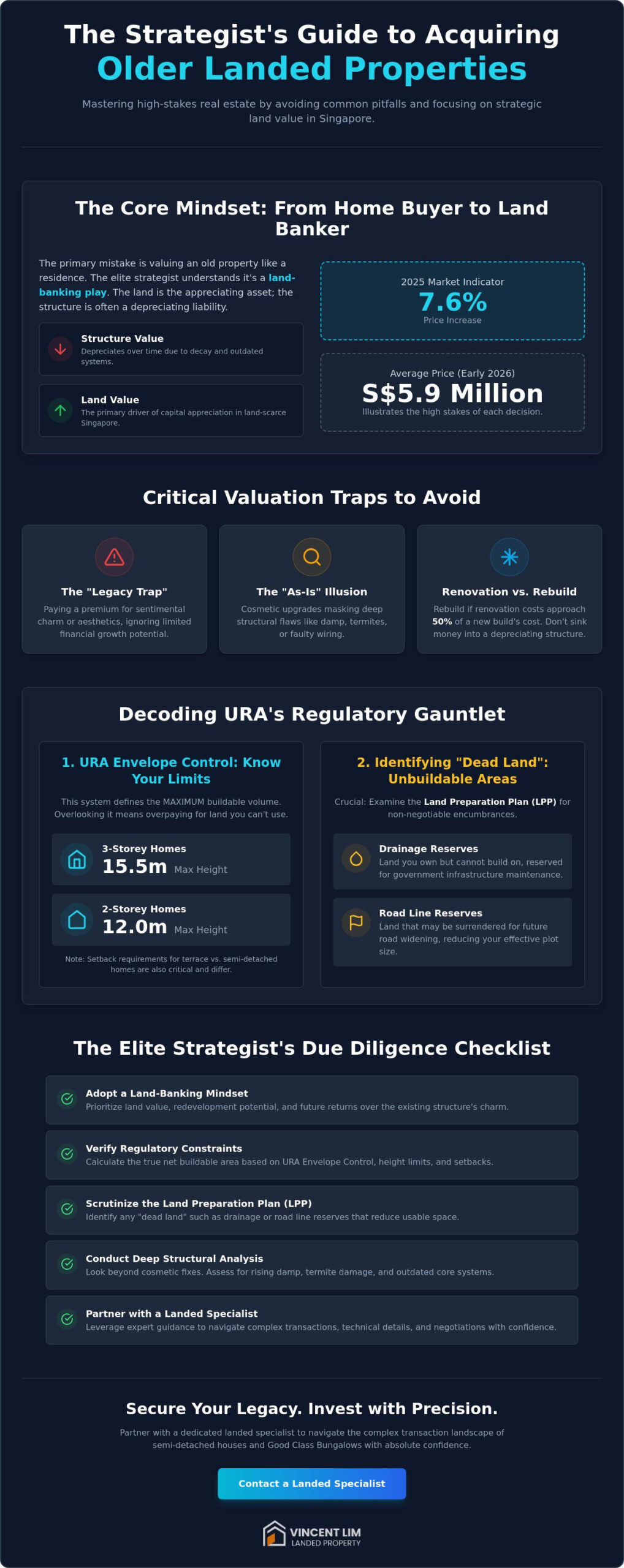
Investors in 2026 are increasingly targeting older plots for their bespoke redevelopment potential. While newer developments offer immediate occupancy, they often lack the specific land dimensions or orientation required for a truly custom legacy home. Understanding The historical context of landed estates reveals that land, unlike the structures built upon it, remains the primary driver of capital appreciation in Singapore’s land-scarce environment. One of the most common mistakes when buying older landed properties is viewing the purchase through the lens of a residential consumer rather than a strategic asset manager. This “Legacy Trap” occurs when buyers pay a premium for sentimental charm or historical aesthetics, only to find themselves stuck with a property that offers limited financial growth. In a market that saw a 7.6% price increase in 2025, the cost of an emotional error is too high to ignore.
Understanding the Land-to-Structure Value Ratio
The elite strategist focuses on the land-to-structure value ratio. In the current market, an older house is frequently a depreciating shell resting on an appreciating plot. If the building’s value represents a negligible percentage of the total price, the acquisition is effectively a land-banking play. Rebuilding usually makes more sense than renovating once the cost of rectifying structural decay approaches 50% of the cost of a new build. With the average price of landed property reaching approximately S$5.9 million in early 2026, your priority must be securing the highest-value land asset possible. This involves analyzing the plot’s potential for subdivision or expansion under current URA guidelines to maximize future returns.
Common Misconceptions About ‘As-Is’ Condition
Don’t let a well-maintained facade mislead you. Sellers often apply cosmetic upgrades to mask fundamental flaws like rising damp, termite infestations, or outdated electrical systems. These “as-is” purchases can quickly become financial liabilities if the structural integrity is compromised. Transitioning to an institutional investor’s perspective means looking past the fresh paint to evaluate drainage, soil stability, and legal encumbrances. Avoiding common mistakes when buying older landed properties starts with a clinical assessment of what cannot be easily changed. You must evaluate the land’s technical specifications and regulatory potential with absolute precision to ensure the asset remains a pillar of your wealth portfolio.
Technical Pitfalls: Overlooking URA and Regulatory Constraints
Technical due diligence is the stage where most high-stakes acquisitions either solidify into a high-value asset or dissolve into a costly liability. One of the most common mistakes when buying older landed properties is failing to look beyond the physical boundaries of the plot. While a property may appear expansive during a site walk, hidden regulatory encumbrances can significantly reduce your actual buildable area. These technical constraints are often the silent killers of redevelopment dreams, turning a perceived bargain into a restricted site with limited capital upside.
URA Setbacks and Height Restrictions
The URA Envelope Control system defines the maximum volume you can build on a plot. For a three-storey home, the maximum height is strictly capped at 15.5 meters, while two-storey homes are limited to 12 meters. These height limits, combined with specific setback requirements, dictate your net buildable area. In 2026, the distinction between terrace and semi-detached setbacks remains critical. A terrace house typically requires a different configuration than a semi-detached property to comply with fire safety and ventilation codes. If you don’t calculate the net buildable area before making an offer, you risk overpaying for land that you simply cannot utilize. Attic and mezzanine rules also play a pivotal role; they can either expand your usable floor area or, if miscalculated, lead to a rejection of your building plans.
The LPP and Technical Due Diligence
Identifying “dead land” is essential for any elite strategist. You must examine the Land Preparation Plan (LPP) to check for drainage reserves and road line reserves. A drainage reserve is essentially land you pay for but cannot build upon, as the government retains rights for infrastructure maintenance. Similarly, road line reserves might require you to surrender a portion of your front garden for future street widening. These encumbrances are non-negotiable.
Sewer line encumbrances are another frequent oversight. A major sewer pipe running across your backyard can instantly veto plans for a basement or a swimming pool. These technicalities are why a pre-purchase Topographical Survey is a mandatory step in a disciplined acquisition process. Analyzing these technicalities requires a strategic refinement of the site’s potential before you commit to a purchase. By uncovering these constraints early, you ensure your investment aligns with your long-term vision for legacy wealth and bespoke living.
Valuation Mistakes: Overpaying for the Wrong Features
Successful landed acquisition requires a total departure from the valuation metrics used in the condominium market. One of the most common mistakes when buying older landed properties is relying heavily on Price Per Square Foot (PSF) as a primary benchmark. PSF is a metric for high-rise living where units are relatively uniform; in the landed segment, it’s a blunt instrument that fails to account for plot shape, frontage, and topographical challenges. A plot with a narrow frontage but high total square footage might have a lower PSF, yet it offers significantly less architectural flexibility than a smaller, wider plot. You aren’t just buying space; you’re buying the potential to build a bespoke structure that maximizes that space.
Paying a premium for a 10-year-old renovation is another frequent error. While the interior might look polished, most renovations from a decade ago are reaching the end of their aesthetic and functional lifecycle. By the time you factor in the cost of undoing someone else’s design choices to suit your own requirements, that “premium” becomes a sunk cost. To ensure long-term ROI, you should evaluate the Asset Progression to Landed Property framework. This strategic approach focuses on how the land itself contributes to your net worth over a 10 to 20-year horizon, rather than the temporary appeal of existing fixtures.
Residual Land Value Calculation
The elite strategist utilizes a residual land value calculation to determine the true worth of a site. This formula takes the projected market value of a completed new build on that specific plot and subtracts the estimated construction costs and a required profit margin. The remaining figure is what you should actually pay for the land. It’s vital to remember that bank valuations often lag behind this strategic land value because they rely on historical transaction data rather than future redevelopment potential. Identifying undervalued plots requires the discipline to look past current market sentiment and calculate the “Plot Ratio” equivalent based on what the URA envelope control allows you to realize.
The Premium for Freehold vs. 99-year Leasehold in 2026
The price gap in the Freehold vs Leasehold Landed Property debate continues to widen as lease decay becomes an imminent threat for older 99-year homes. In 2026, buyers are increasingly wary of the “financing wall” that occurs when a lease drops below 60 years, as this restricts the loan-to-value limits for future purchasers. While leasehold properties might offer a lower entry price, they often lead to financial stagnation as the land value begins to depreciate. Conversely, the strategic advantages of Freehold Detached Houses are found in their role as permanent wealth repositories. These assets provide the ultimate peace of mind, ensuring that your capital remains protected from the inevitable countdown of a leasehold tenure.
The Elite Strategist’s Due Diligence Checklist
Acquiring an older landed asset requires a transition from a generalist’s curiosity to an expert’s scrutiny. One of the most common mistakes when buying older landed properties is treating the due diligence phase as a formality rather than a rigorous technical audit. In the high-stakes environment of 2026, where land values remain resilient despite cooling growth, any oversight in the pre-purchase phase can lead to multi-million dollar corrections later. A disciplined approach ensures that you don’t just buy a house; you secure a high-value land asset free from technical and legal encumbrances.
Phase 1: The Legal and Financial Audit
Your first priority is a comprehensive legal title search to verify ownership and identify any restrictive covenants. Older estates often have historical easements or encroachments where a neighbor’s wall or a public utility pipe crosses into your plot. These issues can severely delay or even block redevelopment plans. Simultaneously, your financial modeling must account for the current tax landscape. As of 2026, Singapore Citizens face an ABSD of 20% on their second property and 30% on their third. Accuracy is paramount here; you should consult a professional to calculate the ABSD for Landed Property acquisitions to ensure your liquidity remains intact for the construction phase. With mortgage rates hovering between 1.8% and 2.2% in early 2026, stress-testing your financing against a 55% TDSR limit is essential for long-term stability.
Phase 2: The Technical and Architectural Review
Once the legal foundation is clear, you must engage an architect to conduct a redevelopment feasibility study. This review determines if your vision fits within the URA Envelope Control guidelines mentioned earlier. For those considering a basement or a swimming pool, soil testing is a non-negotiable requirement. Subsurface conditions in certain areas of Singapore can significantly inflate foundation costs if the soil is too soft or rocky. Additionally, if you’re planning an Addition & Alteration (A&A) rather than a full rebuild, you must evaluate the existing foundation’s capacity. If the original structure can’t support the additional weight of a new mezzanine or attic, you’ll be forced into a full reconstruction, which triggers modern building standards and higher costs.
Success in this segment isn’t about finding the perfect house; it’s about identifying the perfect opportunity through meticulous planning. To avoid the structural and regulatory pitfalls that trap many buyers, you need a partner who understands the technical nuances of these assets. You can request a strategic site evaluation to ensure your next acquisition is a sound foundation for your family’s legacy wealth.
Securing Your Legacy: Partnering with a Landed Specialist
The transition from acquiring a luxury condominium to purchasing a landed asset involves a significant increase in technical complexity. Generalist agents often fail in this segment because they focus on aesthetic appeal rather than regulatory potential. One of the most common mistakes when buying older landed properties is relying on a representative who doesn’t understand the interplay between URA envelope control and land encumbrances. Without a specialist’s perspective, you may inadvertently acquire a property with “dead land” or restrictive covenants that severely limit your future redevelopment options.
The Value of Bespoke Representation
A veteran landed specialist operates as an elite strategist, coordinating a multifaceted team of architects, surveyors, and legal professionals before you even sign the Option to Purchase. This proactive approach ensures that every technical hurdle is cleared in advance. Bespoke representation also grants you access to off-market “pocket listings” that never reach public portals. These exclusive opportunities often involve older landed homes held by families for decades; the true value lies in the plot’s unique dimensions and lack of structural constraints. This white-glove service level ensures that your acquisition is not just a transaction but a meticulously planned step toward legacy wealth.
Consider the case of an unremarkable older terrace house in District 15. Most buyers were deterred by its dilapidated state and seemingly high price per square foot. However, a strategic evaluation revealed a rare 7-meter frontage and a total lack of drainage reserves. While others saw a “lemon,” the specialist recognized a plot capable of supporting a 3.5-storey rebuild with a full basement. By identifying this hidden value, the client secured an asset that significantly outperformed the broader market once the redevelopment was complete. They successfully avoided the common mistakes when buying older landed properties that typically lead to overpaying for structurally compromised assets.
Conclusion and Action Steps
Navigating the landed market requires a departure from conventional real estate thinking. You must value the site’s regulatory potential over its current structural state to avoid the financial stagnation that comes with poor land-banking decisions. By conducting rigorous technical due diligence and understanding the land-to-structure value ratio, you can turn an older plot into a high-performance asset. Now is the time to refine your property portfolio with precision and foresight. To ensure your next acquisition is handled with the highest standards of integrity and expertise, you should Connect with Vincent Lim for a strategic consultation and begin your journey toward a secure landed legacy.
Strategic Refinement for Your Landed Legacy
The path to acquiring a high-value landed asset requires a fundamental shift from a residential buyer’s mindset to that of an elite strategist. You’ve seen how prioritizing a plot’s regulatory potential over its current structural state is the key to long-term capital appreciation. By identifying hidden technical encumbrances and mastering the land-to-structure value ratio, you ensure that your investment serves as a resilient repository for your family’s wealth. Each decision you make should be calculated to maximize the site’s future buildable volume while minimizing technical risk.
Avoiding the common mistakes when buying older landed properties is a complex undertaking that demands seasoned expertise. You need a partner who translates technical URA guidelines into a clear, actionable roadmap for success. Vincent Lim, Executive Associate Director at OrangeTee & Tie, brings over 20 years of Singapore real estate experience to every transaction. As a specialist in GCB and luxury landed sales, he provides the meticulous planning and white-glove service necessary to refine your property portfolio with absolute confidence. He acts as your advocate, ensuring that every acquisition aligns with your vision for legacy and growth.
Secure your landed property future with Vincent Lim
Your journey toward a bespoke legacy home starts with a single, calculated decision. Take that step today and build a foundation that lasts for generations.
Strategic Insights: Frequently Asked Questions
Is it better to rebuild or renovate an older landed property in 2026?
Rebuilding is typically the more strategic choice when the existing structure’s integrity is compromised or when you wish to maximize the plot’s Gross Floor Area. Under current guidelines, an Addition & Alterations project is only classified as such if it involves less than 50% replacement of external walls and floor slabs. If your goal is to avoid common mistakes when buying older landed properties, you should prioritize the land’s long-term redevelopment potential over the current building’s aesthetic charm.
What are the URA setback requirements for a semi-detached house?
URA requires specific setbacks to ensure adequate ventilation and fire safety for landed homes. For a semi-detached house, the front setback is usually 7.5 meters from the road buffer for Category 1 roads, while the side and rear setbacks are typically 2 meters. These requirements can vary based on specific site conditions and road categories. Verifying these setbacks against the Land Preparation Plan is a critical step in determining your actual buildable area.
Can foreigners buy older landed properties in Singapore?
Foreigners are generally restricted from purchasing landed properties on the Singapore mainland without approval from the Land Dealings Approval Unit (LDAU). This approval is rarely granted and typically requires significant economic contribution to Singapore. Sentosa Cove remains the primary exception where foreigners can purchase landed homes, though these transactions are subject to a 60% Additional Buyer’s Stamp Duty and the property must be owner-occupied.
How much does it cost to rebuild a terrace house in Singapore today?
Construction costs for a terrace house vary significantly based on architectural complexity, material selection, and site conditions. Industry professionals report that technical requirements, such as the need for deep piling or soil stabilization, can also impact the final budget. It’s advisable to engage a professional consultant early to establish a realistic financial framework that accounts for the current 2026 labor and material market rates.
What is a drainage reserve and how does it affect my land value?
A drainage reserve is a portion of land earmarked by the government for drainage infrastructure maintenance. While you legally own this land and it is included in your total plot size, you’re prohibited from building permanent structures within its boundaries. This effectively creates “dead land” that can reduce the buildable efficiency of your plot. You must factor this encumbrance into your valuation to avoid overpaying for unusable space.
What should I look for in a topographical survey for an old house?
A topographical survey identifies precise terrain levels, existing boundaries, and the location of mature trees or utility services. For an older house, this survey is vital to determine if the land is “above road level” or if significant earthworks are required for redevelopment. Understanding these physical characteristics prevents unexpected costs during the excavation and foundation phases, ensuring your project remains financially viable.
How does the URA Envelope Control affect my building’s height?
URA Envelope Control dictates the maximum three-dimensional volume a building can occupy on a given plot. For a three-storey landed home, the maximum allowable height is 15.5 meters, while a two-storey home is capped at 12 meters. This system allows for more creative architectural designs, such as high ceilings and mezzanines, as long as the structure remains within the defined volumetric envelope.
Is buying a 99-year leasehold landed property a mistake for legacy planning?
Buying a 99-year leasehold property can be a risk for legacy planning if the remaining lease is relatively short. As the lease drops below 60 years, future buyers face stricter Loan-to-Value limits, which can hinder capital appreciation and resale liquidity. For those focused on multi-generational wealth preservation, freehold assets remain the preferred choice to ensure your capital is protected from the inevitable countdown of leasehold decay.