The transition from public housing to a private landed estate is not merely a purchase; it is a sophisticated migration of capital that defines a family’s legacy for generations. You likely recognize that while the prestige of a landed home is undeniable, the path to acquiring one in 2026 feels fraught with financial complexities. Between shifting interest rates and the intricacies of TDSR and ABSD, the fear of over-leveraging can often stall even the most ambitious plans.
Embarking on your upgrading from HDB to a landed property journey requires more than just a healthy bank balance. It demands a calculated strategy that accounts for hidden maintenance costs and long-term asset progression. This masterclass provides you with a clear, risk-mitigated roadmap for this significant life event. We’ll examine the distinct value propositions of Terrace houses, Semi-Detached homes, and Detached properties, ensuring you move forward with the confidence of an elite strategist who values precision and legacy security.
Key Takeaways
- Establish a secure financial foundation by calculating the true 2026 landed entry price and navigating TDSR limitations with precision.
- Develop a strategic asset progression framework to manage your upgrading from HDB to a landed property journey while mitigating the risks of over-leveraging.
- Evaluate the unique value propositions of Terrace and Semi-Detached homes to align your purchase with both lifestyle needs and resale liquidity.
- Protect your legacy through technical due diligence, including a thorough analysis of URA Master Plan zoning and Envelope Control guidelines.
- Access “invisible inventory” and off-market opportunities by leveraging the expertise of a seasoned landed property specialist.
The Financial Architecture: Assessing Your Readiness for Landed Ownership
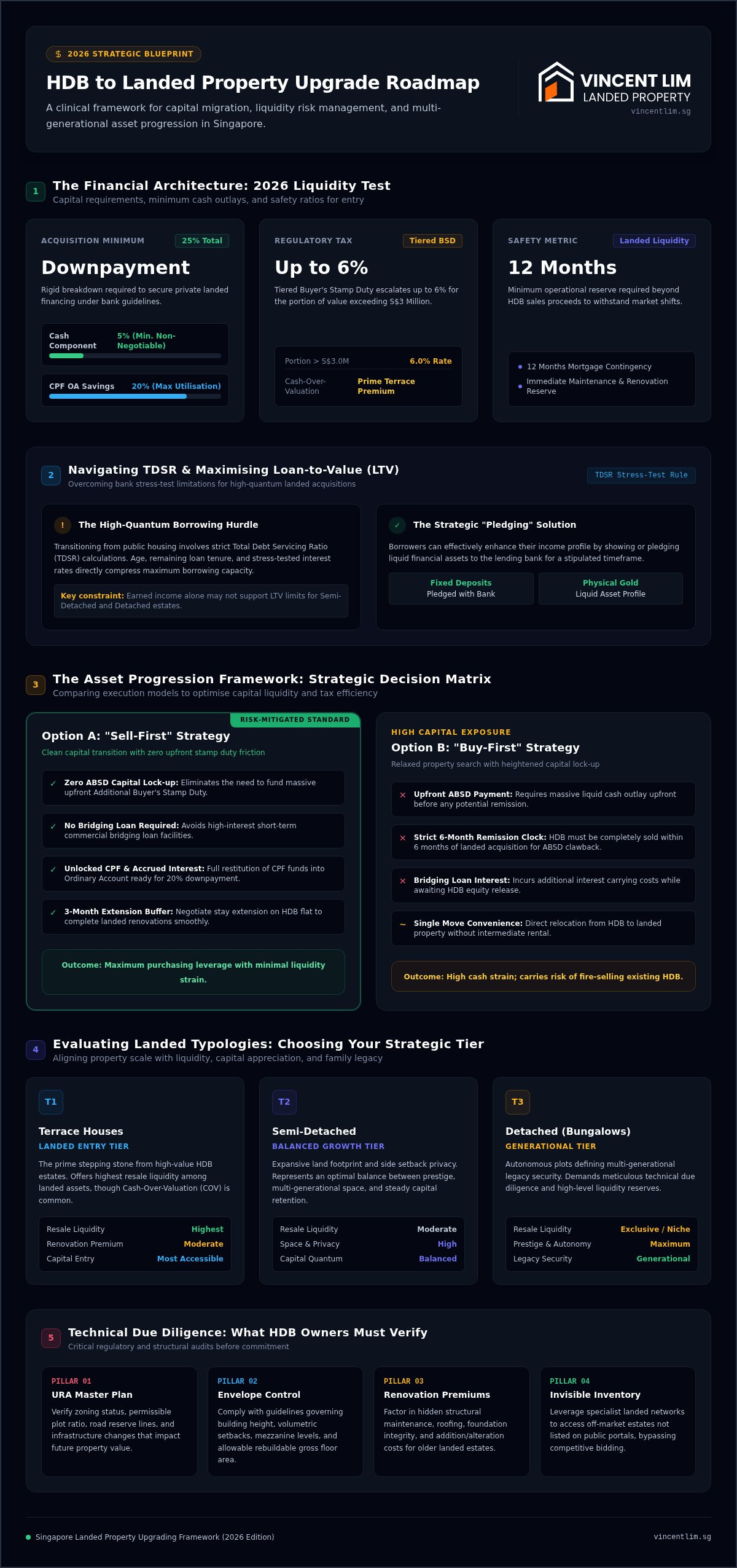
Success in your upgrading from HDB to a landed property journey begins with a clinical assessment of your capital structure. In the 2026 market, the “Landed Entry Price” is a moving target that extends far beyond the listed sale price. Elite strategists don’t just look at the downpayment; they account for the Cash-Over-Valuation (COV) often required for prime terrace houses and the substantial renovation premiums that accompany older landed estates. You must also factor in the Additional Buyer’s Stamp Duty (ABSD). For HDB owners, this often means orchestrating a “sell-first” strategy to avoid the significant capital lock-up of paying ABSD upfront, even if a remission is possible later.
The 2026 Liquidity Test
Acquiring a multi-million dollar asset requires a sophisticated breakdown of the 25% downpayment. While 20% can typically be settled via CPF Ordinary Account savings, the minimum 5% cash component is non-negotiable. Beyond this, you’ll face the tiered Buyer’s Stamp Duty (BSD), which reaches 6% for the portion of property value exceeding S$3 million. Professional planning ensures these costs don’t deplete your operational reserves. The Landed Liquidity Ratio serves as a vital safety metric, representing the proportion of liquid reserves held against the total acquisition cost to ensure your family’s lifestyle remains uninterrupted during market shifts. Relying solely on the proceeds from your HDB sale is a risk; a true safety buffer includes at least twelve months of mortgage contingencies and immediate maintenance funds.
Navigating TDSR and Loan Eligibility
The Total Debt Servicing Ratio (TDSR) remains the most significant hurdle for high-quantum loans. In the current interest rate environment, banks apply a stringent stress-test rate to ensure borrowers can sustain repayments. As you transition from public housing, your age and remaining loan tenure will pivotally influence your monthly repayment structures. If your earned income doesn’t support the required loan-to-value (LTV) limits for a detached or semi-detached home, we can explore the strategic use of “pledging.” By showing the bank liquid assets such as fixed deposits or gold for a specific period, you can effectively boost your income profile. This methodical approach ensures that your upgrading from HDB to a landed property journey is built on a foundation of calculated competence rather than speculative hope.
The Asset Progression Framework: Selling Your HDB for Maximum Leverage
Your HDB flat is more than a residence; it’s a strategic reservoir of equity that fuels your next move. In the 2026 market, many mature estates have reached a price plateau where capital appreciation has slowed. Holding an asset at its ceiling can actually diminish your future purchasing power as landed prices continue to climb. To maximize your leverage, you must treat the sale of your HDB as a clinical financial exit designed to unlock the highest possible liquidity for your landed acquisition.
Step 1: The Valuation and Exit Strategy
Identifying the “sweet spot” for your exit requires a deep dive into historical data and future URA developments. You need to ensure your HDB is positioned to attract a premium valuation, as these funds will cover the initial 5% cash downpayment and the significant stamp duties associated with landed property. A robust asset progression to landed property singapore plan maps out your capital growth over a decade. This foresight ensures you don’t just buy a house; you build a secure legacy. Unlocking your CPF funds and refunding the accrued interest from your HDB sale provides the necessary capital for the subsequent 20% CPF component of your landed purchase.
Step 2: Managing the Logistics of the Move
The “Sell-First vs. Buy-First” dilemma is a critical junction in your upgrading from HDB to a landed property journey. Selling your HDB first is often the most risk-mitigated path. It ensures a clean financial slate, removes the need for a high-interest bridging loan, and eliminates the requirement to pay Additional Buyer’s Stamp Duty (ABSD) upfront. While buying first allows for a more relaxed search, it necessitates a massive capital outlay for ABSD, which can only be remitted after your HDB is sold within a strict 6-month window.
Logistics require surgical precision to avoid double moves or temporary homelessness. Many successful upgraders negotiate a three-month extension of stay in their HDB to facilitate minor renovations or “envelope control” assessments on their new landed estate. Ensuring your financial standing is impeccable before signing the Option to Purchase (OTP) prevents last-minute loan rejections. For those seeking a seamless transition between these two distinct worlds, consulting a specialist can help synchronize these complex timelines and financial milestones.
Evaluating Landed Typologies: Choosing Your Strategic Tier
Selecting the right asset class is a pivotal decision that dictates your future exit strategy and lifestyle experience. While the move is often driven by a desire for space, an elite strategist views each typology through the lens of capital resilience and liquidity. Your upgrading from HDB to a landed property journey involves balancing your immediate family needs with the long-term performance of the asset. In the 2026 market, the distinction between these tiers has become more pronounced, requiring a nuanced understanding of land-to-built ratios and tenure types.
Terrace and Semi-Detached Dynamics
A terrace house for sale singapore represents the most liquid entry point into the landed market. Because the absolute quantum is lower compared to other classes, the pool of potential future buyers is significantly larger. This high resale liquidity makes it an excellent “bridge” asset for those who intend to upgrade again in the future. Many owners find that a “Corner Terrace” provides a strategic middle ground, offering the side garden of a semi-detached home while retaining the lower price point of a terrace.
When you analyze the average price of semi detached house in singapore, you often find a compelling value proposition compared to high-floor luxury condominiums. Semi-detached homes offer a significant jump in privacy, as you share only one party wall. For many upgraders, this tier represents the “sweet spot” where land area is sufficient for multi-generational living without the extreme maintenance requirements of a full detached estate.
The Luxury Pinnacle: Detached Houses and GCBs
A detached house for sale singapore offers complete autonomy and four-sided ventilation, making it a prized asset for wealth preservation. These properties are far scarcer than terraces, which naturally supports their price floor during market volatility. Ultra-high-net-worth individuals often view these as “land banks” where the intrinsic value of the soil outweighs the structure itself.
To understand what is a good class bungalow (GCB), one must look beyond the architecture to the stringent URA requirements, including a minimum land area of 1,400 square meters. These are the crown jewels of Singapore real estate. In 2026, GCBs remain the ultimate defensive play for legacy planning, as their supply is strictly capped. Whether you choose a leasehold property for its higher yield or a freehold asset for its timeless value, your choice should align with your 20-year financial horizon.
Technical Due Diligence: What HDB Owners Often Overlook
Your upgrading from HDB to a landed property journey shifts the burden of maintenance and compliance entirely onto your shoulders. Unlike HDB living, where the Town Council manages structural integrity, landed ownership requires a clinical understanding of the URA Master Plan and zoning regulations. You must verify if a property sits within a designated three-storey semi-detached zone or a primary landed housing estate, as this dictates your future redevelopment potential. The “Envelope Control” guidelines introduced by URA are particularly critical; they regulate the permissible building volume rather than just fixed storey heights, allowing for more creative architectural expressions but also imposing strict volumetric limits.
Decoding Land Constraints
Land size on a brochure can be deceptive. You need to calculate the “Effective Build-Area” by accounting for mandatory setbacks and drainage reserves. A property might have a large footprint, but if a significant portion is encumbered by a Road Line Plan (RLP) or a large drainage reserve, your actual buildable area shrinks. Identifying these easements through a formal land title search is non-negotiable. These constraints directly impact the land’s valuation and your ability to extend the structure in the future.
The Rebuild vs. A&A Strategy
Executing your upgrading from HDB to a landed property journey successfully requires looking beneath the surface. Choosing between Additions & Alterations (A&A) and a full “New Build” is a multi-million dollar decision. In 2026, construction costs for a high-quality landed home typically range from S$400 to S$600+ per square foot (PSF) of gross floor area. While A&A is faster and preserves the existing structure, a new build allows you to maximize the “Envelope Control” volume and modernize the internal layout completely.
It’s vital to remember that a “Defects Liability Period” doesn’t exist for resale landed homes, meaning you inherit all structural flaws the moment you complete the purchase. To ensure your investment is technically sound and your legacy is protected, engaging a landed specialist for a pre-purchase assessment is a prudent step in your asset progression. This level of due diligence provides the peace of mind that your capital is anchored in a structurally and legally sound asset.
The Final Transition: Executing Your Move with Vincent Lim
Executing your upgrading from HDB to a landed property journey is the culmination of years of financial discipline and strategic planning. However, the final mile of this migration is often the most complex. The landed market in Singapore is notoriously fragmented; unlike the standardized pricing of public housing, two seemingly identical terrace houses can vary by hundreds of thousands of dollars based on land shape or technical encumbrances. This is where a seasoned landed property specialist becomes an indispensable partner. They don’t just facilitate a transaction; they protect your interests by identifying value gaps that the average buyer overlooks.
Negotiation in the high-quantum segment requires a different psychological approach than HDB sales. You aren’t just haggling over price; you’re negotiating terms that include extension of stays, structural warranties, and specific repair obligations. Elite strategists leverage deep market intelligence to secure favorable outcomes, ensuring that your transition remains both profitable and stress-free. This level of execution is what transforms a simple purchase into a secure legacy for your family.
Bespoke Acquisition Strategy
Vincent Lim’s approach focuses on identifying “Invisible Inventory”, which are off-market deals that never reach public portals. Many high-net-worth sellers prefer privacy, meaning the most undervalued landed assets are often sold through private networks. By utilizing customized financial modeling, Vincent bridges the specific gap between your HDB sale proceeds and your landed acquisition. This white-glove service extends well beyond the legal completion, coordinating the handover process to ensure your new home meets the highest standards before you move in.
The Elite Strategist’s Advantage
With over two decades of experience in the Singapore real estate market since 2004, Vincent Lim provides access to 20+ years of OrangeTee & Tie network data. This historical perspective is vital for legacy planning, as it allows you to project the long-term resilience of your landed asset against market cycles. Transparency and integrity are the foundation of a partnership that views your success as its primary metric. Your legacy deserves a meticulous approach that prioritizes precision over speed. To begin your migration with the confidence of an expert at your side, booking a private Property Wealth Planning session is your next logical step.
Securing Your Family’s Legacy Through Strategic Asset Migration
Success in this transition requires more than just financial capacity; it demands a clinical understanding of URA zoning, TDSR limitations, and the technical nuances of landed typologies. We’ve established that the most effective path involves a risk-mitigated HDB exit strategy paired with thorough due diligence on envelope control and land encumbrances. Navigating your upgrading from HDB to a landed property journey is a multi-stage process where precision prevents costly errors and ensures long-term capital resilience.
As an Executive Associate Director at OrangeTee & Tie with over 20 years of industry experience, Vincent Lim has acted as a trusted guide for high-net-worth individuals since 2004. His expertise in the Good Class Bungalow market ensures that every acquisition is handled with the highest level of professionalism and strategic foresight. It’s time to move beyond general market advice and implement a plan tailored to your specific objectives. Secure your legacy with a bespoke Property Wealth Planning session with Vincent Lim. Your transition to the prestige of Singapore landed real estate is a significant milestone that deserves the attention of an elite strategist.
Frequently Asked Questions
Can I buy a landed property while still owning my HDB flat?
Yes, you can acquire a landed home while retaining your HDB, provided you’ve completed the five-year Minimum Occupation Period (MOP). However, you’ll be liable for Additional Buyer’s Stamp Duty (ABSD) on the second residential property. For Singapore Citizens in 2026, this represents a significant upfront capital outlay. Most strategists recommend selling the HDB first to unlock liquidity and qualify for ABSD remission, ensuring a smoother financial transition without over-leveraging your portfolio.
How much cash proceeds do I need from my HDB sale to safely upgrade?
You should aim for proceeds that comfortably cover the 5% mandatory cash downpayment and the tiered Buyer’s Stamp Duty (BSD). On a S$5 million property, the cash requirement alone is S$250,000. It’s prudent to have an additional S$150,000 to S$200,000 in liquid reserves. This buffer handles valuation gaps, legal fees, and immediate essential repairs. Relying purely on CPF savings is risky; cash liquidity is the true engine of a successful landed acquisition.
What is the difference between a Terrace House and a Semi-Detached in terms of land title?
Both typologies are titled as separate land plots, but their physical constraints differ. A Terrace House is part of a row of at least three units, sharing two party walls unless it’s an end-unit. A Semi-Detached house shares only one party wall, with the other side remaining open. This open side allows for better ventilation and a garden strip. From a title perspective, Semi-Detached homes often command higher premiums due to the increased land-to-built ratio.
Are there restrictions on foreigners or PRs buying landed property in Singapore?
Landed property is classified as “restricted” under the Residential Property Act. Foreigners and Permanent Residents (PRs) must seek approval from the Land Dealings Approval Unit (LDAU). The authorities assess applicants based on their economic contribution to the country. While specific exclusive enclaves may have unique regulatory frameworks, approval is carefully evaluated on a case-by-case basis. For most PRs, this approval is a necessary first step before signing any Option to Purchase for a Terrace, Semi-Detached, or Detached home.
What are the typical maintenance costs for a landed home compared to an HDB?
Landed maintenance is a significant step up from HDB living. You’re no longer paying Service and Conservancy Charges; instead, you’re responsible for the roof, external walls, and compound. Monthly costs for gardening, pest control, and pool maintenance can range from S$600 to S$1,200. It’s wise to set aside a “sinking fund” for long-term structural upkeep. This ensures your upgrading from HDB to a landed property journey doesn’t lead to unexpected financial strain later.
How does the URA Master Plan affect the resale value of my landed house?
The URA Master Plan is the blueprint for your property’s future value. It outlines zoning, plot ratios, and upcoming infrastructure. If your plot is rezoned for higher-storey heights, its redevelopment potential increases, attracting developers and pushing prices up. Conversely, a plan that introduces new high-rise blocks nearby might affect your privacy. Elite strategists always cross-reference the Master Plan to ensure the land’s scarcity value remains intact over a ten to twenty-year horizon.
Is a 99-year leasehold landed property a good investment for an upgrader?
Leasehold properties can be viable if the goal is maximizing immediate lifestyle and space for a lower entry price. You’ll often find leasehold landed homes in prime areas that would be unaffordable as freehold assets. However, lease decay is a real factor. As the remaining tenure drops below 60 years, bank loan limits and CPF usage become restricted. For those focused on multi-generational legacy planning, freehold properties remain the gold standard for long-term capital preservation.
What happens if the bank valuation for the landed property is lower than the purchase price?
If the bank valuation is lower than your purchase price, you must pay the difference in cash. This gap, known as Cash-Over-Valuation (COV), cannot be financed or paid via CPF. It’s a common hurdle in the upgrading from HDB to a landed property journey that can disrupt your capital flow. Banks only lend based on the lower of the purchase price or valuation, so securing a professional pre-purchase valuation is essential to prevent liquidity shocks.