Did you know that in 2025, Singapore’s landed property segment grew by 7.6%, significantly outperforming the 3.4% growth seen in the broader private residential market? This performance highlights why real estate asset progression singapore remains the definitive path for families looking to consolidate their wealth into tangible, high-value legacies. You’ve likely noticed that the market has shifted toward a more selective environment where scarcity-backed freehold assets are the primary drivers of long-term capital appreciation.
It’s natural to feel concerned about the 2026 ABSD rates, which now reach 30% for a Singapore Citizen’s third property, or the complexities of managing the 55% TDSR threshold for high-value acquisitions. This strategic guide promises to provide the elite framework you need to transition from standard residential ownership into prestigious landed assets like detached houses and Good Class Bungalows. We’ll explore a methodical roadmap for tax-efficient portfolio growth and the meticulous planning required to preserve your family’s legacy for the next generation.
Key Takeaways
- Redefine property growth as a systematic consolidation of equity into scarcity-backed assets rather than a simple sequence of residential upgrades.
- Identify the five-step strategic framework for transitioning from luxury condominiums into the exclusive landed property segment with precision and confidence.
- Navigate the 2026 ABSD landscape and financing regulations to ensure your real estate asset progression singapore remains both tax-efficient and strategically sound.
- Explore the unique investment criteria of Good Class Bungalows and their role as the ultimate instrument for multi-generational legacy planning and wealth preservation.
- Understand why a dedicated luxury specialist is vital for coordinating the white-glove logistics and complex financial structures of high-stakes property acquisitions.
Table of Contents
- The Fundamentals of Asset Progression in Singapore’s 2026 Market
- Strategic Upgrading: Transitioning from Luxury Condos to Landed Homes
- Financial Engineering for High-Net-Worth Asset Progression
- The GCB Pinnacle: Scarcity, Prestige, and Legacy Planning
- Executing Your Progression Plan with a Luxury Specialist
The Fundamentals of Asset Progression in Singapore’s 2026 Market
At its core, real estate asset progression singapore is the disciplined, systematic refinement of a property portfolio to transition from basic residential holdings into high-value, legacy-grade assets. While many homeowners view the “HDB-to-Condo” upgrade as the pinnacle of success, veteran strategists recognize this as merely the foundational step. True wealth building doesn’t stop at a high-rise apartment; it culminates in the acquisition of landed properties that offer both physical land ownership and long-term capital preservation. In the 2026 market, where the era of easy, double-digit annual gains has transitioned into a more measured growth phase, success requires a shift from speculative volume to scarcity-driven quality.
The current landscape demands a more calculated approach to leverage. With the Total Debt Servicing Ratio (TDSR) strictly capped at 55%, your progression plan must be built on a bedrock of financial prudence rather than aggressive borrowing. We’ve seen private home prices rise by 0.9% in the first quarter of 2026 alone, marking the sixth consecutive quarter of growth. This steady momentum suggests that while the “old playbook” of rapid flipping is gone, the rewards for those who hold the right assets remain substantial.
The Scarcity Premium: Why Landed Assets are the End Goal
The primary driver of value in Singapore’s property market is the absolute finite nature of land. While developers can continue to build upwards, increasing the supply of luxury condominiums, they cannot manufacture more ground. This is why the landed property segment grew by 7.6% in 2025, vastly outperforming the 3.4% growth seen in the broader private market. Owners of freehold landed homes hold an asset that naturally resists the depreciation risks often associated with aging 99-year leasehold developments.
According to the URA Master Plan, the scarcity premium is the inherent valuation uplift triggered by the strictly limited allocation of land for low-density housing, ensuring that supply remains perpetually below the demand of the nation’s growing affluent class. Transitioning into a terrace, semi-detached, or detached house isn’t just about more space; it’s about securing a piece of a non-renewable resource.
The 2026 Economic Context for Property Owners
Planning your next move requires a deep understanding of Singapore’s economic fundamentals and how they interact with global wealth flows. Despite a “higher-for-longer” interest rate environment, the luxury detached house and Good Class Bungalow (GCB) segments remain resilient. This resilience is fueled by a consistent influx of global capital and a local preference for “safe haven” assets. Investors have moved away from high-frequency trading toward long-term legacy holding, focusing on properties that can be passed down through generations without losing their prestige or utility. In this climate, your progression strategy must prioritize cash flow stability and tax efficiency to withstand market cycles while positioning you for the next major upswing.
Strategic Upgrading: Transitioning from Luxury Condos to Landed Homes
Transitioning from a high-rise luxury condominium to a landed home represents a pivotal shift in real estate asset progression singapore. While a condo provides lifestyle amenities, a landed property offers something far more valuable: absolute autonomy over the land. For families, the debate between “right-sizing” and “upgrading” often hinges on the need for multi-generational space versus the convenience of concierge services. However, from a wealth perspective, the data is clear. According to the URA Private Property Price Index, landed properties have historically shown more robust resistance to market volatility compared to non-landed segments. Over a 10-year horizon, detached houses often outperform semi-detached units in capital appreciation due to their higher land-to-built ratio and greater redevelopment flexibility.
This transition requires a disciplined five-step framework. It begins with financial clearing and moves through asset selection, technical due diligence, and eventual legacy structuring. The jump to landed wealth isn’t merely a change in address; it’s a move toward an asset class where supply is permanently capped, and demand is perpetually fueled by the nation’s growing affluent class.
Step 1: Equity Assessment and Exit Strategy
A successful transition begins with a rigorous audit of your current holdings. You must calculate your net proceeds by accounting for the outstanding mortgage, accrued CPF interest, and any applicable seller’s stamp duties. Determining your “sweet spot” is essential; for many, moving into a high-potential terrace house serves as a strategic bridge to a semi-detached home. If you’re currently holding a premium asset, you’ll need a strategic guide to selling your landed property or luxury condo to ensure you exit at the market peak. This liquidity is the fuel for your next acquisition.
Step 2: Identifying Redevelopment Potential
In the landed market, you’re buying for the land, not the tiles. Identifying “undervalued” terrace houses often means looking for properties with aging structures but superior plot characteristics. You should prioritize corner terrace units, which offer larger land areas and better ventilation, often commanding a premium upon resale. Understanding plot ratios and building height restrictions is vital. A single-storey house on a plot zoned for a three-storey build represents significant “hidden” value. By maximizing the allowable built-up area, you’re not just creating a home; you’re engineering equity. For those ready to execute this high-stakes move, engaging a luxury property specialist ensures every technical detail is accounted for.
Financial Engineering for High-Net-Worth Asset Progression
Navigating the fiscal complexities of real estate asset progression singapore in 2026 demands a level of precision that goes beyond simple mortgage math. The current regulatory environment, characterized by an ABSD of 20% for Singapore Citizens on their second residential property and 30% on their third, has fundamentally altered the feasibility of traditional expansion strategies. While the “Sell One, Buy Two” model was once a staple for growing portfolios, the upfront capital required for stamp duties now often outweighs the immediate rental yields. Instead, savvy investors are shifting toward consolidation into a single, high-value landed asset that offers superior capital protection and legacy potential.
Decoupling remains a viable mechanism for private property owners to free up one spouse’s name for a second acquisition, yet it requires careful legal and financial orchestration. Owners must account for the 16% Seller’s Stamp Duty (SSD) if the transfer occurs within the first four years of purchase. For those looking further ahead, structuring property ownership through a Trust for minor children has emerged as a sophisticated method for legacy planning. This approach allows families to set aside assets for the next generation while managing their current tax exposure, provided the Trust is structured to meet stringent IRAS requirements.
ABSD Mitigation Strategies for 2026
The most effective way to manage the 2026 tax burden is the “Sell First, Buy Later” sequence. By completing the sale of your existing property before signing the Option to Purchase (OTP) for the new landed home, you eliminate the need for upfront ABSD payments. Matrimonial couples can also utilize the ABSD remission for their primary residence upgrade, provided the first property is sold within six months of the second property’s purchase or TOP date. This requires meticulous timing to ensure liquidity isn’t trapped during the transition. For a deeper dive into these elite maneuvers, consult our Asset Progression to Landed Property guide.
Financing the Luxury Leap
Securing financing for a detached house or GCB involves navigating the 55% Total Debt Servicing Ratio (TDSR) with surgical accuracy. High-income earners and business owners must present a transparent view of their cash flow to satisfy bank stress tests, especially as interest rates remain in a “higher-for-longer” cycle. Monitoring the NUS Singapore Residential Price Index helps sellers time their condo exits to maximize the equity available for their landed purchase. When planning your leverage, remember that the LTV limit for a second property loan is capped at 45% if the tenure exceeds 30 years or the borrower’s 65th birthday, which significantly increases the required cash and CPF outlay. Managing this gap often involves a strategic mix of bridging loans and term loans to maintain operational flexibility during the acquisition phase.
The GCB Pinnacle: Scarcity, Prestige, and Legacy Planning
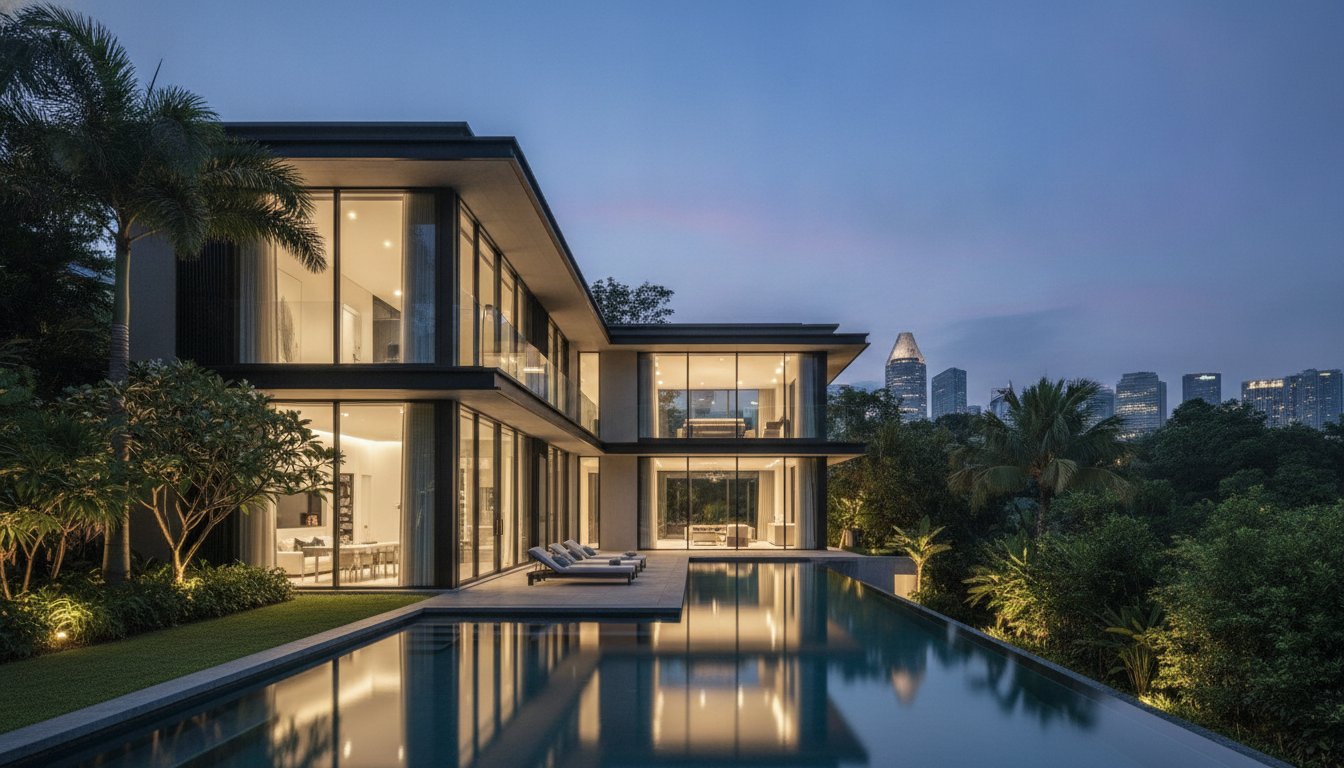
The Good Class Bungalow (GCB) represents the absolute zenith of real estate asset progression singapore. It is an asset class that transcends standard residential metrics, defined by its extreme scarcity and the immense land area it occupies. To qualify as a GCB, a property must be situated within one of the 39 designated GCB Areas, such as Nassim, Cluny, or Chatsworth. These estates must possess a minimum land plot size of 1,400 square meters, approximately 15,070 square feet, and maintain a building height limited to two storeys. With only about 2,800 such units in existence, the GCB is the “Gold Standard” for wealth preservation across Asia, offering a level of privacy and prestige that no luxury condominium can replicate.
Ownership of a GCB serves as a powerful hedge against inflation and market volatility. Because the supply is strictly capped by the Urban Redevelopment Authority, these assets possess a “Prestige Premium” that allows their valuations to decouple from the broader residential market. While mass-market segments may fluctuate based on interest rate cycles, the GCB market operates on the fundamentals of ultra-high-net-worth demand and perpetual scarcity. This makes it an ideal vehicle for a multi-generational family office, providing a physical anchor for a family’s global wealth portfolio.
Eligibility and Acquisition Rules
The barrier to entry for the GCB market is intentionally high. Under current regulations, only Singapore Citizens are permitted to own landed properties in GCB Areas. Permanent Residents (PRs) who wish to acquire such an asset must seek exceptional approval from the Land Dealings (Approval) Unit (LDAU), a process that is rigorous and typically reserved for those who have made significant economic contributions to the nation. For a detailed breakdown of these stringent requirements, refer to our guide on What is a Good Class Bungalow?. This exclusivity ensures that GCBs remain in the hands of committed, long-term stakeholders, further stabilizing their value over decades.
Legacy Planning: Passing the Asset to the Next Generation
In an era of volatile digital assets and fluctuating equity markets, physical land remains the most reliable instrument for legacy planning. A GCB is not just a residence; it is a multi-generational estate that can be passed down through the centuries. Families must choose between a “Transfer of Equity” during their lifetime or allowing the asset to pass through inheritance, each carrying distinct legal and tax implications in Singapore. Strategic acquisition of a Detached House for Sale Singapore within a GCB area requires a long-term perspective on capital preservation. By consolidating wealth into a single, high-value landed asset, you ensure that your family’s financial foundation remains unshakable for the next generation. To begin your journey toward the pinnacle of the property market, consult an elite GCB strategist who understands the nuances of high-stakes luxury transactions.
Executing Your Progression Plan with a Luxury Specialist
High-stakes real estate asset progression singapore requires more than just a standard transaction coordinator; it demands an elite strategist. When you’re managing assets valued in the high seven or eight figures, the margin for error is non-existent. A generalist agent often lacks the nuanced understanding of landed property setbacks, technical plot ratios, and the specific financing hurdles unique to high-net-worth individuals. Our white-glove service ensures that every detail, from the initial valuation to the final legal handover, is handled with meticulous precision. This level of care alleviates the stress of complex acquisitions, providing you with the peace of mind that your family’s capital is protected by seasoned expertise.
True success in the luxury market isn’t found in publicly available portals. It’s found through a partner who operates with a grounded, results-oriented approach and values transparency above all else. By engaging a specialist who focuses on Terrace House, Semi-Detached, and Good Class Bungalow sales, you gain access to a level of market intelligence that generalists simply cannot provide. This bespoke approach is vital for navigating the 2026 landscape, where asset selection is the primary determinant of long-term legacy preservation.
The Vincent Lim Advantage: Since 2004
Vincent Lim, an Executive Associate Director at OrangeTee & Tie, has been a cornerstone of the Singapore luxury market since 2004. This longevity provides a distinct advantage: a veteran network that grants access to off-market GCB and luxury landed listings that never reach the open market. His methodology blends rigorous, data-driven analysis with over two decades of professional intuition. This experience allows for the refinement of strategic negotiation tactics that have been tested across multiple market cycles, from the global financial crisis to the 2026 regulatory environment. You receive comprehensive support that extends far beyond the sale, encompassing expert valuation, legal coordination, and professional renovation consultation to maximize the redevelopment potential of your new detached house or terrace unit.
Your 2026 Roadmap Starts Here
A personalized asset progression consultation is the definitive first step toward securing your family’s multi-generational wealth. During this session, we’ll strip away market noise to focus on your specific financial goals and risk tolerance. We’ll examine tax-efficient structures, verify current leverage limits, and identify specific properties that align with the “Gold Standard” of wealth preservation. Our commitment to integrity serves as a guarantee that every recommendation is made with your long-term success as the priority. You’ll walk away with a clear, actionable roadmap tailored to the 2026 economic climate. Don’t leave your wealth to chance in a complex market. Take the definitive step toward your landed property goals and Book a Strategic Wealth Planning Session with Vincent Lim today to begin your journey toward the pinnacle of Singaporean real estate.
Securing Your Multi-Generational Legacy
The journey toward landed wealth in Singapore is a disciplined marathon of strategic refinement. We’ve explored how land scarcity remains the primary engine for capital appreciation, why the 2026 tax environment requires sophisticated ABSD mitigation, and how Good Class Bungalows represent the ultimate pinnacle of wealth preservation. Success in real estate asset progression singapore isn’t about following the crowd; it’s about making calculated moves backed by data and high-level intuition.
Navigating these high-stakes transactions requires a partner who understands the nuances of the luxury market. Vincent Lim, an Executive Associate Director at OrangeTee & Tie, has specialized in the GCB and luxury landed segments since 2004. With a proven track record in high-value detached house sales, he provides the white-glove service necessary to execute your roadmap with absolute precision. It’s time to transition from standard residential holdings to a legacy that lasts for generations. Consult the Elite Strategist for Your Property Asset Progression and begin your bespoke planning session today.
Frequently Asked Questions
What is the minimum cash/CPF required for asset progression to a landed property in 2026?
You typically need a minimum of 25% of the purchase price in a combination of cash and CPF for your down payment. At least 5% must be paid in cash, while the remaining 20% can be funded through your CPF Ordinary Account or additional cash. It’s vital to also budget for the Buyer’s Stamp Duty (BSD) and legal fees, as these costs cannot be covered by your mortgage loan.
Can I upgrade from an HDB directly to a terrace house?
Yes, you can upgrade directly from an HDB to a terrace house once you’ve fulfilled your five-year Minimum Occupation Period (MOP). This move requires a rigorous assessment of your Total Debt Servicing Ratio (TDSR) to ensure you can manage the larger loan quantum. While possible, many homeowners find that a luxury condominium serves as a helpful intermediate step to build the necessary equity for a landed acquisition.
Is it better to buy a freehold terrace house or a leasehold detached house?
Freehold terrace houses are generally the superior choice for long-term wealth preservation because they don’t suffer from lease decay. While a leasehold detached house might offer more land for the same price, its value will eventually face downward pressure as the lease shortens. For a successful real estate asset progression singapore strategy, freehold land remains the gold standard for preserving a multi-generational legacy.
How does the 2026 ABSD affect my property asset progression plan?
The 2026 ABSD rates make owning multiple properties significantly more expensive, with Singapore Citizens paying 20% on their second residential purchase. This has shifted the market toward a consolidation strategy where owners sell their smaller assets to upgrade into a single, high-value landed home. This approach eliminates the heavy tax burden while focusing your capital on a high-growth, scarcity-backed asset.
What is the “Asset Progression Trap” and how can I avoid it?
The trap occurs when a homeowner over-leverages to acquire a property that lacks strong capital appreciation potential or has high holding costs that drain cash flow. You can avoid this by prioritizing land value and location over cosmetic renovations. Ensure your financing is structured with a safety buffer so that your TDSR stays well within the 55% limit, even if interest rates fluctuate.
How long should I hold a property before progressing to the next asset class?
You should plan to hold your property for at least four years to avoid the Seller’s Stamp Duty (SSD). For properties purchased on or after July 4, 2025, selling within the first year incurs a 16% tax, which scales down over a four-year period. A holding period of five to seven years is usually the “sweet spot” for capturing meaningful capital gains before moving to a higher asset class.
Do I need to sell my current condo before buying a landed home?
Selling your current condo before signing the Option to Purchase for a landed home is often the most tax-efficient route. If you buy the new home first, you must pay the applicable ABSD upfront within 14 days. While you can apply for a remission if you sell your first property within six months, this requires a massive initial cash outlay that could otherwise be used for renovations or other investments.
Why is a Good Class Bungalow (GCB) considered the ultimate progression goal?
A GCB is the ultimate goal because it’s the most exclusive and restricted form of residential land in Singapore. With only about 2,800 units located in 39 gazetted areas, the supply is permanently capped. This extreme scarcity ensures that GCBs maintain their value and prestige regardless of broader market trends, making them the premier choice for ultra-high-net-worth legacy planning.