
The long-standing assumption that Singapore never levies a tax on property profits is a strategic blind spot that can lead to costly encounters with the tax authorities. While it’s true that there’s no formal **capital gains tax levied specifically on landed property in Singapore**, the Inland Revenue Authority of Singapore (IRAS) increasingly utilizes the “Badges of Trade” framework to reclassify investment gains as taxable income. If your transactions appear too frequent or purely profit-driven, you might find your expected windfall significantly reduced by unexpected income tax assessments.
You’ve worked hard to build a portfolio of high-value assets, and it’s natural to feel concerned about how the 2026 tax landscape affects your bottom line. This guide provides the clarity you need to manage these complexities, from navigating the updated Seller’s Stamp Duty rates, which now scale from 16% in the first year down to 4% in the fourth, to optimizing your holding periods for maximum efficiency. We’ll explore a strategic framework for long-term legacy planning and break down the latest ABSD adjustments, ensuring your landed property remains a pillar of wealth rather than a tax liability.
Key Takeaways
- Understand how the Inland Revenue Authority of Singapore (IRAS) distinguishes between tax-free gains and taxable income using the “Badges of Trade” framework.
- Master the 2026 Seller’s Stamp Duty (SSD) schedule to avoid losing 12%, 8%, or 4% of your sale price during the mandatory three-year holding period.
- Learn why the lack of a formal capital gains tax landed property singapore requires a disciplined holding strategy to avoid being audited as a property trader.
- Integrate the 2026 ABSD rates into your financial models to accurately calculate net investment yields and identify the optimal exit window.
- Leverage expert market analysis to align your divestment strategy with legacy planning goals for high-value assets like Good Class Bungalows.
The Reality of Capital Gains Tax in the 2026 Singapore Market
Singapore remains a global outlier by maintaining a tax regime that encourages wealth preservation and long-term investment. For those liquidating high-value assets, the absence of a formal Capital Gains Tax is a significant advantage that distinguishes our market from other global financial hubs. However, relying solely on this headline can be a strategic error in 2026. The Inland Revenue Authority of Singapore (IRAS) maintains a vigilant watch over high-value transactions to ensure that what looks like an investment isn’t actually a business activity. Understanding how capital gains tax landed property singapore is applied in practice requires looking beyond the “no tax” rule and into the nuances of income classification.
While the 3.4% rise in private property prices during 2025 has been more moderate than in previous years, the sheer value of landed assets means that even small percentage gains represent significant sums. Investors must navigate a landscape where the tax-free status of a sale isn’t a guaranteed right but a result of careful strategic positioning. Protecting your ROI in 2026 involves documenting your investment journey to satisfy potential IRAS audits, which are increasingly common for high-quantum transactions.
Capital Gains vs. Trading Income
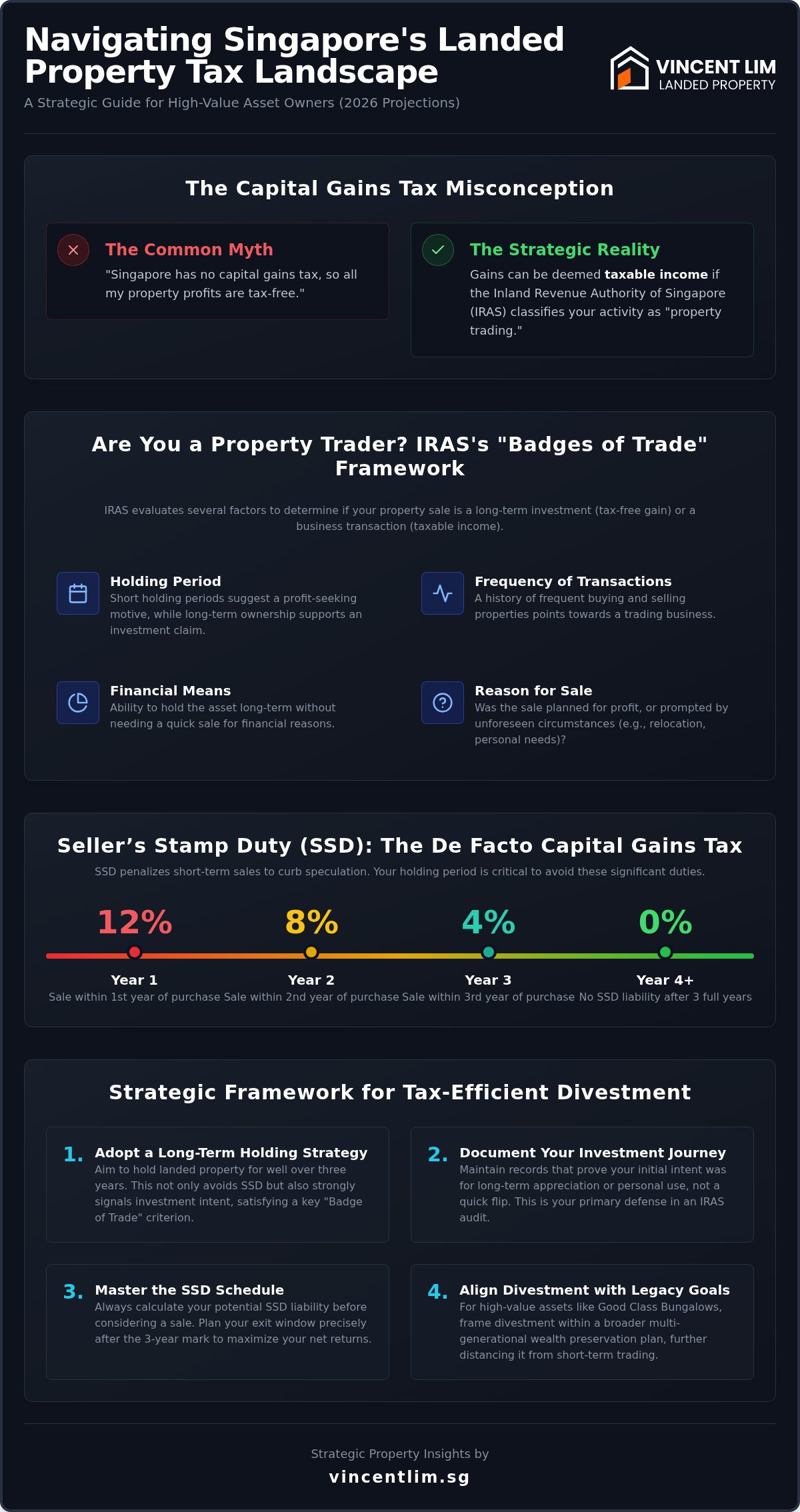
The distinction between a tax-free windfall and a taxable event lies in the nature of the profit. A capital gain is the surplus realized from an asset held for long-term appreciation, often intended for personal use or legacy planning. Conversely, trading income arises when the profit is derived from frequent transactions characterized by a clear profit-seeking intent. The intent of acquisition serves as the primary factor in determining whether your profit remains tax-exempt or becomes subject to prevailing income tax rates. IRAS evaluates several factors to determine this intent, including:
- The holding period: How long the asset was kept before the sale.
- Frequency of transactions: Whether you have a history of buying and selling properties in short succession.
- Financial means: Whether you had the long-term capital to hold the property without a quick sale.
- Reason for sale: Whether the disposal was prompted by an urgent, unforeseen need or a planned exit for profit.
The Scarcity of Landed Assets in 2026
Landed property in Singapore is a finite resource, a reality that has only intensified in 2026. This inherent scarcity supports a long-term holding strategy, which naturally aligns with the criteria for tax-free capital gains. The limited supply of terrace houses, semi-detached homes, and Good Class Bungalows means these assets are typically held for years, if not decades. This long-term horizon is your strongest defense against being classified as a property trader.
Tenure also plays a role in your tax profile. Freehold properties often signal a commitment to multi-generational wealth, whereas short-lease assets might attract closer scrutiny if sold shortly after acquisition. From an elite strategist’s perspective, these assets are more than just residences; they are sophisticated financial instruments that require meticulous planning to ensure the eventual exit remains tax-efficient and preserves the family legacy.
Seller’s Stamp Duty (SSD): The De Facto Capital Gains Tax
While Singapore is celebrated for its lack of a formal Seller’s Stamp Duty (SSD) on investment profits, the SSD functions as a regulatory gatekeeper that luxury property owners must respect. In the 2026 market, this duty acts as a de facto capital gains tax for those who exit their positions prematurely. It’s designed to curb short-term speculation, ensuring that the landed market remains a playground for long-term wealth builders rather than high-frequency flippers. For a high-quantum asset, failing to account for these rates can erase years of projected appreciation in a single transaction.
The 2026 SSD rate schedule remains a critical factor in your divestment timeline. If you sell within the first year of acquisition, you face a 12% duty on the property value. This drops to 8% in the second year and 4% in the third year. Only after the third year has fully elapsed does the liability disappear. Calculating the breakeven point for a landed sale requires a meticulous look at these percentages alongside legal fees and agent commissions. In rare circumstances, such as matrimonial proceedings or certain government acquisitions, IRAS may grant exemptions, but these are exceptions to a very rigid rule.
The SSD Holding Period Strategy
Seasoned luxury investors rarely aim for the bare minimum. A 37-month holding strategy has become the standard for those managing elite portfolios. This buffer ensures that the transaction date falls safely outside the taxable window, protecting the net ROI from unnecessary erosion. The financial stakes vary wildly with the asset class. On a S$10 million terrace house, a first-year exit incurs a S$1.2 million penalty. However, for a S$50 million Good Class Bungalow (GCB), that same early exit results in a S$6 million liability. Timing your market exit isn’t just about finding the right buyer; it’s about navigating the calendar to ensure your hard-earned gains aren’t diverted to the state.
SSD and Asset Progression
Integrating SSD into your asset progression to landed property singapore plan is vital for maintaining liquidity. Rapidly moving up the property ladder can be rewarding, but each rung requires a strategic pause to clear the SSD hurdle. Without proper liquidity planning, a “forced sale” due to changing financial circumstances can become a double blow, combining a potentially soft market price with a heavy tax burden. It’s essential to remember that the duty is calculated based on the actual sale price or the current market value, whichever is higher. Partnering with a specialist who understands these nuances ensures that your progression remains profitable and your legacy remains intact.
When Property Gains Become Taxable: The ‘Badges of Trade’
IRAS doesn’t just look at the calendar to determine your tax liability. They scrutinize the underlying intent behind every transaction to determine if the profit should be treated as tax-free capital or taxable income. While the absence of a formal capital gains tax landed property singapore is a major draw for investors, the “Badges of Trade” framework allows the government to tax “property flippers” at prevailing income tax rates. If your transaction history suggests you’re operating a business rather than holding an investment, your expected gains could be significantly diminished by an unexpected tax bill.
The frequency of your transactions is often the first red flag. While there’s no hard rule, selling three or more properties within a five-year window typically triggers an audit. IRAS also examines your financing methods. If you’ve secured high-leverage, short-term financing that you clearly cannot service without a quick sale, it signals a profit-seeking motive rather than a long-term investment intent. This “feasibility” badge is a common pitfall for those trying to maximize returns through aggressive gearing.
Decoding the IRAS Audit Process
The Badges of Trade consist of six primary criteria used to evaluate your case. Beyond frequency and financing, the “Enhancement of Asset” is a critical factor for landed owners. If you purchase a terrace house, undertake extensive structural renovations, and sell it shortly after completion, IRAS may classify the profit as trading income. To protect your position, it’s vital to document your original intent at the point of purchase. Keeping records of family planning discussions or architectural briefs for personal use can provide the evidence needed to prove the property was intended as a primary residence or a legacy asset.
Strategic Holding for High-Net-Worth Individuals
Managing a luxury portfolio in 2026 requires a disciplined narrative. High-net-worth individuals must ensure their acquisition and divestment patterns reflect a commitment to long-term wealth preservation. Partnering with a landed property specialist is essential for timing these exits without attracting the “trader” label. A professional advisor helps you align your sales with genuine life milestones or portfolio rebalancing needs.
Consider the case of a S$45 million GCB owner who sold their property after only a four-year hold. Because they could demonstrate the sale was necessitated by an unforeseen relocation and had initially invested significant capital into bespoke interior fittings for personal use, they successfully defended their “long-term investment” status. This strategic documentation saved them from an income tax assessment that would have functioned exactly like a capital gains tax landed property singapore, preserving millions in net profit.
2026 Financial Planning: ABSD and Net Investment Yields
Achieving a true capital gain in the Singapore landed market requires a sophisticated understanding of the entry friction created by the Additional Buyer’s Stamp Duty (ABSD). While there is no formal capital gains tax landed property singapore, the substantial upfront tax liability effectively shifts the breakeven point, demanding a patient holding strategy. In 2026, Singapore Citizens acquiring their second residential property face a 20% ABSD, while the rate for a third or subsequent property stands at 30%. These figures represent a significant capital drag that must be recouped through long-term appreciation before any net profit is realized.
Despite these entry costs, landed property remains the ultimate hedge against inflation in 2026. The tangible nature of land, coupled with the government’s one-off 10% property tax rebate for owner-occupiers, provides a level of security that paper assets cannot match. The key is to view the ABSD not as a lost cost, but as a premium paid for access to one of the world’s most stable and scarce real estate markets. Successful wealth preservation in this segment relies on minimizing tax drag through precise acquisition timing and structure.
The Impact of ABSD on Capital Growth
For those navigating the luxury segment, the calculation is rigorous. Even for local investors, the combined weight of Buyer’s Stamp Duty (up to 6%) and ABSD means your asset must appreciate by nearly a quarter of its value just to reach a neutral position. Given that the private property price index rose by a more measured 3.4% in 2025, investors must adopt a decade-long perspective. This makes the analysis of asset types critical, particularly when evaluating what is a good class bungalow and how its unique scarcity affects its specific ROI trajectory. To ensure your entry price aligns with your long-term goals, consult with a seasoned strategist for a data-driven acquisition plan.
Legacy Planning and Multi-Generational Wealth
Structuring family holdings requires an elite strategist’s touch to minimize tax exposure during wealth transfer. In 2026, the rules surrounding trusts remain a primary consideration, as a 65% ABSD (Trust) rate applies to the transfer of residential property into a living trust unless specific conditions for a remission are met. This makes the initial acquisition structure paramount for multi-generational wealth. Choosing the right ownership model at the start ensures that the property serves as a robust hedge against inflation while remaining a viable legacy asset for the next generation. Permanent Residents also face a 5% ABSD on their first purchase and 30% on their second, creating a tiered entry barrier that favors citizens for large-scale portfolios.
Securing Your Legacy: The Vincent Lim Advantage
Successfully managing high-value assets requires more than just market awareness. It demands a partner who possesses the foresight to anticipate regulatory shifts and the precision to execute complex transactions. While the absence of a formal capital gains tax landed property singapore offers a clear advantage, the intricacies of the “Badges of Trade” and evolving ABSD rules create a landscape where errors are expensive. Vincent Lim provides the seasoned authority needed to navigate these waters, ensuring that your divestment or acquisition aligns perfectly with your broader financial objectives.
Strategic wealth planning is built on a foundation of data and discretion. Through the extensive OrangeTee & Tie network, clients gain access to an exclusive pool of off-market buyers, allowing for high-value sales that remain private and professional. This “white-glove” service level is complemented by meticulous due diligence. Every transaction is scrutinized to ensure your history remains beyond IRAS reproach, protecting the tax-free status of your gains through documented investment intent and logical holding patterns. This methodical approach ensures that your hard-earned equity is preserved for the next generation.
A White-Glove Approach to Landed Sales
With over 20 years of experience in the luxury market since 2004, Vincent Lim has mastered the art of asset progression. He refines your sell my landed property singapore strategy by coordinating directly with legal and tax professionals. This collaborative effort ensures that every detail, from SSD holding periods to net ROI calculations, is handled with meticulous care. Acting as a trusted guide, he alleviates the stress of high-stakes transactions by projecting a calm, calculated competence that yields superior results in the 2026 market.
Your Next Step in Strategic Wealth Planning
The 2026 real estate environment rewards those who plan with precision. Scheduling a private consultation allows for a comprehensive evaluation of your landed portfolio’s health, identifying the optimal “exit window” to maximize your capital growth. You’ll receive customized reporting on market trends specific to your asset class, whether you hold a terrace house or a Good Class Bungalow. Don’t leave your legacy to chance. Partner with an elite strategist for your next detached house for sale singapore acquisition and secure your family’s financial future today.
Master Your Property Divestment Strategy for 2026
Singapore’s landed market offers unparalleled stability, yet the path to a tax-efficient exit requires meticulous planning. You’ve learned that while there’s no formal capital gains tax landed property singapore, the intersection of Seller’s Stamp Duty and the “Badges of Trade” can significantly impact your net returns. Success in this high-stakes environment isn’t just about the sale price. It’s about the precision of your holding strategy and the clarity of your investment intent.
By aligning your divestment with long-term legacy goals and navigating the 2026 ABSD landscape, you protect your wealth from unnecessary tax drag. Whether you’re managing a terrace house or a Good Class Bungalow, professional guidance ensures your transaction remains beyond reproach. Consult with Vincent Lim for a strategic, tax-efficient landed property divestment. As an Executive Associate Director at OrangeTee & Tie with over 20 years of experience, Vincent specializes in GCBs and luxury residences. Your journey toward a secure and profitable property legacy starts with a single, well-timed decision.
Frequently Asked Questions
Is there a capital gains tax on property in Singapore in 2026?
Singapore doesn’t impose a formal capital gains tax landed property singapore in 2026. Profits from property sales are typically considered capital gains and remain tax-free for most individual owners. However, if you’re found to be trading in properties with a profit-seeking motive, IRAS will treat your gains as taxable income. This distinction depends on your specific circumstances and transaction history rather than a fixed tax rate.
How long must I hold my terrace house to avoid Seller’s Stamp Duty?
You must hold your property for more than three years to fully avoid Seller’s Stamp Duty (SSD). Any sale within the first 36 months triggers a staggered tax liability. Specifically, selling in year one incurs a 12% duty, year two costs 8%, and year three costs 4%. Strategically planning your exit for the 37th month ensures your transaction is completely exempt from these specific holding period penalties.
What are the ‘Badges of Trade’ that IRAS uses to tax property gains?
The “Badges of Trade” are criteria IRAS uses to determine if a sale is a business transaction. They evaluate the following:
- Frequency of your property transactions
- Length of your holding period
- Method of financing used for the purchase
- Efforts made to enhance the property
- Reason for the eventual disposal
Documenting your original intent is essential to defending your tax-exempt status during an audit.
Can I be taxed on capital gains if I sell a GCB after 5 years?
Selling a Good Class Bungalow after a five-year holding period usually qualifies the profit as a tax-free capital gain. This duration strongly suggests a long-term investment rather than a trading activity. However, if you’ve a high frequency of other property sales during this timeframe, IRAS might still scrutinize the transaction. Most owners who hold high-value assets for five years or more find their gains remain beyond the reach of income tax.
Does the 2026 ABSD rate affect the calculation of my capital gains?
While ABSD isn’t a direct tax on your profit, it significantly impacts your net capital gains tax landed property singapore calculation. Since ABSD is an upfront cost, it raises your overall acquisition price. You’ll need a higher sale price to achieve the same net profit compared to a transaction without ABSD. In 2026, Singapore Citizens pay 20% on their second property, making it a critical factor in your ROI projections.
Are there any exemptions for Seller’s Stamp Duty in 2026?
Yes, specific exemptions exist for SSD in 2026. These include properties transferred during matrimonial proceedings, such as a divorce, or assets acquired by the government under the Land Acquisition Act. Additionally, individuals who are declared bankrupt and forced to sell their property to repay creditors may qualify for a waiver. It’s vital to consult with a specialist to verify your eligibility for these rare but important tax reliefs.
How does IRAS distinguish between an investor and a property trader?
IRAS distinguishes between the two by looking at your primary intent during the acquisition. An investor typically buys for long-term rental yield, personal use, or multi-generational legacy planning. A property trader, however, enters the market with a clear intent to flip the asset for a short-term gain. They evaluate your financial capacity to hold the asset and whether your transaction patterns mirror those of a commercial business operation.
What happens if I sell my landed property at a loss in Singapore?
If you sell your landed property at a capital loss, you generally cannot deduct that loss against your other taxable income. Since Singapore doesn’t tax capital gains, it doesn’t provide tax relief for capital losses. However, if you’re classified as a property trader and your gains are taxable as income, your losses might be deductible against your business profits. This highlights why your tax classification is so important for financial planning.