
A cooling measure can reduce one buyer’s budget without setting the price of every landed home. Understanding how cooling measures affect landed property prices means looking beyond policy headlines: the effect depends on who is buying, how they finance the purchase and the property’s own market context.
It’s reasonable to ask whether changes to Additional Buyer’s Stamp Duty, borrowing limits or Seller’s Stamp Duty could weaken demand or change your buying or selling plans. These measures affect different buyers in different ways. A price movement around the same time as a policy change does not, by itself, show that the policy caused it.
This article explains how cooling measures can influence landed-home demand, financing and pricing in Singapore. It also considers why the landed segment may respond differently from the wider private-property market, how to assess market evidence and what to check before making a property decision. The aim is to help you evaluate what the rules could mean for a specific home and your circumstances.
Key Takeaways
- Cooling measures can affect landed property prices through changes to buyer costs, financing capacity and sentiment. They do not set an individual home’s value.
- Check which rules apply to your buyer profile and the relevant policy dates before estimating affordability or likely demand.
- Assess terrace, semi-detached, detached and GCB homes in context. Buyer pools and property-specific features can shape their exposure differently.
- Compare relevant transactions over a suitable period, verify the data and consider other market influences before attributing price movements to policy.
- Use separate checklists to guide your next steps as a buyer or seller, while treating policy as one factor in a property-specific decision.
How Singapore’s cooling measures can affect landed property prices
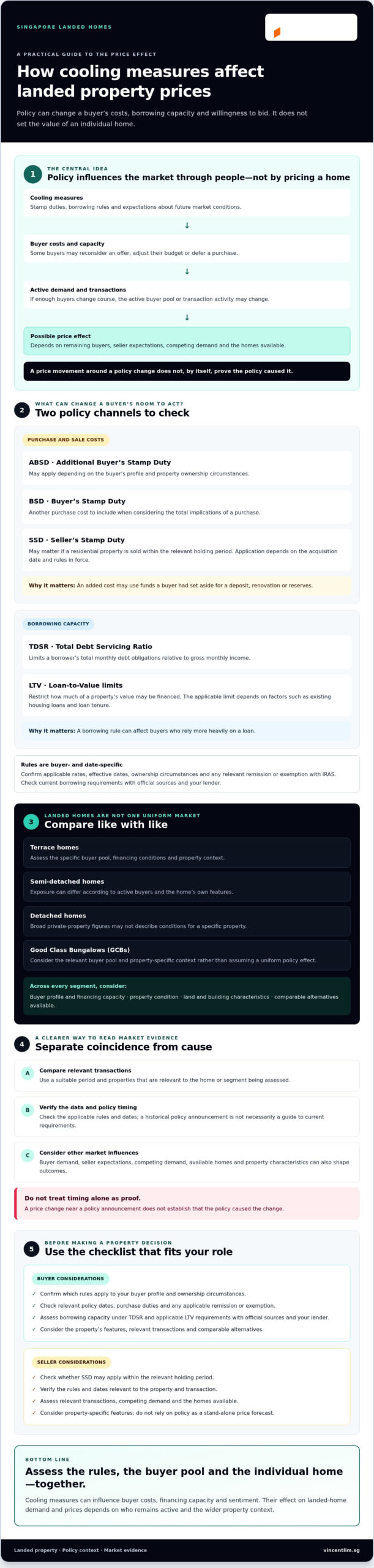
Property cooling measures are policy interventions intended to moderate demand and manage risks in the housing market. In Singapore, they can affect a buyer’s decision through purchase costs, borrowing capacity, eligibility under applicable rules and expectations about future market conditions. Their effect on prices is indirect: a policy may change who is able or willing to bid, but it does not set the value of a particular landed home.
This approach sits within a broader housing context. Singapore’s public housing framework helps explain the government’s active role in housing policy, including its attention to affordability and market stability. Private residential property, including landed homes, is also shaped by individual buyers, sellers and property characteristics.
What counts as a property cooling measure in Singapore?
Additional Buyer’s Stamp Duty (ABSD) is an extra duty that may apply to a residential property purchase, depending on the buyer’s profile and property ownership circumstances. Seller’s Stamp Duty (SSD) may apply when a residential property is sold within the relevant holding period. Rates and application can depend on when the property was acquired and the rules in force. Check the Inland Revenue Authority of Singapore (IRAS) guidance for the relevant transaction date.
Borrowing rules also shape purchasing capacity. The Total Debt Servicing Ratio (TDSR) limits a borrower’s total monthly debt obligations relative to gross monthly income. Loan-to-value (LTV) limits restrict how much of a property’s value may be financed, with the applicable limit depending on factors such as existing housing loans and loan tenure. Verify current requirements with official sources and your lender before relying on an estimated budget.
Why landed property may respond differently
Landed homes do not necessarily react to a policy change in the same way as other private residential properties. The impact depends on the buyers active for a particular home, their financing capacity and the property’s features. A change affecting buyers with multiple properties, for example, may influence demand differently from a borrowing rule that affects buyers relying more heavily on a loan. Property condition, land and building characteristics, and the availability of comparable alternatives can also matter.
These influences do not guarantee a different outcome for landed homes. They mean broad market figures may not describe conditions for a specific property or segment. Policy is one influence to assess, not a stand-alone price forecast.
In brief: Cooling measures can change buyer costs and capacity, which may alter demand. The resulting price effect depends on who remains active and what other market forces are doing. That is the central principle behind understanding how cooling measures affect landed property prices. A policy announcement and a price movement occurring around the same time are not, by themselves, proof that one caused the other.
How stamp duties and borrowing limits influence landed-home demand
Stamp duties and borrowing rules affect the room a buyer has to act, not the physical qualities or intrinsic value of a home. If an added purchase cost uses funds the buyer had set aside for a deposit, renovation or reserves, they may reconsider an offer, adjust their budget or defer the purchase. If enough buyers respond this way, the active pool may narrow and transaction activity may change. Any effect on prices also depends on seller expectations, competing demand and the homes available.
How stamp duties can change buyer decisions
Additional Buyer’s Stamp Duty (ABSD) depends on factors such as the buyer’s profile and existing property ownership. Buyer’s Stamp Duty (BSD) is another purchase cost, while Seller’s Stamp Duty (SSD) may matter to an owner considering a sale within the applicable holding period. The total implications therefore differ from buyer to buyer and can change when policy changes. Before making an offer or setting a sale timeline, confirm the rules, rates, effective dates and any relevant remission or exemption directly with the Inland Revenue Authority of Singapore (IRAS).
The official 2021 cooling measures provide an example of policy changes affecting both ABSD and borrowing conditions. Treat that release as a record of measures announced at the time, not as a guide to current rates or requirements.
How borrowing rules can shape purchasing power
The Total Debt Servicing Ratio (TDSR) limits the share of a borrower’s income that can go towards total monthly debt obligations. Loan-to-Value (LTV) limits restrict the proportion of a property’s value that may be financed by a housing loan. In practice, these rules can affect how much a buyer can borrow and how much cash or other funding is needed to complete a purchase. Current requirements may depend on the borrower’s circumstances and loan details, so confirm them with the Monetary Authority of Singapore (MAS) and a lender before relying on an estimate.
Financing eligibility is not the same as market value. A buyer who can borrow less may reduce an offer or withdraw, while another buyer with different finances may still proceed. Landed-home buyers are not all affected in the same way: the balance between borrowing and available funds varies by individual.
For buyers, calculate acquisition costs and confirm loan capacity before committing. Then check whether comparable homes support the proposed price. For sellers, a smaller pool of eligible or willing buyers is one possible demand effect, not proof that a particular home must sell for less. Transaction volumes, comparable sales and broader market conditions help show what actually followed a policy change.
Owners considering terrace, semi-detached, detached or GCB sales can discuss the buyer pool for a specific landed home as part of assessing the market evidence.
Do cooling measures affect terrace, semi-detached, detached and GCB prices equally?
There is no single answer across landed homes. To assess how cooling measures affect landed property prices, consider which buyers are active for each property, how they might finance a purchase and which property features shape their choices. Test these questions against current evidence rather than assuming that one category is automatically more exposed or resilient than another.
What to consider across landed-home types
Terrace, semi-detached and detached homes differ in their physical form and may appeal to buyers with different priorities. Someone comparing a terrace home may focus on its layout and land attributes, while a buyer considering a detached home may weigh the site and building configuration differently. Good Class Bungalow (GCB) transactions also call for property-specific analysis. Avoid generalising from a small number of sales or assuming every buyer in a category has the same financing profile.
Separate policy effects from other price drivers
For a meaningful comparison, track the policy channel separately from factors such as land size, condition, tenure and potential for redevelopment, where relevant. Then check whether supply, buyer sentiment or financing conditions changed during the same period. The table provides questions to investigate, not a ranking of segment performance.
| Landed-home segment | Policy channel to test | Other influences to examine |
|---|---|---|
| Terrace | Did buyer-specific duties or borrowing constraints affect the likely buyer pool? | Compare land and building attributes, condition and relevant comparable sales. |
| Semi-detached | Did the policy change alter affordability for buyers considering this type of home? | Review site characteristics, tenure and the availability of similar homes. |
| Detached | Did financing capacity or purchase costs affect the willingness or ability to transact? | Assess the individual plot, building condition and any relevant redevelopment considerations. |
| GCB | Examine the circumstances of actual buyers rather than assuming a uniform response. | Give close attention to property-specific features and the comparability of sales. |
Compare achieved prices and transaction volumes as separate measures. Fewer transactions may indicate reduced activity, but they do not establish that prices fell. Conversely, a small number of high-value sales can lift an average without showing that typical properties achieved more. Check the number and characteristics of sales, and compare transactions that are genuinely relevant over a suitable period.
Keep this caveat in view: A price shift after a policy change is a signal to investigate, not proof of cause. Timing alone cannot show whether policy, property differences or wider market conditions drove the result.
How to assess cooling measures before buying or selling landed property
Turn policy headlines into a property-specific review. Identify which rules apply, test your finances or asking-price assumptions, and compare those findings with relevant market evidence. This helps you assess how cooling measures affect landed property prices without treating a policy announcement as a forecast.
A buyer’s checklist for policy and price evidence
- Start with the relevant date and your circumstances. Identify the date that matters for your intended transaction, then confirm how your citizenship or residency status, property ownership and purchase structure affect applicable duties and rules. Check current guidance from the Inland Revenue Authority of Singapore (IRAS) and the Monetary Authority of Singapore (MAS), since requirements can change.
- Build a complete affordability picture. Ask your lender to assess borrowing capacity under current requirements. Include purchase duties and other transaction costs in your budget, and consider whether you would remain comfortable if your borrowing capacity or financial circumstances changed. Seek qualified tax, legal or financial advice where your situation requires it.
- Compare genuinely similar transactions. Review landed sales relevant to the property’s type and characteristics, using a period appropriate to your question. Check the source and date of the records. A broad market index or a handful of transactions may not reflect differences in land, condition, tenure or other features.
- Record the limits of the comparison. Note whether transaction numbers are small, whether the properties differ materially and whether other market conditions shifted during the same period. Separate what the records show from what you infer about policy’s role.
A seller’s checklist for interpreting buyer demand
For owners, a policy change is a reason to review the evidence, not to revise an asking price automatically. Consider current enquiries alongside comparable achieved prices, transaction activity and your property’s specific strengths. If interest changes, assess whether policy may be one factor or whether pricing, presentation, financing conditions or wider buyer sentiment may also be relevant.
Base your positioning strategy on the property’s evidence and likely buyer pool. A strategic guide to selling landed property can help owners organise the questions to consider before deciding how to proceed.
For a focused review of a terrace, semi-detached, detached or GCB sale, discuss your landed-property decision with Vincent Lim.
What cooling measures mean for your landed-property decision
Cooling measures can influence the costs, financing and demand surrounding a landed-home transaction, but they cannot predict what one property will sell for. The practical questions are how the rules apply to your circumstances and whether relevant transaction evidence supports your intended decision. Treat policy as one factor in a considered assessment, not a substitute for evaluating the property itself.
If you’re buying, confirm the duties and borrowing requirements that apply to you on the relevant transaction date. Check your financing with your lender, then compare the property with genuinely similar landed-home sales, taking account of its condition, land attributes and other relevant features. If you’re considering a sale, review current buyer interest and comparable achieved prices before adjusting your asking-price expectations. A policy change alone is not sufficient evidence to justify a particular price.
When to seek a property-specific assessment
Consider a tailored assessment if uncertainty about policy eligibility, financing or timing could materially change your plans. Bring together your circumstances, current rules, comparable transactions and the features of the specific home. Buyers considering how a purchase may fit into their broader property plans can also read this landed property asset progression guide.
For either side of a transaction, give more weight to evidence that closely matches the property and the decision at hand. Broad market movements can provide context, but they do not replace an examination of relevant sales, buyer demand and the home’s attributes. Where legal, tax or financing questions require specialist judgement, consult the appropriate qualified professional.
A considered next step with Vincent Lim
Vincent Lim’s work includes sales of terrace, semi-detached, detached and Good Class Bungalow properties. A discussion about your objectives and the available transaction evidence can help frame the questions to address before you decide how to proceed. It is not a promise of a particular sale price or outcome. The purpose is to assess the decision in its specific context.
If you’re weighing a purchase or sale, discuss your landed-property decision with Vincent Lim. Bring the property details, your intended timing and any policy or financing questions you’re working through. A measured review can help separate confirmed requirements and market evidence from assumptions, so your next step is grounded in the factors that matter to you.
Make your next landed-property decision with confidence
Cooling measures can influence buyer costs, financing capacity and demand, but they do not determine the price of an individual landed home. A clear assessment checks which rules apply to your circumstances, compares relevant transactions and accounts for the property’s own features. That is the practical answer to how cooling measures affect landed property prices: policy is one influence to evaluate, not a stand-alone forecast.
For buyers, confirm your financing and transaction requirements before committing. For owners, weigh current enquiries and comparable sales before changing your price expectations. In both cases, policy dates and market evidence matter. A price movement that follows a change does not, by itself, prove that the change caused it.
Vincent Lim works with buyers and owners on terrace, semi-detached, detached and Good Class Bungalow sales, as well as luxury condominiums. A property-specific discussion can help clarify the questions to investigate and the evidence relevant to your plans. Discuss your landed-property plans with Vincent Lim to assess the factors that matter to your decision.
Frequently Asked Questions
How do cooling measures affect landed property prices in Singapore?
Cooling measures can affect landed prices indirectly by changing purchase costs, borrowing capacity or buyers’ willingness to proceed. An applicable duty may alter a buyer’s total budget, while lending rules may affect how much they can finance. These changes can influence demand and transaction activity, but their effect varies with buyer circumstances, property characteristics and wider market conditions. They do not set the price of an individual home.
Do cooling measures always lower landed property prices?
No. Measures may restrain some buyers’ spending or reduce the number willing to transact, but that does not guarantee prices will fall. Other buyers may remain active, while comparable supply, property-specific attributes and broader market sentiment can also influence sale prices. Assess achieved prices and transaction volumes separately. A change in the number of sales may signal different activity, but does not by itself establish that prices have declined.
Which cooling measures can affect a landed-property buyer?
Depending on the buyer and transaction, relevant measures can include Additional Buyer’s Stamp Duty (ABSD), Buyer’s Stamp Duty (BSD), Loan-to-Value (LTV) limits and the Total Debt Servicing Ratio (TDSR). Seller’s Stamp Duty may also matter if a buyer later sells within the applicable period. Rules and rates can depend on individual circumstances and transaction dates, so verify current requirements with IRAS, MAS and your lender before committing.
Are terrace, semi-detached and detached house prices affected equally?
Not necessarily. The effect can differ according to each home’s buyer pool, buyers’ financing circumstances and the property’s own features. Compare terrace, semi-detached and detached transactions with genuinely similar homes rather than assuming that one category is always more exposed to policy changes. Check transaction dates, sale characteristics and the number of comparable records. A broad market trend may offer context, but may not reflect conditions for a specific property.
Can cooling measures make landed property prices fall?
They can contribute to downward price pressure if they reduce buyers’ purchasing capacity or willingness to transact, but a price fall is not automatic. Seller expectations, active buyer demand and property-specific factors also shape agreed prices. To assess an apparent decline, compare relevant achieved transactions over a suitable period and consider whether the homes are genuinely comparable. Do not infer that a particular measure caused a fall from a price movement alone.
How can I tell whether a cooling measure caused a price change?
You cannot establish causation from timing alone. Identify the measure’s effective date and who it applied to, then examine landed transactions before and after that date using a suitable comparison period. Check the source and dates of the records, the number of sales and whether property characteristics differ. Also consider other changes in supply, sentiment or financing conditions. The evidence may indicate an association without proving the policy caused the change.
Should I delay buying or selling landed property because of cooling measures?
Not solely because a measure has changed. Buyers should confirm applicable duties, financing capacity and transaction readiness, then assess comparable sales and the individual property. Sellers should review buyer enquiries and achieved prices before changing their expectations. Timing depends on your objectives and circumstances as well as current evidence. If policy eligibility, financing or timing could materially affect your decision, seek relevant professional advice before proceeding or delaying.