Could a parking space advertised as “private” still leave your household with the wrong spot, limited access or an arrangement that isn’t clearly documented? When considering a luxury condo with private car park space, don’t rely on the label alone. Establish how the space is assigned and whether it suits your needs.
Parking can make daily life more convenient, but its practical value depends on more than its presence in a listing. Find out whether the space is allocated, reserved for exclusive use or documented separately. Then consider whether its layout and access work for your vehicle and routine.
This 2026 guide explains how to compare parking arrangements and what to review in the relevant transaction and management documents before committing. It also shows how to weigh everyday usability alongside the wider condominium proposition. Vincent Lim (OrangeTee & Tie) has been active in Singapore real estate since approximately 2004. His experience in luxury condominium sales supports a structured approach to comparing properties and organising transaction steps, so you can assess the details with greater clarity.
Key Takeaways
- Distinguish allocated, exclusive-use and separately documented parking arrangements before assessing what a listing promises.
- Test whether a luxury condo with private car park space suits your vehicle, access needs and household routines.
- Compare condominiums using practical criteria such as bay identification, vehicle fit, access and available management information.
- Review the listing, identified bay, transaction documents and management information before committing.
- See how Vincent Lim can help organise your priorities, compare suitable options and coordinate the next steps in your purchase.
What Does “Luxury Condo with Private Car Park Space” Actually Mean?
A listing may describe a parking bay as “private,” but that word alone doesn’t establish the buyer’s rights. A private car park space is an arrangement described in marketing or transaction materials. Its precise use, access and status must be established from the documents that apply to the specific property. For a buyer considering a luxury condo with private car park space, an attractive listing description is a starting point for review, not proof of ownership, transferability or continuing access.
Luxury is a broad market description, not a parking classification. A general definition of luxury apartment discusses features such as amenities and market value, but those qualities don’t establish the rights attached to a particular bay. Assess the condominium’s overall proposition separately from the parking arrangement, and establish what the relevant documents say about the space.
Allocated, exclusive-use and separately documented parking
These terms are useful prompts for investigation, not interchangeable legal conclusions. “Allocated” may describe a bay assigned for a resident’s use; “exclusive-use” may indicate that use is reserved for a particular unit or party; and “separately documented” suggests that the arrangement is recorded apart from the general unit description. Their precise meaning depends on the property’s documents. Don’t assume any one term establishes ownership or a right to sell the bay separately.
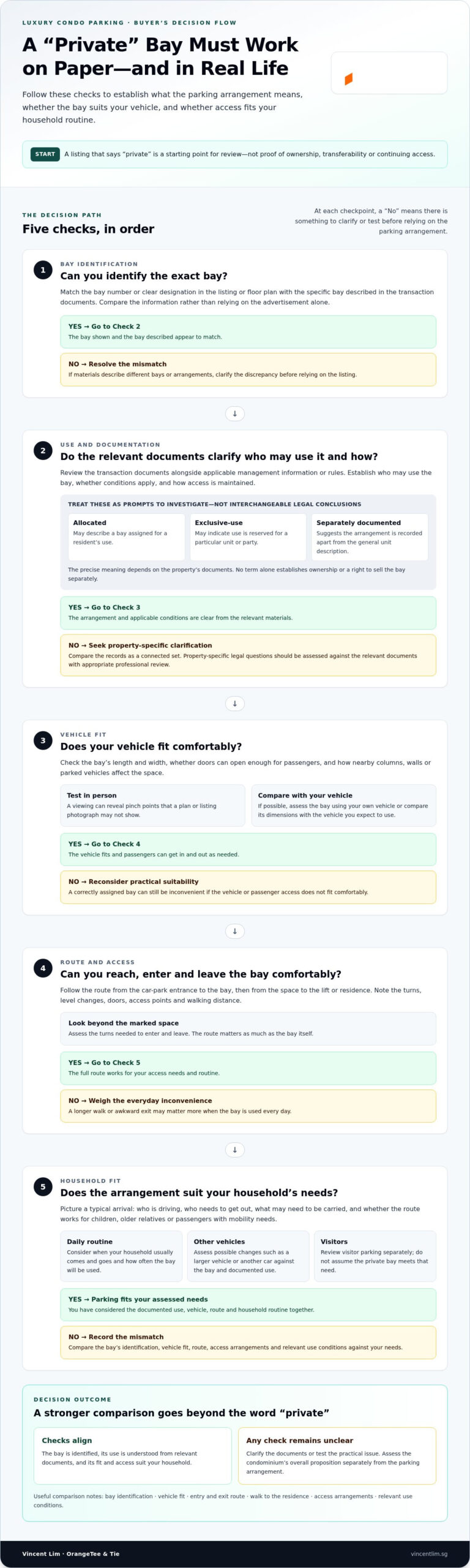
Identify the bay by its number or another clear designation. Then establish which unit or party may use it, whether that use is subject to conditions, and how access is maintained. Compare the listing and any floor plan with the transaction documents and relevant management information. If the materials describe different bays or arrangements, resolve the discrepancy before relying on the advertisement.
What Singapore condominium documents can clarify
In a Singapore condominium, the Management Corporation Strata Title (MCST) is a relevant management entity. Depending on the development and parking arrangement, applicable transaction and management documents may help clarify how a bay is identified, who may use it, and what rules govern access or use. The relevant records vary, so don’t assume one document list or ownership model applies to every condominium.
Review the materials as a connected set. Match the bay shown or described in the marketing information to the specific bay referenced in the transaction documents, then compare both with applicable management records or rules. A parking plan may help locate a space, while transaction documents may describe the arrangement. Where details differ, don’t read either in isolation. Property-specific legal questions should be assessed against the relevant documents with appropriate professional review.
This distinction helps prevent a convenient phrase from being mistaken for a confirmed right. Establish what the arrangement permits, how it is recorded and whether it aligns with the purchase. Next, assess whether the identified space works for your vehicle and daily routine.
How to Judge Whether a Private Parking Space Fits Your Lifestyle
A correctly assigned bay can still be inconvenient for your household. Its usefulness depends on whether your vehicle fits comfortably, how easily you can reach it and whether access works with your routine. A floor plan or listing photograph can help you shortlist a property, but it won’t show every turning movement, obstruction or everyday pinch point.
Assess parking suitability with three checks: whether your vehicle fits, whether you can access the bay comfortably, and whether the documented use matches your household’s needs.
Check the bay and access route in person
During a viewing, inspect the bay and follow the route from the car-park entrance. Check whether the space accommodates your vehicle’s length and width, and whether doors can open enough for passengers to get in and out. Look at nearby columns, walls and parked vehicles, then assess the turns needed to enter and leave. A bay that looks generous on a plan may feel different in use.
Follow the route from the space to the lift or residence, noting changes in level, turns, doors and access points. If possible, assess the bay using your own vehicle, or compare its dimensions with the vehicle you expect to use. Don’t rely on a plan alone. The route matters as much as the marked space.
Match parking access to household needs
Think through a typical arrival: who is driving, who needs to get out, what may need to be carried, and whether the route is manageable at the times your household usually comes and goes. Consider children, older relatives or passengers with mobility needs. A longer walk or awkward exit may matter more if the space is used every day than if it is occasional parking.
Consider whether the arrangement serves one vehicle or your household’s wider needs. Treat visitor parking separately: review the available options and whether they suit occasional guests rather than assuming your private bay can meet that need. If you may change to a larger vehicle, add another car or adjust household routines, assess those possibilities against the bay and its documented use.
For a practical comparison, record the bay’s identification, vehicle fit, entry and exit route, walk to the residence, access arrangements and any relevant use conditions. This makes it easier to compare properties on everyday function rather than the word “private” alone.
Buyers considering a luxury condo with private car park space can define their requirements before viewing, then use those priorities to assess each option consistently. Vincent Lim provides luxury condominium sales services in Singapore. Explore Singapore luxury condominium options with your parking needs in view.
How to Compare Luxury Condos with Private Parking Arrangements
Comparing parking across developments is easier when you use the same criteria for each property. Otherwise, a prominent feature in one listing can overshadow a less visible but more important difference, such as the bay’s documented use or whether your vehicle fits comfortably. Assess parking separately, then weigh it alongside the home and your household’s priorities.
Use a consistent parking comparison framework
Create a simple comparison table and give each condominium its own column. Record what the relevant documents say rather than relying on a marketing label. Keep observations separate from preferences: “bay identified in transaction documents” is a record; “short walk to lift” is an assessment. This makes it easier to see where information is clear and where details need closer review.
- Documented arrangement: Note how the parking use is described in relevant transaction and management information.
- Bay identification: Record the bay number or other identifier and whether it matches the materials you reviewed.
- Vehicle suitability: Assess the fit for your current vehicle, including the space needed to enter, park and exit.
- Location and access: Compare the route from the entrance, turning movements and walk from the bay to the residence.
- Management information: Capture relevant rules or conditions that could affect how the space is used.
Apply the same framework to every candidate. A well-positioned bay may save time on a regular commute, while a bay with easier vehicle access may better suit a larger car or passengers who need extra room. Decide which trade-off matters most to your household instead of treating one feature as universally superior.
Weigh parking against the complete property proposition
Parking is one part of the purchase, not a substitute for assessing the condominium as a whole. Compare each home’s layout, shared facilities, location and suitability for your daily life. A convenient bay may carry little practical weight if the home itself doesn’t meet your needs. Equally, a strong overall fit deserves a careful look at any parking limitations.
Separate what you can observe from what you can conclude. A space that appears convenient doesn’t by itself establish higher resale value or stronger investment performance. Any assessment of value should be specific to the property and supported by relevant evidence, not inferred from prestige language or a parking feature alone. For homeowners exploring property values in other regions, platforms such as stevekooner.com offer comparative home evaluations that factor in specific property features alongside current market conditions.
For a buyer considering a luxury condo with private car park space, the comparison should reflect present needs as well as a considered ownership horizon. If your longer-term plans include a different property type, explore how condominium ownership may fit within asset progression to landed property. A consistent framework keeps the decision grounded in documented details, daily usability and the complete property proposition.
What to Verify Before Buying a Condo with Private Parking
Before committing, treat the parking arrangement as part of the transaction review, not simply a listing feature. Trace the advertised space through the records for the specific property, note any conditions that affect use or access, and address inconsistencies before proceeding. A methodical sequence keeps the review focused.
- Review the listing. Save the exact wording, images and any plan or description referring to parking. Note whether the listing identifies a particular bay or uses a general phrase such as “private parking.” Treat these details as claims to reconcile, not a complete account of the arrangement.
- Identify the bay. Match the described space to a specific bay number or other identifier. Compare its location with the plan and your viewing notes. If the listing and plan appear to refer to different spaces, record the discrepancy rather than assuming they mean the same bay.
- Examine the transaction documents. Review the documents relevant to the purchase for the parking arrangement, permitted use and any stated conditions. Note whether the space is treated as part of the unit transaction or described separately, and whether the documents address transfer or ongoing use.
- Review management information. Consider the applicable MCST information and management rules for the development. Look for details that may affect access, visitor parking or the use of shared facilities. The relevant records and conditions can differ between properties.
- Arrange professional review. Have discrepancies and property-specific questions considered through the appropriate transaction review process. Where a point raises a legal or regulatory issue, assess it against current authoritative Singapore sources and obtain suitable professional advice before relying on an interpretation.
Reconcile listing details with transaction documents
Compare each parking claim with the documents governing the specific property. Confirm that the identified bay, arrangement and any conditions described during the sale align with the transaction materials. If details conflict or remain unclear, record the exact point and address it through the proper review process before proceeding. This principle applies across residential markets globally; full-service brokerages such as Pinnacle Realty, which assists residential and commercial clients across the Greater Toronto Area, similarly emphasize verifying that advertised property features are backed by official records before completing a purchase. This helps distinguish a marketing description from an arrangement supported by the purchase documents.
Understand management information and ongoing conditions
Management information can add context about how parking operates after purchase. Review applicable rules for the development, including information about access, visitor parking and shared facilities. Don’t assume one condominium’s practices apply to another. The scope of use, access and transfer conditions is property-specific, so assess each point against the relevant records and obtain appropriate review where interpretation is needed.
Verify a private parking claim through property-specific records, not listing language alone. This is a useful standard for any buyer considering a luxury condo with private car park space, especially when the arrangement is central to the decision. Vincent Lim can help organise property comparisons and transaction steps around the details that matter to your purchase. Discuss your luxury condominium purchase with those priorities in view.
How Vincent Lim Can Guide Your Luxury Condo Purchase
A considered purchase starts with a clear view of what matters to you, not with a long list of features. Vincent Lim provides luxury condominium sales services across Singapore and can help organise comparisons around the home, parking arrangement and your wider purchase priorities. He has been active in Singapore real estate since approximately 2004, with experience in luxury condominium and landed-property sales.
A measured approach brings structure to a decision with several moving parts. Rather than treating a private bay as a stand-alone selling point, consider how it fits your household’s vehicle needs, routines and expectations for the property as a whole.
From buyer priorities to a focused property shortlist
Vincent can help establish your priorities before comparing options: the type of home you seek, your vehicle requirements, access considerations and the parking arrangement that would best support your routine. A clear brief makes it easier to distinguish essential requirements from preferences, keeping comparisons focused as you review properties.
Each shortlisted condominium can then be considered against consistent criteria, including the identified bay, available information about its use, practical access and the home’s wider features. This doesn’t replace a property-specific document review. It helps organise the questions and differences that deserve attention before you decide which options merit closer consideration.
A structured process can move through these stages:
- Establish priorities: clarify your home, vehicle, access and household needs.
- Compare suitable options: assess condominium choices against the same requirements.
- Examine parking details: organise the listing information, identified bay and relevant property records for review.
- Coordinate next steps: note unresolved questions and sequence the wider purchase considerations.
Coordinate the next steps with confidence
Once you have a shortlist, Vincent can help coordinate parking questions alongside the broader purchase review. For example, if a listing description and the information for a particular bay appear inconsistent, record that difference clearly as a point requiring attention in the transaction process. The relevant documents and any legal questions still need appropriate property-specific review.
This coordination helps keep the process orderly without assuming that every condominium follows the same parking arrangement or that one feature determines the right choice. Your priorities remain central. The aim is to compare options carefully, understand which details need further review and proceed with a clear view of the next actions, without promising a particular purchase outcome.
If you’re considering a luxury condo with private car park space, discuss your priorities, vehicle needs and property requirements with Vincent Lim. Discuss your luxury condominium requirements with Vincent Lim.
Make Your Next Property Decision with Clarity
Turn your parking needs into a clear brief before assessing another property. Decide what must work every day, where you can be flexible and which details need professional review. That distinction helps keep a luxury condo with private car park space in perspective: parking should support the home and your plans, not substitute for evaluating the whole purchase.
Vincent Lim specialises in luxury condominium and landed-property sales and has been active in Singapore real estate since approximately 2004. His experience across both property types can help you consider immediate requirements alongside broader ownership plans, while keeping comparisons and transaction steps organised.
Bring your priorities into focus and take the next step with a measured plan. Discuss your luxury condominium requirements with Vincent Lim and begin assessing your options with confidence.
Frequently Asked Questions
Can I install an electric vehicle charger at my private condo parking space?
Possibly, but having a private or allocated bay doesn’t automatically establish permission to install a charger. Before making plans, establish whether installation at that location is allowed, what approval process applies, and whether the building’s electrical capacity can support it. Clarify responsibility for installation, ongoing upkeep and any changes if you sell. Review current Singapore requirements and ensure the technical details are assessed before proceeding.
Does every luxury condominium in Singapore provide a private car park space?
No. Don’t assume that every unit in a luxury condominium comes with a private bay. Parking provision and the arrangement attached to a unit can differ by development and transaction. Review the specific unit’s sale materials and purchase documents to establish whether parking is included, assigned separately or not offered with that unit. If your household needs space for more than one vehicle, assess that requirement separately rather than treating one advertised bay as sufficient.
Can I rent out my allocated condo parking space separately?
That depends on the rights attached to the particular space and the development’s applicable management rules. Before making plans to rent it out, review the relevant purchase documents and management rules, including any conditions on who may use the bay. An allocation for your use shouldn’t be assumed to include a right to lease it independently. Establish the arrangement and any restrictions before making an agreement.
What should I do if another vehicle repeatedly blocks access to my parking space?
Document the incidents and report them through the development’s established management channel. Note dates and times, identify the affected bay and, where appropriate, take clear photographs without confronting the other driver. Keep a record of the report and the applicable process for addressing obstruction. If access is urgently blocked or there’s a safety concern, follow the development’s emergency procedures. Retain copies of communications in case the issue recurs.
How can I tell whether a condo parking bay is large enough for my vehicle?
Compare the bay’s measured dimensions with your vehicle’s length and width, allowing for mirrors and the space needed to open doors. Consider how neighbouring vehicles, pillars or walls could affect entry and exit. If possible, test the fit with the vehicle you expect to use rather than relying only on a drawing. Check car-park height clearance too, especially if you drive a taller vehicle or use a roof-mounted accessory.
Can I use visitor parking as my regular private parking space?
Generally, visitor parking shouldn’t be treated as a substitute for a private bay. Its purpose and permitted duration depend on the development’s management rules, and availability may vary. Regularly leaving your vehicle in a visitor lot could inconvenience residents and guests or breach applicable rules. Review the current visitor-parking arrangements and base your purchase decision on the parking rights attached to your own unit.