The most consequential number in Singapore’s luxury property market isn’t a price per square foot. It’s 1,400. That single figure, the minimum GCB land size mandated by the Urban Redevelopment Authority, determines whether a property qualifies as one of Singapore’s most coveted and legally protected assets, or simply an expensive house.
If you’ve spent time researching Good Class Bungalows, you already understand the stakes. The regulations are precise, the available inventory is finite, and the margin for error on a transaction of this magnitude is effectively zero. A plot that falls short of the threshold, carries an awkward configuration, or conceals planning constraints can erode value in ways that aren’t visible until it’s too late.
This guide is built to change that. Drawing on over two decades of specialist experience in Singapore’s luxury landed market, it delivers a clear, practical framework for evaluating GCB land size, understanding plot efficiency, and identifying the technical factors that separate a genuinely strategic acquisition from a costly misstep. From the 1,400 sqm threshold to the finer points of plot width and buildable area, every critical dimension is covered here.
Key Takeaways
- Understanding gcb land size begins with the URA’s 1,400 sqm minimum threshold — the precise legal boundary that separates a Good Class Bungalow from a standard detached house, and the single most critical figure in any GCB acquisition.
- Plot dimensions extend well beyond total area: minimum width requirements and plot configuration directly determine your buildable footprint and, ultimately, the long-term value of the asset.
- Plots exceeding 2,800 sqm carry rare subdivision potential, making land size a genuine wealth multiplier — but only when evaluated against the full framework of URA planning constraints.
- Visible square footage tells only part of the story; topography, soil conditions, and plot elevation introduce hidden cost variables that can materially alter the economics of any redevelopment.
- Transactions of this complexity demand a specialist with deep market knowledge — this guide outlines the precise due diligence framework that separates a strategic GCB acquisition from an expensive oversight.
The 1,400 Sqm Rule: Decoding the Minimum GCB Land Size
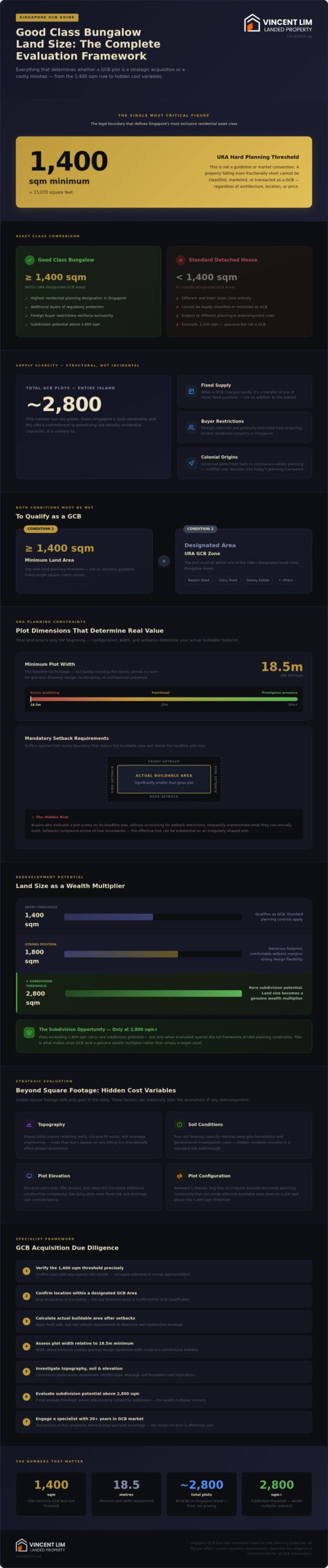
Singapore’s Urban Redevelopment Authority is precise about what constitutes a Good Class Bungalow, and the foundation of that precision is a single measurement: 1,400 square metres, or approximately 15,070 square feet. This isn’t an advisory guideline or a market convention. It’s a hard planning threshold, and a property that falls even fractionally short of it cannot be classified, marketed, or transacted as a GCB, regardless of its architecture, location, or asking price.
The distinction matters enormously. A detached house on, say, 1,200 sqm in a prime district may be spacious, private, and expensive. But it occupies an entirely different asset class from a genuine GCB. The regulatory classification governs what can be built on the land, how it can be redeveloped, and critically, who can purchase it. Foreign nationals, for instance, are generally restricted from acquiring landed residential property in Singapore, and GCBs carry additional layers of regulatory protection that reinforce their exclusivity.
Scarcity is structural, not incidental. Across the entire island, the total supply of GCB plots is estimated at approximately 2,800. That figure hasn’t grown, and given Singapore’s land constraints and the URA’s commitment to preserving low-density residential character, it’s unlikely to. When a GCB changes hands, it typically represents a transfer of one of those fixed positions, not an addition to the market. This is precisely why gcb land size functions as the primary determinant of asset class, not merely a physical attribute of the property.
The Significance of GCB Designated Areas
Meeting the 1,400 sqm threshold is necessary, but it isn’t sufficient on its own. A plot must also sit within one of the URA’s designated Good Class Bungalow Areas, which include established enclaves such as Nassim Road, Cluny Road, and Dalvey Estate, among others. These zones carry Singapore’s highest residential planning designation, characterised by strict controls on building height, plot coverage, and density. Understanding what is a Good Class Bungalow in its full regulatory context is essential before any acquisition decision is made.
Historical Context of GCB Plot Sizes
The generous land parcels that define today’s GCB landscape trace their origins to colonial-era estate planning, when large bungalow compounds were established across Singapore’s leafier districts. Over decades, those estates were gradually codified into the planning framework that exists today. The 1,400 sqm minimum was designed to preserve that low-density character, and the URA has consistently resisted pressures to allow subdivision below that threshold. The result is a supply base that remains largely intact, with each qualifying plot retaining the spatial qualities that make gcb land size synonymous with enduring prestige.
URA Planning Constraints: How Plot Dimensions Impact Value
Total land area is only the beginning of the analysis. A plot that comfortably clears the 1,400 sqm threshold can still deliver a deeply compromised outcome if its dimensions, shape, or configuration work against the URA’s layered planning controls. Understanding these constraints isn’t a technical exercise reserved for architects; it’s foundational knowledge for any buyer making a decision of this magnitude.
The URA stipulates a minimum plot width of 18.5 metres for GCB plots. That figure establishes the baseline, but it tells you very little about what the land can actually deliver. A plot sitting precisely at 18.5 metres of frontage leaves almost no margin for gracious driveway design, generous landscaping, or the kind of architectural presence that defines a genuinely prestigious bungalow. Width isn’t just a measurement. It’s the canvas upon which everything else is drawn.
Setbacks compound this further. GCB plots are subject to mandatory front, side, and rear setback requirements that effectively reduce the buildable area from every boundary. Once those buffers are applied, the portion of land available for the built structure can be considerably smaller than the gross plot area suggests. Buyers who evaluate a plot purely on its headline size, without accounting for setback encroachments, routinely overestimate what they can build.
The 35% maximum site coverage rule places a firm ceiling on this further. No more than 35% of the total plot area may be covered by the building footprint, which means that on a 1,400 sqm plot, the maximum covered area is 490 sqm. The remaining 65% must be left as open space, greenery, and landscaping. This constraint is deliberate. It preserves the low-density, garden-estate character that defines GCB living and protects long-term resale value by ensuring the residential environment doesn’t erode over time.
Plot Width vs. Architectural Flexibility
Wider frontages command a measurable premium in the GCB market, and the reasoning is straightforward. A generous plot width enables a broader building envelope, more expansive entrance design, and the visual grandeur that buyers at this level expect. Narrow plots, even those meeting the 18.5-metre minimum, force architectural compromises: tighter driveways, constrained façade proportions, and reduced kerb appeal. When evaluating gcb land size, experienced buyers treat width as a proxy for architectural freedom, not merely a secondary dimension. Regular, near-rectangular plots consistently outperform irregular configurations in both design efficiency and resale liquidity.
Site Coverage and the Greenery Requirement
The 65% open-space requirement is often misread as a restriction. In practice, it’s a value protector. It’s precisely what prevents GCB enclaves from densifying and losing the spatial quality that justifies their pricing. This stands in meaningful contrast to a standard detached house for sale Singapore, where planning controls are less stringent and the long-term character of the surrounding streetscape is less assured. For buyers weighing asset quality over time, that regulatory discipline is a feature, not a limitation.
Translating these constraints into a coherent acquisition strategy requires the kind of specialist insight that goes well beyond reading a planning document. If you’re assessing a specific plot against this framework, working with an adviser who has navigated these parameters across multiple transactions is the most reliable way to ensure nothing critical is missed.
Redevelopment Potential: Land Size as a Wealth Multiplier
Not all GCB plots are created equal, and the gap between a 1,400 sqm site and a 3,000 sqm one isn’t simply a matter of space. It’s a difference in strategic optionality. Larger plots don’t just accommodate a grander residence; they unlock a fundamentally different range of wealth-building possibilities that smaller qualifying plots cannot access, regardless of their location or price.
The question serious buyers ask isn’t only “does this plot qualify?” It’s “what can this plot become?” A site in the 1,400 to 2,000 sqm range offers solid residential utility and the full prestige of the GCB designation. Push beyond 2,800 sqm, however, and the calculus shifts entirely. At that threshold, gcb land size transitions from a residential attribute into a genuine wealth instrument.
For multi-generational families, larger plots serve a different but equally compelling purpose. A site of 3,000 sqm or more can be designed to accommodate two distinct residential wings within a single compound, preserving family proximity while maintaining the privacy and independence that each generation values. This approach to legacy planning, structuring a single asset to serve multiple generations simultaneously, represents one of the most sophisticated applications of GCB ownership. It converts a residential acquisition into a long-term family infrastructure decision.
On the question of price appreciation, the evidence from Singapore’s landed market is consistent: plots with generous land area have demonstrated stronger capital retention over time than those sitting near the minimum threshold. This isn’t surprising. Scarcity compounds as you move up the size spectrum. Plots exceeding 2,500 sqm change hands infrequently, and when they do, they attract a narrower but more committed pool of buyers, which tends to support pricing even through broader market corrections.
Subdivision Strategies for Ultra-Large Plots
When a GCB plot exceeds 2,800 sqm, the possibility of subdivision into two separate qualifying plots enters the picture. Each resulting plot must independently meet the 1,400 sqm minimum and satisfy all applicable URA dimension requirements, including the 18.5-metre minimum width. When those conditions can be met, the implications are extraordinary: a single acquisition, structured correctly, can yield two separately titled GCB assets. The combined value of those two plots frequently exceeds the price paid for the original parcel, making this the most powerful value-creation mechanism available in Singapore’s residential land market. Identifying plots where this potential is genuinely achievable, rather than theoretically possible, requires the kind of technical reading of URA parameters that underpins serious landed property redevelopment potential analysis.
Privacy and Buffer Zones
Larger plots deliver something that money alone can’t manufacture on a constrained site: distance. The buffer land that surrounds the main structure on a generous plot insulates the residence from neighbouring developments, preserves sightlines, and ensures that future construction on adjacent properties doesn’t compromise the living environment. This spatial insulation is a core component of what it means to own a GCB at the highest level. It’s the physical expression of the asset’s enduring exclusivity, and it’s a dimension of value that only becomes apparent when you consider what gcb land size truly protects over a multi-decade ownership horizon.
Strategic Evaluation: Assessing GCB Land Beyond Square Footage
A plot’s stated land area is a starting point, not a conclusion. Two GCB sites can share identical square footage and sit within the same designated enclave, yet deliver fundamentally different outcomes for a buyer. The difference lies beneath the surface, sometimes literally. Topography, soil conditions, mature vegetation, and drainage characteristics each shape what a plot can realistically deliver, and none of these variables appear in a listing description.
This is the dimension of gcb land size that most buyers underestimate until they’re already committed. The gross area figure tells you whether a plot qualifies. The physical characteristics of that land tell you what it’s actually worth.
Terrain and Elevated Living
Elevated GCB plots consistently attract the strongest premiums in Singapore’s landed market. The reasons are both practical and experiential: commanding sightlines, enhanced natural ventilation, and a sense of separation from street-level activity that flat plots simply cannot replicate. A natural slope also creates genuine architectural opportunity. Skilled designers can exploit level changes to introduce basement levels, split-level living arrangements, or multi-tiered landscaping that would be impossible to achieve on a flat site without prohibitive earthworks.
That said, hilly terrain carries a cost premium that buyers must price in before acquisition. Retaining walls, additional foundation engineering, and more complex drainage systems all add to the redevelopment budget. The question isn’t whether an elevated site is desirable; it almost always is. The question is whether the acquisition price already reflects that premium, and whether the construction cost uplift has been properly accounted for in the buyer’s financial modelling.
Sunken plots present the inverse challenge. A site that sits below street level or within a natural depression faces drainage vulnerability, potential flooding risk during heavy rainfall, and structural engineering requirements that can materially inflate construction costs. These factors don’t disqualify a plot, but they must be assessed rigorously before any offer is made.
Environmental and Conservation Constraints
Mature trees on a GCB plot can be among its most visually compelling features. They can also be among its most consequential planning constraints. Under NParks regulations, trees of significant girth or ecological value may be subject to conservation requirements that restrict their removal or the proximity of construction activity to their root zones. On a generous plot, this might affect a small portion of the buildable envelope. On a tighter site, a cluster of protected trees can meaningfully reduce the usable area available for development, regardless of what the gross land area suggests.
Navigating these constraints requires coordinated input from multiple professionals: qualified arborists to assess tree health and classification, architects to model the building envelope around any conservation zones, and planners familiar with NParks submission requirements. This isn’t a process that can be retrofitted after a purchase decision is made. It belongs in the due diligence phase, before exchange of contracts.
The practical implication is straightforward: always assess the usable land area of a GCB plot, not just the gross figure. Slopes, drainage easements, and tree conservation zones each reduce the effective canvas available for development. A 2,000 sqm plot with significant topographical constraints may deliver less buildable utility than a well-configured 1,600 sqm flat site.
Identifying these variables before they become costly surprises is precisely where specialist guidance earns its value. Speak with Vincent Lim to conduct a thorough site assessment before committing to any GCB acquisition.
Acquiring a Legacy: The Specialist Approach to GCB Land
Every dimension covered in this guide, from the 1,400 sqm threshold to subdivision potential to the hidden costs of terrain, converges at a single point: the acquisition decision. And that decision, made correctly, requires more than technical knowledge. It requires a specialist who has navigated this precise market across multiple cycles, with the professional relationships and off-market access that only two decades of dedicated practice can build.
The GCB segment doesn’t reward generalists. A transaction of this magnitude involves regulatory complexity, long-term wealth implications, and a negotiating environment where information asymmetry can cost a buyer millions. The difference between a competent agent and a genuine GCB specialist isn’t just experience. It’s the depth of market intelligence they bring to every assessment, and the discipline to tell a client when a plot doesn’t meet the standard, even when the deal looks attractive on paper.
Bespoke Asset Selection
Vincent Lim’s approach to gcb land size evaluation begins well before a plot reaches the open market. With over 20 years of specialist experience in Singapore’s luxury landed segment, Vincent has developed a precise methodology for identifying plots where the efficiency ratio, the proportion of usable, developable land relative to gross area, is materially higher than the listing suggests. This means accounting for setbacks, tree conservation zones, topography, and URA planning constraints before a client ever steps onto the site.
Off-market access is central to this process. A significant share of GCB transactions are conducted discreetly, between principals, without public listing. Buyers who rely solely on advertised inventory are, by definition, working with an incomplete picture of what’s available. Vincent’s established network within Singapore’s landed property community means that qualified buyers gain early visibility into opportunities that never reach the broader market, a structural advantage in a segment where supply is fixed and competition among serious buyers is intense.
Every acquisition is also framed within the client’s broader property wealth planning objectives. Whether the goal is a primary residence, a multi-generational compound, or a land asset with subdivision potential, the selection criteria are calibrated accordingly from the outset.
Seamless Transaction Management
A GCB acquisition doesn’t conclude at offer acceptance. It moves through a coordinated sequence involving legal due diligence, URA planning verification, architectural feasibility assessment, and, where relevant, specialist input on soil conditions and arboricultural constraints. Managing these workstreams simultaneously, without allowing any single thread to create delays or expose the buyer to unquantified risk, is where specialist brokerage delivers its clearest value.
Vincent’s results-oriented approach means that architects, lawyers, and planning consultants are engaged at the right stages, with clear briefs and coordinated timelines. Nothing is left to assumption. Every material variable is surfaced before exchange, not after.
Land size is the foundation. But strategy is the architect of wealth. Consult with Vincent Lim for a rigorous, personalised GCB land analysis before your next acquisition.
Your Next Move in Singapore’s Most Exclusive Market
GCB land size is never just a number. It’s the regulatory threshold that determines asset class, the planning parameter that shapes architectural ambition, and the strategic variable that separates a sound acquisition from a generational wealth decision. The 1,400 sqm minimum qualifies a plot; what lies beyond that figure, in terms of configuration, usable area, and subdivision potential, determines what that plot is truly worth.
The buyers who succeed in this market don’t simply identify qualifying plots. They assess every layer beneath the headline figure, from setback encroachments and terrain complexity to off-market opportunities that never reach public listings. That depth of analysis requires specialist knowledge that takes years to build.
Vincent Lim, Executive Associate Director at OrangeTee and Tie, brings over 20 years of dedicated expertise in Singapore’s luxury landed segment to every client engagement. His methodology is precise, his market access is extensive, and his commitment to protecting client interests is absolute.
Don’t leave a decision of this magnitude to chance. Secure Your Legacy: Consult Vincent Lim for GCB Strategic Planning and approach your next acquisition with the confidence it deserves.
Frequently Asked Questions About GCB Land Size
What is the absolute minimum land size for a Good Class Bungalow?
The URA mandates a minimum land area of 1,400 square metres, equivalent to approximately 15,070 square feet, for a property to qualify as a Good Class Bungalow. This is a hard planning threshold, not a guideline. A plot measuring even fractionally below this figure cannot be classified, marketed, or transacted as a GCB, regardless of its location, architecture, or price.
Can I subdivide a GCB plot if it is larger than 2,800 sqm?
Subdivision becomes a genuine possibility once a plot exceeds 2,800 sqm, but it isn’t automatic. Each resulting plot must independently satisfy the 1,400 sqm minimum and meet all applicable URA dimension requirements, including the 18.5-metre minimum width. When those conditions are achievable, the combined value of the two resulting titled assets frequently exceeds the original acquisition price, making this one of the most powerful value-creation mechanisms in Singapore’s residential land market.
Why do GCBs have a 35% site coverage limit?
The 35% maximum site coverage rule is a deliberate planning instrument designed to preserve the low-density, garden-estate character that defines GCB enclaves. It ensures that at least 65% of every qualifying plot remains as open space, greenery, and landscaping. This constraint protects the residential environment from incremental densification and, in doing so, safeguards the long-term value of every GCB asset within those designated areas.
Does a larger GCB land size always mean a higher resale value?
Size is a strong indicator of value, but it’s not the only one. A larger gcb land size delivers greater architectural flexibility, stronger privacy buffers, and, beyond 2,800 sqm, subdivision potential. However, usable area matters more than gross area. A 2,500 sqm plot burdened by significant topographical constraints, drainage easements, or tree conservation zones may deliver less developable utility than a well-configured 1,800 sqm flat site in a comparable enclave.
Are there specific plot width requirements for GCBs?
Yes. The URA stipulates a minimum plot width of 18.5 metres for GCB plots. It’s important to understand that this is a floor, not a benchmark. Plots sitting precisely at the minimum leave little room for gracious driveway design or architectural presence. Wider frontages consistently command a measurable premium in the GCB market because they enable broader building envelopes and the visual grandeur that buyers at this level expect.
How does topography affect the valuation of a GCB land plot?
Topography has a direct and material impact on both value and development cost. Elevated plots attract strong premiums for their sightlines, natural ventilation, and architectural opportunity, but they also carry higher construction costs for retaining walls, foundation engineering, and drainage systems. Sunken or low-lying plots introduce flooding risk and structural complexity. Buyers should always obtain a thorough site assessment before committing, since terrain characteristics don’t appear in listing descriptions but can significantly alter project economics.
Can a permanent resident (PR) buy a GCB based on its land size?
Land size doesn’t determine eligibility to purchase a GCB; citizenship status does. Under Singapore’s Residential Property Act, GCBs are classified as restricted residential properties. Singapore Permanent Residents are generally not permitted to acquire landed residential property, including GCBs, without prior approval from the Singapore Land Authority. Eligibility rules are subject to regulatory review, so prospective buyers should obtain current legal advice before proceeding with any acquisition.
What is the difference between a GCB and a standard detached house in terms of land?
The primary distinction is the minimum land area and the planning zone in which the property sits. A standard detached house has no mandated minimum plot size comparable to the GCB threshold and is not subject to the same URA designated area restrictions. GCBs must meet the 1,400 sqm minimum and be located within one of the URA’s gazetted Good Class Bungalow Areas, which carry Singapore’s most stringent residential planning controls. These regulatory differences place the two property types in entirely separate asset classes.