
Selling a Good Class Bungalow or detached home just one day before your fourth anniversary could result in a tax liability that wipes out years of capital appreciation. For high net worth owners, the seller’s stamp duty for landed property singapore is far more than a routine administrative fee; it’s a multi-million dollar strategic hurdle that requires seasoned oversight. You’ve worked hard to build significant equity in your landed asset, and it’s only right to feel protective of those gains as you consider a transition.
Navigating the 2025 holding period changes and their impact on 2026 transactions can feel complex, especially when the difference between a 4% and 8% tax rate is measured in six figures. This guide is designed to provide the calculated competence you need to time your exit with professional precision. We’ll examine the exact financial impact on luxury landed sales and help you develop a clear strategy that prioritises wealth preservation. By understanding these nuances, you can move forward with the peace of mind that your legacy and your capital remain protected.
Key Takeaways
- Understand the 2026 tiered framework for seller’s stamp duty for landed property singapore, where holding periods now extend to four years for assets acquired from July 2025 onwards.
- Master the precise timing of your exit to navigate the 16%, 12%, 8%, and 4% tax brackets, ensuring you protect the equity in your multi-million dollar asset.
- Learn why the Inland Revenue Authority of Singapore (IRAS) may calculate duty based on market value rather than your agreed sale price, a critical distinction for GCB and detached house owners.
- Identify specific legal exemptions that may apply to your situation, such as transfers during matrimonial proceedings, bankruptcy, or compulsory government acquisitions.
- Recognise the value of professional coordination between specialists and valuers to refine your exit strategy and prevent significant financial oversights during the transaction.
Understanding Seller’s Stamp Duty for Landed Assets
In the Singapore residential market, Seller’s Stamp Duty (SSD) functions as a strategic cooling measure designed to curb short-term speculation and maintain price stability. While Stamp duty is a common global fiscal tool, the application of seller’s stamp duty for landed property singapore carries significantly higher stakes for owners of high-value assets. Unlike strata-titled apartments, landed properties involve substantial land area and complex valuations, meaning any tax liability is calculated against a much larger financial base. This tax applies to the entirety of the transaction, encompassing both the physical structure and the underlying residential land.
To accurately assess your liability, you must identify the precise Date of Purchase and Date of Sale. In most instances, these dates are determined by the day the Option to Purchase (OTP) was exercised or the Sale and Purchase Agreement was signed. Even a discrepancy of a few days can shift your transaction into a higher tax bracket. For a multi-million dollar asset, this oversight can result in a tax bill that exceeds your expected profit margin.
The Strategic Impact of SSD on Landed Property Equity
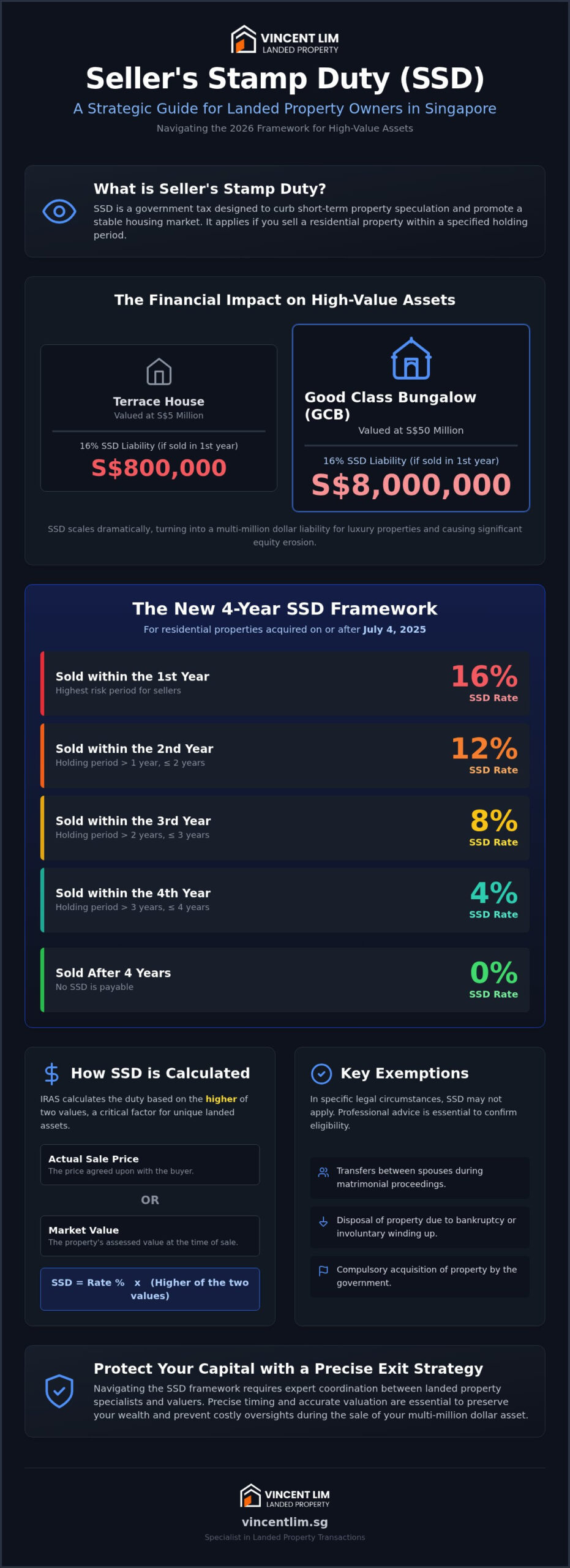
The financial weight of SSD scales dramatically with the value of the property. A 16% tax on a S$5 million terrace house results in a S$800,000 liability; however, for a Good Class Bungalow (GCB) priced at S$50 million, that same percentage translates to an S$8 million tax bill. This phenomenon, known as equity erosion, can fundamentally compromise your financial position if you sell within the mandatory holding period. To protect your capital, you need a strategic guide to selling your landed property that accounts for these massive variables before you list the asset for sale.
Landed Property vs. Strata-Titled Units: The SSD Scale
Landed assets differ from luxury condominiums because of their inherent scarcity and unique land status. The Inland Revenue Authority of Singapore (IRAS) calculates SSD based on the higher of the sale price or the prevailing market value at the time of sale. For unique detached houses where comparable transactions are rare, this “market value” rule introduces a layer of uncertainty that doesn’t exist in high-volume condo blocks. The Singapore Land Authority (SLA) plays a vital role here, as they determine the official land status which dictates whether SSD applies to the full extent of the plot. Relying on an expert valuation is the only way to ensure your exit strategy remains anchored in financial reality.
The 2026 SSD Framework: Rates and Holding Periods
The regulatory landscape for seller’s stamp duty for landed property singapore underwent a significant transformation in mid-2025. For any residential property or land acquired on or after 4 July 2025, the mandatory holding period has been extended to four years. This adjustment represents a tightening of the previous three-year framework, requiring landed owners to commit to a longer investment horizon to avoid substantial tax liabilities. According to the official guidelines on Seller’s Stamp Duty (SSD) for Residential Property, the duty is calculated as a percentage of the higher of the actual sale price or the current market value.
The 2026 rate tiers are structured to penalise short-term exits heavily. If you dispose of your asset within the first year of ownership, you face a 16% duty. This rate decreases to 12% in the second year, 8% in the third year, and 4% in the final year of the holding period. While the Inland Revenue Authority of Singapore (IRAS) rounds the final SSD amount down to the nearest dollar, this provides negligible relief when dealing with the high-quantum transactions typical of the landed market. Precision in your financial planning is not optional; it’s a requirement for wealth preservation.
The July 2025 Policy Shift: What Has Changed?
The transition from a three-year to a four-year holding period caught many investors off guard. Beyond the extended duration, the government implemented a four-percentage-point increase across every tier. This shift fundamentally alters asset progression to landed property strategies. Owners who previously planned a three-year cycle must now recalibrate their cash flow projections to account for an additional twelve months of holding costs or risk a significant 4% tax hit that didn’t exist under the old rules. Success in this environment requires a disciplined approach to timing.
Calculating the Holding Period with Precision
The holding period is calculated from the date the Option to Purchase (OTP) is exercised, not the date of legal completion. This distinction is a common pitfall. If you exercise an OTP on 1 August 2025, your one-year mark is 31 July 2026. Selling on the 365th day instead of the 366th day could cost you 4% of your property’s value. On a S$15 million detached house, that single day represents a S$600,000 mistake. Consulting with a seasoned advisor ensures that your sale documentation is timed to the exact day, preventing accidental tax triggers that erode your hard-earned equity.
SSD for High-Value Assets: GCBs and Detached Houses
The financial implications of seller’s stamp duty for landed property singapore reach their most critical point when dealing with high-quantum assets. For owners of Good Class Bungalows (GCBs), the tax is not merely a transaction cost; it’s a multi-million dollar event that can fundamentally alter a portfolio’s net return. Understanding what is a good class bungalow status entails also means recognising that these properties are subject to intense scrutiny from the Inland Revenue Authority of Singapore (IRAS). Because GCBs and detached houses often sit on expansive plots with unique architectural specifications, the “Market Value” rule becomes a significant risk factor during the sale process.
IRAS calculates SSD based on the higher of the actual sale price or the prevailing market value. In a market influenced by various Measures To Cool The Property Market, the government ensures that transactions reflect true value rather than artificially deflated figures. If a seller agrees to a lower price for a quick exit, but IRAS determines the market value is higher, the seller must pay duty on the higher amount. This makes professional coordination with seasoned valuers essential to justify the transaction price and prevent unexpected tax demands.
The Market Value Challenge for Prestigious Assets
Prestigious assets often feature bespoke elements such as multi-level basement car parks, Olympic-sized pools, or extensive professional landscaping. These unique features complicate standard appraisal models, leading to a potential “valuation gap” between the seller’s expectations and the tax authority’s assessment. An Elite Strategist manages this risk by presenting comprehensive market data and technical justifications to IRAS. Without this meticulous preparation, a detached house owner might find themselves liable for a tax bill based on a valuation that fails to account for specific site constraints or market nuances.
Payment Timeline and Financial Orchestration
Meticulous cash flow management is vital because SSD must be paid within 14 days of the date of the sale document (usually the exercised Option to Purchase). Unlike buyers, who may have more flexibility, sellers must have liquid funds ready to settle this liability almost immediately. It’s important to clarify that CPF funds cannot be utilised by sellers to cover SSD; it must be paid in cash. This 14-day rule requires precise financial orchestration, especially when preparing a detached house for sale singapore. Failing to meet this deadline results in significant penalties, further eroding the equity you’ve built in your asset.
Strategic Exemptions and Wealth Planning
While the 2026 framework for seller’s stamp duty for landed property singapore is rigorous, specific legal scenarios allow for exemptions that protect your capital from unnecessary erosion. These provisions aren’t loopholes; they’re established regulatory reliefs designed for involuntary or structured property disposals. For the elite property owner, understanding these exemptions is a vital component of a broader wealth preservation strategy. Beyond the standard four-year holding period, certain life events or government actions may negate the SSD liability entirely. These include properties disposed of due to bankruptcy, compulsory acquisitions under the Land Acquisitions Act, or foreigners required to sell under the Residential Property Act.
Strategic wealth planning also involves the use of trust structures. While recent regulatory shifts have tightened the rules around additional buyer’s stamp duty for trusts, the holding period for SSD remains a critical calculation for trustees. Managing a multi-generational landed asset requires a clear-eyed view of when a sale or transfer might trigger a tax event. Even developers have access to SSD remission, though this is less applicable to the individual GCB or detached house owner. For most, the focus remains on personal estate management and the timing of asset restructuring.
Matrimonial Splits and Estate Transfers
Transferring landed property during matrimonial proceedings is one of the most common scenarios where SSD exemptions apply. When a property interest is transferred pursuant to a court order for a divorce, it’s generally exempt from SSD. This provides essential financial relief during a period of significant personal transition. Inheritance follows a similar logic of continuity. When you inherit a landed property, the holding period doesn’t reset to zero. Instead, the holding period is typically anchored to the date the deceased originally acquired the asset. This allows beneficiaries to dispose of an inherited home without facing the 16% Year 1 tax rate, provided the original owner held it for the required duration.
SSD as a Component of Legacy Planning
Landed property is fundamentally a long-term hold asset. The inherent scarcity of land in Singapore makes it the ultimate vehicle for legacy planning. High net worth families often view these homes through a multi-generational lens, which naturally mitigates the friction of SSD. However, problems often arise during the “strategic gifting” of property interests to the next generation. If a portion of the property is “sold” or transferred to a child within the four-year window, it may trigger a pro-rated SSD liability. Precision in timing these handovers is where the expertise of a landed property specialist becomes indispensable. By coordinating with legal counsel, you can ensure that your estate planning doesn’t result in an avoidable multi-million dollar tax bill. A bespoke approach to legacy management ensures that your transition of wealth is as seamless as it is tax-efficient.
Navigating the Sale with a Landed Specialist
The complexity of a multi-million dollar transaction requires more than just a passing knowledge of tax law. When managing the seller’s stamp duty for landed property singapore, the margin for error is non-existent. Engaging a specialist with over 20 years of specific experience in the luxury landed sector provides the seasoned authority necessary to protect your equity. Vincent Lim acts as the central coordinator, refining the communication between conveyancing lawyers, independent valuers, and IRAS. This high-level oversight ensures that every document is filed with precision and that the transaction timeline is managed to the exact day. Timing is everything.
Preventing common pitfalls is a hallmark of this bespoke service. Many owners face unnecessary penalties due to late payments or miscalculated holding periods that were not audited prior to the sale. By conducting a thorough pre-sale assessment, a specialist identifies potential tax triggers before they become financial liabilities. This white-glove approach treats your property not just as a house, but as a prestigious national asset that demands meticulous financial orchestration and personal accountability.
The Strategic Advantage of Seasoned Authority
Negotiating the sale of a Good Class Bungalow or a detached house involves layers of due diligence that standard residential agents rarely encounter. As an Elite Strategist active since 2004, Vincent Lim (OrangeTee & Tie) has navigated numerous market cycles and regulatory shifts. His track record includes managing complex holding period scenarios where the timing of an Option to Purchase exercise was the critical factor in a successful exit. This level of discipline ensures a seamless, risk-free transfer of ownership, allowing you to transition your capital with absolute confidence. You are not just hiring an agent; you are partnering with a veteran professional who values integrity and transparency above all else.
Conclusion: Securing Your Financial Legacy
The 2026 landscape for seller’s stamp duty for landed property singapore is defined by longer holding periods and higher tax brackets. While these measures aim to ensure market stability, they also place a greater responsibility on the seller to execute with precision. Protecting your hard-earned capital requires a proactive stance and a deep understanding of how market valuations intersect with tax liability. Securing your financial legacy means leaving nothing to chance and ensuring your exit strategy is as refined as the asset you are selling. For those seeking to time their next move with professional precision, a private, confidential consultation is the first step toward a successful transaction.
Secure your next landed asset with strategic precision. Contact Vincent Lim today.
Securing Your Legacy Through Strategic Precision
The 2026 regulatory environment requires a sophisticated approach to asset management. With the extension of the mandatory holding period and the increased rate tiers, the financial stakes for disposing of a high-value asset have never been higher. Mastering the seller’s stamp duty for landed property singapore is not just about avoiding a tax; it’s about protecting the multi-generational equity built into your GCB or detached home. By aligning your exit strategy with precise market valuations and legal exemptions, you ensure that your capital remains preserved for the future.
Success in the luxury landed market depends on meticulous timing and the coordination of expert resources. Vincent Lim provides the white-glove service required for these high-stakes transactions, drawing on over 20 years of luxury real estate expertise. As an Elite Strategist at OrangeTee & Tie, he specialises in refining complex transaction timelines to prevent costly financial oversights. You deserve the peace of mind that comes from working with a dedicated partner who values the integrity of your legacy above all else. Your journey toward a seamless and profitable transition begins with a single, calculated step.
Secure your next landed asset with strategic precision; contact Vincent Lim today.
Frequently Asked Questions
What is the current Seller’s Stamp Duty rate for landed property in 2026?
The current rates for residential assets acquired on or after 4 July 2025 are structured into four annual tiers. You’ll incur a 16% duty if you sell within the first year; 12% in the second; 8% in the third; and 4% in the fourth. These percentages apply to the higher of the sale price or market value. For acquisitions made between March 2017 and July 2025, the previous three-year holding period and lower rates still apply.
Does the Seller’s Stamp Duty holding period apply to Good Class Bungalows?
Yes, the holding period applies to all residential properties, including Good Class Bungalows. Because GCBs represent the pinnacle of the market, the financial impact of seller’s stamp duty for landed property singapore is particularly significant. A 16% tax on a S$40 million GCB results in a S$6.4 million liability. Owners must ensure their exit strategy accounts for the full four-year window to protect their substantial capital appreciation and avoid massive equity erosion.
Can I appeal to IRAS for an SSD waiver if I sell for a loss?
IRAS generally doesn’t grant waivers based on financial loss or poor investment performance. SSD is a transaction tax calculated on the gross sale price or market value, not your net profit. While you can submit an appeal through the IRAS portal, success is typically reserved for extreme cases like involuntary disposals or specific legal exemptions. Relying on a loss to avoid the tax is a risky strategy that rarely yields a favourable outcome for the seller.
How is the holding period calculated if I bought my land and built the house later?
The holding period is calculated from the date you acquired the land, not when the construction was completed. If you purchased a plot on 1 August 2025 and finished building your detached house in 2027, your four-year countdown still began on the 2025 land acquisition date. This is a critical distinction for owners who engage in rebuild and sell strategies, as it allows for a more efficient exit than many initially assume.
Is SSD payable if I transfer my landed property to a family member as a gift?
Yes, a transfer by way of a gift is considered a disposal and triggers SSD if it occurs within the holding period. IRAS assesses the duty based on the market value of the property at the time of the gift. Many owners mistakenly believe that non-monetary transfers are exempt. To avoid an unexpected tax bill, you should consult with a specialist to determine if your family estate planning aligns with the mandatory holding duration.
What happens if I cannot pay the SSD within the 14-day deadline?
Failing to pay within the 14-day window leads to immediate financial penalties. For delays of up to three months, a penalty of S$10 or an amount equal to the duty, whichever is higher, may be imposed. If the delay exceeds three months, the penalty increases to four times the original duty. For high-quantum landed assets, these late fees can quickly escalate into millions of dollars, making liquid fund preparation an absolute necessity before signing any sale documents.
Are there any SSD exemptions for foreigners selling landed property?
Foreigners are generally subject to the same SSD rules as Singapore citizens. However, a specific exemption exists if a foreigner is required to sell their residential property under the Residential Property Act. This usually occurs when a foreign owner no longer meets the criteria to hold landed property in Singapore. Outside of this specific regulatory requirement, foreigners must adhere to the standard four-year holding period and tiered rate structure to avoid tax liabilities.
Does SSD apply to the sale of a leasehold landed property?
Yes, SSD applies to both freehold and leasehold landed properties. The tax is focused on the residential nature of the asset rather than the tenure of the land. Whether you’re selling a 99-year leasehold terrace house or a 999-year semi-detached home, the four-year holding period remains the primary factor in determining your liability. The calculation remains consistent, using the higher of the market value or the sale price to determine the final duty amount.